

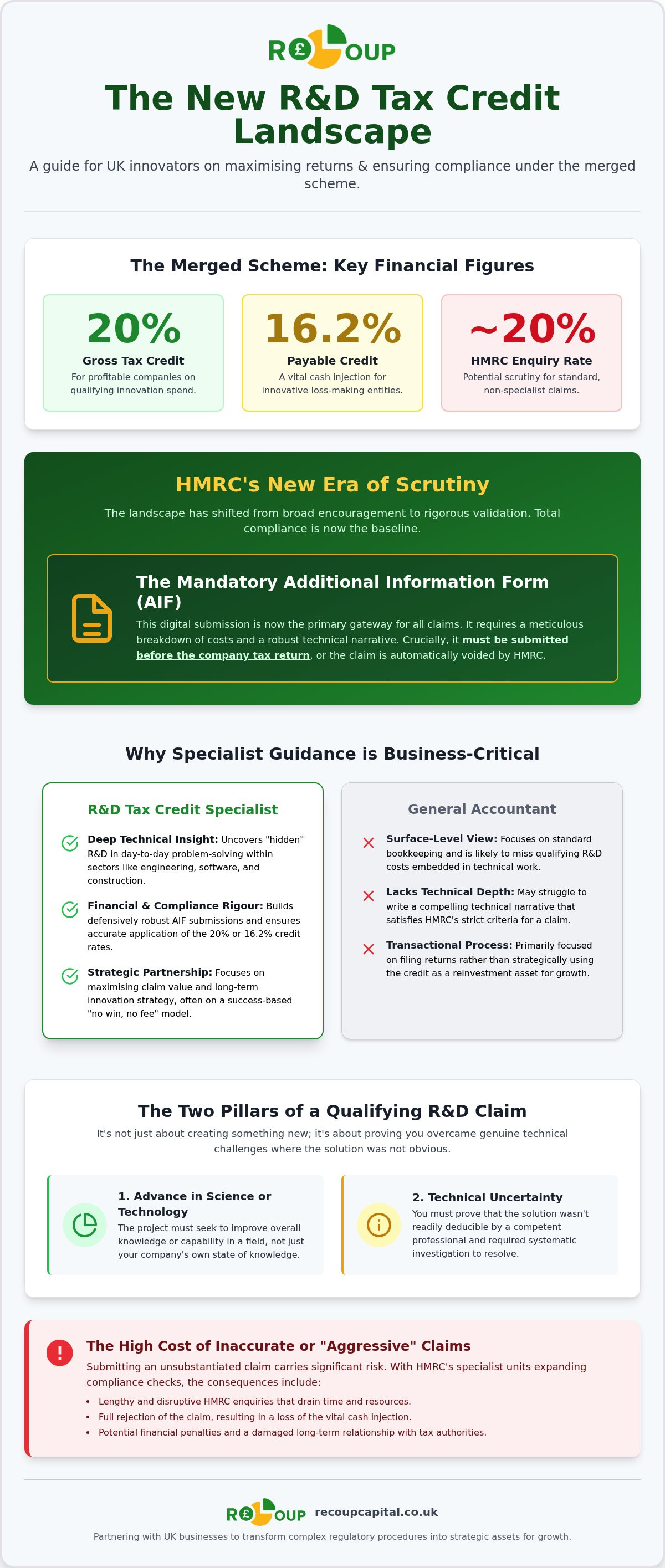
Did you know that under the merged R&D tax relief scheme, profitable companies can now secure a gross tax credit of 20% on their qualifying innovation spend? While this represents a vital cash injection, the landscape has shifted. HMRC has significantly increased its scrutiny, with industry data indicating that enquiry rates for standard claims can reach as high as 20%. It's natural to feel concerned that the complexity of new legislation or the threat of a technical audit might outweigh the financial benefits of your hard work.
We understand that your primary focus is on growth, not deciphering tax code. You need results. By working with r&d tax credit specialists failsworth businesses can trust, you ensure every penny of your innovation is captured whilst maintaining total compliance with current standards. This article explains how specialist guidance secures a maximised tax credit, including the 16.2% payable credit for loss-making entities, with minimal disruption to your team. We'll show you how to turn these returns into strategic assets for long-term reinvestment and future success.
Key Takeaways
- Master the new transparency standards by understanding the mandatory Additional Information Form (AIF) requirements that now underpin every compliant claim.
- Distinguish between standard financial bookkeeping and technical project assessments to ensure your innovation is fully captured without triggering HMRC red flags.
- Identify qualifying R&D in sectors like construction and engineering, where bespoke material science and technical uncertainty create significant recovery opportunities.
- Partner with r&d tax credit specialists failsworth businesses can trust to transform complex regulatory procedures into a streamlined, low-friction path to reinvestment.
- Reframe your tax credits as strategic assets for growth by adopting a partnership-oriented approach that prioritises long-term innovation over simple transactional paperwork.
The Vital Role of R&D Tax Credit Specialists in Modern Business
Innovation is the lifeblood of British industry, yet the financial rewards for taking technical risks often remain locked behind complex regulatory barriers. At its core, the UK's R&D tax incentive scheme is a government initiative designed to reward limited companies for overcoming technical uncertainties. It isn't a grant; it's a powerful mechanism for reclaiming costs associated with developing new products, processes, or services. Despite the clear benefits, the distance between a technical breakthrough on the factory floor and a successful submission to HMRC is vast. This is where r&d tax credit specialists failsworth businesses can trust become essential, acting as the vital link between technical innovation and tax legislation.
The national innovation landscape has transformed. A successful claim is no longer just a "simple refund" to be tucked away. It's a strategic financial tool that provides essential liquidity for reinvestment. Professional representation ensures that your business doesn't just "process" a claim, but actively defends its right to innovation relief whilst maintaining total transparency with the tax authorities.
What Constitutes an R&D Tax Credit Specialist?
A true specialist offers a unique blend of chartered tax accounting and sector-specific technical expertise. Unlike generalists, these professionals understand the nuances of engineering, software development, and material science. This depth of knowledge is critical when claiming R&D tax credits, as it allows for the identification of qualifying activities that might otherwise be overlooked. A partnership-oriented specialist prioritises results through a success-based fee model, often referred to as "no win, no fee". This aligns the consultant's interests directly with yours, ensuring that the focus remains on accuracy and value rather than billable hours.
- Technical Insight: Identifying "hidden" R&D in day-to-day problem-solving.
- Financial Rigour: Applying the correct rates under the merged 20% gross credit scheme.
- Compliance First: Ensuring every claim is backed by robust technical documentation.
Why UK Businesses Are Re-evaluating Their Innovation Claims
The legislative shift in April 2024, which merged the SME and RDEC schemes into a single framework, has forced many companies to rethink their approach. For profitable companies paying the main rate of corporation tax, the 20% gross credit now results in a net benefit of approximately 15% of qualifying expenditure. For loss-making entities, a 16.2% payable credit offers a vital lifeline. These figures represent significant capital that can be used to bolster business valuation or fund the next phase of growth. In a competitive market, these credits aren't just perks; they're strategic assets that provide the breathing room needed to stay ahead of the curve.
Navigating HMRC Compliance and New Transparency Standards
HMRC's approach has evolved from a position of broad encouragement to one of rigorous validation. For any business submitting a claim, the mandatory Additional Information Form (AIF) is now the primary gateway. This digital submission requires a meticulous breakdown of qualifying costs and a detailed technical project description. It must be submitted before the company tax return, or the claim will be automatically removed by HMRC. This shift reflects a national trend towards higher transparency, making the role of professional representation more critical than ever.
The technical narrative must explicitly address how the project sought to achieve an "Advance in Science or Technology". This isn't just about making a better product; it's about proving that the solution wasn't readily deducible by a competent professional. Managing "Technical Uncertainty" is the pivot point. You must document exactly where the existing knowledge base failed and how your systematic investigation attempted to bridge that gap. By engaging r&d tax credit specialists failsworth innovators can ensure these narratives are not just descriptive, but defensively robust.
The Consequences of Inaccurate or "Aggressive" Claims
Submitting an unsubstantiated claim carries significant risk. HMRC has expanded its specialist units to conduct more compliance checks, particularly scrutinising software and AI-based claims throughout 2026. An "aggressive" claim that overstates technical challenges or includes non-qualifying costs can lead to heavy penalties and a permanent "red flag" on your tax record. A specialist provides a forensic audit of your innovation before submission, acting as a protective barrier between your business and potential enquiries. If you are unsure about your current status, it may be beneficial to consult with the experts at Recoup Capital for further clarity.
Staying Compliant with the Merged R&D Scheme
The unified R&D relief system, which came into full effect for accounting periods starting on or after 1 April 2024, has fundamentally changed how companies manage their claims. One of the most significant shifts involves subcontracted R&D. Under the new rules, the "decision maker" who intends to undertake the R&D and bears the risk is generally the party entitled to claim. This prevents the "double claiming" of relief that occasionally occurred under the previous bifurcated system.
Understanding these nuances is essential for staying on the right side of official government guidance. To navigate these complexities safely, you can Learn more about the R&D tax credits process to see how we align your technical breakthroughs with the latest transparency standards. Adopting a compliance-first mindset ensures your claim remains a strategic asset rather than a regulatory liability.
Specialist R&D Consultants vs General Accountants
Your general accountant is likely a master of annual compliance and standard corporate tax. They're essential for keeping your business running smoothly. However, the gap between financial bookkeeping and a technical project assessment is wide. Whilst an accountant looks at the ledger to find costs, r&d tax credit specialists failsworth innovators rely on look at the factory floor to find technical uncertainty. This distinction is vital because generalists often miss "hidden" R&D embedded in daily problem-solving. They might see an invoice for raw materials; we see the failed prototypes and the systematic investigation that defines a qualifying project.
The opportunity cost of a non-specialist claim is significant. Leaving money on the table is a common reality for businesses that rely solely on broad accounting practices. A specialist doesn't just stop at R&D. We look for synergistic opportunities, such as capital allowances or land remediation relief, ensuring every available incentive is utilised to bolster your bottom line. This holistic approach transforms a standard filing into a comprehensive capital recovery strategy.
Technical Depth vs Broad Accounting
Defining the "scientific or technological baseline" is the most challenging part of any HMRC submission. A generalist may struggle to articulate exactly how your project exceeds industry standards. Specialists bring sector-specific experts, from engineering to material science, who can translate your technical breakthroughs into the language HMRC expects. This technical depth is what protects you during an enquiry. If HMRC asks for a detailed breakdown of your systematic investigation, a specialist provides a robust, evidence-based defence that a general accountant might not be equipped to manage.
Fee Structures and Value Proposition
Fee models often reveal the level of commitment you can expect. Most general accountants charge hourly rates or fixed fees, which can feel like an additional overhead regardless of the claim's outcome. A specialist typically operates on a success-based model. This aligns our interests with yours; we're incentivised to conduct a deeper investigation to maximise your returns. Why choose a specialist for your claim? Because a results-oriented partner treats your tax credit as a strategic asset for growth, not just another box to tick on a tax return. By choosing r&d tax credit specialists failsworth companies can ensure their innovation is rewarded with the precision it deserves.
Identifying Qualifying R&D Activities in Your Sector
Identifying what counts as innovation is often the biggest hurdle for businesses. HMRC looks for three specific criteria: an Advance in science or technology, Technical Uncertainty that couldn't be easily resolved, and a Systematic Investigation to find the answer. In manufacturing, this might look like developing a faster production line or creating a more durable prototype. For software, it's not just building an app; it's about solving complex data processing issues or creating new algorithms where no standard solution exists. The key is to prove that your team attempted to resolve a problem that wasn't readily deducible by another competent professional in your field.
By working with r&d tax credit specialists failsworth companies can trust, you ensure that these technical challenges are translated into a language that HMRC recognises. We don't just look at the end product; we look at the failures, the iterations, and the technical dead ends that occurred along the way. These "technical uncertainties" are the heart of a successful claim.
The Construction Sector: A Hidden Goldmine for R&D
Construction firms often overlook their own innovation. When you encounter unique site constraints or unstable ground conditions that require bespoke engineering solutions, you are likely performing R&D. Developing sustainable materials or Modern Methods of Construction (MMC) also qualifies. Often, these projects overlap with other incentives. For example, you should Explore Land Remediation Relief for developers to see if your site preparation costs are also eligible for recovery. Capturing these details requires a technical eye that understands the reality of the building site.
Qualifying Costs: What Can You Actually Claim?
The breadth of claimable costs is wider than many realise. Staffing costs are the primary driver, covering gross salaries, Class 1 National Insurance, and pension contributions for those directly involved in the innovation process. You can also claim for subcontracted R&D and Externally Provided Workers (EPWs), though the rates vary based on your specific scheme and the nature of the contract. Consumables, such as materials used for prototypes or chemicals used in testing, along with software licences and a proportion of utilities used during the R&D process are all eligible for relief.
To capture these costs accurately, you need a partner who understands the technical reality of your work. We don't just look at the numbers; we look at the engineering challenges you've conquered. If you're ready to see what your innovation is worth, request a technical review with Recoup Capital to start your claim journey. Choosing r&d tax credit specialists failsworth businesses can depend on ensures that no eligible cost is left behind.
The Recoup Capital Approach: Partnering for Innovation
Recoup Capital doesn't just process paperwork; we act as a proactive guide through the intricacies of innovation funding. Our national team, comprised of chartered tax accountants and technical specialists, prioritises accuracy and transparency above all else. We understand that the transition to the merged R&D scheme requires a more sophisticated approach to documentation. By adopting a success-based fee model, we demonstrate our commitment to value before any financial transaction takes place. This approach ensures that r&d tax credit specialists failsworth innovators choose are fully aligned with their specific business objectives. We reframe your financial returns as strategic assets, providing the capital utility needed to fuel future breakthroughs or support business acquisitions.
Our commitment to HMRC transparency is at the heart of everything we do. We maintain rigorous compliance standards to protect your reputation whilst maximising your claim's potential. This relationship-first approach transforms complex regulatory procedures into an approachable opportunity for growth. Whether you are a small enterprise or a large corporation, our national coverage ensures you have access to top-tier technical expertise regardless of your sector.
A Streamlined, Low-Friction Process
Our journey begins with a high-energy discovery call to identify potential opportunities without any up-front costs. We know your time is valuable, and your daily operations shouldn't suffer for the sake of a tax claim. That's why we've designed a technical data collection process that minimises the burden on your internal team. We handle the heavy lifting, from drafting robust technical narratives to calculating qualifying costs with forensic precision. We ensure that the R&D Tax Credits explained in detail during our consultation translate into a smooth, low-friction path to recovery. By working with r&d tax credit specialists failsworth businesses can rely on, you ensure your innovation is documented correctly the first time.
Beyond R&D: A Holistic View of Corporate Tax
Whilst R&D relief is a powerful tool, it's often just one piece of a much larger financial puzzle. We take a holistic view of your corporate tax position, integrating incentives like Patent Box and capital allowances into a cohesive long-term strategy. This ensures that no stone is left unturned in your pursuit of capital recovery. For businesses looking toward the future, our Discover our Corporate Finance services provide essential support for mid-market transactions and growth capital. This partnership-oriented mindset ensures that your innovation today creates a solid foundation for your success tomorrow. We don't just deliver a refund; we provide the strategic advice necessary to turn that refund into a catalyst for business expansion.
Secure Your Future Through Strategic Innovation Funding
The landscape of R&D tax relief has fundamentally shifted, making technical accuracy and compliance-first documentation non-negotiable. It's no longer enough to simply submit a claim; you must be prepared to defend it with a robust technical narrative that meets HMRC's evolving standards. By partnering with r&d tax credit specialists failsworth businesses rely on, you ensure that every qualifying activity is captured whilst your reputation remains fully protected.
Our team of chartered tax accountants and technical specialists provides national UK coverage across all innovation sectors, from construction to software. We believe in demonstrating value through results, which is why we operate on a success-based fee model. This ensures our goals are perfectly aligned with your long-term growth. Don't let your technical breakthroughs go unrewarded or leave your business exposed to unnecessary risks. Book your no-obligation R&D discovery call with Recoup Capital today and turn your innovation into a strategic asset for tomorrow. We're ready to help you capitalise on your hard work.
Frequently Asked Questions
How much can I claim back through R&D tax credits in 2026?
The amount you can reclaim depends on your specific tax position and the nature of your expenditure. Most companies now operate under a merged scheme offering a 20% gross credit, which typically nets a 15% benefit for profitable entities after corporation tax. Loss-making firms can receive a 16.2% cash credit. R&D-intensive SMEs spending at least 30% of their total expenditure on innovation may access more generous Enhanced R&D Intensive Support (ERIS) rates.
What is the difference between the SME scheme and the RDEC scheme?
From April 2024, the previous SME and RDEC schemes were consolidated into a single unified system. This change aims to simplify the process, though it has introduced stricter compliance requirements. Whilst most businesses now follow this merged framework, a separate path remains for loss-making, R&D-intensive SMEs. These intensive firms can still benefit from higher deduction rates, making it vital to correctly categorise your business to ensure you aren't missing out on enhanced relief.
Can I claim R&D tax credits if my project was a failure?
Yes, you can claim for projects that did not achieve their technical goals. HMRC rewards the attempt to overcome technical uncertainty, not just successful outcomes. In fact, a project failure often provides the best evidence of technical uncertainty, proving that the solution was not readily deducible by a competent professional. By partnering with r&d tax credit specialists failsworth innovators can ensure these failed projects are documented as valid systematic investigations.
How long does it take for HMRC to process an R&D tax credit claim?
HMRC aim to process 95% of R&D tax credit claims within 40 days of submission. However, this timeline can be extended if your claim is selected for a compliance check or if there are delays in the Additional Information Form (AIF) verification. Ensuring your technical narrative is robust and your financial data is forensically accurate from the start helps prevent avoidable delays. Specialists manage the end-to-end liaison with HMRC to keep your claim on track.
Do I need a specialist if my accountant already handles my tax returns?
General accountants are essential for standard compliance, but R&D specialists bridge the gap between financial data and technical innovation. We employ chartered tax accountants who work alongside technical experts to identify qualifying activities that are often missed in standard bookkeeping. By focusing exclusively on innovation incentives, we provide a more exhaustive investigation into your costs whilst ensuring your technical narratives are robust enough to withstand the increased scrutiny currently being applied by HMRC.
What happens if HMRC opens an enquiry into my R&D claim?
If HMRC opens an enquiry, they will request detailed evidence regarding the technical uncertainties of your projects and the systematic investigation undertaken. This can be an intimidating process without professional representation. A specialist provides full enquiry defence, acting as a protective barrier between your business and the tax authorities. We use our technical documentation and forensic audit records to justify every pound claimed, minimising the risk of penalties or the rejection of your relief.
Is there a time limit for making a retroactive R&D claim?
You can generally claim R&D tax relief for your last two completed accounting periods. This means you have a two-year window from the end of the accounting period in which the R&D expenditure was incurred to submit or amend a claim. It's vital to act within this timeframe to avoid losing out on significant cash injections. We help you review your past activities to identify any missed opportunities for innovation relief or capital allowances.
Does my business need to be in a specific sector to qualify for R&D relief?
No, R&D tax credits are available to limited companies in any sector, provided they are seeking a scientific or technological advance. Whilst manufacturing, engineering, and software are common, we also secure substantial claims in construction, food technology, and life sciences. By working with r&d tax credit specialists failsworth businesses can identify qualifying activities in non-obvious areas, such as bespoke site engineering or material science, that traditional accounting methods frequently miss.


