

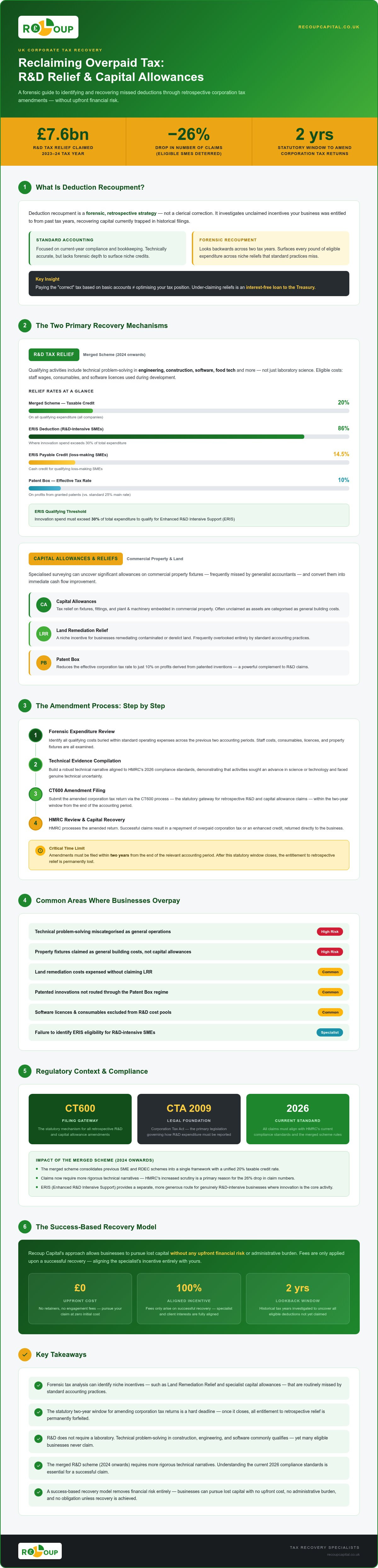
Did you know that UK businesses claimed £7.6 billion in R&D tax relief during the 2023-24 tax year, yet a significant number of companies are still leaving thousands on the table? It's frustrating to realise that your innovation hasn't been fully rewarded due to the sheer complexity of the UK tax code. We understand that the prospect of an HMRC enquiry can feel daunting, particularly whilst you're trying to manage cash flow constraints. However, the most effective way to strengthen your balance sheet often lies in the past. By amending corporation tax return for r&d within the statutory two-year window, you can reclaim overpaid capital that belongs back in your business.
This guide provides a clear framework for identifying missed deductions and successfully navigating retrospective claims. You'll discover how to leverage the merged R&D scheme and forensic capital allowances to turn historical tax positions into strategic growth assets. We will outline exactly how to minimise your administrative burden whilst ensuring your business remains fully compliant and future-proofed against regulatory shifts.
Key Takeaways
- Discover how forensic tax analysis identifies niche capital incentives, such as Land Remediation Relief, that are frequently overlooked by standard accounting practices.
- Learn the precise steps for amending corporation tax return for r&d within the statutory two-year window to unlock historical overpayments.
- Understand how specialised surveying can uncover significant capital allowances on commercial property fixtures, transforming them into immediate cash flow.
- Recognise the impact of recent HMRC regulatory shifts, including the merged R&D scheme, to ensure your future claims remain fully compliant.
- Explore how a success-based recovery model allows your business to pursue lost capital without any upfront financial risk or administrative burden.
Understanding Deduction Recoupment in the UK Tax Landscape
Deduction recoupment is a forensic strategy designed to identify and recover capital that remains trapped within historical tax filings. It isn't a simple clerical correction. Instead, it's a proactive investigation into unclaimed incentives that your business was entitled to all along. For many UK limited companies, the process of amending corporation tax return for r&d serves as the primary mechanism for this recovery. Whilst your annual accounts might be technically accurate, they often lack the forensic depth required to surface niche credits that HMRC actually encourages businesses to claim.
Standard accounting practices are built for compliance and general bookkeeping. This is why niche incentives like Capital Allowances or Land Remediation Relief are frequently overlooked. Generalist accountants focus on the "here and now" of the current financial year. Recoupment shifts the focus backwards, ensuring that every pound of eligible expenditure from previous years is accounted for. This strategic identification distinguishes recoupment from a standard refund, as it requires a deep understanding of HMRC's evolving compliance standards to ensure a successful claim.
The Distinction Between Overpayment and Under-claiming
Many directors feel a sense of security when their tax bill matches their profit and loss statement. However, paying the "correct" amount of tax based on basic accounts doesn't mean you've optimised your position. There's a significant gap between statutory compliance and true tax efficiency. If your business is innovating or improving commercial property, under-claiming these reliefs is essentially an interest-free loan to the Treasury. This unutilised liquidity could otherwise be reinvested into your next project or used to alleviate immediate cash flow pressures.
Regulatory Frameworks Governing Tax Recovery
The recoupment journey is anchored in the Corporation Tax Act and detailed HMRC manuals that dictate how businesses should report expenditure. The CT600 filing process is the gateway for these claims. Deduction recoupment is the retrospective application of eligible tax reliefs to historical filings. When amending corporation tax return for r&d, you must adhere to the two-year statutory window from the end of the relevant accounting period. Success depends on aligning your technical evidence with the specific regulatory requirements of 2026, ensuring that every claim stands up to HMRC's rigorous scrutiny.
Maximising Recovery Through R&D and Capital Allowances
Innovation is expensive. However, the UK tax system is specifically designed to reward companies that take technical risks. For many businesses, the process of amending corporation tax return for r&d becomes a strategic exercise in capital recovery rather than a simple administrative task. By looking back at the last two financial years, you can often uncover significant sums that were previously categorised as standard operating expenses. When combined with capital allowances on property, these reliefs create a powerful synergy that can substantially improve your business liquidity.
Whilst many directors associate R&D purely with laboratory-based science, the reality is that technical problem-solving on a construction site or software development floor frequently qualifies. According to HMRC data from September 2025, over £7.6 billion was claimed in R&D tax relief for the 2023-24 period. Despite this, the number of claims dropped by 26%, suggesting that many eligible SMEs are being deterred by increased scrutiny. Understanding the R&D tax credits explained in current 2026 regulations is the first step toward reclaiming what your business is owed.
Recouping Innovation Costs via R&D Tax Relief
Qualifying for recoupment requires identifying activities that sought an advance in science or technology. In sectors like engineering or food tech, this often includes staff costs, consumables, and software licences used during the development phase. Under the merged scheme, companies can access a 20% taxable credit on qualifying expenditure. For loss-making, R&D-intensive SMEs where innovation spend exceeds 30% of total expenditure, the Enhanced R&D Intensive Support (ERIS) provides an 86% deduction and a 14.5% payable credit. Additionally, if your innovation resulted in a granted patent, the Patent Box can further reduce your effective tax rate to 10% on relevant profits.
Capital Allowance Recoupment for Property Owners
Property often holds the largest volume of "hidden" tax relief. Standard accounting usually captures obvious items like furniture, but forensic surveying is required to identify embedded fixtures such as heating systems, security installations, and complex electrical cabling. These items often make up a significant percentage of a commercial building's purchase price or fit-out cost. If you own commercial property, prioritising the task of amending corporation tax return for r&d alongside a review of Capital allowances on commercial property can yield immediate cash injections. If you suspect your property contains unclaimed allowances, our specialists can conduct a forensic audit to surface these strategic assets.
Identifying 'Lost' Deductions: Where Businesses Overpay
Many UK limited companies pay more corporation tax than necessary simply because they aren't aware of the full breadth of available reliefs. It's a common misconception that a "clean" set of accounts implies a tax-efficient position. In reality, failing to audit historical submissions creates a significant opportunity cost. This trapped capital could be funding new hires, purchasing equipment, or securing your next premises. Identifying these missed opportunities involves more than just amending corporation tax return for r&d; it requires a forensic eye for detail across your entire expenditure profile.
Land Remediation and Environmental Deductions
Developers working on brownfield sites often overlook a powerful incentive known as Land Remediation Relief. This relief allows companies to claim a 150% tax deduction for qualifying expenditure on cleaning up contaminated or derelict land. Despite its value, it's frequently left on the table because it requires specific technical evidence that goes beyond standard bookkeeping. If your business has invested in removing asbestos, treating sulphate-contaminated soil, or clearing long-term derelict structures, you could be eligible for a substantial recoupment. You can learn more about Land remediation relief for developers to see if your historical projects qualify for a retrospective claim.
The Pitfalls of Generalist Accounting
Whilst your current financial advisor likely provides excellent service for day-to-day compliance, they may not possess the forensic tools required to identify niche deductions. There's a fundamental difference between "processing paperwork" and "maximising relief". Generalists often lack the industry-specific technical knowledge to argue complex cases with HMRC. For example, a food tech company might believe they're simply "improving a recipe", whilst a forensic specialist identifies the technical uncertainties they overcame to extend shelf-life or reduce sodium content without compromising texture. These are the nuances that generalists miss.
The strategic act of amending corporation tax return for r&d can often trigger a broader review of your tax position. By looking beyond the obvious, you can transform historical overpayments into strategic assets. This proactive approach ensures your business isn't just following the rules, but is actually being rewarded for the risks it takes. Don't let your innovation go unrecognised because of a standard reporting template.
The Process of Amending Corporation Tax Return for R&D
Transitioning from identifying a missed opportunity to actually receiving a credit requires a structured, evidence-led approach. When amending corporation tax return for r&d, precision is your greatest asset. HMRC expects a clear link between your technical activities and the costs you're claiming. This isn't just about changing numbers on a form; it's about telling the story of your innovation in a way that aligns with current tax legislation. HMRC allows businesses to amend tax returns retrospectively, typically up to two years from the end of the relevant accounting period.
The journey begins with a thorough audit of your historical projects to ensure they meet the 2026 definition of scientific or technological advancement. Once qualifying activities are identified, you must quantify the associated costs, such as staff salaries, subcontractor fees, and consumables. This data is then compiled into a comprehensive technical report. This document acts as your primary defence, providing HMRC with the transparency they require to approve the claim without unnecessary delays.
Gathering Evidence and Forensic Documentation
Robust evidence is the foundation of any successful recoupment. For R&D claims, this includes project plans, meeting minutes, and staff time-sheets that demonstrate the technical uncertainties your team faced. For capital allowances, it often involves forensic site surveys and detailed invoices for embedded fixtures. Organising these records retrospectively can be challenging, but it's essential for validating your claim's accuracy. Our in-house team of chartered tax accountants specialises in this forensic reconstruction. We ensure every pound claimed is backed by documentation that meets the highest standards. This proactive preparation significantly reduces the likelihood of friction during the review process.
Managing the HMRC Submission
The actual submission involves updating your CT600 and, for accounting periods beginning after April 2023, submitting an Additional Information Form (AIF). This digital form must be completed before the amended return is filed, detailing the technical nature of your projects and the specific costs involved. Successfully amending corporation tax return for r&d requires more than just updated figures. You must be prepared for potential enquiries. If HMRC requests further details, having a specialist liaison can be the difference between a swift approval and a protracted dispute. In 2026, average processing times are roughly 45 days for SMEs, though RDEC claims can take up to 130 days. Managing these timelines effectively ensures your capital is recovered as quickly as possible.
If you're unsure whether your historical projects meet the latest eligibility criteria, you can speak with our technical specialists for a no-obligation assessment of your recoupment potential.
How Recoup Capital Secures Your Corporate Tax Recovery
Recoup Capital functions as a protective guide through the complexities of the UK tax landscape. We don't just process paperwork; we act as long-term partners invested in your business's future. By taking the lead on amending corporation tax return for r&d, we allow your internal finance team to focus on daily operations whilst we conduct the forensic heavy lifting. Our in-house team of chartered tax accountants and technical specialists understands the specific nuances of your sector, whether you operate in construction, engineering, or food tech. This deep industry knowledge ensures that every potential credit is identified and defended with technical authority, providing you with the peace of mind that your claims are robust and compliant.
Our Success-Based Fee Structure Explained
We believe in demonstrating value through results rather than delivering a traditional sales pitch. This is why we operate on a success-based fee structure, ensuring our incentives are perfectly aligned with your capital recovery goals. This model removes the financial barrier to entry for SMEs, as there are no upfront costs to begin the recoupment process. It's a risk-efficient philosophy that reflects our confidence in our forensic methodology, which often includes specialised surveying to uncover hidden capital allowances that generalists miss. If we don't successfully recover overpaid tax for your business, you don't pay a fee. It's a straightforward, transparent approach that transforms a complex regulatory procedure into an approachable opportunity for growth.
Partnering for Long-Term Capital Strategy
Securing a one-off refund is only the beginning of our collaboration. We view recovered capital as a strategic asset that should be reinvested into your business to fuel further innovation and expansion. By amending corporation tax return for r&d for previous years, we help you establish a robust framework for future tax efficiency. This proactive strategy ensures that your business remains compliant with HMRC's evolving standards, such as the merged R&D scheme and the 2026 Advance Assurance pilot. We're here to help you navigate these changes, turning tax relief into a perpetual tool for business evolution rather than a simple annual checkbox. Our goal is to ensure your innovation is always fully recognised and rewarded by the tax system.
If you're ready to explore how much capital remains trapped in your historical filings, speak to our specialists about your recoupment potential to begin your recovery journey.
Unlocking the Strategic Value of Your Historical Tax Position
Your business's past innovation represents a significant financial asset that shouldn't be left with HMRC. By conducting a forensic audit of previous filings, you can identify trapped capital across R&D, capital allowances, and land remediation. This process of amending corporation tax return for r&d within the two-year statutory window is a proven method for injecting liquidity back into your operations. It's not just about a refund; it's about reclaiming resources to fuel your next phase of growth.
Recoup Capital provides the expert support needed to navigate these technical procedures. Our in-house team of chartered tax accountants uses specialist industry knowledge to ensure every claim is robust and fully compliant. Because we operate on a success-based fee model, your interests are always our priority. You can focus on your core business whilst we handle the forensic heavy lifting. This partnership ensures that complex regulatory hurdles become approachable opportunities for reinvestment.
Discover your recoupment potential with a no-obligation audit from Recoup Capital and turn your historical overpayments into a strategic business tool today. Your next breakthrough could be funded by the innovation you've already achieved.
Frequently Asked Questions
What exactly is deduction recoupment in a UK business context?
Deduction recoupment is the proactive identification and recovery of overpaid corporate tax through specialised reliefs like R&D Tax Credits and Capital Allowances. It differs from standard accounting by applying a forensic lens to historical expenditure. This process ensures that capital previously trapped in tax filings is returned to the business. It's a strategic exercise that transforms past innovation into current liquidity, allowing for immediate reinvestment into your company's growth.
How far back can my business go to recoup missed tax deductions?
You can typically look back up to two years from the end of the relevant accounting period when amending corporation tax return for r&d. This statutory time limit is firm, and extensions are only granted in exceptional circumstances. For other reliefs, such as Capital Allowances, you may be able to claim on qualifying items still in use by the business, regardless of when they were purchased. This creates a significant window for retrospective recovery.
Does amending a corporation tax return for R&D increase my risk of an enquiry?
Whilst HMRC has increased its compliance checks, a robustly documented claim shouldn't cause concern. The key is providing a detailed technical report and an Additional Information Form (AIF) that meets current transparency standards. In 2026, HMRC's focus is on the quality of evidence rather than the act of claiming itself. Working with specialists ensures your submission is accurate and defensible, which effectively manages the risk of a protracted enquiry.
Can I recoup deductions if my company is currently loss-making?
Yes, loss-making companies are often eligible for significant cash injections through the recoupment process. Under the Enhanced R&D Intensive Support (ERIS) scheme, R&D-intensive SMEs can claim a payable tax credit of 14.5% of the surrenderable loss. This provides vital cash flow even when your business isn't currently paying corporation tax. It's a critical mechanism for supporting innovative firms during the pre-revenue or heavy development phases of their lifecycle.
How long does the deduction recoupment process typically take with HMRC?
Processing times vary depending on the complexity and type of your claim. As of early 2026, HMRC aims to process SME R&D tax credit claims in approximately 45 days. If your company falls under the RDEC or hybrid schemes, the average processing time is roughly 130 days. These timelines reflect HMRC's more rigorous review process, making it essential to submit a complete and accurate filing the first time to avoid further delays.
What is the difference between an R&D tax credit and deduction recoupment?
An R&D tax credit is the specific financial incentive provided by the government, whilst deduction recoupment is the overarching strategy used to identify and claim it. Recoupment involves a forensic audit of previous years to find qualifying activities that were missed during the original filing. Essentially, amending corporation tax return for r&d is the vehicle used to perform recoupment, turning historical technical efforts into tangible financial returns.
Do I need my current accountant’s permission to work with a specialist?
You don't need permission from your current accountant to engage a specialist for niche tax reliefs. Most generalist accountants welcome the collaboration, as they often lack the forensic surveying tools or technical R&D expertise required for these complex claims. Recoup Capital works alongside your existing finance team to handle the technical heavy lifting without disrupting your day-to-day bookkeeping or annual compliance cycles. It's a partnership designed to maximise your total tax efficiency.
What happens if HMRC rejects a retrospective recoupment claim?
If a claim is rejected, HMRC provides a formal explanation and an opportunity to appeal or provide further evidence. However, working with a specialist significantly reduces this risk through thorough pre-submission vetting. Because Recoup Capital operates on a success-based fee structure, our incentives are fully aligned with your success. We only move forward with claims that have a strong technical basis, ensuring that your time and resources are protected throughout the process.


