

Could a machine decide the fate of your next innovation incentive? As of September 2026, HMRC's use of sophisticated risk-profiling tools has fundamentally changed the rules of engagement for every UK business. Achieving hmrc r&d tax claim transparency ai is no longer just about ticking boxes on an Additional Information Form; it's about ensuring your technical narrative stands up to automated scrutiny without losing its vital human depth. You've likely felt the growing weight of these digital requirements, perhaps worrying that your efficiency-focused reporting might inadvertently trigger a lengthy and costly enquiry.
We understand that the pressure to remain compliant can feel like a distraction from your core mission of growth. This article provides a clear roadmap through the 2026 regulatory landscape, showing you exactly how to use AI for documentation whilst maintaining a robust, audit-proof framework. You'll discover a strategy to balance digital precision with the expert oversight necessary to protect your claim's integrity. By the end of this guide, you will have a proven methodology to turn these complex compliance standards into a strategic advantage for your business innovation.
Key Takeaways
- Understand how HMRC now uses machine learning to flag generic technical reports and identify anomalous claim values against industry benchmarks.
- Learn the essential steps to achieve hmrc r&d tax claim transparency ai by moving beyond simple box-ticking to providing deep, narrative-driven evidence.
- Implement a robust documentation framework that prioritises real-time project tracking and clearly defines where industry-standard practice ends and innovation begins.
- Discover why relying solely on AI-prepared reports increases audit risk and how to balance digital efficiency with the expert human oversight required for a successful claim.
- Explore how a partnership-oriented approach and a success-based model protect your business from the financial and operational strain of a lengthy HMRC enquiry.
The New Era of HMRC R&D Tax Claim Transparency
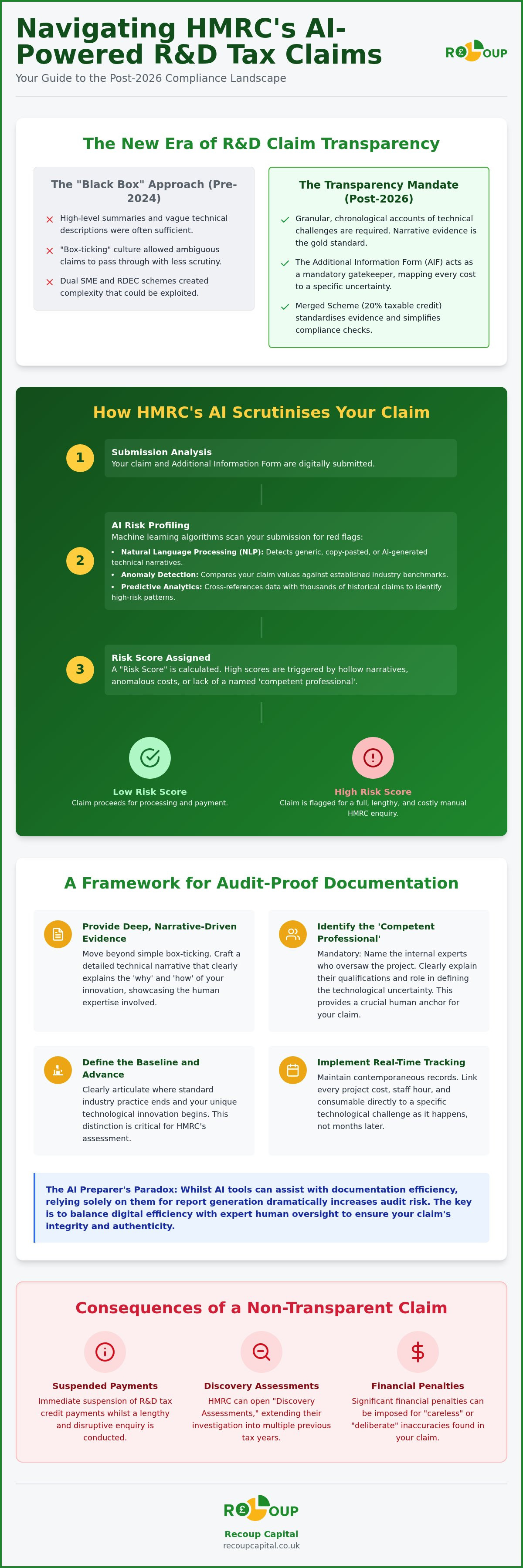
HMRC has redefined what it means to be open. In 2026, achieving hmrc r&d tax claim transparency ai is no longer a buzzword; it's a structural requirement. Transparency now means providing a granular, chronological account of technological challenges rather than just submitting a high-level summary. The UK's R&D tax incentive landscape has moved away from the "black box" approach where companies hoped for the best. Instead, you're expected to show your workings clearly. This shift targets the "box-ticking" culture that once allowed vague claims to slip through. Now, narrative evidence is the gold standard for every limited company.
Why HMRC Demands Greater Disclosure in 2026
The introduction of the Merged Scheme for accounting periods beginning on or after 1 April 2024 was a turning point. By combining the SME and RDEC frameworks into a single 20% taxable credit system, the government standardised the evidence required from every claimant. This move helps HMRC identify "R&D cowboys" who previously exploited the complexities of dual systems. Digital-first reporting allows the tax office to cross-reference data points instantly, making it harder to hide behind ambiguous technical descriptions.
A key part of this new transparency is the mandatory identification of the "competent professional." You must name the internal experts who oversaw the project and explain their relevant expertise. HMRC wants to know that the person defining the technological uncertainty actually understands the science involved. If your claim lacks this human anchor, it's flagged as high-risk by automated systems, often leading to a full enquiry that could have been avoided with better disclosure.
The Impact of the Additional Information Form (AIF)
Since August 2023, the Additional Information Form has been the gatekeeper of every submission. In 2026, the scrutiny on this form has intensified to ensure hmrc r&d tax claim transparency ai standards are met. Any claim submitted without a correctly completed AIF faces automatic rejection before a human even sees it. It isn't just a formality; it's a map of your innovation that requires precise details on project dates, costs, and technical breakthroughs.
You must link every penny of project costs directly to a specific technological uncertainty. This level of detail ensures that your R&D tax credits explained in the report are backed by hard evidence. Non-transparent claims amongst UK limited companies now face severe consequences, including:
- Immediate suspension of credit payments whilst an enquiry is conducted.
- In-depth "Discovery Assessments" that can span multiple previous tax years.
- Financial penalties for "careless" or "deliberate" inaccuracies in the technical report.
Compliance isn't just about avoiding trouble. It's about building a sustainable foundation for your company's future growth through honest and detailed reporting.
How HMRC is Using AI for Risk-Profiling and Compliance
HMRC's digital transformation has reached a critical peak in 2026. The tax office now employs sophisticated machine learning algorithms to evaluate every submission before a human caseworker ever opens the file. This shift has made hmrc r&d tax claim transparency ai a central pillar of successful claims. These tools scan technical narratives specifically to identify generic, AI-generated content that lacks the specific technological uncertainty required by law. If your report sounds like a standard language model output, it will likely be flagged for manual review.
Through Natural Language Processing (NLP), HMRC can detect technical descriptions that have been copy-pasted from online repositories or generated by standard language models. Each submission now receives a "Risk Score" based on these linguistic markers and the financial data provided. If your narrative feels hollow or follows a detectable template, your score rises. This automated system identifies anomalous claim values by comparing your expenditure against established industry benchmarks. A claim that deviates significantly from the norm without a clear, human-led explanation is an immediate target for scrutiny.
Predictive Analytics in R&D Audits
HMRC's predictive analytics compare your claim against thousands of historical industry peers. In sectors like construction and engineering, certain markers are viewed as high-risk. For instance, claiming for routine site improvements that the AI identifies as industry-standard practice will trigger a red flag. The danger of industry-average claiming behaviour is that it suggests a lack of genuine innovation. You must prove your project went beyond the baseline. If you're unsure how your current documentation measures up, you might want to evaluate your claim's robustness before filing.
The Automated Enquiry Trigger
When the AI flags a claim for a lack of technical depth, the enquiry process begins almost immediately. HMRC hits its 40-day processing target for about 85% of cases; however, this speed also applies to flagging anomalies. You don't have months to prepare your evidence anymore. You must be ready from day one. Transparency isn't just a compliance requirement; it's your primary shield. By providing clear, human-led narratives that the AI cannot debunk as generic, you significantly lower your Risk Score. This human-centric approach is the only way to satisfy the new demands for hmrc r&d tax claim transparency ai whilst protecting your business from automated scrutiny.
The AI Preparer’s Paradox: Efficiency vs. Audit Risk
Speed is a seductive trap in the 2026 tax landscape. Whilst AI-assisted preparation tools have flooded the market, promising to cut documentation time by half, they've simultaneously created a new category of audit risk. The core of the issue lies in "genericism." When a consultant relies too heavily on automated software to draft technical narratives, the resulting output often lacks the specific, idiosyncratic detail that proves a genuine technological breakthrough. Achieving true hmrc r&d tax claim transparency ai requires a delicate balance between digital efficiency and the irreplaceable nuance of human expertise.
HMRC's own detection systems are now expertly tuned to spot the rhythmic patterns of large language models. If your technical report sounds like a polished Wikipedia entry rather than a gritty account of trial and error, it's a red flag. The paradox is clear: the more you use AI to "optimise" your claim for speed, the more likely you are to trigger the very scrutiny you're trying to avoid. Successful claims in this era are built on "human-in-the-loop" verification, where every technical uncertainty is interrogated by a specialist before it ever reaches a digital filing portal.
When AI Hallucinates Innovation
AI models are designed to be helpful, which often leads to "hallucinations" where the software invents technological breakthroughs that never actually occurred. In a high-stakes environment, these fictional uncertainties are catastrophic. HMRC now cross-references technical text against global patent databases and academic papers in real-time. If an AI preparer claims you've solved a problem that is actually common industry knowledge, the system flags it as a "careless" error. It's vital to remember that the legal responsibility for the claim's accuracy rests solely with the company director, not the software provider or the AI tool used to draft it.
Expert-Led vs. Tool-Led Submissions
A chartered tax accountant brings a level of interpretation that no algorithm can replicate. Grey areas, such as the boundary between routine site-based problem solving and qualifying R&D, require professional judgement. Tool-led submissions often rely on rigid questionnaires that miss the subtle technical challenges found in construction or engineering projects. In contrast, forensic technical interviews conducted by humans can uncover hidden qualifying costs that a machine would overlook.
You don't have to choose between technology and safety. The most robust strategy involves using AI for data organisation whilst leaving the technical narrative to specialists. If you're wondering why claim R&D tax credits through a specialist rather than a software-only platform, the answer lies in enquiry protection. A human partner doesn't just process paperwork; they act as a protective guide, ensuring your claim remains transparent, compliant, and successful in an increasingly automated world.
A Framework for Transparent Documentation in the AI Era
Proactive documentation is the only reliable way to meet the 2026 standards for hmrc r&d tax claim transparency ai. You can no longer rely on retroactive summaries or memory; HMRC expects a contemporary trail of evidence that proves innovation as it happened. Building a robust framework involves five essential steps that transform your internal records into an audit-proof narrative. This approach ensures that when an automated system scans your filing, it finds the specific, granular data points that signal a compliant and high-quality claim.
- Step 1: Real-time project tracking. Gather evidence whilst the work is in progress. This includes technical logs, emails, and project management tickets that capture the specific challenges faced.
- Step 2: Defining the Baseline. Clearly state the industry-standard knowledge at the start. You must prove that the solution wasn't already available in the public domain or easily deducible by a competent professional.
- Step 3: Documenting Trial and Error. HMRC wants to see the failures. Detailed accounts of abandoned prototypes or failed code iterations are powerful proof of genuine technological uncertainty.
- Step 4: Financial Transparency. Every pound must be traceable. You need a clear link between your payroll data and the specific technical tasks performed on the project.
- Step 5: The Competent Professional’s Review. Ensure your lead engineer or scientist signs off on the technical narrative. This provides the human accountability that AI-driven audits require.
Proving Technological Uncertainty
Transparency is about moving beyond the statement "we had a problem." You must explain why the solution wasn't readily deducible to an expert in your field. Use sketches, architectural diagrams, and meeting minutes to show the evolution of your thinking. Organising these documents into a chronological folder structure creates a transparent proof trail. This level of detail satisfies the logic of an AI-driven audit, as it provides the context that generic, automated reports often miss.
The Role of Forensic Accounting
General bookkeeping is rarely enough for R&D transparency. You must apportion staff time with precision, avoiding the "round-number" red flags that trigger enquiries. If every team member is listed at exactly 50% or 100% involvement, it suggests a lack of careful calculation. Whilst R&D covers revenue expenditure, you should also consider Capital Allowances for tax relief on physical assets and infrastructure used during your innovation process.
To ensure your documentation framework is robust enough to withstand modern scrutiny, you can request a specialist documentation review to identify any potential gaps before you file.
Navigating the Future of Innovation Incentives with Recoup Capital
The 2026 landscape demands more than just a service provider; it requires a protective guide. Recoup Capital integrates hmrc r&d tax claim transparency ai into every stage of the process, ensuring your documentation isn't just compliant, but authoritative. We don't believe in high-volume, automated filings that trigger red flags. Instead, we focus on building a relationship-first partnership that secures your capital whilst protecting your reputation. Our success-based fee model perfectly aligns our interests with your safety. We only win when your claim is successfully processed and remains secure against enquiry.
This approach transforms a potentially intimidating regulatory procedure into an approachable opportunity for growth. By involving our team early, you gain access to specialists who understand the nuances of construction and engineering innovation. We act as your voice in HMRC liaisons, defending your technical breakthroughs with the weight of professional tax expertise. It is a proactive stance that replaces the fear of an audit with the confidence of transparent, evidence-backed reporting.
A Partnership Focused on Long-Term Compliance
We prioritise robust technical narratives that reflect the true complexity of your work. Our team of chartered tax accountants ensures that every claim is interpreted correctly, especially in those "grey areas" where software often fails. By choosing our specialist-led approach for Claiming R&D Tax Credits, you're investing in a submission built to withstand the most rigorous digital profiling. We don't just process paperwork. We provide a long-term collaboration that evolves alongside changing government standards, ensuring you never fall behind the compliance curve.
Securing Your Business Growth
Reframing tax relief as a strategic asset allows you to view these returns as tools for future innovation. A transparent, enquiry-ready submission provides the peace of mind necessary to focus on your next project. It's about more than just a refund; it's about building a sustainable framework for capital recovery that supports your bottom line year after year. Our goal is to ensure your business continues to innovate without the friction of regulatory uncertainty.
If you're concerned about how your current documentation might perform under an automated audit, a no-obligation review is the best place to start. We can examine your existing claiming behaviour and identify any gaps in your hmrc r&d tax claim transparency ai strategy. Booking a 2026 R&D compliance health check ensures you're prepared for whatever the digital landscape brings next. Let's work together to transform your innovation into a secure, strategic financial asset.
Future-Proofing Your Innovation Strategy
HMRC's transition to automated risk-profiling means that generic, tool-led submissions are no longer a viable option for UK businesses. Success in 2026 depends on a shift toward narrative depth and contemporary evidence that proves technological uncertainty beyond reasonable doubt. Achieving hmrc r&d tax claim transparency ai standards is a strategic necessity that protects your capital from the disruption of an enquiry. By prioritising expert technical narratives over high-volume automation, you ensure that every claim is a robust reflection of your company's genuine breakthroughs.
Our team of Chartered Tax Accountants acts as a protective guide, helping you navigate these complex digital filing requirements with confidence. We operate on a success-based fee structure, which means our partnership is built on the shared goal of claim safety and long-term compliance. Don't let your innovation be overlooked by a machine when you can lead with clarity and authority. Now is the time to secure your innovation with a transparent R&D review from Recoup Capital. We're here to help your business thrive in this new era of digital accountability.
Frequently Asked Questions
How does HMRC’s AI specifically flag R&D claims for enquiry?
HMRC uses machine learning to assign a "Risk Score" by comparing technical narratives against linguistic patterns of AI-generated content. It also cross-references expenditure against industry benchmarks to find anomalies. If a claim deviates significantly from peer data in construction or engineering, it triggers a manual review. This digital profiling ensures hmrc r&d tax claim transparency ai standards are upheld by filtering out generic submissions that lack technical depth.
Can I use ChatGPT to write my R&D technical narrative?
You should avoid using standard AI tools to draft your narrative because HMRC's detection software easily identifies the rhythmic patterns of large language models. Generic reports often lack the specific technical grit and trial-and-error details required for a successful claim. Whilst AI can assist with data organisation, the final narrative needs human oversight from a competent professional to ensure it reflects genuine technological uncertainty and unique project challenges.
What are the most common transparency red flags in 2026?
Common red flags include using "round numbers" for staff time apportionments, such as exactly 50% for every employee, and providing vague technical descriptions that sound like industry-standard practice. HMRC also flags claims that fail to name a competent professional or lack a clear "baseline" of existing technology. Any report that appears to be copy-pasted from academic papers without specific project context will likely trigger an immediate automated enquiry.
Does HMRC require me to disclose if I used AI to prepare my claim?
HMRC currently focuses on the quality and accuracy of the submission rather than a mandatory disclosure of the tools used. However, the Additional Information Form (AIF) requires a level of detail that generic AI often struggles to provide. If you use AI, you must ensure a human expert verifies every technical claim, as the company director remains legally responsible for any "hallucinations" or inaccuracies found in the report.
What happens if HMRC finds my R&D claim is not transparent enough?
If a claim lacks transparency, HMRC may immediately suspend credit payments whilst they conduct a formal enquiry. This can lead to "Discovery Assessments" into previous tax years and financial penalties if the lack of detail is deemed careless or deliberate. In extreme cases, HMRC has the power to remove non-compliant claims entirely, making it vital to maintain a robust and honest documentation framework from the start of every project.
How has the Merged R&D Scheme changed transparency requirements for SMEs?
The Merged Scheme, effective for periods starting on or after 1 April 2024, standardised the evidence required across all company sizes. SMEs must now provide the same level of granular data as large corporations, including detailed project dates and cost-linking. This shift has removed the "box-ticking" luxury SMEs once had, making hmrc r&d tax claim transparency ai a universal requirement for every limited company seeking innovation incentives in the UK.
What evidence does HMRC consider 'transparent' for software development projects?
For software projects, HMRC looks for contemporary evidence such as code commits, architectural diagrams, and documentation of failed sprints. They want to see where you encountered a technological bottleneck that couldn't be solved using standard libraries or existing solutions. Providing a chronological log of these challenges proves that the work went beyond routine programming and into the territory of genuine R&D, satisfying the need for a clear audit trail.
Is a success-based fee model still compliant with HMRC standards?
Yes, a success-based fee model remains a compliant and ethical way to engage a specialist consultancy like Recoup Capital. This structure ensures that your interests are aligned with your advisor's, as they only receive payment when a claim is safely processed. HMRC's main concern is the accuracy of the technical report; having chartered tax accountants oversee the submission ensures that the claim is both maximised and robust against enquiry.


