

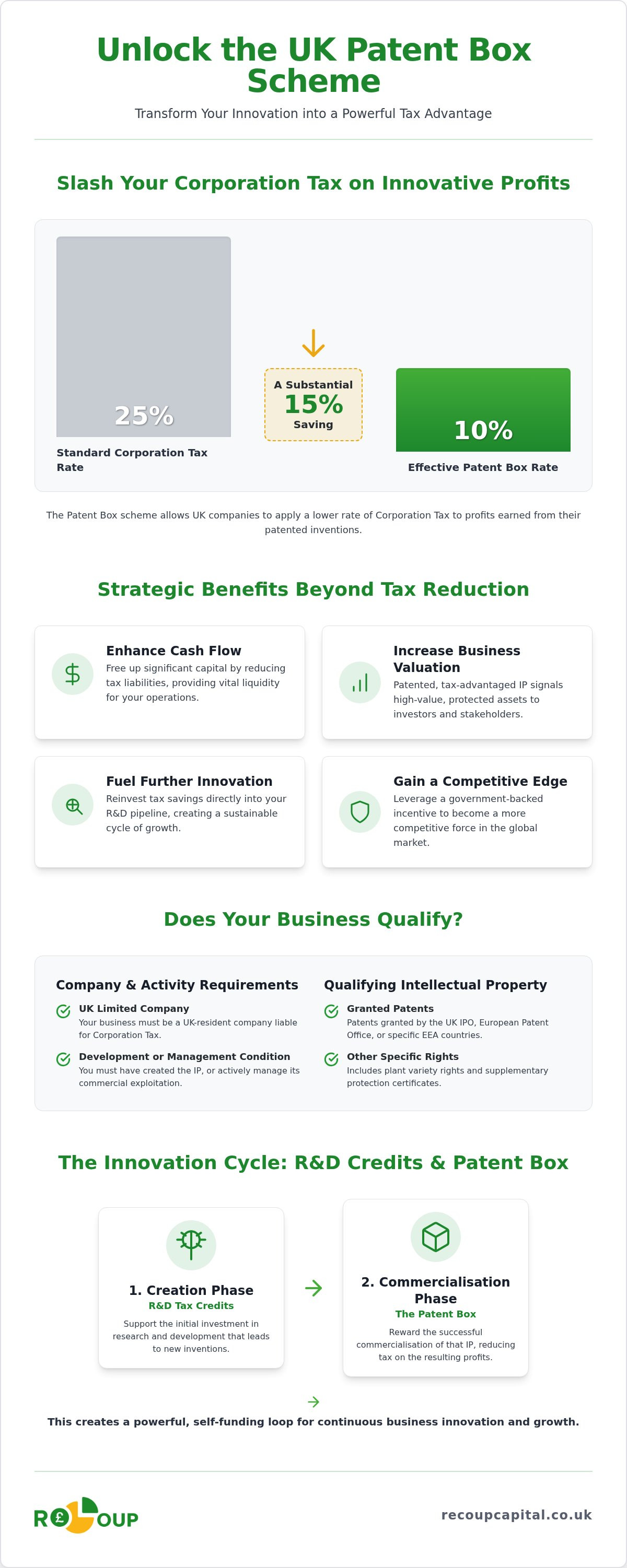
Did you know that whilst the UK's main Corporation Tax rate remains at 25%, your most innovative profits could be taxed at a significantly lower rate of just 10%? It's a startling disparity. Many businesses overlook this, yet the uk patent box scheme exists specifically to reward the risks you've taken in developing unique intellectual property. We understand that watching a substantial portion of your innovation budget disappear into tax liabilities is disheartening. It feels like a penalty for success. This is especially true when you're trying to scale in a competitive global market.
You deserve a tax strategy that acts as a protective guide for your growth rather than a hurdle to overcome. This article will show you how to reduce your Corporation Tax to an effective rate of 10% whilst strategically reinvesting in your business growth. You'll discover the exact criteria for qualifying IP, how to master the nexus fraction without the typical fear of an inquiry, and the steps to create a robust claim process. We'll show you how to turn these financial returns into strategic assets that fuel your next phase of business innovation.
Key Takeaways
- Learn how to reduce your Corporation Tax liability to an effective rate of 10% on profits generated from qualifying intellectual property.
- Navigate the eligibility requirements of the uk patent box scheme to ensure your limited company and IP assets are positioned for maximum relief.
- Understand how to combine R&D Tax Credits with the Patent Box to support your business through both the creation and commercialisation phases.
- Gain clarity on the Nexus fraction calculation to ensure your claims are robust, accurate, and fully compliant with HMRC regulations.
- Discover how to transform tax savings into strategic assets that can be reinvested to fuel long-term business innovation and growth.
What is the UK Patent Box Scheme? An Overview for 2026
The UK Patent Box scheme is a strategic tax tool for UK innovation. It serves as a powerful government incentive designed to encourage companies to keep their intellectual property (IP) and the associated high-value jobs within the UK. By offering a reduced effective Corporation Tax rate of just 10% on qualifying profits, the government rewards businesses that choose to commercialise their inventions locally rather than moving operations offshore. It's a proactive measure that transforms the UK into a competitive hub for global technology and manufacturing.
In 2026, this scheme is more relevant than ever. With the main rate of Corporation Tax holding steady at 25%, the gap between the standard rate and the Patent Box rate represents a substantial 15% saving. For a growing business, this isn't just a tax break; it's a significant capital recovery opportunity. It allows you to reclaim funds that would otherwise be lost to the Treasury, providing a reliable source of internal funding during a period of rising operational costs.
The Core Benefits of Electing into the Scheme
Electing into the uk patent box scheme provides more than just a lower tax bill. It fundamentally alters your business's financial trajectory. Companies that successfully claim this relief often see a dramatic improvement in their annual cash flow. This liquidity is vital for reinvesting in further research and development, ensuring your innovation pipeline never runs dry. Beyond the immediate cash benefit, holding patented IP that generates tax-advantaged income significantly enhances your business valuation. It signals to investors and stakeholders that your company possesses protected, high-value assets that are being managed with fiscal precision.
How the 10% Effective Rate is Achieved
The mechanism behind the 10% rate isn't a direct tax cut in the traditional sense. Instead, it's achieved through a specific "Patent Box deduction" from your company's total taxable profits. HMRC requires a clear distinction between your normal trading profits and those derived specifically from your IP. This involves identifying income from the sale of patented items, products containing patented components, or the licensing of patent rights. Once these IP-derived profits are isolated, the deduction is applied to bring the effective tax rate down. It's a precise calculation that rewards the commercial success of your ingenuity. When managed correctly, this process ensures that your most innovative revenue streams are protected from the full weight of standard corporate taxation.
Eligibility Criteria: Does Your Business Qualify?
To access the 10% rate, your business must first meet specific entity and activity tests within the uk patent box scheme. Primarily, you must be a UK-resident limited company liable for Corporation Tax. Simply owning a patent is rarely enough to satisfy HMRC. You must also meet the "Development Condition." This means your company must have played a significant role in creating or developing the patented invention. This often involves performing the original R&D that led to the patent or making substantial improvements to the technology thereafter. It's a proactive requirement designed to ensure the tax relief supports genuine UK-based innovation activity rather than passive income.
For companies operating within larger corporate structures, the "Management Condition" becomes a vital consideration. If your company didn't perform the original development but now holds the rights, you must demonstrate that you perform significant management activity regarding that intellectual property. This includes strategic decision-making about the further development or commercial exploitation of the patent. It isn't enough to simply hold the asset on your balance sheet; you must be the entity driving its commercial value.
Qualifying Intellectual Property Rights
Not all intellectual property qualifies for this specific relief. The scheme focuses on patents granted by the UK Intellectual Property Office (IPO) or the European Patent Office (EPO). Additionally, patents from specific EEA countries, such as Austria, Denmark, and Germany, are eligible. Beyond standard mechanical or digital patents, the relief also covers plant variety rights and supplementary protection certificates for medicinal products. To ensure your specific IP assets meet the strict legal definitions, you should consult the official government guidance which outlines the exhaustive list of qualifying rights.
Exclusive Licences and Group Structures
Ownership isn't the only path to relief. If your company holds an exclusive licence to use a patent, you can still benefit from the uk patent box scheme. To qualify, the licence must grant you rights to the exclusion of all other persons, including the patent owner, within at least one national territory. This allows innovative companies to leverage third-party technology whilst still benefiting from the 10% tax rate on the resulting profits. Within group structures, these rules allow for the strategic distribution of IP benefits, provided the management and development conditions are strictly adhered to by the claiming entity. Understanding these nuances is key to ensuring your claim is defensible. If you're unsure if your current IP portfolio fits these criteria, it's worth exploring why claiming under the correct framework is essential for your long-term fiscal health.
The Synergy: Combining Patent Box with R&D Tax Credits
Innovation isn't a single event; it's a journey from a concept in a laboratory to a product on a shelf. To maximise your financial recovery, you must view your tax strategy through this same lens. R&D Tax Credits and the uk patent box scheme are designed to work in tandem, providing a continuous stream of capital throughout the innovation lifecycle. Whilst R&D credits support the "creation" phase by lowering the cost of discovery, the Patent Box supports the "commercialisation" phase by protecting the profits your discovery generates.
By aligning these two incentives, you create a self-sustaining loop of reinvestment. The cash recovered from your R&D claim can fund the patent application process, which in turn unlocks the lower tax rate of the Patent Box. This holistic approach ensures you aren't leaving money on the table at either end of the process. Understanding this relationship is the first step toward building a resilient fiscal strategy. Learn why claiming R&D tax credits is essential for establishing the foundation of this cycle.
Differences in Qualifying Expenditure and Income
A common misconception amongst business owners is that claiming both incentives constitutes "double dipping." This isn't the case. R&D Tax Credits are expenditure-based; they look backward at the money you've already spent on staff, software, and consumables. Conversely, the Patent Box is income-based; it looks forward at the profits you're earning from your patented assets. Because they target different parts of your profit and loss statement, they are entirely complementary. You're effectively being rewarded for the risk of development and then rewarded again for the success of that development.
Strategic Planning for Maximum Relief
To truly maximise your benefit, your R&D data must be meticulously organised. The calculation for the uk patent box scheme relies heavily on your "nexus fraction," which is a ratio determined by your qualifying R&D expenditure. If your R&D records are fragmented, your Patent Box claim will suffer. Timing is also critical. Aligning your patent applications with your tax years can prevent gaps in relief and ensure a smooth transition from development-phase support to commercial-phase protection. These two schemes form a comprehensive innovation support system that protects your business from the initial laboratory breakthrough to the final global sale.
Calculating Your Benefit: The Nexus Fraction Explained
The calculation behind the uk patent box scheme often feels like the most intimidating part of the process. At its heart lies the "Nexus" rule, a mechanism designed by HMRC to ensure that tax relief is proportional to the R&D work actually performed by your company. It acts as a bridge between your innovation costs and your commercial rewards. If you developed the technology in-house, your benefit is protected. However, if you acquired the IP or outsourced the R&D to connected parties, the relief is scaled back. Understanding this link is vital for accurate financial modelling.
Identifying Relevant IP Income (RIPI)
Before you can apply the nexus fraction, you must first isolate your Relevant IP Income (RIPI). This isn't just the profit from selling a standalone patent. It encompasses several streams:
- Income from the sale of patented items or complex products containing at least one patented component.
- Licence fees and royalties generated from your qualifying intellectual property.
- Proceeds from the sale of the IP rights themselves.
By accurately identifying these streams, you ensure that every pound of IP-derived revenue is working toward your tax reduction. It's about finding the "hidden" value in your sales data that qualifies for that lower tax rate.
The R&D Fraction Calculation
The R&D fraction is the formula that determines how much of your IP profit qualifies for the 10% rate. The specific calculation is: (qualifying R&D expenditure × 1.3) ÷ (total R&D expenditure + acquisition costs + subcontracted R&D to connected parties). The "1.3" multiplier is a generous uplift provided by the government to help businesses whose fraction might otherwise be slightly diluted. It's a clear signal that the uk patent box scheme prioritises companies that keep their innovation domestic and in-house. Costs paid to connected parties or for the acquisition of patents will lower this fraction, directly reducing your overall tax saving.
Meticulous record-keeping is the foundation of a successful claim. You must be able to track every pound of expenditure back to the specific patent it supports. Without this level of detail, your nexus fraction remains a guess rather than a robust financial figure. If you're concerned about how your current R&D structure affects your potential relief, we can help you understand your R&D data to ensure your Patent Box claim is both maximised and compliant. Proper tracking today ensures that your innovation becomes a strategic asset tomorrow.
Strategic Implementation: Maximising Your Claim with Recoup Capital
Electing into the uk patent box scheme is a deliberate strategic choice. It isn't an automatic adjustment made by HMRC; you must formally elect into the scheme within your Corporation Tax return. This usually needs to happen within two years of the end of the accounting period in which the relevant profits arose. Whilst this window offers some flexibility, missing the deadline means forfeiting a substantial relief opportunity. We act as a proactive guide through this process, ensuring your election is timed perfectly to capture the full benefit of your intellectual property assets.
Identifying qualifying income is where many businesses falter without expert support. It's straightforward to spot a direct royalty payment, but it's much harder to isolate the IP value within a complex, bundled product or a range of spare parts. Our specialists are trained to look deeper. We find "hidden" income streams that generalists often overlook, ensuring your claim reflects the true commercial value of your ingenuity. Our approach to R&D tax credits and innovation relief is built on this meticulous attention to detail, transforming technical data into strategic business tools that fuel your future growth.
The Value of Specialist Tax Guidance
General accountants provide an essential service for day-to-day operations, but the uk patent box scheme requires a level of niche expertise that goes beyond standard bookkeeping. Navigating international patent rights or complex group structures demands a specialist's eye to ensure compliance whilst pushing for the maximum legitimate relief. Our success-based fee model means our interests are perfectly aligned with your business success; we only succeed when you recover capital. This partnership-oriented style removes the friction of traditional consultancy and focuses entirely on delivering measurable results for your bottom line.
Next Steps: Preparing for Your Patent Box Election
Preparation is the foundation of a robust and defensible claim. You should start by gathering all technical documentation, including official patent grant letters from the UKIPO or EPO. It's also vital to review your historical R&D claims. Since your nexus fraction is built on these figures, any inaccuracies in your R&D data will ripple through to your Patent Box benefit. Once your records are in order, the most effective next step is to book a consultation. We can help you transform your innovation into a strategic asset, providing the professional clarity needed to navigate these regulatory landscapes with confidence and precision.
Future-Proof Your Innovation Strategy
The potential of your patented innovations shouldn't be restricted by standard corporate tax rates. By effectively utilising the uk patent box scheme, you can secure a 10% tax rate on qualifying profits, creating a powerful mechanism for capital recovery. This strategy works best when integrated with your existing R&D tax credits. It ensures that every stage of your innovation lifecycle, from initial concept to commercial success, is fiscally optimised.
Our team of specialist chartered tax accountants is dedicated to helping you navigate these complexities. With our success-based fee structure and deep expertise in the synergy between R&D and Patent Box claims, we act as a protective guide for your business growth. We prefer to demonstrate value through results, ensuring your intellectual property remains a strategic asset for the long term. Secure your 10% tax rate; speak with a Recoup Capital specialist today.
Frequently Asked Questions
What is the UK Patent Box scheme and how does it lower tax?
The uk patent box scheme is a government tax incentive that allows UK companies to apply a reduced 10% Corporation Tax rate to profits earned from patented inventions. This represents a significant saving compared to the main rate of 25%. The relief is achieved through a specific deduction from your taxable profits, which is calculated based on the income generated by your qualifying intellectual property. It's designed to reward companies for commercialising their innovations within the UK.
Can I claim Patent Box relief if my patent is still pending?
You can certainly begin tracking profits while a patent application is pending. However, you can't actually receive the tax relief until the patent is officially granted by the UK Intellectual Property Office or the European Patent Office. Once granted, you can claim for the profits generated during the "pending" period, provided you've elected into the scheme. This ensures that the time spent in the application phase isn't lost for tax purposes.
Do I need to own the patent to qualify for the scheme?
Ownership is not a strict requirement for qualification. You can benefit from the scheme if your company holds an exclusive licence for the patent. This licence must grant you rights to the exclusion of all other persons, including the owner, within at least one national territory. You must also demonstrate that you've met the development or management conditions by being actively involved in the creation or strategic direction of the intellectual property.
How does the Patent Box interact with R&D tax credits?
These two incentives form a powerful, self-sustaining innovation cycle. R&D tax credits provide relief on the costs incurred during the development phase, whilst the Patent Box reduces tax on the profits earned during the commercial phase. Crucially, your R&D expenditure data is used to calculate the "nexus fraction," which determines how much of your profit qualifies for the 10% rate. Managing both together ensures you maximise your total capital recovery.
What happens if my company makes a loss instead of a profit?
If your qualifying activity results in a loss, you don't receive an immediate tax benefit. Instead, these "relevant IP losses" are carried forward and must be offset against future profits within the Patent Box scheme. This ring-fencing ensures that the reduced tax rate only applies to net profits over time. It's a long-term mechanism that protects the integrity of the scheme whilst still rewarding eventual commercial success and future tax savings.
Is the Patent Box scheme only for large pharmaceutical companies?
No, the uk patent box scheme is accessible to limited companies of all sizes across various sectors. Whilst pharmaceutical and engineering giants are prominent claimants, many innovative SMEs successfully use the scheme to lower their tax liabilities. Any company that develops and commercialises patented technology in the UK can qualify. It's a strategic tool for growth that helps smaller businesses reinvest their profits back into further research and development.
How long does a company have to elect into the Patent Box?
A company must elect into the scheme within two years of the end of the accounting period in which the profits first arose. This election is made via your Corporation Tax return. Once you've entered the scheme, the election remains in force for all subsequent years. You don't need to re-elect annually, but you should review your qualifying income regularly to ensure your claims remain accurate and compliant with HMRC requirements.
What records do I need to keep for an HMRC Patent Box claim?
To support a successful claim, you must maintain meticulous records that bridge your R&D activity with your sales income. Essential documentation includes:
- Official patent grant letters and exclusive licence agreements.
- Detailed breakdowns of income derived from patented products.
- Evidence of R&D expenditure to support the nexus fraction calculation.
This robust tracking transforms technical data into a defensible financial asset, ensuring your submission remains compliant during any HMRC inquiry.


