

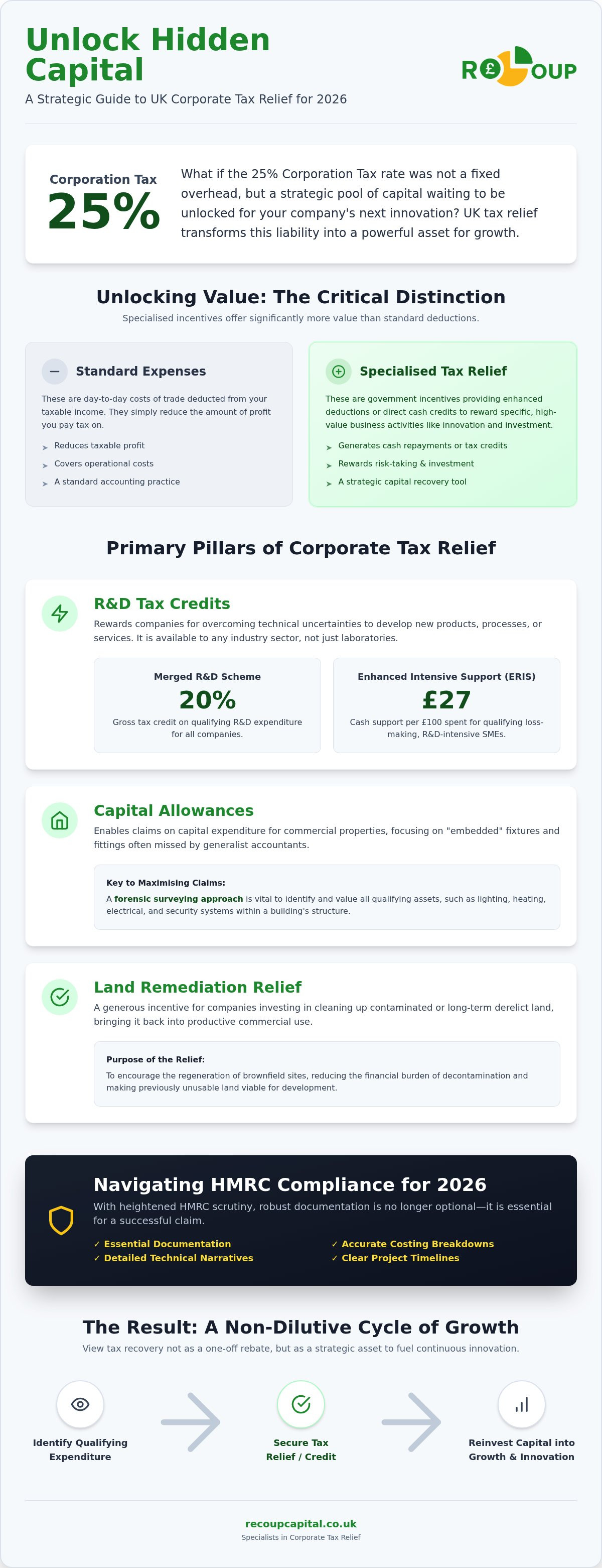
What if the 25% Corporation Tax rate wasn't a fixed overhead, but a strategic pool of capital waiting to be unlocked for your company's next innovation? For many UK limited companies, the complexity of HMRC regulations feels like a barrier rather than an opportunity. You've likely felt the mounting pressure of administrative burdens whilst worrying that an ambitious claim might inadvertently trigger a formal inquiry. It's a common frustration to see potential growth capital tied up in taxes simply because the qualification criteria for corporate tax relief UK seem like a moving target.
You deserve a partnership that transforms these intimidating procedures into a streamlined path for business reinvestment. This article provides the clarity you need to identify, claim, and reinvest the full spectrum of available incentives to fuel your competitive advantage in 2026. We'll provide a definitive roadmap of the latest incentives, including the merged R&D scheme and forensic capital allowances. You'll learn how to maximise your capital recovery and ensure absolute compliance with the newest standards, turning tax returns into powerful strategic assets for your firm's future.
Key Takeaways
- Identify the critical distinction between standard deductible expenses and specialised corporate tax relief UK incentives to unlock hidden capital.
- Learn how the merged R&D scheme provides a 20% gross credit for businesses solving technical uncertainties across any industry sector.
- Discover why a forensic surveying approach is vital for maximising Capital Allowances on building fixtures and embedded assets.
- Understand the essential documentation and technical narratives required to satisfy HMRC's heightened compliance standards in 2026.
- Reframe your tax recovery as a strategic, non-dilutive asset that fuels a continuous cycle of innovation and competitive growth.
Understanding the Corporate Tax Relief Landscape in the UK
Corporate tax relief UK isn't just a collection of accounting loopholes; it's a deliberate government strategy designed to reward specific, high-value business activities. Unlike standard business expenses which simply deduct the day-to-day costs of trade from your taxable income, these incentives provide enhanced deductions or cash credits. They're built into the UK corporation tax system to foster a culture of innovation and physical investment. By reducing the financial risk associated with research or property development, the Treasury aims to keep the UK competitive on a global stage. This proactive approach helps businesses recover capital that would otherwise be lost to the exchequer.
The landscape is divided into several specialised pillars, each targeting a different aspect of business growth. These primary categories include:
- R&D Tax Credits: This scheme rewards companies that overcome technical uncertainties to develop new products, processes, or services. It's not just for scientists in lab coats; it's for any firm solving technical problems.
- Capital Allowances: This relief is available for capital expenditure on commercial property. It focuses on "embedded" fixtures such as lighting, heating, and security systems that generalist accountants often overlook.
- Land Remediation Relief: A generous incentive for companies cleaning up contaminated or derelict land to bring it back into productive commercial use.
Who Qualifies for Corporate Tax Relief?
Eligibility is specifically reserved for UK limited companies. Whether you're an ambitious SME or a large enterprise, the core requirement is that you're liable for Corporation Tax. However, many eligible activities go unnoticed because they don't look like "innovation" on a standard spreadsheet. Generalist firms often miss these claims because they lack the forensic surveying or technical expertise required to translate complex engineering or construction projects into the language of HMRC compliance. If your business is taking risks to improve a process or refurbish a facility, you're likely sitting on unclaimed capital.
The Strategic Importance of Capital Recovery
We encourage you to view these reliefs as strategic assets rather than simple rebates. In 2026, businesses face a unique set of economic pressures, from shifting tax rates to fluctuating operational costs. Recovered capital acts as a non-dilutive funding source, allowing you to strengthen your balance sheet without the need for external borrowing or giving up equity. It provides the liquidity needed to hire specialised talent or invest in new equipment. Corporate tax relief is a mechanism for reinvesting in business growth by transforming past expenditure into a catalyst for future expansion.
R&D Tax Credits: The Engine of Business Innovation
Innovation isn't a luxury; it's a necessity for survival in the 2026 market. Many businesses mistakenly believe that corporate tax relief UK incentives for research and development are reserved for pharmaceutical giants or tech pioneers in lab coats. In reality, the Research and Development (R&D) relief scheme is designed for any limited company that overcomes technical uncertainty to improve a product, process, or service. If your team is asking "how can we make this work?" rather than "how do we follow the manual?", you're likely performing qualifying R&D.
The landscape has shifted towards a merged R&D scheme for accounting periods beginning on or after 1 April 2024. This provides a 20% gross credit on qualifying expenditure, simplifying the process whilst maintaining high rewards. For loss-making SMEs with an R&D intensity of at least 30%, the Enhanced R&D Intensive Support (ERIS) remains a vital lifeline. It offers a more generous path, potentially providing up to £27 in cash support for every £100 spent. Understanding which path your business falls into is the first step toward significant capital recovery.
Identifying R&D in Construction and Engineering
Construction and engineering firms often overlook their own innovation because they view it as "just part of the job". Developing bespoke structural solutions for a challenging site or creating sustainable, low-carbon material blends are prime examples of qualifying activities. Even the integration of complex BIM software with legacy site management systems can count. These projects involve technical risks where the outcome isn't guaranteed. You can learn more about R&D tax credits for innovation to see how your specific projects align with HMRC's criteria. Our specialists often find that what a generalist accountant sees as a standard project cost is actually a high-value claim opportunity.
Maximising Your Claim Value
Capturing the full value of a claim requires looking far beyond simple invoices. You must account for staff time, including the proportion of salaries and pension contributions dedicated to the project. Consumable items, such as materials used in prototypes or heat and light for the workspace, also qualify. To satisfy HMRC's 2026 standards, these costs must be backed by robust technical reports that narrate the scientific or technical advancement. A forensic approach identifies these nuances, ensuring you don't leave money on the table. If you're unsure if your recent projects qualify, a success-based assessment can provide the clarity needed without upfront cost.
Capital Allowances and Land Remediation: Unlocking Hidden Value
Whilst most generalist accountants capture obvious deductions like laptops or vehicles, the most substantial opportunities for corporate tax relief UK often lie within the building's physical infrastructure. Capital Allowances permit limited companies to write off the cost of "integral features" and fixtures permanently attached to a commercial property. These aren't just surface-level assets; they include the complex systems that make a building functional. For property owners and developers, identifying these embedded assets is the difference between a standard tax return and a significant capital recovery event.
The real strategic advantage in 2026 comes from "stacking" these reliefs. A single construction project might qualify for Land Remediation Relief during the site preparation phase, Capital Allowances during the fit-out, and R&D tax credits if innovative building methods are used. By combining these incentives, firms can drastically reduce their effective tax rate and improve project margins. This multi-layered approach ensures that no qualifying expenditure is left unclaimed across the entire lifecycle of a property investment.
Forensic Analysis of Commercial Property
Identifying hidden assets requires more than just a review of invoices; it demands a forensic surveying process. Many high-value items like air conditioning systems, specialised data cabling, and integrated security sensors are often "bundled" into general construction costs. We distinguish between revenue-based repairs, which are immediately deductible, and capital improvements that provide long-term relief. You can explore capital allowances for commercial property to see how forensic surveying uncovers value that standard accounting methods frequently overlook. With the Main Pool Writing Down Allowance (WDA) rate set at 14% from April 2026, accurately categorising these assets from day one is vital for your long-term cash flow.
Derelict Land and Environmental Relief
Land Remediation Relief is a powerful incentive for companies bringing contaminated or derelict sites back into productive use. If your project involves asbestos removal, soil decontamination, or the treatment of harmful organisms like Japanese Knotweed, you can claim a 150% tax deduction on qualifying remediation costs. For a company paying the 25% Corporation Tax rate, this equates to a 37.5% tax saving on every pound spent. Even loss-making companies can benefit by surrendering their loss for a 16% cash tax credit. Our guide to land remediation tax benefits explains how developers can turn environmental liabilities into strategic financial assets. This relief is particularly valuable for construction firms tackling complex urban regeneration projects where site preparation costs would otherwise be prohibitive.
Navigating HMRC Compliance and New Standards for 2026
HMRC's approach to corporate tax relief UK has entered a new era of digital precision. With the expansion of Making Tax Digital and enhanced data analysis tools, the tax authorities are now scrutinising claims with unprecedented detail. Transparency is no longer optional; it's the foundation of a successful claim. To meet these heightened standards, your submission must move beyond simple figures. You need a technical narrative that explains the scientific or technical advancement behind your innovation and a financial breakdown that justifies every penny of expenditure.
Receiving an inquiry notice shouldn't be a cause for alarm if your documentation is robust. We view an inquiry as an opportunity to demonstrate the technical integrity of your projects. By providing clear, evidence-based responses, you can resolve questions quickly and maintain a positive relationship with tax inspectors. Our success-based fee model ensures that we're as invested in the accuracy of your claim as you are. We don't just process paperwork; we act as your protective guide through the regulatory landscape, ensuring your business remains on the right side of evolving standards.
The 5-Step Process for a Compliant Claim
- Initial discovery: We identify potential relief areas across your entire business operation, looking for innovation that generalists often miss.
- Forensic data collection: Our team gathers the specific financial evidence and technical proof required for a solid foundation.
- Report drafting: We create a robust technical narrative that translates your work into HMRC's specialised language.
- Submission and liaison: We manage all communication with tax authorities, handling any queries on your behalf to reduce your administrative burden.
- Fund recovery: You receive the tax credit or a significant reduction in your Corporation Tax liability to reinvest in your growth.
Specialist Consultants vs General Accountants
Generalist accountants are excellent at managing day-to-day compliance, but they often take a conservative approach to specialised corporate tax relief UK incentives. This caution can lead to missed opportunities and left-behind capital that your business could be using to scale. By contrast, having chartered tax accountants and forensic surveyors in the same room allows us to uncover value that others overlook. Specialised forensic surveying is essential for compliance in 2026 because it provides the objective, technical evidence required to withstand rigorous HMRC scrutiny. If you're concerned about the accuracy of a previous claim or want to explore new opportunities, we offer a risk-free assessment to ensure you're fully compliant whilst maximising your recovery.
Strategic Reinvestment: Turning Tax Relief into Business Growth
Viewing a tax return as a mere compliance chore is a missed opportunity for any ambitious director. In the current fiscal environment, corporate tax relief UK incentives should be reframed as a vital source of non-dilutive capital. Whilst external lenders often demand high interest rates or equity stakes, recovered tax capital remains entirely under your control. It's a strategic asset that strengthens your balance sheet, making your company more attractive for future corporate finance transactions or acquisitions. By unlocking this internal funding, you reduce your reliance on expensive debt and maintain the agility needed to pivot in a shifting market.
This approach creates what we call a virtuous cycle of innovation. When you successfully claim relief on a project, those funds can be immediately funneled back into the next phase of development. This reinvestment often qualifies for further relief in the following accounting period, effectively subsidising your company's growth through its own technical advancements. It's a self-sustaining engine for expansion. Proactive financial planning ensures that tax recovery isn't just a year-end bonus; it's a core component of your long-term investment strategy.
Scaling Innovation with Recovered Funds
The most successful firms allocate their tax savings with surgical precision. For an engineering company, this might mean using a Research and Development credit to purchase a state-of-the-art CNC machine or specialised 3D printing equipment that was previously out of reach. Other businesses choose to invest in human capital, hiring senior technical leads to accelerate project timelines. These are not just expenses; they are investments in your competitive edge. You'll find that claiming tax relief is a strategic business move because it provides the liquidity required to take calculated risks without straining your operational cash flow.
Partnering for Long-Term Success
True capital utility is rarely achieved through one-off claims or a reactive approach to HMRC deadlines. It requires a partnership-oriented consultancy model where specialists act as protective guides through every stage of your business journey. We focus on building long-term collaborations that move beyond processing paperwork to identify sustained recovery opportunities across your entire operation. This proactive stance ensures you're always prepared for regulatory shifts whilst maximising every available incentive. If you're ready to transform your tax liabilities into growth assets, we invite you to book a no-cost assessment with Recoup Capital. Our success-based model means we're fully invested in your results, providing a risk-free path to unlocking the capital your innovation deserves.
Transform Your Tax Strategy into a Growth Engine
Securing the full spectrum of corporate tax relief UK in 2026 requires a shift from reactive filing to proactive capital recovery. We've explored how identifying technical uncertainties and conducting forensic surveying on building fixtures can turn tax liabilities into reinvestment capital. It's about more than just a refund; it's about building a resilient, innovation-led foundation for your business's future expansion.
Our expert team of chartered tax accountants and forensic surveyors specialises in navigating the complexities of sectors like construction and engineering. We're dedicated to ensuring your claims are robust and fully compliant with the latest HMRC standards. With our success-based fee model, we only win when you do. This partnership approach provides a risk-free opportunity to strengthen your balance sheet and fuel your competitive advantage.
Maximise your capital recovery with a specialist assessment from Recoup Capital. Your next phase of growth is waiting to be unlocked, and we're here to ensure your innovation receives the financial recognition it deserves. Let's start a conversation that transforms your regulatory obligations into strategic assets.
Frequently Asked Questions
What is the most common corporate tax relief for UK businesses?
R&D Tax Credits and Capital Allowances are the most widely utilised forms of corporate tax relief UK businesses access today. While R&D relief is the primary driver for innovation-led firms, Capital Allowances apply to almost any limited company that owns or leases commercial premises. These incentives aren't just one-off rebates; they're strategic tools designed to stimulate investment in both intellectual property and the physical infrastructure required for long-term sustainable growth.
Can I claim R&D tax credits if my project was a failure?
Yes, you can claim R&D tax credits even if your project didn't achieve its technical goals. HMRC's criteria focus on the attempt to resolve technical uncertainty, not the ultimate success of the venture. In fact, a failed project often provides the strongest evidence of technical uncertainty. As long as you can document the systematic process of investigation and the technical challenges encountered, the expenditure remains eligible for relief under current standards.
How far back can my company claim corporate tax relief?
You can typically claim for your two most recently completed accounting periods. This means you have a two-year window from the end of the accounting period in which the expenditure was incurred to submit or amend a claim. For Capital Allowances, the rules are slightly different. You can often claim on assets you still own, even if they were purchased many years ago, provided no prior claim was made on those items.
Is Land Remediation Relief available for new build projects?
Yes, Land Remediation Relief is frequently claimed during the early stages of new build developments on brownfield sites. If you're developing land that requires the removal of contaminants like asbestos or the treatment of invasive species like Japanese Knotweed, the costs qualify. This relief provides a 150% deduction for qualifying expenditure, making it a vital tool for developers transforming derelict land into productive commercial assets whilst reducing their overall tax liability.
Do I need to be a technology company to qualify for R&D relief?
No, you don't need to be a technology firm or have a laboratory to qualify. R&D occurs in any sector where a company seeks to achieve a technical advancement by resolving uncertainty. We frequently secure claims for companies in construction, engineering, and food technology. If your team is developing bespoke structural solutions or improving manufacturing processes, you're likely performing qualifying activities that fall under corporate tax relief UK incentives and deserve professional assessment.
How long does it typically take to receive a tax credit from HMRC?
HMRC aims to process R&D tax credit claims within 28 to 40 days of submission. However, this timeline can vary depending on the complexity of the claim and the current volume of applications. For Capital Allowances, the relief is usually realised as a reduction in your Corporation Tax liability when your return is filed. Working with specialists ensures your documentation is correct first time, which helps prevent unnecessary processing delays and secures your funding faster.
What happens if HMRC decides to inquire into my tax relief claim?
An inquiry is a formal request for more information regarding your submission. If this happens, you'll need to provide technical narratives and financial evidence to support your figures. It isn't necessarily a sign of wrongdoing; HMRC often selects claims for random checks or to clarify specific technical points. Having a specialist partner to manage this liaison ensures that your responses are professional, accurate, and delivered with the confidence that comes from robust preparation.
Can I claim both R&D tax credits and Capital Allowances at the same time?
Yes, you can claim both incentives simultaneously, provided they cover different types of expenditure. R&D tax credits primarily cover revenue costs like staff salaries and consumables, while Capital Allowances target capital expenditure on physical assets like plant, machinery, and building fixtures. Stacking these reliefs is a highly effective way to maximise your total capital recovery and ensure no qualifying spend is overlooked during a project's lifecycle, strengthening your company's overall financial position.


