

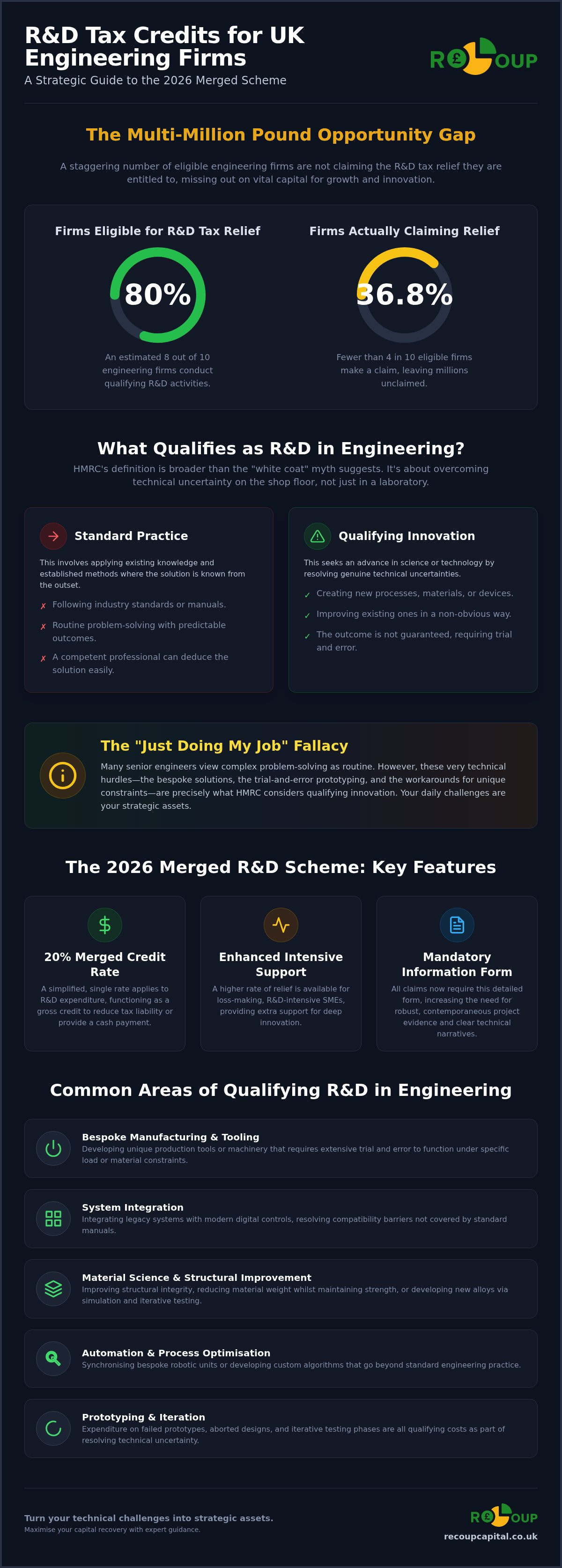
Did you know that while an estimated 80% of engineering firms are eligible for tax relief, only 36.8% actually claim it? This staggering gap represents millions of pounds in unclaimed r&d tax credits for engineering companies across the UK. Most directors feel that their bespoke technical solutions are just part of the job; however, these very uncertainties are exactly what HMRC is looking to reward. We understand that the complexity of the 2026 merged R&D scheme can feel like a barrier, especially with the increased scrutiny on compliance and the mandatory Additional Information Form.
It's time to turn your technical challenges into strategic assets. This guide will help you identify qualifying innovation within your projects and navigate the 2026 regulations to maximise your capital recovery. We'll explore how the 20% merged credit rate works in practice, the specific criteria for Enhanced R&D Intensive Support, and how to build a repeatable process for successful HMRC submissions. By the end of this article, you'll have a clear roadmap to secure a significant cash injection or tax reduction for your business.
Key Takeaways
- Identify the specific technical uncertainties in bespoke manufacturing and system integration that HMRC classifies as qualifying innovation.
- Navigate the complexities of the 2026 merged R&D tax scheme to determine your precise credit rate and eligibility for intensive support.
- Maximise the value of r&d tax credits for engineering companies by implementing a robust, repeatable process for gathering contemporaneous project evidence.
- Protect your business from compliance risks and HMRC enquiries by mastering the requirements of the mandatory Additional Information Form (AIF).
- Learn how to reframe your tax recovery as a strategic asset to fuel future technical growth and enhance your firm's competitive edge.
What are R&D Tax Credits for Engineering Companies?
R&D tax credits are a cornerstone UK tax incentive for R&D, designed to reward companies that invest in scientific or technological advancement. For the engineering sector, this relief is particularly potent. It isn't a grant or a handout. It's a statutory entitlement that allows businesses to recoup a significant portion of their investment in innovation. With the 20% gross credit rate under the merged scheme, r&d tax credits for engineering companies function as a strategic asset in 2026, providing the cash flow necessary to reinvest in talent, equipment, and future growth.
The engineering sector remains one of the largest beneficiaries of this scheme because the industry is built on technical evolution. However, a persistent "white coat" myth often prevents firms from claiming. Many directors believe R&D only happens in sterile laboratories with scientists in lab coats. In reality, innovation in engineering usually happens on the shop floor, amidst the noise of production lines and the complexity of CAD models. If your team is resolving technical uncertainties to create a more efficient, durable, or capable product, you're likely innovating in the eyes of HMRC. This relief isn't just a refund; it's a tool for maintaining a competitive edge.
The Core Definition of Innovation in Engineering
To qualify, a project must seek an advance in science or technology. This means going beyond "standard practice." In a mechanical or civil context, this might involve developing new alloys, improving structural load capacities, or creating more efficient fluid dynamics. Innovation occurs when there is genuine technical uncertainty, whilst standard practice relies on established methods. If a competent professional in your field can look at a problem and immediately deduce the solution using existing knowledge, it's standard practice. When the answer isn't "yes" from the start, and trial, error, or prototyping is required, you've found your R&D.
Why Engineering Firms Often Under-Claim
A significant hurdle is the "just doing my job" fallacy. Senior engineers are paid to solve problems; they often view complex technical hurdles as routine tasks rather than qualifying innovation. This mindset leads to missed opportunities when identifying r&d tax credits for engineering companies. Bespoke manufacturing, where every project involves unique constraints and new technical challenges, is a goldmine for claims. Many firms fail to realise that the time spent on failed prototypes or aborted designs is also qualifying expenditure. You can learn more about how these nuances work by reviewing how R&D tax credits explained by specialists can clarify your eligibility.
Identifying Qualifying Engineering Projects: Where is the Innovation?
Identifying qualifying innovation requires a shift in perspective. It's not just about the final product; it's about the technical journey taken to get there. For many firms, the most valuable R&D occurs when trying to improve structural integrity or reduce material weight whilst maintaining strength. These projects often involve complex simulations and iterative testing of new components in extreme environments. If your engineers are integrating legacy systems with modern digital control interfaces, they're likely resolving technical uncertainties that qualify for support. The process of making outdated hardware communicate with sophisticated AI-driven software is rarely a simple "plug and play" task. It involves resolving compatibility barriers that aren't addressed in standard manuals. Automated production lines also offer fertile ground for claims, as synchronising multiple bespoke robotic units often requires custom algorithms and mechanical overrides that go beyond standard engineering practice.
According to official HMRC guidance, the project must aim to achieve an advance in overall knowledge or capability in a field of science or technology. This means your work must seek to extend the baseline of what's currently possible in the industry. For r&d tax credits for engineering companies, the key is to look for where the path was unclear and the outcome was not guaranteed from the outset.
Bespoke Manufacturing and Tooling
Developing unique production tools is a high-risk endeavour. It's rarely a linear path. When you create bespoke machinery, you're often forced into extensive "trial and error" phases to ensure the equipment functions under specific load or speed constraints. HMRC values the rigour of this process. In fact, failed prototypes are often the strongest evidence for an R&D claim. They demonstrate that the solution wasn't obvious and required a systematic investigation to overcome. If you're unsure if your recent project qualifies, a no-cost technical assessment can help clarify the potential value of your innovation.
Process and Environmental Engineering
The 2026 regulatory landscape has placed a premium on "Green Engineering." Innovation in waste reduction and energy efficiency within engineering plants now requires advanced material treatments and new chemical processes. These aren't standard upgrades. They involve significant scientific challenges to meet modern environmental standards without compromising output. R&d tax credits for engineering companies are designed to offset the costs of these essential advancements. Whether you're developing a new method for heat recovery or engineering a closed-loop material cycle, the technical hurdles you face represent qualifying R&D. By documenting how you've addressed these process-level uncertainties, you can transform regulatory compliance into a strategic financial asset.
SME Scheme vs RDEC: Navigating the 2026 Merged Landscape
The 2026 tax landscape represents a unified front for UK innovation. Since 1 April 2024, the previously distinct SME and RDEC schemes have been consolidated into a single Merged Scheme. This change simplifies the process for large engineering groups and smaller firms alike, offering a gross credit rate of 20%. For a company paying the main rate of corporation tax at 25%, this results in a net benefit of approximately 15% to 16.2%. This "Above the Line" credit is particularly advantageous as it appears in your accounts before tax, positively impacting your EBITDA and overall company valuation. It transforms r&d tax credits for engineering companies from a simple tax saving into a strategic financial asset that strengthens your balance sheet.
Loss-making SMEs with high innovation spend shouldn't overlook the Enhanced R&D Intensive Support (ERIS). To qualify for this more generous relief, your qualifying R&D expenditure must constitute at least 30% of your total expenditure. Firms meeting this threshold can claim a payable tax credit of up to 14.5%. This can result in a cash repayment of up to 27p for every £1 of qualifying spend. This targeted support is vital for engineering startups pushing the boundaries of what's technically possible, providing a critical cash injection during the high-risk phases of development.
The Merged Scheme: A New Standard for Engineering
The 2026 rules have significantly changed how subcontracted R&D is handled. In the new merged landscape, the decision-maker who chooses to undertake the R&D is generally the one entitled to the claim. This prevents double-claiming within engineering supply chains and provides greater clarity for lead contractors. You must also be mindful of restrictions on overseas expenditure, which now limit claims for work performed outside the UK unless specific exceptions apply. Understanding these nuances is essential for accurately calculating r&d tax credits for engineering companies and ensuring your supply chain contracts are structured correctly.
Qualifying Costs in the Engineering Budget
When building your claim, you must accurately apportion costs across several categories. Staff costs are often the largest component, encompassing gross salaries, Class 1 NICs, and pension contributions for everyone from lead designers to the testing team. You can also include:
- Consumables: Materials, water, fuel, and power used specifically during the R&D phase of a project, including prototype materials.
- Software: Licences for CAD, simulation tools, and project management software used to resolve technical uncertainties.
- Subcontracted R&D: Payments made to third parties for specific technical tasks that contribute to your overall innovation.
Correctly identifying these expenditures ensures you aren't leaving money on the table. If you're unsure how to categorise your specific engineering spend, reviewing our FAQs can provide immediate clarity on common scenarios and qualifying criteria.
Preparing a Robust Engineering Claim: HMRC Compliance in 2026
In 2026, the margin for error in R&D submissions has vanished. HMRC has transitioned to a digital-first compliance model, making the mandatory Additional Information Form (AIF) the most critical component of your claim. This form must be submitted before your CT600 corporation tax return. It requires a granular breakdown of qualifying costs and a robust technical justification for every project. For r&d tax credits for engineering companies, this means your internal documentation must be impeccable. You can no longer rely on retrospective estimates. Instead, you must present contemporaneous evidence such as project logs, CAD revision histories, and technical meeting minutes that prove the R&D was happening in real-time.
The Technical Narrative: Proving Uncertainty
Drafting the report is an exercise in translation. You must bridge the gap between complex "engineer-speak" and the specific legislative language HMRC inspectors use to evaluate claims. A successful narrative follows a clear structure: the technical objective, the specific uncertainties encountered, and the systematic resolution. When claiming R&D tax credits, don't shy away from your failures. Highlighting the prototypes that cracked under pressure or the software loops that failed to sync provides the strongest evidence that a solution was not readily deducible. These "dead ends" prove that you were pushing against the boundaries of standard practice.
Avoiding HMRC Enquiries
HMRC's increased scrutiny means that "red flags" now trigger enquiries more frequently than in previous years. Common pitfalls for engineering firms include using rounded figures in costings or providing overly generic project descriptions that lack technical depth. A forensic cost breakdown is essential. You must be able to justify exactly how much time each lead designer or technician spent on the qualifying phases of a project. Specialist R&D consultants act as a protective guide here, ensuring your claim for r&d tax credits for engineering companies is built on a foundation of evidence that can withstand a formal enquiry. To ensure your documentation meets these rigorous 2026 standards, you can arrange a specialist compliance review to safeguard your submission.
Maximising Your Recovery with Recoup Capital
Generalist accountants often view engineering through a standard financial lens. They see invoices and payroll, but they may miss the technical uncertainties hidden in a bespoke manufacturing project or a complex system integration. At Recoup Capital, we specialise in identifying r&d tax credits for engineering companies by digging into the technical reality of your work. Our approach isn't about simply processing paperwork; it's about translating your engineering excellence into a compliant, high-value tax submission. We understand that your time is best spent on the shop floor or at the design terminal, not navigating the intricacies of the 2026 tax code.
Our methodology is built on three distinct pillars: technical assessment, forensic accounting, and expert submission. First, we identify the genuine innovation within your projects. Then, our chartered tax accountants conduct a forensic review of your expenditure to ensure every qualifying pound is captured, from staff NICs to consumable materials. Finally, we handle the entire HMRC submission process, including the mandatory Additional Information Form. This ensures your claim is robust, accurate, and fully aligned with the latest regulatory standards. We don't just find the numbers; we build the narrative that justifies them.
We operate on a success-based fee structure. This ensures our interests are perfectly aligned with your recovery; we only succeed when you do. By reframing these returns as strategic assets rather than mere refunds, we help you secure the capital needed for future reinvestment. It's a partnership-oriented approach designed to fuel your firm's long-term growth and technical capability. We've seen first-hand how a significant cash injection can transform a firm's ability to take on more ambitious, high-risk projects.
Why Specialism Matters in Engineering
Engineering is a nuanced field. You need a guide who understands the difference between standard maintenance and a genuine technological advance. Our team includes chartered tax accountants with a deep understanding of the UK engineering landscape. We've recovered millions of pounds for our clients, transforming complex regulatory hurdles into approachable opportunities. We act as a proactive partner, staying ahead of HMRC's shifting requirements so you can focus on your core operations. This specialist focus ensures that no qualifying activity is overlooked, regardless of how "standard" it may seem to your internal team.
Your Next Steps: A No-Cost Technical Review
Getting started is straightforward and risk-free. Our initial technical assessment is designed to identify "hidden" R&D without disrupting your daily workflow. We'll review your recent projects and provide a clear, evidence-based estimate of your potential recovery. From the first consultation to seeing cash in your bank account, we manage the timeline with efficiency and transparency. It's time to claim what your innovation deserves and turn your tax position into a competitive advantage. Book your no-cost R&D assessment with Recoup Capital today to begin your recovery journey.
Securing Your Engineering Future through Strategic Innovation
The 2026 tax landscape offers a unique opportunity for firms to transform technical challenges into financial strength. By navigating the complexities of the merged scheme and mastering the requirements of the Additional Information Form, you can unlock significant capital for reinvestment. Remember that your bespoke technical resolutions and iterative testing are the very foundation of r&d tax credits for engineering companies. These returns shouldn't be viewed as mere refunds; they're strategic assets that fuel your competitive edge in a demanding market.
At Recoup Capital, we act as your protective guide through every stage of the submission process. Our team of Chartered Tax Accountants are specialists in engineering and manufacturing innovation, ensuring your claim is both maximised and compliant. With our success-based fee structure, our goals are perfectly aligned with your recovery. It's time to move beyond the paperwork and focus on what you do best: engineering the future. Discover your engineering firm's claim potential with a free specialist assessment today. We're ready to build a long-term partnership that supports your business growth for years to come.
Frequently Asked Questions
What qualifies as R&D in the engineering sector?
Qualifying R&D occurs when a project seeks to achieve a scientific or technological advance by resolving technical uncertainties. In engineering, this often involves developing more efficient fluid dynamics, enhancing thermal management in electronics, or improving acoustic insulation in construction. If the solution isn't readily deducible by a competent professional and requires iterative testing or prototyping, it likely qualifies. This includes work on bespoke components or complex system integrations that push beyond standard industry knowledge.
Can we claim for R&D if our project was a commercial failure?
Yes, commercial success isn't a requirement for a valid claim. In fact, technical failure often provides the most robust evidence of the technical uncertainty HMRC requires. If your team spent time and resources attempting to resolve a technical hurdle but ultimately aborted the project, those costs still qualify. Documenting why a prototype failed or why a material treatment didn't meet specifications demonstrates that the solution was not obvious from the outset.
How has the 2026 Merged R&D Scheme changed for engineering SMEs?
Since 1 April 2024, the separate SME and RDEC schemes have been replaced by a single Merged Scheme. For engineering SMEs in 2026, this means a gross credit rate of 20% on qualifying expenditure. This taxable credit is recorded "above the line," which can improve your company's EBITDA. Whilst the rate is lower than the previous SME scheme, the unified structure provides more certainty for firms navigating complex supply chains and subcontracted technical work.
What is the 'R&D Intensive' SME status and do we qualify?
The Enhanced R&D Intensive Support (ERIS) is a separate scheme for loss-making SMEs whose qualifying R&D expenditure accounts for at least 30% of their total expenditure. If you meet this intensity threshold, you can claim a higher payable tax credit of up to 14.5% of the surrenderable loss. This can result in a cash repayment of up to 27p for every £1 spent on qualifying r&d tax credits for engineering companies, providing vital support for innovation-heavy firms.
Can we claim for subcontracted engineering work under the new rules?
Under the 2026 merged rules, the right to claim generally lies with the company that makes the decision to undertake the R&D. If your firm identifies a technical uncertainty and hires a subcontractor to perform specific tasks to help resolve it, you can usually claim those costs. However, you must be aware of the new restrictions on overseas expenditure. In most cases, the R&D activity must take place within the UK to remain eligible for relief.
How far back can an engineering company claim R&D tax credits?
You can generally claim for R&D tax relief up to two years after the end of the accounting period in which the expenditure occurred. This allows firms to review past projects for overlooked innovation. However, first-time claimants or those who haven't claimed in the last three years must pre-notify HMRC of their intention to claim. This notification must be submitted within six months of the end of the relevant accounting period to ensure your claim remains valid.
What information does HMRC require for an engineering R&D claim?
Every claim must include a mandatory Additional Information Form (AIF) submitted through HMRC's digital portal. This requires a detailed technical narrative explaining the scientific or technological advance and the uncertainties you faced. You must also provide a forensic breakdown of costs, including staff time, consumables, and software licences. For r&d tax credits for engineering companies, providing contemporaneous evidence like test results or design iterations is essential to justify the expenditure and protect against compliance enquiries.
Do we need a dedicated R&D department to qualify for tax relief?
No, you don't need a formal R&D department or a laboratory to qualify. Innovation frequently happens on the production line, in the design office, or during site-based problem solving. Any employee involved in resolving technical uncertainties, from lead engineers to technicians, can have their time apportioned to a claim. The scheme is designed to reward the act of innovation itself, regardless of your company's internal structure or the job titles of the staff involved.


