

The best-known R&D tax adviser may not be the right fit for your business. When evaluating your options, marketing language can make it hard to see how different firms’ services, technical expertise and responsibilities differ in practice. The rules have also changed: for accounting periods beginning on or after 1 April 2024, the previous SME and RDEC schemes were replaced by the merged R&D Expenditure Credit and Enhanced R&D Intensive Support. Careful assessment of both the technical work and its tax treatment is essential.
This guide examines what leading R&D advisers publicly offer, then sets out practical ways to assess credentials, claim processes, support and fees. Use the same criteria for all providers, and weigh their proposed involvement against your claim’s needs and your team’s capacity. Recoup Capital is included as an alternative option: its R&D claim support covers technical assessment, preparation and submission, and HMRC liaison, with fees calculated as a percentage of the tax benefit or cash credit recovered. The aim is to help you build a useful shortlist and have a more informed conversation before you engage.
Key Takeaways
- Compare ABGI and ForrestBrown using the same criteria, rather than relying on brand recognition or broad service claims.
- Look for dated evidence of each firm’s expertise, claim process and responsibilities, from technical assessment through to HMRC liaison.
- Compare fee structures by their components and calculation basis, then read the engagement terms to see who is responsible for each step.
- Assess each adviser against your claim’s needs and your team’s capacity to identify the most practical fit.
- Include Recoup Capital as a third option, with R&D claim support covering technical assessment, preparation, submission and HMRC liaison.
ABGI vs ForrestBrown: what should an R&D tax adviser comparison answer?
Focus on the work each adviser undertakes, not which name is better known. A fair comparison covers who handles each stage, what evidence supports the firm’s claims and what the engagement terms include. Service descriptions, ownership and terms can change, so note the date of any firm-specific information and compare it with each company’s current materials.
What do ABGI and ForrestBrown publicly say they do?
In its 2026 company materials, ABGI presents R&D tax support as part of a wider innovation and funding consultancy. ForrestBrown’s 2026 materials position it as an R&D tax specialist. In July 2026, the firm announced Claim Clarity, a review of claims for risks and missed opportunities. Treat these as the firms’ own descriptions, not independent proof of results. Check current ownership, UK service scope and credentials against primary sources before drawing conclusions.
How can you separate evidence from promotion?
Look for specific descriptions of technical assessment, cost analysis, claim preparation and submission, including who communicates with HMRC. A broad claim of expertise tells you less than a dated process explanation or engagement document that assigns responsibilities. Third-party commentary may provide context, but it should not replace evidence from the adviser or current HMRC guidance. For background, see this overview of R&D tax credits.
Why does the right adviser depend on your claim?
A business with one well-documented project and strong in-house technical knowledge may need a different level of support from a company claiming across several projects or disciplines. The latter may also need to coordinate records spread across teams. Consider the complexity of the work, the quality of cost records and how much technical input your staff can provide. Eligibility and relief depend on the company’s circumstances and current HMRC rules. Recoup’s R&D tax credits explained guide sets out the basics. Keep adjacent tax issues separate: stamp duty land tax requires its own assessment, not an assumption within an R&D comparison.
So, for ABGI vs ForrestBrown, the useful question is which documented service and division of responsibilities fit your claim, evidence and internal capacity. That gives you a practical basis for comparing the firms’ processes and terms in the next sections.
Compare ABGI and ForrestBrown on expertise, claim process and compliance
Look beyond sector labels to the work each adviser documents, the people involved and the hand-offs your business will manage. The table gives dated examples from each firm’s published materials. It is not a complete audit of either firm. If a source does not spell out a responsibility, treat that as a question to resolve in the proposal or engagement terms, rather than proof that the service is absent.
| Comparison criterion | ABGI | ForrestBrown |
|---|---|---|
| Technical assessment | ABGI company materials (2026) describe a wider innovation and funding consultancy. The cited material does not detail its technical assessment method. | ForrestBrown’s Claim Clarity announcement (July 2026) describes a review for claim risks and missed opportunities. Check the scope of any full claim assessment separately. |
| Financial analysis | ABGI company materials (2026) describe its wider services and funding platform, but the cited source does not set out R&D cost analysis responsibilities. | ForrestBrown’s published guidance on overseas expenditure (6 June 2024) addresses a cost-rule issue. Confirm how cost identification and calculation are handled for your claim. |
| Preparation and submission | The cited ABGI materials do not specify who drafts, reviews or submits a UK R&D claim. | The cited ForrestBrown materials do not, by themselves, define who completes each preparation and submission step under an engagement. |
| HMRC liaison and credentials | Use current company materials and engagement documents to identify the named team’s relevant qualifications and who manages HMRC correspondence. | Apply the same test: look for current primary-source evidence of relevant qualifications and a clear allocation of HMRC correspondence. |
How should you assess technical and tax expertise?
Look for a clear explanation of how the adviser identifies technical uncertainty and distinguishes qualifying work from routine development. Ask for examples that show the reasoning and evidence trail, not just successful outcomes. Record professional qualifications only where current company or professional-body sources support them. An example can demonstrate an approach, but it cannot guarantee that your projects will qualify.
What should a compliant claim process make clear?
Trace the process from project descriptions and staff input through cost records, supporting evidence, review and submission. Establish who drafts the technical narrative, checks the financial figures, obtains your approval, files the claim and handles HMRC questions. GOV.UK’s official government guidance sets out the current rules. Adviser support does not remove your company’s responsibility to provide accurate, complete information.
For a practical overview of how information gathering and filing fit together, read Recoup’s guidance on claiming R&D tax credits. Apply the same evidence standard to each firm, then compare its documented process with the needs of your projects and internal team.
Which adviser offers the clearest fees, communication and ongoing support?
Fee transparency means knowing what you are paying for and how the charge is calculated, not simply seeing a figure on a website. In an ABGI vs ForrestBrown comparison, separate public descriptions from the terms that apply to a particular engagement. ABGI’s 2026 materials do not publicly list R&D claim fees. ForrestBrown’s 2026 materials describe fixed-fee, contingent-fee and combined pricing options. These descriptions do not establish the terms for a particular claim, so compare the firms’ current engagement documents.
How can you compare R&D consultancy fees fairly?
Read the scope alongside the fee basis. A proposal should explain which stages are covered, how the charge is calculated, when it becomes payable and what could generate additional fees. Look for clear treatment of claim preparation, submission, responses to HMRC and any later amendments. If pricing depends on an outcome, clarify how that outcome is defined and what happens if the relief differs from an initial estimate.
Recoup Capital uses a success-based fee calculated as a percentage of the tax benefit or cash credit recovered. This describes how the fee is calculated; it is not a promise that a claim will be accepted or that a particular benefit will result. Compare it with ABGI’s and ForrestBrown’s written terms rather than assuming that public descriptions of pricing apply to your engagement.
What does useful client support look like during a claim?
Clear support makes it easier to see who does what. Compare how each adviser sets out information requests, review stages, named contacts and communication points. For example, will your technical team explain project advances while finance provides cost records? Will you have an opportunity to review the claim before submission? The answers show how much coordination your own staff will need to provide.
Do not assume that post-submission or HMRC enquiry support is included just because an adviser prepares a claim. Establish whether the written scope covers correspondence, additional evidence requests, amendments or further work, and whether any of these affect the fee. Apply the same standard to each firm: a clear service boundary is more useful than a broad assurance of ongoing support.
Recoup’s R&D claim support covers technical assessment, preparation and submission, as well as HMRC liaison. Bringing these stages together can reduce internal hand-offs. Explore the R&D claim process, then compare its scope and responsibilities with the engagement terms you are considering.
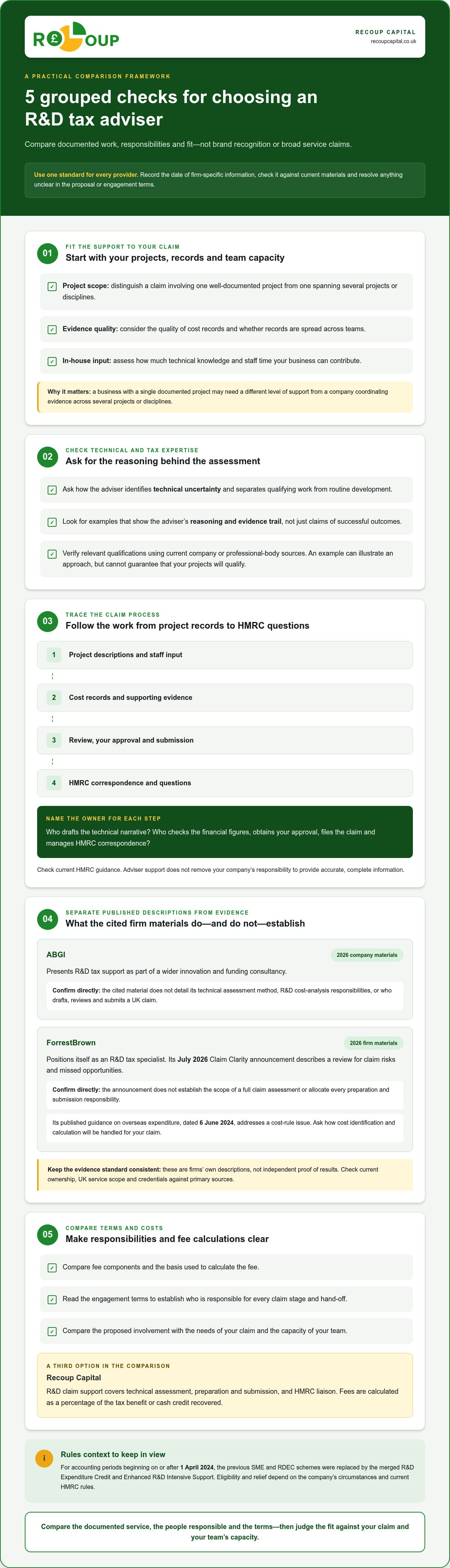
Use this checklist to decide between ABGI and ForrestBrown
Turn the comparison into a repeatable assessment. Score ABGI and ForrestBrown against the same criteria, using current written evidence rather than impressions from a sales conversation. A simple scale such as “clear evidence”, “some evidence” or “unclear” can show what each proposal explains and where details need clarification.
A five-step R&D tax adviser comparison checklist
- Define the scope. List the projects and accounting periods under consideration. Note the technical, financial and submission support your business needs.
- Assess expertise. Compare documented sector experience, relevant qualifications and each adviser’s proposed method for assessing technical work. Give more weight to specific evidence than general claims.
- Map delivery. Record who gathers project information, checks costs, drafts and reviews the claim, submits it and handles HMRC contact. Note what your staff must provide at each stage.
- Compare fees and communication. Review the fee calculation, payment terms, scope boundaries, named contacts and planned review points. Record separately any post-submission or enquiry support included.
- Score the evidence. Apply the same standard to both firms. Mark unclear points for resolution in the written engagement terms before deciding.
Keep the comparison grounded in your claim. A company with well-documented project records and in-house technical expertise may need a different level of adviser involvement from one managing several projects, disciplines or record-keeping systems. Company size or sector alone does not establish eligibility; the work and supporting facts matter.
When might a business need more hands-on claim support?
More coordination may be needed when technical explanations involve several teams, cost records sit across different systems, or internal staff have limited time to assemble evidence. In that situation, weigh how much end-to-end support each adviser sets out and whether responsibilities are clear from assessment through submission and any agreed HMRC liaison. Recoup’s overview of reasons to claim R&D relief can help you consider the potential value of exploring a claim without treating eligibility as automatic.
After completing the checklist, add Recoup Capital as a third option and assess it on the same basis. Its R&D support covers technical assessment, claim preparation and submission, and HMRC liaison, which can reduce the coordination burden on your team. Explore Recoup’s R&D claim support as part of your shortlist.
How Recoup Capital fits into your ABGI vs ForrestBrown shortlist
Assess Recoup Capital alongside ABGI and ForrestBrown using the same criteria: relevant expertise, clear responsibilities, claim process and written fee terms. There is no universal winner. The aim is to find the adviser whose approach best matches your projects, records and the time your team can commit.
What does Recoup Capital bring to an R&D claim?
Recoup’s team includes specialists and chartered tax accountants. Its R&D claim support connects technical assessment with claim preparation and submission, followed by liaison with HMRC. Bringing these stages together can reduce the coordination burden, particularly when technical explanations and financial records need input from different people.
Recoup’s R&D claim fees are success-based and calculated as a percentage of the tax benefit or cash credit recovered. This explains the fee basis, but it does not guarantee that a claim will be accepted or that a particular amount will be recovered. Review the proposed scope and engagement terms so you understand the responsibilities and how the process applies to your circumstances.
If relief is recovered, it may provide capital for business priorities such as development, equipment or working capital. Treat this as a potential benefit, not guaranteed funding: eligibility and the outcome depend on the company’s circumstances and the applicable rules.
What is a sensible next step after comparing advisers?
Before an initial discussion, gather a practical outline of the work you are considering, the relevant accounting period or periods, available project records and the cost information your finance team can access. You do not need a polished claim narrative to start a useful conversation. A clear picture of what was developed, what challenges arose and where supporting information sits can help focus the discussion.
Then compare each adviser’s proposed involvement against your checklist. Consider how technical assessment, financial analysis, preparation, submission and HMRC contact will be handled, and how much coordination will remain with your team. This gives you a grounded basis for deciding whether the service and terms suit your business, rather than relying on general promises or a headline fee model alone.
If you’d like to discuss your company’s circumstances and possible next steps, discuss your R&D tax claim with Recoup Capital. It’s a practical way to explore whether a claim merits further assessment and what information would be useful to review.
Choose an adviser with confidence and take the next step
The right choice in an ABGI vs ForrestBrown comparison depends on how well an adviser’s documented expertise, claim process and engagement terms fit your business. Compare like with like: technical assessment, financial analysis, responsibilities, communication and fees. Then weigh those details against your project evidence and your internal team’s capacity.
Recoup Capital is another option to assess against the same criteria. Its team includes specialists and chartered tax accountants, and its R&D claim support runs from technical assessment through preparation and submission to HMRC liaison. Fees are success-based and calculated as a percentage of the tax benefit or cash credit recovered. That explains the fee basis, not a guaranteed claim outcome.
With a clearer picture of your projects, accounting periods and available records, you can have a more focused conversation about possible next steps. Discuss your R&D tax claim with Recoup Capital to explore an approach that suits your circumstances. A considered comparison can help you move forward with greater clarity and confidence.
Frequently Asked Questions
Is ABGI or ForrestBrown better for R&D tax credits?
Neither adviser is automatically better for every business. The right fit depends on your projects, records and internal capacity. Compare each firm’s documented technical assessment, financial analysis, claim process, HMRC support and engagement terms. ABGI presents a broader consultancy offer, whilst ForrestBrown positions itself around R&D tax expertise. Treat these as starting points for comparison, not proof of which firm will deliver the best outcome for your claim.
What is the difference between ABGI and ForrestBrown?
ABGI’s 2026 company materials describe a broader innovation and funding consultancy, whilst ForrestBrown’s public materials focus on R&D tax. In July 2026, ForrestBrown announced Claim Clarity, a review intended to identify risks and missed opportunities in claims. These public descriptions do not establish the responsibilities or terms for your engagement. Compare current company information and written proposals to see who assesses projects, analyses costs, prepares the claim and handles HMRC contact.
How much do ABGI or ForrestBrown charge for an R&D tax claim?
ABGI does not publicly list R&D claim fees in the information reviewed. ForrestBrown describes flexible options, including fixed-fee, contingent-fee or combined arrangements, but the charge for a particular claim depends on its engagement terms. Compare what work is covered, how the fee is calculated, when it becomes payable and what could incur an additional charge. Ask for a written breakdown, as public pricing descriptions are not a substitute for the terms offered to your business.
Can I change R&D tax advisers from ABGI or ForrestBrown to another firm?
You can explore changing advisers, but first review your existing engagement terms and any work already completed. Clarify how notice, outstanding fees, access to working papers and responsibility for ongoing HMRC correspondence will be handled. Before a new adviser takes over, organise copies of submitted claims, supporting evidence and relevant communications. A clear handover can help avoid duplicated work or uncertainty about who is responsible for the next step.
What should I compare when choosing an R&D tax credit adviser?
Compare equivalent services using the same evidence standard. Look at how each adviser assesses technical uncertainty, analyses project costs, prepares and submits claims, and supports HMRC correspondence. Check relevant qualifications against current primary sources, then review the fee basis, scope boundaries, communication arrangements and named responsibilities in writing. Finally, consider how much time your team can give to gathering evidence and answering technical questions, as this affects the support you may need.
Does choosing an R&D tax consultant guarantee that HMRC will accept my claim?
No. Engaging a consultant cannot guarantee HMRC acceptance, a particular tax benefit or a cash credit. Eligibility and the outcome depend on your company’s circumstances, the work undertaken, the evidence provided and the applicable rules. An adviser can help assess and prepare a claim, but your business must provide accurate information and review the submission. Be cautious of any statement that presents a specific outcome as certain before the facts have been assessed.
Can Recoup Capital be compared with ABGI and ForrestBrown?
Yes. Include Recoup Capital as a third option and compare its expertise, responsibilities, process and written terms using the same criteria. Its R&D support covers technical assessment, claim preparation and submission, and HMRC liaison. The team includes specialists and chartered tax accountants. Recoup’s claim fees are success-based, calculated as a percentage of the tax benefit or cash credit recovered. This fee basis does not guarantee that a claim will be accepted or produce a particular result.


