

A lower headline fee doesn’t automatically mean your business keeps more of its R&D tax benefit. The Recoup Capital pricing model is described as including fixed and contingent fee options, but its contingent percentage isn’t publicly disclosed. The terms behind a specific proposal therefore matter more than the fee label alone.
It’s understandable to focus on the fee. When claim calculations are unclear, comparing providers can feel like comparing unlike figures. A percentage-based charge can reduce the cash benefit available to put back into innovation and growth, while differences in service scope affect how much support your business receives.
This article explains what’s publicly evidenced about our pricing and how to compare fee structures using the claim value, calculation basis, service scope and net benefit to your business. It also covers the engagement details to understand, including what work is covered, how HMRC correspondence is handled and how fees apply if a claim doesn’t result in a benefit. The aim is a like-for-like comparison, not a decision based on a headline percentage alone.
Key Takeaways
- The forrestbrown pricing model is described as offering fixed-fee and contingent options. Compare the terms behind each proposal rather than relying on a headline figure.
- For percentage-based fees, establish exactly which tax benefit or cash credit is used to calculate the charge.
- Compare percentage-based, fixed-fee and time-based structures against the work included, payment trigger and responsibility for HMRC correspondence.
- Before signing, check the fee definition, covered services and what happens if the engagement ends early.
- Recoup Capital calculates its professional fee as a percentage of the total tax benefit or cash credit recovered, with support from technical assessment to HMRC liaison.
What does the ForrestBrown pricing model tell you about R&D claim fees?
Before sharing project details and company financial information, it’s reasonable to want a clear picture of an adviser’s fees. A pricing model is the basis on which professional fees are calculated and charged. For an R&D claim, that basis is only the starting point. The calculation method, work included and benefit your business retains all matter.
The UK R&D tax incentive provides context for these claims, but it doesn’t explain a particular adviser’s commercial terms. Those need to be clear in the proposal and engagement agreement.
What can be established about ForrestBrown’s fees?
The forrestbrown pricing model is described as having fixed and contingent fee options, but the contingent percentage isn’t publicly disclosed. That means you shouldn’t assume a particular rate or calculation basis when estimating the cost of a specific engagement. The fee and scope in the proposal and contract are what matter for your business.
For a reliable comparison, look for the written terms that explain how the fee is calculated, what work it covers and when it becomes payable. If a detail isn’t set out, don’t fill the gap with an assumption. Treat it as a point that needs clear wording before you compare the proposal with another fee structure.
Why the headline fee does not tell the whole story
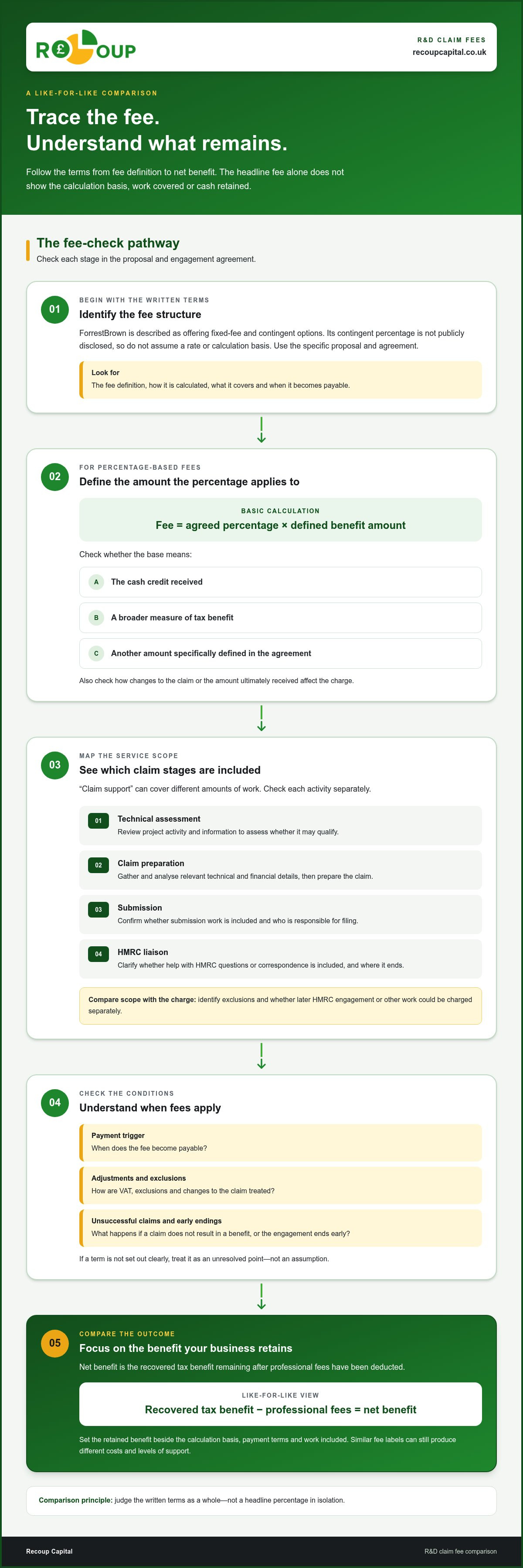
Two proposals can use similar fee descriptions but calculate the charge on different bases. For example, the contract should clarify whether a percentage applies to the cash credit received, another measure of tax benefit, or a defined amount after adjustments. The calculation base can change what the business pays, even when the quoted percentages look comparable. Check the written terms for the definition, as well as the treatment of VAT, exclusions and unsuccessful claims.
Scope matters just as much. Compare what the technical assessment and claim preparation involve, whether submission support is included, and who handles HMRC correspondence if questions arise. A fee comparison is incomplete if one proposal covers more of the claim process than another.
Net benefit is the recovered tax benefit remaining after professional fees have been deducted. That’s the amount available to support business priorities, including future innovation. Compare this retained benefit alongside the work covered rather than judging value from the headline fee alone.
For context on a separate tax topic, Recoup Capital’s stamp duty land tax guidance covers a different area of relief and should not be confused with R&D claim pricing.
How do percentage-based R&D claim fees work in practice?
A percentage-based fee links the adviser’s charge to a defined amount of tax benefit or cash credit. The calculation may sound straightforward, but the contract needs to state what that benefit means, how it’s measured and when the fee becomes payable. Without those definitions, a percentage alone isn’t enough to estimate the cost or compare proposals.
When considering a percentage-based proposal alongside the forrestbrown pricing model, separate the general fee mechanics from assumptions about ForrestBrown’s specific terms. The agreement, not the label, should set out the calculation.
What does a percentage of the tax benefit mean?
The basic calculation can be expressed as fee = agreed percentage × defined benefit amount. The percentage is the rate set out in the agreement; the benefit amount is the contractually defined figure to which it applies. Don’t assume a particular rate or calculation base unless the proposal states it.
Read the definition carefully. Does the base refer to a cash credit received, a broader tax benefit, or another specified measure? Does the agreement explain how a change to the claim or the amount ultimately received affects the calculation? Clear wording makes it easier to understand the potential charge and the benefit left for the business to use.
Which claim activities should the fee cover?
Fees are easier to compare when the work is broken into stages, rather than described only as “claim support”. Check whether the engagement covers:
- Technical assessment: reviewing the project activity and information to assess whether it may qualify.
- Claim preparation: gathering and analysing relevant technical and financial details, then preparing the claim.
- Submission: completing the agreed submission work and clarifying who is responsible for filing it.
- HMRC liaison: defining whether support with HMRC questions or correspondence is included, and where that support ends.
Look for exclusions, such as extra work outside the stated scope, and clarify whether later HMRC engagement would be charged separately. A lower apparent fee may cover fewer activities, while broader support may include more of the process. Compare the charge with the specific work delivered.
Professional conduct matters alongside the fee structure. The Chartered Institute of Taxation’s professional standards for R&D tax services provide relevant context when considering the quality and ethics expected of advisers. For a practical overview of the claim stages, see Recoup Capital’s guidance on claiming R&D tax credits.
How should you compare the ForrestBrown pricing model with other fee structures?
A useful comparison puts each proposal against the same claim and expected work. Assess the forrestbrown pricing model using its documented terms, not assumptions based on a fee label. Apply the same approach to every alternative: a low headline fee may cover less work, use a different calculation base or leave more responsibility with your business.
Which fee structure fits your priorities?
Each structure has different implications for budget certainty and how charges relate to the work. Use the table as a comparison framework, not as a statement about the terms of any particular provider.
| Structure | Calculation base | Payment trigger | Compare in the scope |
|---|---|---|---|
| Percentage-based | An agreed percentage of a defined tax benefit or cash credit. | The event specified in the agreement, such as a defined point in the claim process. | Deliverables, exclusions and whether HMRC correspondence is covered. |
| Fixed-fee | A set fee for the agreed work, rather than a proportion of the benefit. | The milestones or dates set out in the terms. | Whether the scope remains clear if the claim is more involved than expected, and what falls outside it. |
| Time-based | Time spent on the engagement, charged according to the agreed basis. | As stated in the engagement terms, potentially by billing interval or milestone. | How work is recorded, what tasks are included and how the scope is managed. |
A percentage-based fee may link the charge to a defined benefit, while a fixed fee can make the agreed cost easier to identify in advance. Time-based fees connect charges to work undertaken, so clarity on scope and how time is recorded becomes especially important. Claim complexity matters too: a straightforward, well-defined engagement and a claim requiring extensive technical analysis may call for different comparisons. None of these structures is automatically the best fit.
How can you compare net benefit fairly?
Start with the same confirmed tax benefit figure for each proposal. Then compare equivalent deliverables: technical assessment, preparation, submission and any agreed follow-up. Record each provider’s calculation base and payment trigger, and note exclusions or additional charges. Deduct professional fees and other applicable charges only where the provider’s terms specify them. This gives you a consistent view of what the business retains.
The lowest headline fee doesn’t necessarily deliver the strongest value if key work is excluded or HMRC correspondence is handled separately. Equally, a higher fee isn’t proof of better support. Compare the written scope and retained benefit together. If you need background on how the relief works before weighing proposals, read R&D tax credits explained.
What should you check in an R&D tax claim engagement before signing?
Before committing, make sure the written agreement turns the fee and service description into clear responsibilities. This matters whether you’re reviewing the forrestbrown pricing model or another adviser’s proposal. Verbal explanations are no substitute for terms you can refer back to if the claim changes or questions arise.
Which fee and scope terms need plain-English definitions?
Read the fee clause alongside the scope of work. If the fee depends on a percentage, the agreement should define exactly which benefit is used as its base and how that figure is measured. It should also make clear when payment is due and how the calculation changes if the claim amount is revised.
Use this checklist to review the key terms:
- Fee base: What specific tax benefit or cash credit is used to calculate the fee?
- Payment trigger: When does the fee become payable, and what happens if the timing or value of the claim changes?
- Work covered: Are technical assessment, claim preparation and submission included?
- Exclusions and additional charges: Which tasks fall outside the agreed scope, and does the contract describe separate charges for them?
- Ending the engagement: What notice or termination provisions apply, and how are fees handled if either party ends the arrangement before completion?
Plain language helps prevent misunderstandings. If a clause depends on phrases such as “benefit received” or “claim support”, check that the agreement explains what those mean in practice.
How should responsibilities and HMRC follow-up be described?
A well-defined engagement should make clear what the company needs to provide, such as project records and relevant cost information, and who is responsible for preparing the technical narrative. It should also identify who reviews the information, who submits the claim and what support is included if HMRC asks questions or requests further details.
HMRC follow-up can involve work beyond preparing an initial claim, so look for a clear description of what happens next and whether further assistance sits inside or outside the agreed scope. No adviser can promise that HMRC will accept a claim or that a particular result will follow. Clear responsibilities help both sides understand the process and respond appropriately.
For answers to common process questions, browse Recoup Capital’s answers to R&D tax credit FAQs. Recoup Capital also provides end-to-end R&D tax credit claim support, including HMRC liaison. Explore Recoup Capital’s R&D claim support.
How does Recoup Capital’s success-based R&D tax credit fee model compare?
Once you’ve assessed how a fee is calculated, what the engagement covers and how much benefit your business may retain, you can make a more meaningful comparison. Recoup Capital offers a clear point of reference: its professional fee is calculated as a percentage of the total tax benefit or cash credit recovered.
That describes Recoup’s approach, not ForrestBrown’s terms. Compare the forrestbrown pricing model using the details in ForrestBrown’s written proposal and engagement agreement. Consider the calculation base and service scope alongside the fee basis, rather than treating one structure as automatically better.
What does Recoup’s success-based approach include?
Recoup’s professional fee is linked to the total tax benefit or cash credit recovered. Its end-to-end R&D claim support covers technical assessment, claim preparation and submission, as well as liaison with HMRC. The service spans the claim process, from assessing the technical case through to submission and HMRC contact.
For a like-for-like comparison, set those activities beside the deliverables and responsibilities in the other proposal’s written terms. Check whether the same stages are covered and how each agreement defines the benefit used to calculate a percentage fee. Recoup’s stated basis is a comparison point, not evidence that another provider charges more or less.
R&D tax relief can provide capital that a business may put towards future innovation and growth. Consider how much benefit remains after professional fees, alongside the work and support included.
What is a sensible next step for your business?
Before discussing a potential claim, organise a brief outline of the R&D activity, the people and costs involved, and any relevant project records. Note your questions about technical assessment, claim preparation, submission, HMRC liaison and how the fee is calculated. Having these details to hand can make it easier to understand the potential claim and service approach.
Compare ForrestBrown’s written engagement terms and Recoup’s stated fee basis against the same claim information and scope. Focus on clear terms and the benefit your business could retain, not a headline figure alone.
Discuss your R&D tax credit claim with Recoup Capital to explore the potential claim and understand the support involved.
Make your next R&D claim decision with clarity
The forrestbrown pricing model is best assessed from its written terms, not a headline fee alone. Compare how the fee is calculated, what work it covers, when it’s payable and how much benefit your business retains. Clear definitions of the fee base, claim scope and HMRC follow-up support a like-for-like comparison.
Recoup Capital provides another point of comparison: its professional fees are calculated as a percentage of the total tax benefit or cash credit recovered. Its end-to-end support covers technical assessment, claim preparation and submission, and HMRC liaison. The team includes specialist advisers and chartered tax accountants. The recovered relief may then provide capital to support your business’s innovation and growth.
Bring together your project details and questions about fees, responsibilities and support, then discuss your R&D tax credit claim with Recoup Capital. A clear conversation can help you understand the options and take your next step with confidence.
Frequently Asked Questions
How does the ForrestBrown pricing model work?
The forrestbrown pricing model is described as offering fixed and contingent fee options, but the contingent percentage isn’t publicly disclosed. A specific proposal should set out the calculation basis, payment trigger and work included. Compare those terms with the agreed claim scope and the benefit your business would retain.
Does ForrestBrown charge a percentage of an R&D tax claim?
The contingent percentage isn’t publicly disclosed, so don’t assume a rate or calculation base for a particular engagement. Rely on the written proposal and contract, which should define the fee basis and, if it is percentage-based, specify exactly which tax benefit or cash credit is used in the calculation.
What is a success-based fee for R&D tax credits?
A success-based fee is a professional charge linked to a defined tax benefit or cash credit recovered for the client. The agreement should explain what counts as the benefit, how it’s measured and when the fee becomes payable. The label alone doesn’t establish whether any charge applies if a claim is unsuccessful, so read the relevant contract terms carefully before proceeding.
How can I compare R&D tax credit consultancy fees?
Compare proposals using the same expected benefit and equivalent service scope. Check the calculation base, payment trigger, included work, exclusions and responsibility for HMRC correspondence. Then calculate the benefit remaining after professional fees and any other charges specified in each agreement. A lower headline fee may cover fewer activities, so assess the work and retained benefit together rather than choosing on price alone.
Do R&D tax credit consultants charge if a claim is unsuccessful?
There isn’t one rule that can be assumed across all consultants. Whether a fee is payable after an unsuccessful claim depends on the written agreement, including how it defines success and when payment is triggered. Check for any separate charges for work already completed, claim preparation or additional HMRC support. Don’t treat the phrase “success-based” as a substitute for clear contract wording.
What should an R&D tax claim fee include?
The agreement should itemise the service so you can see what the fee covers. Look for technical assessment, claim preparation and submission, plus a clear description of any HMRC liaison or follow-up support. It should also identify work outside the scope and how separate charges are handled. Confirm who supplies project and cost information, and who prepares and reviews the technical narrative.
Is a percentage-based R&D tax credit fee better than a fixed fee?
Neither structure is automatically better. A percentage-based fee links the charge to a defined benefit or cash credit, while a fixed fee sets a charge for agreed work. Your priorities matter: consider budget certainty, claim complexity, scope clarity and the amount of benefit retained. Compare each written proposal on equivalent deliverables and payment terms, not just the fee structure or headline figure.


