

The provider with the longest service list isn’t necessarily the right fit for your R&D tax claim. If you’re comparing alternative R&D tax credit providers in the UK, similar promises can make it difficult to see who will assess the technical case, analyse the costs, prepare the claim and handle HMRC correspondence. The key is to understand what each service actually includes and who is responsible at each stage.
That uncertainty is understandable. A well-supported claim depends on identifying qualifying R&D, connecting the technical work to relevant evidence and presenting the claim correctly. Fees matter too, but a headline percentage alone won’t tell you what support is included or how responsibilities are shared.
This guide explains the types of UK providers that prepare R&D claims and how to compare their technical and tax expertise, evidence handling, communication, HMRC support and fee models. It also explains how an end-to-end service brings these elements together. At Recoup Capital, specialists and chartered tax accountants support limited companies from technical assessment through claim submission and HMRC liaison. Fees are based on a percentage of the tax benefit or cash credit recovered. The aim is to help you assess the fit, pursue a well-supported claim and consider how any relief could contribute to your company’s growth, subject to eligibility and the claim outcome.
Key Takeaways
- Comparing randd uk competitors starts with recognising that specialist consultancies, accountancy practices, professional services firms and funding platforms may offer different types of support.
- Use a consistent scorecard to compare technical and tax expertise, evidence preparation, claim submission, HMRC correspondence and communication.
- Clarify the adviser’s role at each stage, how evidence supports the technical narrative and cost calculations, and what the fee covers.
- Look for a clear explanation of eligibility and uncertainty, not promises about a particular claim outcome.
- Recoup Capital brings technical assessment, claim submission and HMRC liaison together, with specialists and chartered tax accountants supporting limited companies.
What “R&D tax credit competitors” means for a UK company
Searching for randd uk competitors usually means comparing firms that help companies prepare R&D tax claims, rather than looking for every source of business funding. Search results may include specialist claim consultancies, accountancy practices, larger professional services firms and platforms that identify funding opportunities. These organisations may all discuss business finance, but they don’t necessarily do the same work.
R&D tax relief is a tax claim based on a company’s eligible research and development activity and related expenditure. A grant is a separate funding route, with its own application process and criteria. A business might explore both, but grant discovery alone doesn’t assess an R&D project, prepare its claim or manage the tax submission.
Which services count as R&D tax claim support?
Claim support can include assessing the technical work, considering which costs may qualify and preparing documentation that explains the projects and expenditure. Depending on the provider’s scope, it may also include submitting the claim and liaising with HMRC. To understand the scheme’s fundamentals before comparing services, read this guide to R&D tax credits.
The distinction matters because the technical account of what a company sought to achieve needs to connect with the financial information used in the claim. Look beyond a headline promise: establish who handles each part, how evidence is developed and who communicates with HMRC.
Why grant platforms and general advisers are not direct substitutes
GrantFinder, for example, presents a funding intelligence platform for finding grants and other opportunities. Its website promotes access to 8,500+ live opportunities, updated daily. That may help a company explore funding options, but it is different from preparing an R&D tax claim.
Crowe illustrates a broad professional services firm, with tax and advisory capabilities across industries. Quantuma presents broader business advisory work, including business transactions and financial challenges. Neither broad positioning, by itself, tells you how an R&D claim will be technically assessed, documented or managed. Focus on the particular service being considered, not just the firm’s overall menu.
For a useful comparison, assess claim expertise, evidence quality, accountability, communication and fee structure. Establish which stages the service covers and how responsibilities are divided. A firm that identifies a potential claim but leaves technical documentation or HMRC correspondence outside its scope offers a different level of support from one that manages the process end to end.
Other tax reliefs have separate rules and processes. For example, businesses considering property-related tax matters can read about Stamp Duty Land Tax. Keep that distinct from the R&D claim comparison: the right randd uk competitors assessment starts with what each provider actually does for the claim.
How UK R&D tax claim providers differ in expertise and delivery
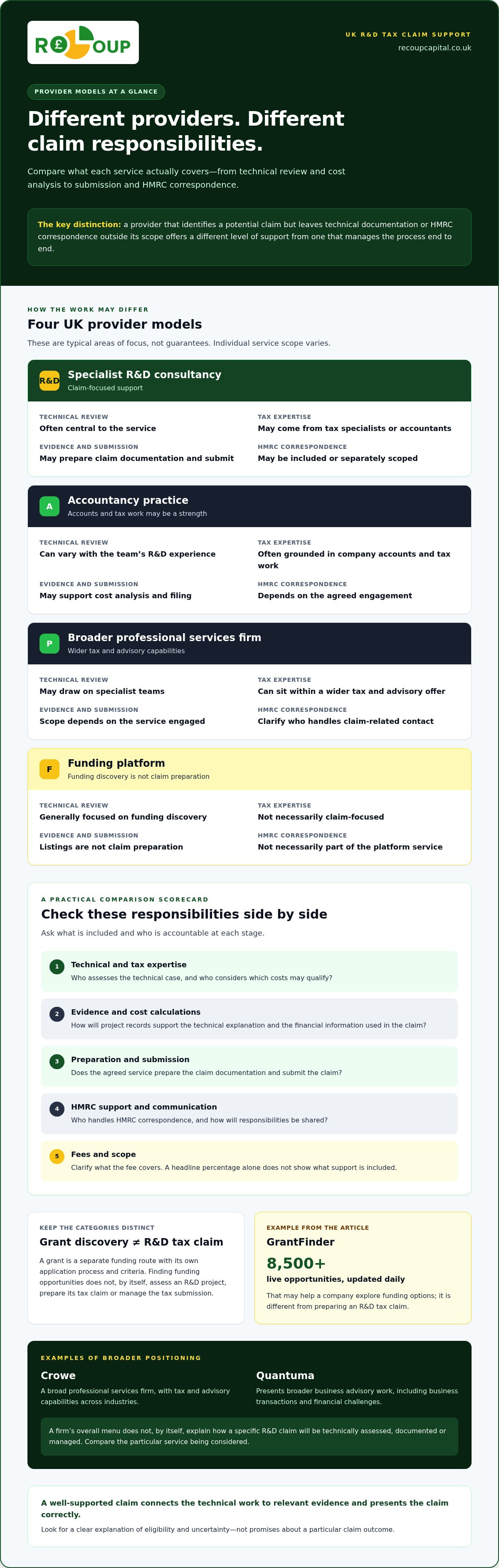
Providers appearing in searches for randd uk competitors can have different strengths. A specialist R&D consultancy may focus on technical assessments and claim preparation; an accountancy practice may bring detailed knowledge of a client’s accounts; a broader professional services firm may offer tax and advisory teams across multiple areas. A funding platform, by contrast, may help identify opportunities without preparing a tax claim. These distinctions describe typical models, not a guarantee of what every firm includes.
Compare the work the provider will actually undertake. The table outlines typical areas of focus, though individual service scope varies.
| Provider model | Technical review | Tax expertise | Evidence and submission | HMRC correspondence |
|---|---|---|---|---|
| Specialist R&D consultancy | Often central to the service | May be provided by tax specialists or accountants | May prepare claim documentation and submit | May be included or separately scoped |
| Accountancy practice | Can vary by the team’s R&D experience | Often grounded in company accounts and tax work | May support cost analysis and filing | Depends on the agreed engagement |
| Broader professional services firm | May draw on specialist teams | Can sit within a wider tax and advisory offer | Scope depends on the service engaged | Clarify who handles claim-related contact |
| Funding platform | Generally focused on funding discovery | Not necessarily claim-focused | Listings are not claim preparation | Not necessarily part of the platform service |
What should an R&D tax adviser do from assessment to submission?
A sound assessment explores the project: the technical advance the company sought, the uncertainties it faced and how the work attempted to resolve them. Cost analysis should then connect relevant project records with accounting information, rather than sit apart from the technical explanation. Sector familiarity can help an adviser understand the work in context, whether it involves engineering processes or construction methods, but broad industry coverage alone doesn’t prove claim expertise.
For the rules and eligibility, refer to official UK government guidance. Submission and HMRC liaison may also form part of end-to-end support. Recoup Capital supports limited companies from technical assessment through claim submission and HMRC liaison, with specialists and chartered tax accountants involved.
How does specialist support compare with using an existing accountant?
An existing accountant may already understand the company’s accounts and tax position. Specialist R&D input can add focused technical assessment and claim documentation. The two approaches can work together, but collaboration isn’t a universal requirement; responsibilities depend on the agreed scope. For more detail on the process, read Recoup Capital’s guidance on claiming R&D tax credits.
A practical framework for comparing R&D tax competitors
A consistent scorecard makes the differences between randd uk competitors easier to judge. Compare each firm on technical capability, tax expertise, evidence discipline, service scope and communication. Look for clear explanations of how eligibility is assessed and where uncertainty remains. A credible adviser can explain the basis for a claim without promising that HMRC will accept it or that it will produce a particular benefit.
Use these criteria to keep the comparison focused on the claim itself:
- Technical capability: Does the assessment explore the advance sought and the technical uncertainties, rather than relying on a broad description of innovation?
- Tax expertise: Is there appropriate tax knowledge to connect the project assessment with the claim’s financial treatment?
- Evidence discipline: Are project records and cost information organised to support the claim narrative and calculations?
- Service scope: Is it clear who assesses, prepares and submits the claim, and who handles any subsequent HMRC correspondence?
- Communication: Are assumptions, information gaps and responsibilities explained in plain language?
Questions that reveal the quality of the claim process
Read the proposed process and engagement terms closely. Identify who conducts the technical review and who analyses the financial information. Understand how project evidence, cost records and review decisions will be documented, and whether the company will be able to follow the reasoning behind the claim. Establish who prepares and submits it, and whether HMRC correspondence is included in the agreed support or handled separately.
These details show how accountable the process is. A polished website or a long list of advisory services can’t replace a clear description of the work, the evidence required and the handover points.
How to compare fees and commercial fit
Compare fee structures on the basis each firm states. A fixed fee and a percentage-based fee may cover different work, so assess the calculation method alongside the deliverables, exclusions and responsibilities. Don’t treat a lower headline fee as equivalent value if key stages sit outside the scope, and don’t assume any fee model guarantees acceptance or a particular claim outcome.
Recoup Capital’s R&D claim support uses a success-based fee calculated as a percentage of the tax benefit or cash credit recovered. The fee basis is distinct from the outcome: eligibility and any relief depend on the claim. Recovered relief may provide capital for business growth, subject to the claim result.
Keep adjacent tax matters separate in your comparison. Stamp Duty Land Tax is distinct from R&D tax relief, and Stamp Duty Land Tax guidance addresses that separate area. For an R&D claim, a clear scope, documented evidence and accountable delivery are more useful measures of fit than a firm’s overall service breadth. Explore Recoup Capital’s R&D tax claim support to see how technical assessment, submission and HMRC liaison fit together.
How to assess compliance, evidence and HMRC support before choosing
A clear process helps protect claim quality, but professional support doesn’t transfer every responsibility from the company or guarantee HMRC acceptance. Before appointing an adviser, make sure the work, decision-making and communication responsibilities are understood. Use this four-step review to compare randd uk competitors on what matters in practice:
- Define the scope: Identify whether support covers technical assessment, eligible cost analysis, claim documentation and submission.
- Inspect evidence methods: Understand how project information and financial records are gathered, reviewed and connected to the claim narrative.
- Clarify submission roles: Establish who prepares and submits the claim, who approves the information and who manages HMRC correspondence.
- Document fees and terms: Record the fee basis, included work, exclusions and each party’s responsibilities in the engagement terms.
R&D tax rules and HMRC requirements can change, so check the current position against official UK government guidance before relying on older checklists or deadlines. An adviser should explain the rules relevant to the accounting period and the company’s circumstances, rather than present past requirements as universal.
What evidence supports a defensible R&D claim?
Evidence should help explain the technical story: the advance the company sought, the uncertainties it encountered and the work undertaken to address them. Project notes, staff information, cost records and accounting data may all contribute, depending on the activity and claim. The key is coherence. Relevant records should support both the narrative and the cost calculations, with figures that can be traced and explained. No generic document list is a complete requirement for every company.
What happens if HMRC asks questions about a claim?
HMRC may ask for supporting information or a response about a claim. The company may need to provide records, clarify project details or approve information supplied on its behalf. Agree in advance who coordinates the response and how the adviser will liaise with HMRC. Recoup Capital’s support includes HMRC liaison, helping manage that part of the process without promising a particular enquiry outcome.
Compliance matters, but so does the purpose of any relief received. Subject to eligibility and the claim outcome, recovered relief may provide capital the company can put towards its plans. Explore these reasons companies claim R&D tax credits to consider the potential business value.
For support spanning technical assessment, submission and HMRC liaison, explore Recoup Capital’s R&D tax claim support.
Choosing an R&D tax partner: where Recoup Capital fits
The right fit depends on the support your company needs. If your priority is a focused R&D claim, look for a service that joins technical assessment with tax-accounting expertise and explains who handles each stage. A broader advisory relationship may suit a company seeking help across several business matters as well. Comparing randd uk competitors is most useful when you match each provider’s scope to your needs, rather than choosing on the breadth of a firm’s service menu.
When Recoup Capital may be a suitable partner
Recoup Capital supports limited companies through technical assessment, claim submission and HMRC liaison. Its team includes R&D specialists and chartered tax accountants, bringing project and financial perspectives together. The consultancy works with companies across sectors, including construction and engineering, where understanding the nature of the technical work is important. Any potential relief depends on the company’s eligibility, supporting evidence and the outcome of its claim.
What to prepare for an initial R&D claim discussion
A concise overview is a practical place to start. Note the projects you want to discuss, the technical challenges encountered and the records that may help explain the work. Relevant accounting information can help clarify the costs connected to those projects. You can also identify any existing advisers and describe the support already in place, making responsibilities and possible working arrangements easier to discuss.
Before taking the next step, review the R&D claim process. It can help you organise your questions and understand how the stages fit together. Recoup Capital’s R&D claim fees are success-based and calculated as a percentage of the tax benefit or cash credit recovered. The fee basis doesn’t guarantee eligibility, acceptance or a particular result.
Consider any relief as a potential source of capital for business plans, subject to eligibility and the claim outcome. To discuss your company’s activity, records and R&D claim questions, speak with Recoup Capital about R&D tax claim support.
Choose support that strengthens your R&D claim
The best fit isn’t necessarily the firm with the broadest service menu. Comparing randd uk competitors means looking closely at who assesses the technical work, how evidence and costs are connected, and who takes responsibility for submission and HMRC liaison. Clear scope, accountable communication and transparent fees help you judge the support against your company’s needs.
Recoup Capital supports limited companies nationally, with specialists and chartered tax accountants providing end-to-end support from technical assessment through submission and HMRC liaison. Its success-based R&D claim fees are calculated as a percentage of the tax benefit or cash credit recovered. Any relief depends on eligibility, evidence and the claim outcome, but if recovered, it may help fund your company’s next stage of growth.
Ready to explore your options? Discuss your company’s R&D claim with Recoup Capital, including your activity, records and questions. A clearer understanding of the process can help you take the next step with confidence.
Frequently Asked Questions
How do I compare R&D tax credit providers in the UK?
Compare the work each provider will actually do, not just its headline claims. Check who assesses the technical activity and costs, how evidence is developed, who prepares and submits the claim, and whether HMRC correspondence is included. Clarify how the fee is calculated and what it covers. A consistent scorecard helps distinguish randd uk competitors that offer specialist claim preparation from firms focused on other services.
Are R&D tax credit specialists better than accountants?
Neither is automatically better; the right choice depends on the expertise and support your company needs. An accountant may know your accounts and tax position, while an R&D specialist can focus on the technical assessment and claim evidence. Some providers combine these skills, and an accountant and specialist may work together. Compare relevant experience, scope and responsibilities rather than relying on job titles alone.
What should an R&D tax credit consultant do?
An R&D tax consultant should assess the company’s projects and technical uncertainties, analyse relevant costs, and help prepare claim documentation that connects the technical narrative with financial records. Depending on the agreed scope, the consultant may also submit the claim and liaise with HMRC. The company should understand who makes decisions, what information is needed and which tasks remain its responsibility.
How do R&D tax claim advisers charge?
Fee structures vary, so compare the stated basis with the work included and any exclusions. Some advisers may charge a fixed fee, while others use a percentage-based or another arrangement. Recoup Capital’s R&D claim fee is success-based and calculated as a percentage of the tax benefit or cash credit recovered. No fee structure, by itself, establishes eligibility or guarantees a claim outcome.
Can a grant-finding platform claim R&D tax credits for my company?
A grant-finding platform helps businesses search for funding opportunities; that function is different from assessing and preparing an R&D tax claim. A platform listing shouldn’t be taken as evidence that claim preparation or HMRC support is included. Review the specific service and responsibilities described. R&D tax relief is a tax claim based on eligible company activity, while grants follow a separate funding route.
What happens if HMRC questions an R&D tax credit claim?
HMRC may request supporting information or ask the company to clarify aspects of its claim. The company may need to help provide project details and records, even if an adviser prepared the submission. Agree in advance who will coordinate responses and what HMRC liaison the service includes. Recoup Capital supports HMRC liaison, but no adviser can promise a particular outcome to an enquiry.
Is a success-based R&D tax adviser fee a guarantee of a successful claim?
No. A success-based fee describes how the adviser’s fee is calculated; it doesn’t guarantee that a company is eligible, that HMRC will accept a claim or that a particular benefit will be recovered. The outcome depends on the company’s circumstances, the evidence and the claim assessment. Read the engagement terms so you understand how the fee is defined and when it applies.


