

What if money spent on innovation could help strengthen your business, rather than simply disappear into project costs? To recoup expenditure means to recover money already spent, but that doesn’t make every business cost refundable or eligible for tax relief. The distinction can be easy to miss when search results mix a simple definition with unrelated services.
If you’re wondering whether development work, staff time or other project spending could count, start with evidence and eligibility, not an assumed refund. UK R&D tax relief may offer a route to recover some eligible innovation expenditure, but the rules are specific and the outcome depends on the company’s circumstances. A claim isn’t guaranteed cash back.
This guide explains what recoup means in a business context, which types of costs may be relevant and how to begin reviewing your records. It also explains why innovation alone doesn’t establish eligibility, and when technical assessment alongside tax-accounting expertise may help. Recoup Capital supports limited companies with R&D tax credit claims, but the first step is understanding what the work involved and whether it meets the relevant criteria.
Key Takeaways
- In business, to recoup means to recover money already spent, but it doesn’t guarantee a refund or tax relief.
- Start by defining the project, identifying related costs and gathering records. Accounting labels alone don’t establish eligibility.
- Compare R&D tax relief with grants and other tax provisions to understand which route may fit your circumstances.
- Prepare project timelines, technical records, staff details and traceable cost information before reviewing potential R&D expenditure.
- Recoup Capital supports limited companies with technical assessment, claim preparation, submission and HMRC liaison. Eligibility depends on the evidence and applicable rules.
What does recoup mean in business, and what does it not promise?
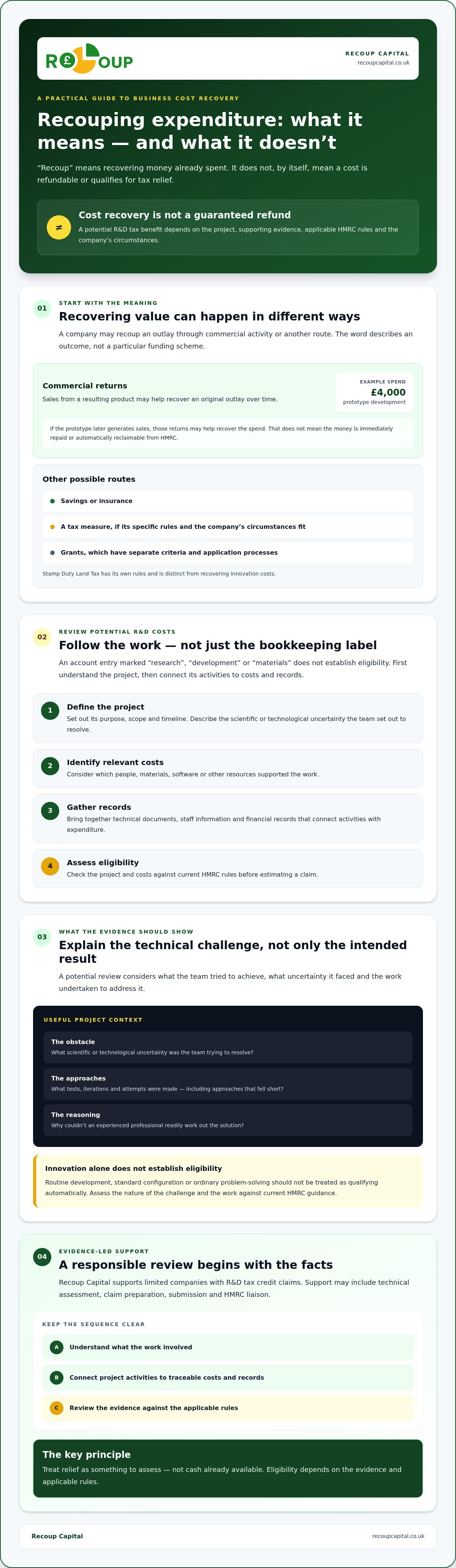
In business, to recoup money is to get back some or all of an amount previously spent, lost or invested. The term describes an outcome, not a particular funding scheme. Depending on the circumstances, a company might recoup an outlay through sales, savings, insurance or a tax measure.
Search results can add confusion: RECOUP is also the name of a UK organisation focused on plastics resource efficiency and recycling, while Recoup is used by a wastewater heat-recovery business. These organisations are separate from the everyday financial meaning of the word and from Recoup Capital, a UK consultancy specialising in R&D tax credits and corporate finance.
What does recoup mean in a company’s accounts?
Suppose a company spends £4,000 developing a prototype. If the resulting product later generates sales, those returns may help the company recover the value of its original outlay over time. That doesn’t mean £4,000 is immediately repaid, or that the expenditure can automatically be reclaimed from HMRC.
Making value back through commercial activity is different from receiving money through a tax claim. A potential tax benefit depends on the relevant rules and the company’s own circumstances. Accounting records can show how expenditure was recorded, but the category assigned to a cost doesn’t establish whether it qualifies for relief.
Why might a business look into recovering expenditure?
Reviewing project costs can help a company understand where resources went and make more informed cash-flow or reinvestment decisions. If work involved seeking an advance in science or technology by resolving technological uncertainty, R&D tax relief may be one possible route to assess. It’s a specific tax incentive, not a general way to recover every investment. For historical context, see this overview of the R&D tax incentive.
Grants are a separate form of funding, with their own criteria and application processes. Other tax provisions also address different types of expenditure or circumstances. For instance, Stamp Duty Land Tax has its own rules and is distinct from recovering innovation costs. Read more about Stamp Duty Land Tax.
Cost recovery describes getting value back; it doesn’t guarantee a refund. For an R&D tax relief claim, the project, supporting evidence and applicable HMRC rules all matter. First establish what the work involved and keep records that connect the activities to the costs. Don’t treat potential relief as money available to the business before it has been assessed.
How can a business identify costs that may be recoverable?
A useful review starts with the work itself, not a scan of the accounts for promising labels. A cost recorded as “research”, “development” or “materials” isn’t automatically eligible for R&D tax relief. First establish what the company was trying to achieve, then connect the relevant activities to the expenditure and supporting evidence.
For a potential R&D review, work through four steps:
- Define the project: set out its purpose, scope and timeline.
- Identify relevant costs: consider which people, materials, software or other resources supported the work.
- Gather records: bring together technical documents, staff information and financial records.
- Assess eligibility: check the project and costs against current HMRC rules before estimating a claim.
This sequence helps distinguish a documented review from guesswork. It can also reveal missing records before you decide whether specialist input could help.
Start with the project and the uncertainty it addressed
Ask what scientific or technological uncertainty the team set out to resolve, and why an experienced professional couldn’t readily work out the solution. Describe the tests, iterations and unsuccessful attempts, not just the intended end result. Routine development, standard configuration or ordinary problem-solving shouldn’t be treated as qualifying automatically. The nature of the challenge and the work undertaken need to be assessed against HMRC’s current guidance.
For example, a project file that records a technical obstacle, the approaches trialled and why they fell short can provide more useful context than a general description such as “new product development”. The detail matters.
Build an evidence trail before estimating a potential claim
Bring together dated project plans, design notes, test results and records of decisions, alongside information about who worked on each activity and when. Then link the relevant cost information to those activities and the accounting period in which the work took place. A payroll or purchase ledger entry alone may not explain how a cost relates to the project, so make that connection clear.
- Record project stages, technical aims and key changes.
- Note staff roles and their involvement in the work.
- Keep traceable records for potentially relevant expenditure.
- Identify gaps or estimates, and don’t present them as confirmed facts.
Eligibility and documentation requirements can depend on the applicable rules and the company’s circumstances, so check current HMRC guidance before relying on a cost in a claim. Recoup Capital’s R&D tax credits explained page offers further context. If a project’s technical evidence or cost allocation is difficult to interpret, you can also explore specialist support for an R&D tax relief review.
R&D tax relief and other recovery routes: what is the difference?
Businesses may use “cost recovery” to describe several different things, but the routes aren’t interchangeable. R&D tax relief is a tax measure for companies with qualifying research and development activity. A grant is funding awarded under a separate scheme with its own criteria, while an ordinary refund usually means money returned after a payment or transaction. Neither a grant nor a refund is another name for R&D relief.
| Route | Broad purpose | What to establish |
|---|---|---|
| R&D tax relief | Provides tax treatment for qualifying R&D expenditure under the applicable UK rules. | Whether the project, costs and claim meet current HMRC requirements. |
| Grant | Funding offered through a separate programme, usually with its own aims and conditions. | Whether a relevant grant is available and whether the business meets its criteria. |
| Other tax provisions | Address particular types of expenditure or business circumstances. | Which provision applies and whether the expenditure meets its specific rules. |
Tax relief isn’t automatically a cash payment. Depending on the applicable scheme and the company’s circumstances, it may affect Corporation Tax or be delivered through a payable credit. The amount and treatment need to be assessed against current rules, so don’t assume every innovation cost will produce a refund. For background on the claim process, see this guide to claiming R&D tax credits.
When might another tax relief be relevant?
Capital Allowances may be relevant when a company invests in qualifying assets used in its business. Land Remediation Relief relates to eligible expenditure on remediating contaminated or derelict land. These provisions have distinct requirements and aren’t substitutes for R&D tax relief. The type of spending and the supporting evidence matter.
Recoup Capital offers R&D tax credits, Capital Allowances and Land Remediation Relief, alongside other listed tax services, but it doesn’t sell grants. A business considering a grant would need to explore the relevant funding programme separately. For any tax route, check current scheme rules and HMRC guidance before reaching a conclusion about eligibility.
How to prepare for a responsible review of potential R&D costs
A well-organised evidence file makes it easier to explain what a project involved and how its costs relate to the work. It doesn’t confirm eligibility or guarantee a claim. Treat preparation as a way to support a careful assessment, and check the applicable HMRC requirements before making a claim.
Which records should a company gather first?
Start with documents that help tell a clear, dated story of the project. Depending on the work and the company’s records, useful material may include project plans, technical notes, design changes, test results, invoices and relevant payroll information. There isn’t one universal document list for every claim, so focus on records that support the activities and costs being reviewed.
For example, a test result can show what the team tried and what happened, while a project plan may establish when different stages took place. Staff records and invoices can help identify who worked on the project and what resources were used. Together, these documents should help make the link between the technical work, the people involved and the associated expenditure clear.
- Project timeline: note key stages, dates, changes and milestones.
- Technical evidence: gather records of the challenge, approaches tested and results, including unsuccessful attempts.
- Staff involvement: identify the people involved and what they contributed.
- Cost information: collect relevant financial records and note how each amount connects to project activity.
If a figure is estimated or a record is missing, flag that clearly rather than presenting an assumption as verified information. Clear gaps are easier to address than unexplained totals.
What questions should directors and finance teams ask?
Bring the right perspectives together. A technical lead or project specialist may be best placed to explain the uncertainty and work undertaken, while finance colleagues can help trace costs back to the company’s records. Ask: what scientific or technological uncertainty did the project seek to resolve? What steps did the team take, and what evidence records the outcome? Which staff and costs relate to those activities, and for what period?
Then check that the account is consistent across project notes, staff information and cost records. The relevant rules, claim process and documentation requirements can change, so verify them against current HMRC guidance rather than relying on an old checklist. Recoup Capital’s guide to why businesses claim R&D tax relief offers further context on the potential rationale.
For limited companies seeking a specialist assessment of project evidence and associated costs, explore an evidence-led R&D claim review with Recoup Capital. A review can help clarify what the records support, but it can’t guarantee that expenditure qualifies.
How Recoup Capital supports an evidence-led R&D tax relief claim
A search for “Recoup” may bring up organisations working in areas such as plastics resource efficiency or wastewater heat recovery. Recoup Capital is a separate UK consultancy, specialising in R&D tax credits and corporate finance. Its focus here is helping limited companies assess potential R&D claims using project evidence and relevant tax expertise.
What can a specialist review contribute?
Assessing a potential claim involves more than sorting costs into accounting categories. Recoup Capital’s specialists and chartered tax accountants combine technical assessment with tax-accounting expertise to examine the project, the work undertaken and how costs relate to it. This can help a company build a clearer picture of whether the available evidence supports taking the matter further. It doesn’t establish eligibility in advance or guarantee a particular outcome.
Support can cover the process from technical assessment and claim preparation through to submission and liaison with HMRC. Liaison is part of the service, not a promise that HMRC won’t ask questions or seek further information. Any claim still needs to reflect the company’s circumstances and meet the applicable requirements.
R&D tax relief claim fees are success-based and calculated as a percentage of the tax benefit or cash credit recovered. Before proceeding, understand the basis of the fee alongside the proposed scope of work. The fee arrangement doesn’t remove the need to assess whether a claim is appropriate.
What is a sensible next step for a UK company?
Before seeking advice, gather what you can: a simple project timeline, technical notes describing the challenge, records of tests or approaches tried, details of staff involvement and information that helps trace costs to the work. You don’t need to have every document perfectly organised to start a discussion. A clear account of what the team was trying to resolve is a practical first step.
From there, a review can consider whether the work may be relevant under current rules and which evidence needs further attention. The aim is to make an informed decision, not to assume that every innovation project should become a claim. A responsible assessment may conclude that the available facts don’t support proceeding.
If your company is considering whether R&D tax relief could be relevant, visit Recoup Capital to discuss your circumstances. A conversation can help clarify possible next steps without promising eligibility or a recovery.
Turn a careful cost review into a clearer next step
To recoup business expenditure, start with evidence, not an expectation of a refund. The project’s technical work, the uncertainty it addressed and the costs connected to it all need to be considered against applicable HMRC rules. R&D tax relief is one potential route, not a fit for every innovation project or business expense.
Organising project timelines, technical records, staff details and traceable cost information can help a company make a more informed decision. If specialist input would be useful, Recoup Capital’s specialists and chartered tax accountants support limited companies from technical assessment and claim preparation through submission and HMRC liaison. R&D claim fees are success-based and calculated as a percentage of the tax benefit or cash credit recovered. Eligibility and outcomes aren’t guaranteed.
If you’re weighing up whether an R&D tax relief review may be relevant, discuss your company’s circumstances with Recoup Capital. A considered first conversation can help you understand possible next steps and move forward with greater clarity.
Frequently Asked Questions
What does recoup mean in business?
In business, recoup means to recover money previously spent, lost or invested. A company might recoup an equipment outlay through later sales, or recover eligible expenditure through a tax measure. The word describes getting value back, not a specific scheme or guaranteed payment. It can also appear as an organisation’s name, so search results for “Recoup” may refer to unrelated businesses rather than this financial meaning.
How can a UK company recoup eligible R&D costs?
A UK company may seek R&D tax relief where its project meets HMRC’s criteria and relevant costs are supported by evidence. It should describe the scientific or technological advance sought, the uncertainty addressed, the work undertaken and the costs connected to it, then assess these against current scheme rules and claim procedures. An accounting label alone doesn’t determine eligibility, and submitting a claim doesn’t assure recovery.
Does recouping business expenditure mean getting a cash refund?
No. Recouping describes recovering value, but it doesn’t necessarily mean cash is paid back immediately. Under R&D tax relief, the treatment depends on the applicable scheme and the company’s circumstances. A benefit may affect Corporation Tax or, where the rules allow, take the form of a payable credit. The outcome and timing aren’t guaranteed, so businesses shouldn’t treat a potential claim as confirmed cash in their forecasts.
Can a business claim R&D tax relief for unsuccessful projects?
Potentially. An unsuccessful project may still involve qualifying R&D activity if the work sought an advance in science or technology by resolving scientific or technological uncertainty. A failed test or abandoned approach can help explain what the team tried, but failure alone doesn’t make a project eligible. The company must assess the technical work and relevant expenditure against HMRC’s rules and retain evidence that supports its account.
What evidence should a company gather before reviewing an R&D claim?
Gather records that tell a coherent, dated story of the project and link expenditure to the work. Depending on the claim, these may include project plans, technical notes, design changes, test results, staff roles, relevant payroll records and invoices. Note the project period and who can explain each activity. Requirements depend on the circumstances, so check current HMRC guidance rather than treating any checklist as definitive.
How does R&D tax relief differ from a grant?
R&D tax relief is a tax measure assessed under applicable rules against qualifying activity and expenditure. A grant is funding provided through a separate programme, with its own aims and conditions. The routes aren’t interchangeable, and neither should be assumed to apply without checking its criteria. Recoup Capital offers R&D tax credits and other listed tax services, but doesn’t sell grants.
Does Recoup Capital guarantee that a business will recover money?
No. Recoup Capital doesn’t guarantee eligibility, a successful claim or a particular recovery. Its specialists and chartered tax accountants support limited companies from technical assessment through claim preparation and submission, including HMRC liaison. R&D claim fees are success-based and calculated as a percentage of the tax benefit or cash credit recovered. That fee arrangement isn’t a promise that a claim will qualify or produce a specific result.


