

The exit route with the lowest apparent tax bill may not be the right deal for your business. For innovators, tax efficient exit strategies for innovators start with preparation. A share sale, asset sale or succession can have different tax and commercial implications, while unclear R&D records or intellectual property ownership may raise questions during due diligence.
It’s understandable to focus first on what you’ll receive and how much tax may be due. But transaction structure, evidence and timing can all affect the options available. Leaving these questions until a buyer is at the table may limit your choices.
This guide explains the main exit routes for UK innovators, what to review in your R&D claims, intellectual property and business records, and when corporate finance and tax specialists may help. You’ll come away better prepared to compare options and identify questions to resolve before starting formal discussions.
Key Takeaways
- Compare a share sale, asset sale, succession and partial exit by considering what transfers, who retains control and which issues need specialist review.
- Tax efficient exit strategies for innovators begin with clear owner objectives and early preparation, not a last-minute promise of tax savings.
- Bring accounts, shareholder records, contracts and intellectual-property ownership information together before due diligence begins.
- Check that R&D project evidence, expenditure support, submitted claims and HMRC correspondence tell a consistent story.
- Before appointing advisers, clarify their transaction experience, scope, fees, responsibilities, timelines and how they’ll coordinate with your existing advisers.
Why tax-efficient exit strategies matter for innovators before a sale
Wanting to realise the value of years of product development is entirely understandable. But an innovative company’s exit involves more than agreeing a price. Ownership arrangements, financial information, intellectual property (IP) and historic R&D claims may all come under buyer scrutiny. Preparing these details early can help you understand your options without rushing into a transaction.
Early exit planning is about building informed choices; last-minute tax structuring is about reacting when those choices may already be limited. A clear plan doesn’t commit you to selling. It helps you consider what you want from an exit, identify information that needs attention and decide when to involve relevant advisers. The broader Exit planning process also considers the owner’s goals alongside business readiness.
What does a tax-efficient business exit mean?
It means considering the tax implications of potential routes and preparing based on your company’s specific facts. Tax treatment can depend on the transaction structure, ownership and applicable legislation, so a possible tax advantage is not guaranteed. Nor is it the same as achieving the best commercial value, completing a deal or meeting your personal goals. Ask a qualified adviser to check any proposed tax position against current HMRC guidance.
Why innovators should start exit planning early
Product development can leave a valuable but complex trail: who created or owns the IP, which company holds the rights, how projects were funded and what evidence supports R&D claims. Buyers may ask how these details connect with company accounts and contracts. If property forms part of a transaction, consider whether stamp duty land tax needs a separate review.
Set an objective before choosing a route. You may want to step away, retain some involvement or support continued growth under new ownership. That goal can guide practical preparation, such as checking shareholder records and reconciling R&D project evidence with submitted claims and HMRC correspondence. R&D tax relief doesn’t automatically increase a sale price or make a company ready for sale. Clear, supportable records help others assess the position.
Specialist R&D tax support can help review claims and supporting evidence, while corporate finance advice may be relevant when assessing a disposal, valuation or negotiation. The right input depends on your circumstances and the questions you need answered.
How exit routes can affect an innovative company, its owners and its assets
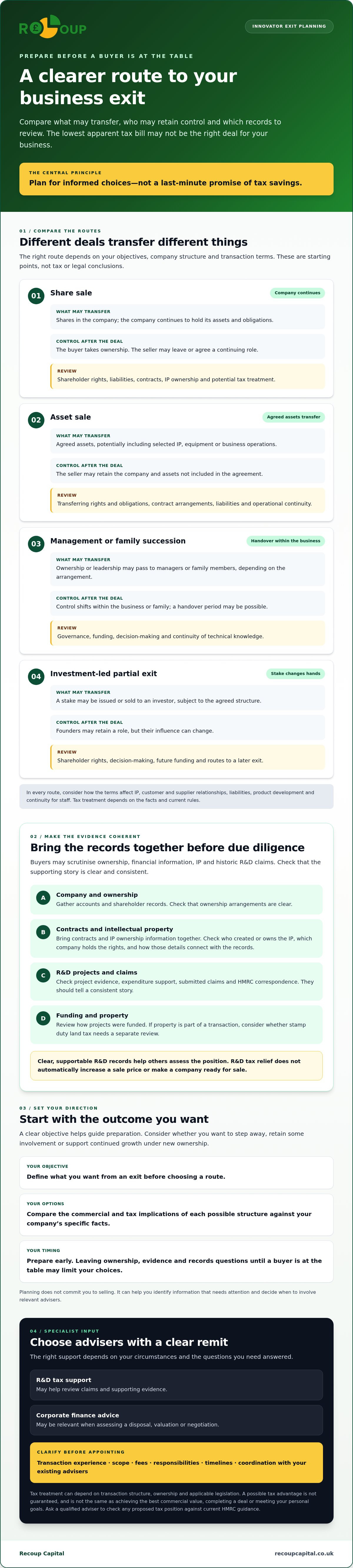
The right route depends on more than the headline price. A buyer may be interested in the company’s shares, selected assets or a stake that allows the founders to remain involved. For an innovation-led business, consider how each option affects control of intellectual property (IP), customer and supplier relationships, liabilities, product development and continuity for staff.
The table offers a starting point, not a tax or legal conclusion. What transfers and who retains control depend on the company’s structure and transaction terms. Tax treatment also depends on the facts and current rules, so take advice before relying on an assumed outcome.
| Route | What may transfer | Control after the deal | What to review |
|---|---|---|---|
| Share sale | Shares in the company, with the company continuing to hold its assets and obligations. | The buyer takes ownership; the seller may leave or agree a continuing role. | Shareholder rights, liabilities, contracts, IP ownership and potential tax treatment. |
| Asset sale | Agreed assets, which could include selected IP, equipment or business operations. | The seller may retain the company and assets not included in the agreement. | Which rights and obligations transfer, contract arrangements, liabilities and operational continuity. |
| Management or family succession | Ownership or leadership may pass to managers or family members, depending on the arrangement. | Control shifts within the business or family, with a handover period possible. | Governance, funding, decision-making and continuity of technical knowledge. |
| Investment-led partial exit | A stake may be issued or sold to an investor, subject to the agreed structure. | Founders may retain a role, but their influence can change. | Shareholder rights, decision-making, future funding and routes to a later exit. |
Share sale or asset sale: what should owners compare?
In a share sale, the buyer acquires shares in the company. In an asset sale, the parties identify which assets are included. That distinction can affect how contracts, liabilities and IP are handled, and whether operations can continue smoothly. Ask a solicitor and tax adviser to review the proposed terms and consequences. GOV.UK’s guidance on Business Asset Disposal Relief explains a relief with specific qualifying conditions. Don’t assume it applies to your transaction.
Succession, partial sale or investment: when might they fit?
A full sale may suit owners seeking a clean break, whilst succession or partial investment may better match plans to retain leadership or participate in future growth. Management and family handovers need clear governance and a practical continuity plan. Investor arrangements require close attention to shareholder rights and decision-making. For support assessing a disposal, valuation or negotiation, corporate finance advisory may help you compare options. This is one of the tax efficient exit strategies for innovators decisions where commercial aims and tax review should be considered together.
What tax and innovation records should you review before choosing an exit?
A well-organised evidence pack helps you and your advisers spot gaps before a buyer asks detailed questions. Bring together records showing who owns the business and its assets, how it has performed, and how its innovation work and tax claims have been documented. Keep original records where possible, and flag anything incomplete rather than trying to fill gaps from memory.
Use this checklist to separate information gathering from conclusions that need professional review:
- Gather: company accounts, shareholder and ownership records, material customer, supplier and employment contracts, and documents relating to patents, software, designs and know-how.
- Gather: R&D project descriptions, records of technical uncertainties and development work, cost calculations and supporting expenditure records, submitted claims, and HMRC correspondence.
- Ask an adviser to assess: whether records support the positions taken, whether inconsistencies need addressing, and how the proposed transaction could affect tax, contracts, IP rights or outstanding obligations.
How R&D tax claims and evidence fit into exit preparation
A claim review should connect each project’s technical description and uncertainties with the work undertaken and the costs reported. Check that project records, expenditure support, submitted figures and HMRC correspondence are consistent. Gaps or conflicting explanations don’t automatically establish that a claim is wrong, but they should be investigated before due diligence. For an overview of R&D tax credit claims, see the claim preparation guidance. A claim history should be accurate and evidenced. Don’t assume a claim or any associated tax position simply transfers with a business sale.
How to make intellectual property easier to assess
For each important asset, record what it is, who created or owns it, where ownership is documented, and whether another party has rights to use it. Distinguish registered rights, such as patents, from confidential know-how and contractual rights in development or licensing agreements. If employees, founders or contractors contributed to software or designs, check the relevant agreements rather than assuming the company owns every output.
Keep the evidence separate from the tax conclusions. For example, list the patents and related development records you hold, but ask a specialist to verify ownership and any transaction implications. Business Asset Disposal Relief is another area for individual review: eligibility depends on the facts and current rules. Patent Box may also merit separate assessment where relevant, but don’t assume that owning a patent means the company qualifies. These checks help make tax efficient exit strategies for innovators evidence-led, without treating a document checklist as a guarantee of tax treatment or sale readiness.
How to prepare an exit strategy for an innovative business step by step
Exit preparation is a readiness exercise, not a commitment to sell. A structured process gives owners room to clarify what they want, organise information about the business and get expert input before discussing terms with a buyer.
- Step 1: Agree the owners’ objectives. Record the preferred timing, appetite for retaining control, desired level of future involvement and priorities for staff, customers and continued product development. If owners have different aims, surface those differences early.
- Step 2: Build a picture of business readiness. Review financial performance, cash flow, customer and supplier dependencies, material contracts and management capability. Note where the company relies heavily on a founder, a key customer or a particular technical specialist, as these dependencies may prompt questions about continuity.
- Step 3: Map innovation evidence and open questions. List R&D claims and supporting project and cost records, then note any gaps or inconsistencies for review. Identify technical files and IP ownership questions that need follow-up. Early, accurate records make specialist review more efficient.
- Step 4: Compare possible routes without choosing a buyer. Consider whether a full disposal, succession, investment or another structure could fit the owners’ aims. Focus on implications to investigate, such as control, continuity, contracts and tax assumptions, rather than making a premature commitment.
- Step 5: Turn findings into an adviser-reviewed action plan. Prioritise unresolved issues, assign responsibility for gathering information and agree which questions need corporate finance, tax or legal advice. Set review points against the owners’ preferred timing, while keeping the plan flexible as circumstances change.
Build the exit brief and establish readiness
A concise written brief helps advisers understand the desired outcome and the business behind it. Include the owners involved, timing preferences, control and continuity priorities, plus a short summary of performance and dependencies. Add a list of R&D claims, technical files and IP questions that need checking. This is a working document, not a sales memorandum or a promise to proceed.
Bring the right advisers in at the right stage
Corporate finance advice may help when you’re assessing a disposal, valuation or negotiation approach. Specialist tax input can review R&D claims and transaction assumptions against the relevant facts, without guaranteeing a particular tax result. Coordinate these reviews with legal and other qualified advisers before agreeing transaction terms, so commercial, ownership and tax questions are considered together.
If you’re ready to explore the financial options, you can review corporate finance support as part of your preparation. The aim of tax efficient exit strategies for innovators is to make informed choices at the right pace, not to force a sale before the business and its owners are ready.
Choosing an exit adviser and taking your next step with confidence
The right adviser should make a complex process clearer, not promise a particular tax result or sale price. Look for experience relevant to your type of transaction and innovation-led business, a well-defined scope of work, evidence-led recommendations and communication that helps you understand decisions as they arise.
Before appointing anyone, ask how they’ll work with your existing advisers and what they need from you. Clear answers help you compare expertise and understand how the advice will fit together.
Questions to ask before appointing an exit adviser
- What experience do you have with disposals involving businesses like ours, and how would you approach valuation, exit-route assessment and negotiations?
- How will you review our R&D claims, supporting technical and cost evidence, and HMRC correspondence? What is outside your remit?
- What are the fees, deliverables and expected timelines, and how will changes in scope be agreed?
- How will confidential business, financial and technical information be handled?
- How will you coordinate with our legal, tax and other existing advisers, and who will be responsible for each part of the work?
Ask for the proposed scope in writing. This makes it easier to see whether the adviser is assessing options, supporting negotiations or reviewing claims, and where you’ll need separate legal or other specialist input.
How Recoup Capital may support an innovation-led exit
Recoup Capital’s corporate finance work includes advice on acquisitions, disposals, valuations and negotiations. Its R&D tax credit support covers technical assessment, claims and HMRC liaison, which may be relevant when reviewing claim records as part of broader exit preparation. The appropriate work depends on your circumstances and should be agreed following a review. Corporate finance and R&D tax expertise do not replace legal advice; involve a solicitor and other qualified advisers where the transaction requires it.
Good tax efficient exit strategies for innovators bring commercial aims, tax questions and evidence into the same conversation, while keeping recommendations grounded in the facts and current rules. If you’d like to explore which questions to address first, you can discuss your business exit options with Recoup Capital. This is a way to outline your situation and consider whether its corporate finance or R&D tax expertise may be relevant, without committing to a transaction.
Make your next exit decision with a clearer plan
A considered exit begins with your objectives, not a rushed choice of buyer or deal structure. Compare routes in light of ownership, control and continuity, then organise company, R&D and intellectual-property records so advisers can assess the facts.
Tax efficient exit strategies for innovators aren’t guaranteed tax savings. The right approach depends on your business, transaction terms and current rules. Early preparation gives you time to identify questions, review claim evidence and coordinate corporate finance, tax and legal advice before agreeing terms.
Recoup Capital’s corporate finance advisory includes support with disposals, valuation and negotiation. Its R&D tax claim support covers technical assessment, submission and HMRC liaison, which may form part of wider exit preparation. Any advice or recommendations will depend on your circumstances and a review of the relevant information.
Start with a conversation about what you want from an exit and what needs attention. Discuss your business exit options with Recoup Capital, and take the next step at a pace that works for you. With clear priorities and the right evidence, you can approach the process with greater confidence.
Frequently Asked Questions
What is the most tax-efficient way to sell an innovative business?
There’s no single most tax-efficient route for every innovative business. The outcome depends on the company’s structure, its owners, the proposed transaction and the rules in force at the time. A share sale and an asset sale can have different tax, legal and commercial implications. Compare the options with qualified tax and legal advisers, and check any potential relief against current HMRC guidance before agreeing terms.
Can R&D tax credits affect the sale of a business?
Yes, R&D tax claims and supporting records may be examined during financial and tax due diligence. A buyer might ask how projects were described, how costs were calculated, what evidence supports the claims and whether there has been correspondence with HMRC. A claim doesn’t automatically increase the sale price or transfer in a particular way. Review the company’s claims and records with a specialist before making representations to a buyer.
Should I claim R&D tax relief before selling my company?
Only consider a potential claim after assessing the facts and available evidence, not simply because a sale is planned. Review whether the activities and costs may qualify, whether relevant deadlines apply and whether project records support the position. Check current HMRC requirements with a qualified specialist. If a transaction is already being discussed, coordinate decisions about claims and evidence with your tax, legal and corporate finance advisers before taking action.
When should an innovator start planning an exit?
Start when an exit becomes a credible future objective, rather than waiting for a buyer to approach. Early planning gives owners time to clarify what they want, organise company and technical records, confirm intellectual-property ownership and identify potential due-diligence questions. That preparation can support more informed tax efficient exit strategies for innovators. Planning doesn’t commit the company to a sale; it helps owners consider options before a decision is urgent.
Is a share sale or asset sale better for a technology company?
Neither option is automatically better. A share sale transfers ownership of the company, whilst an asset sale relates to specified business assets. The practical effects depend on the transaction documents and circumstances. Compare how contracts, liabilities, intellectual property and operations may be affected, alongside the possible tax treatment. Ask qualified legal and tax advisers to review the proposed structure before selecting a route or agreeing terms with a buyer.
What documents should an innovative company prepare for due diligence?
Start with current accounts, shareholder and ownership records, material contracts, intellectual-property information, and details of key staff and suppliers. For R&D, organise project descriptions, technical records, cost calculations, submitted claims and HMRC correspondence. The documents requested will depend on the transaction. Keep the evidence accurate, consistent and accessible, and ask advisers to identify gaps before sharing confidential material with a prospective buyer.
Can a corporate finance adviser help with a business exit?
A corporate finance adviser may support disposal planning, valuation and negotiations, depending on the agreed scope. Recoup Capital’s corporate finance advisory includes these areas, whilst its R&D tax claim support covers technical assessment, submission and HMRC liaison. Tax specialists can review claims and assumptions, but this doesn’t replace legal advice. Ask prospective advisers about relevant transaction experience, responsibilities, fees, confidentiality and how they’ll coordinate with your existing professional team.


