

What if the same innovation could be relevant to two tax reliefs, but for entirely different reasons? Managing intellectual property for tax purposes means keeping development work distinct from the income later generated by a qualifying patented invention. For UK businesses, that distinction can shape whether R&D Tax Relief, Patent Box, or neither route applies.
It can be difficult to join up the relevant records. IP ownership may sit across a company, founders, contractors or group entities, while development costs and commercial use are recorded elsewhere. Without a clear link between the work, the rights and the income, it can be harder to assess eligibility and support a claim.
This guide explains how IP ownership, development activity and commercialisation can affect UK tax relief, and why R&D relief and Patent Box should be assessed separately. You’ll find practical records to gather, questions to raise with a qualified tax adviser and criteria for comparing the relevant routes. The aim is a clearer, evidence-led view of the options, not an assumption that a particular relief or outcome is guaranteed.
Key Takeaways
- Managing intellectual property for tax purposes means tracking ownership, development, commercial use and supporting evidence, not just patents.
- Compare R&D tax relief with Patent Box by looking at the activity each is intended to support. A patent alone does not make a project eligible.
- Review ownership agreements early to clarify who developed, controls and benefits from the IP, and identify gaps that may need attention.
- Use a structured checklist to organise project records, ownership documents, expenditure evidence and income linked to IP.
- A specialist tax adviser can help assess whether your records and business activities fit relevant relief rules. Keep tax advice distinct from legal advice on IP protection.
Managing IP for Tax: What it Means for UK Businesses
Managing intellectual property for tax purposes means keeping a clear record of who owns or controls an IP asset, how it was developed, how the business uses it and what financial evidence relates to it. That record helps a company assess tax questions and make informed commercial decisions. It does not register rights, establish legal ownership or protect an invention from infringement.
The distinction matters. A company may have paid to develop software or use a design, but payment alone does not necessarily show who owns the resulting rights. Equally, owning an IP asset does not automatically mean the company qualifies for tax relief. Ownership and eligibility are separate questions, each requiring evidence and assessment against the relevant rules.
Which intellectual property and business records matter?
Businesses may hold patents, copyright, designs, software and know-how. These are not interchangeable: the form of protection, how ownership arises and how an asset can be used commercially may differ. A patent is a registered right, while copyright can apply to original works such as software. Know-how may be commercially valuable without being a registered IP right.
Build a record that connects each asset to its history and use. Note who created or contributed to it, when development took place, which agreements apply, what costs were recorded and how the asset supports business activity or generates income. Link these details to the relevant project and accounting period. This makes it easier to clarify ownership, support accounting judgements and give tax advisers a reliable basis for assessing potential relief. The same information can inform decisions about licensing, development and commercialisation.
Why IP decisions can affect more than one tax question
R&D relief concerns qualifying development activity under the rules that apply to the company and accounting period. The presence of a patent is not enough: the work itself must meet the relevant criteria. Records of technical uncertainty, project work and associated expenditure may therefore be important to an assessment.
Patent Box is a separate UK tax regime concerning eligible profits linked to qualifying patented inventions. For a neutral overview of the concept, see Patent Box. A company needs to examine the connection between its qualifying patent, the relevant income and the applicable rules. Simply owning IP or incurring development costs does not establish eligibility for either relief.
Keep these questions distinct when reviewing your records. Specialist tax advice can help assess whether the facts support a particular relief, while legal advice may be needed about registering or enforcing rights. Property-related tax is a separate subject. Businesses reviewing that area can read about stamp duty land tax.
R&D tax relief and Patent Box: compare the purpose before choosing a route
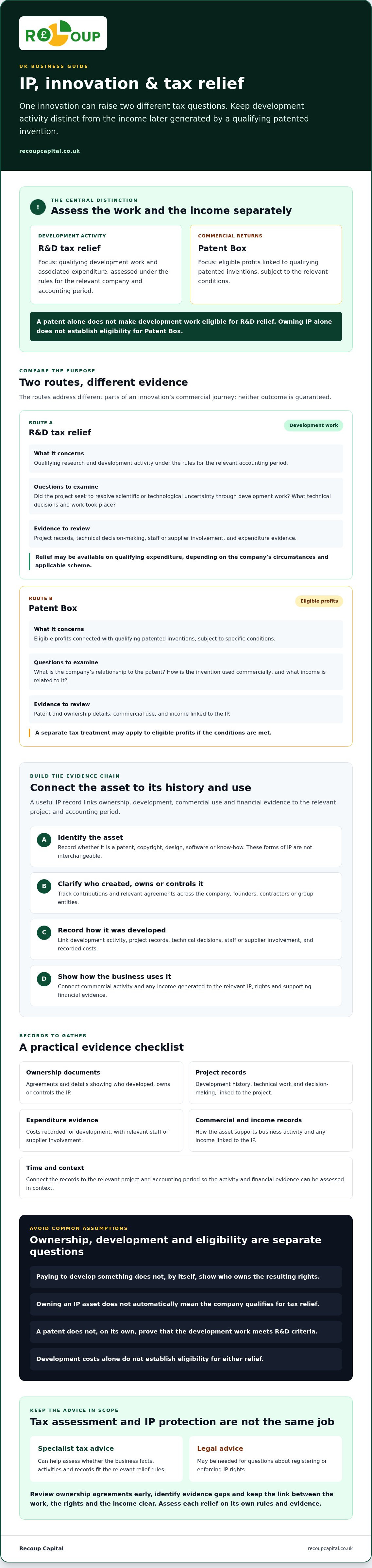
These reliefs address different parts of an innovation’s commercial journey. R&D relief focuses on qualifying development activity and associated expenditure; Patent Box concerns eligible profits connected with qualifying patented inventions. A patent alone does not establish that development work qualifies for R&D relief, and owning intellectual property does not automatically qualify a company for Patent Box.
| Area to compare | R&D tax relief | Patent Box |
|---|---|---|
| Purpose | Supports qualifying research and development activity under the rules for the relevant accounting period. | Applies to eligible profits linked to qualifying patented inventions, subject to specific conditions. |
| Business activity | Investigate projects that sought to resolve scientific or technological uncertainty through development work. | Investigate the company’s relationship to the patent, the invention’s commercial use and related income. |
| Potential benefit | Relief may be available on qualifying expenditure, depending on the company’s circumstances and applicable scheme. | A separate tax treatment may apply to eligible profits if the conditions are met. |
| Evidence to review | Project records, technical decision-making, staff or supplier involvement and expenditure evidence. | Patent and ownership details, relevant income, commercial records and the required calculations. |
When to investigate R&D Tax Credits
Start with the work, not the outcome. Review whether a project aimed to resolve scientific or technological uncertainty and whether the team undertook systematic development to address it. Routine adaptation, routine testing or a commercially successful launch does not, by itself, demonstrate qualifying R&D. The rules and scheme can depend on the accounting period, so check current HMRC guidance. For an overview, see R&D tax credits explained, including how to approach claiming R&D tax credits.
When to investigate Patent Box
Patent Box is not a general reward for owning any intellectual property. Before considering it, verify the current conditions for the patent, the company’s role, the income connected with the invention and the required calculation. A patented product may generate different types of income, so do not assume all its profits are eligible. Keep clear evidence linking the patent to the relevant commercial activity.
Can both reliefs be relevant to one business?
Potentially. A business may need to assess qualifying development activity separately from profits linked to a patented invention. That does not mean the same cost or profit automatically qualifies under multiple rules. Managing intellectual property for tax purposes means keeping these evidence trails distinct and asking an adviser to review interactions, accounting periods and current requirements before making a claim or Patent Box election. An evidence-based assessment can help establish which route may fit the facts, without assuming eligibility or a particular outcome.
Common IP tax assumptions that can expose a business to avoidable risk
Paying to create an asset, buying it or recording it on the balance sheet does not automatically create an entitlement to tax relief. A business may have a genuine commercial asset but lack evidence that it meets the conditions for a particular relief. The reverse can also be true: development work may warrant assessment even if it has not resulted in a patent or commercially successful product.
A possible tax opportunity is only a starting point. Entitlement depends on the company, activity, relevant period, expenditure or income, supporting records and current rules for the relief being considered. This is central to managing intellectual property for tax purposes, particularly where technical teams, finance staff and external contributors hold different parts of the evidence.
Does owning a patent automatically qualify a company for Patent Box?
No. Patent Box is not an automatic tax reward for owning a patent. The company needs to check the applicable conditions, including its relationship to the relevant patent and the connection between qualifying patented inventions and income included in the calculation. Details matter, so confirm the current rules with HMRC guidance or a suitably qualified tax adviser rather than assuming that all income from a patented product is eligible.
Can R&D tax relief cover every cost of creating intellectual property?
No. The treatment depends on the activity undertaken, the type of cost and the rules applying to the company’s accounting period. A development project may include qualifying work alongside routine adaptation, production or commercial activity, and costs need to be assessed accordingly. Check current scheme rules for eligible cost categories and exclusions before making an assessment.
An accounting label such as “software development” or “product design” does not establish that the underlying work qualifies. Nor does an asset’s eventual value prove that the activity met the relevant criteria. Project evidence should explain the technical challenge and the work the team carried out; cost records should separately support the amounts being considered.
What can go wrong when IP ownership and project records are unclear?
Unclear agreements can leave uncertainty about who created, controls or commercially exploits an asset. This can happen when employees, contractors or collaborators contributed to development but contracts or later assignment documents do not clearly record the arrangements. If ownership and commercial use are difficult to trace, it may also be harder to connect relevant income to a patent or determine which company’s activity and costs need review.
Keep dated project notes, contracts, assignment documents, cost records and evidence of commercial use together, with clear links to the relevant project and accounting period. If HMRC asks for information, incomplete records may make it harder to explain the facts and support an assessment. This does not predetermine an enquiry or its outcome, but it is a practical reason to identify gaps early and seek appropriate advice.
A practical checklist for organising IP and tax evidence
A useful review starts with a simple map, not a tax calculation. List the business’s IP assets and development projects, identify the companies and people involved, and note the relevant accounting periods. This gives you a framework for managing intellectual property for tax purposes and helps an adviser see where evidence is complete or needs clarification.
Build an IP and project evidence register
Keep a register that links each asset to the work behind it. Record contributors, key dates, agreements, business purpose and how the project progressed. Technical notes should explain the work carried out and the challenges addressed, rather than simply describe the finished product.
Organise financial records separately, then link invoices, payroll information and other expenditure records to the relevant project where possible. A cost appearing in a project folder or labelled “development” does not prove it qualifies for relief; the activity, cost type and current rules still need assessment.
Review ownership, licensing and commercial use
Gather employment, contractor, collaboration, assignment and licence agreements. Map which company owns or uses each asset, who has rights to exploit it, and where related commercial income is recorded. If several group companies are involved, make those relationships clear rather than assuming that one company’s development, ownership and income automatically belong together for tax purposes.
Flag unclear rights, related-party arrangements and cross-border activity for professional review. A tax adviser can consider the relief implications, while questions about legal ownership or the meaning of an agreement may need a suitably qualified legal adviser.
Prepare focused questions for an adviser
Before a meeting, gather the register, project records, agreements and relevant financial information. Then prepare questions such as:
- Which relief route, if any, appears relevant to our actual activities and circumstances?
- Are the ownership, project, expenditure and income records sufficient to support an assessment?
- Do group arrangements, overseas activity or existing claims affect the review?
- What current deadlines, notification requirements and evidence expectations should we confirm before taking action?
- Could existing claims, elections or accounting treatment affect the position?
These questions focus the discussion on facts, gaps and next steps, rather than assumptions about an outcome. Recoup Capital advises limited companies on R&D Tax Credits and Patent Box, and can support technical assessment and claims. Discuss your R&D Tax Credits or Patent Box position with a specialist adviser.
How specialist tax advice can connect IP records with relief opportunities
Well-organised records are a strong starting point, but they still need to be assessed against the rules for the relief in question. A specialist can review technical activity, ownership and commercial evidence alongside the company’s expenditure or income, then identify what may support a claim and where information is missing. Managing intellectual property for tax purposes is a practical exercise in connecting business facts with the right tax questions.
What a tax review can and cannot establish
A tax review can help a company understand whether its circumstances appear to fit relevant R&D Tax Credits or Patent Box criteria, and support the preparation of a claim and HMRC submission where appropriate. It cannot guarantee eligibility, acceptance or a particular tax outcome. Any assessment depends on the facts, records and current rules.
Bring complete project notes, ownership and licensing documents, cost records, and information about income linked to the IP. If there is a dispute about who legally owns an asset or what an agreement means, seek advice from a qualified legal professional. Tax advisers can consider the tax implications, but that is not a substitute for legal advice.
Choose support that matches the tax question
Ask about the adviser’s experience with the specific relief you’re considering, and how they approach technical evidence, calculations, claim preparation, submission and HMRC correspondence. A clear explanation of the review process helps you understand what information is needed and how conclusions will be reached. Recoup Capital’s specialists and chartered tax accountants advise limited companies on R&D Tax Credits and Patent Box, including technical assessment, claim preparation and HMRC submissions.
Consider how a potential relief fits the company’s wider plans, rather than treating it as a standalone exercise. Where funding and future business strategy are also under review, corporate finance advisory may be relevant to that broader discussion. The tax assessment itself should remain grounded in the evidence and the rules for the relief being considered.
If you’d like to explore whether your company’s development activity and records warrant a closer review, you can discuss your circumstances with Recoup Capital without assuming a particular result. To read more about the claim process, see claiming R&D Tax Credits.
Turn clear IP records into informed tax decisions
Managing intellectual property for tax purposes starts with knowing who owns or uses each asset, what development work took place and how the IP generates income. Those facts help businesses assess two separate questions: whether project activity may qualify for R&D Tax Credits, and whether profits linked to a qualifying patented invention may warrant a Patent Box review. Neither outcome follows from owning IP alone.
Keep project, ownership, expenditure and income evidence organised, then check it against the rules for the relevant accounting period. Where records are incomplete or arrangements involve several contributors or companies, a specialist review can help clarify what needs further investigation. Assess any potential relief on the evidence, not assumption.
Recoup Capital’s specialists and chartered tax accountants support technical assessment, tax claims and HMRC submissions for relevant reliefs. If you’re considering R&D Tax Credits or Patent Box, Discuss your company’s R&D and Patent Box position with our specialists. A clear review can help you understand your options and plan your next steps.
Frequently Asked Questions
Does owning intellectual property automatically reduce Corporation Tax?
No. Owning intellectual property does not automatically reduce a company’s Corporation Tax bill or qualify it for relief. The tax treatment depends on the facts, including how the asset was acquired or developed, how costs are treated and whether the conditions for a specific relief are met. Keep supporting records and ask a qualified tax adviser to assess the activity, accounting period and current rules before relying on a tax benefit.
Can a company claim R&D Tax Credits and Patent Box?
Yes, a company may be able to consider both because they address different tax questions. R&D relief concerns qualifying development activity and related expenditure, while Patent Box concerns eligible profits linked to qualifying patented inventions. This does not mean the same cost or profit automatically qualifies under both. Assess each route separately against current rules, keep the evidence distinct and seek advice on any interaction before making a claim or election.
Does a patent qualify a business for Patent Box?
No. Having a patent does not by itself establish that a company qualifies for Patent Box or that all income from a patented product is eligible. The assessment depends on the applicable conditions, including the company’s relationship to the relevant patent, the income connected with the invention and the required calculation. Check current HMRC guidance or ask a suitably qualified tax adviser to review the company’s circumstances and records.
What records should a business keep for IP-related tax decisions?
Keep records that connect each asset to its development, ownership, use and financial results. Useful documents include dated project notes, creator and contributor details, employment or contractor agreements, assignments, licences, invoices, payroll records and information showing how the IP is used commercially. Organise these by project and accounting period where possible. Clear records help advisers assess the facts, but do not by themselves prove that a cost or income qualifies for relief.
Can software development qualify for R&D Tax Credits in the UK?
Yes, software development can potentially qualify if the work meets the relevant scientific or technological criteria for the applicable accounting period. Writing code, creating a new product or upgrading existing software is not sufficient on its own. The assessment focuses on the technical challenge and the work undertaken to address it, rather than the project label or eventual commercial success. Keep records of the uncertainty, investigations, decisions and development activity, then check current HMRC guidance.
Should a business protect its IP before seeking tax advice?
Not necessarily. A business can seek tax advice to understand how its development work, ownership arrangements and commercial use may relate to relief, even if it has not completed every step in its IP protection strategy. Tax advice does not register rights or resolve ownership disputes. If you need to protect an invention, clarify legal ownership or interpret an agreement, consult a qualified legal professional alongside any tax adviser.
When should a company review its intellectual property for tax purposes?
Review IP as projects begin and develop, when ownership or licensing arrangements change, when an invention is patented or commercialised, and when preparing relevant tax claims or elections. An early review can help identify missing records before details become difficult to reconstruct. Managing intellectual property for tax purposes is an ongoing process, not just a year-end task. Check current deadlines and requirements with a qualified adviser for each accounting period and relief under consideration.


