

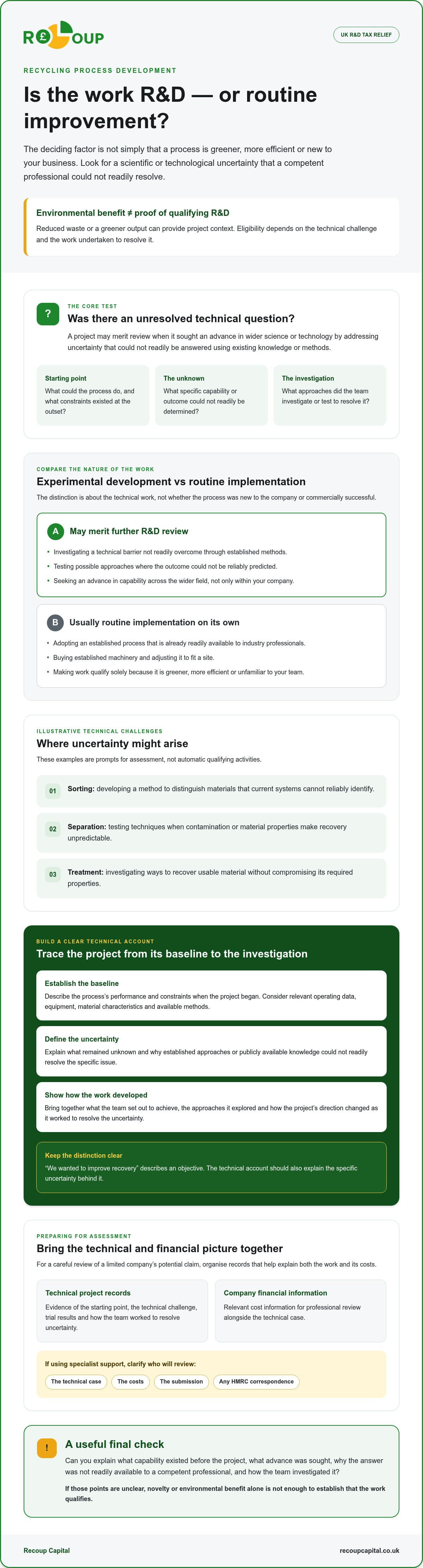
A recycling process isn’t qualifying R&D simply because it’s greener, more efficient or new to your business. The key question is whether you faced a scientific or technological uncertainty that a competent professional couldn’t readily resolve. If you’re considering claiming for developing new recycling processes, this distinction can help you separate genuine experimental work from routine adaptation, installation or production.
It’s understandable to be unsure where the boundary lies, especially when technical decisions, trial results and project costs are spread across different records. This guide explains which recycling process development may qualify for UK R&D tax relief, why commercial success isn’t essential, and what evidence can help show the uncertainty you set out to overcome and how you worked to resolve it. You’ll also learn which project costs may be relevant for professional review and how limited companies can assess and submit a claim carefully. Considering the technical and financial details together can help you make a clearer decision about your next steps.
Key Takeaways
- Assess the technical challenge behind a recycling process, not just its environmental benefits or novelty to your business.
- Trace what your team set out to achieve, what professionals couldn’t readily resolve, and how the project’s approach developed.
- Use the comparison of experimental development and routine implementation to judge whether work may merit further review.
- For claiming for developing new recycling processes, bring technical project records and relevant company financial information together for assessment.
- Compare in-house preparation with specialist support, and clarify who will review the technical case, costs, submission and any HMRC correspondence.
Could developing a new recycling process qualify for R&D tax relief?
A recycling process can deliver a clear environmental benefit without its development meeting the test for tax relief. For UK R&D purposes, greener outputs, reduced waste or a process that is new to your company aren’t enough on their own. The key question is whether the work aimed to resolve a scientific or technological uncertainty that couldn’t readily be answered using existing knowledge.
In brief: qualifying R&D is work on a project seeking an advance in overall science or technology by resolving scientific or technological uncertainty that a competent professional couldn’t readily resolve.
What does HMRC mean by an advance in science or technology?
The advance must relate to knowledge or capability in the wider field, not just your company’s know-how. A process may be unfamiliar to your team but already established and readily available to professionals across the industry. Adopting it would not, by itself, amount to an advance.
For example, imagine a team trying to separate two materials in a mixed waste stream. Existing equipment and published methods may not show whether a proposed treatment can separate them reliably without damaging the material. Investigating and testing possible approaches could involve technological uncertainty. Simply buying established machinery and adjusting it to fit a site is different. The environmental result matters, but it doesn’t establish that the development work addressed an unresolved technological problem.
HMRC’s guidance focuses on whether the uncertainty, and the work to resolve it, relate to an advance in science or technology. For background on the history and broad purpose of UK R&D tax credits, Wikipedia provides an overview. Assess a current claim against HMRC’s applicable guidance. Recoup Capital’s R&D tax credit claim support page also outlines its support for UK limited companies.
Which recycling projects might merit an eligibility review?
Consider whether the project encountered a technical barrier that wasn’t readily overcome through established methods. These questions may help identify work for review:
- Did the team develop a sorting method to distinguish materials that current systems cannot reliably identify?
- Did it test separation techniques where contamination or material properties made recovery unpredictable?
- Did it investigate treatment methods to recover usable material without compromising its required properties?
These are starting points, not automatic qualifying activities. The detail matters: what capability existed before the project, what advance was sought, and why a competent professional couldn’t readily determine how to achieve it. If you’re claiming for developing new recycling processes, assess the technical work rather than relying on the process’s novelty or environmental value. For the broader framework, see R&D tax credits explained.
How technical uncertainty shapes a recycling-process R&D claim
A strong technical account follows the project from what the process could do at the outset to the capability the team sought to achieve. It explains the gap between those points, why a competent professional couldn’t readily bridge it using knowledge or methods available at the time, and what the team did to investigate possible solutions.
For example, a recycling company might know that conventional sorting struggles to separate a particular mix of fine material. The aim could be to recover a cleaner output, but the technical uncertainty is more specific: whether a modified separation process can distinguish the materials reliably without damaging them. A commercial target, such as lowering costs, or an environmental ambition, such as reducing waste, provides context. Neither alone explains the technological challenge.
How to describe the starting point and technical challenge
Set out the process’s baseline performance and constraints when the project began. Refer to relevant operating data, existing equipment, material characteristics and methods already available to the team. Then identify what remained unknown and why established approaches or publicly available knowledge couldn’t readily resolve that specific issue.
Be precise about the distinction: “we wanted to improve recovery” is an objective; “we couldn’t determine whether this feedstock could be separated at the required purity using available techniques” describes a potential technical uncertainty that needs evidence.
What development work can demonstrate an attempt to resolve uncertainty?
Show how the team investigated the problem. Relevant records might include hypotheses, process designs, prototype details, trial plans, test results, analysis and decisions to change direction. Failed approaches can be informative if they show what was tested, what happened and what the team learned. Keep the account grounded in actual project work, rather than reconstructed assumptions.
- Record the question each trial was intended to answer and the method used.
- Capture results, including unexpected outcomes, and explain how they shaped the next step.
- Separate experimental investigation from routine commissioning, production adjustments or standard optimisation.
Under HMRC’s guidance, the project must seek an advance in overall scientific or technological knowledge or capability, with systematic work directly addressing scientific or technological uncertainty that a competent professional couldn’t readily resolve. Evidence should connect the uncertainty to the investigation and its findings, rather than simply list activities.
Clear records can make claiming for developing new recycling processes easier to assess, though they don’t guarantee that a project or its costs qualify. If you’ve mapped the technical challenge but want an experienced view of the case and its supporting evidence, explore R&D tax credit claim support from Recoup Capital.
Qualifying R&D or routine recycling improvements? Compare the work
Not every new or improved recycling process is R&D. A change can make production faster, reduce waste or help meet an environmental target without resolving a scientific or technological uncertainty. The practical test is what the team had to investigate: was the solution readily deducible by a competent professional, or did the work seek to overcome a genuine technical unknown?
Use this comparison as an initial guide, not a verdict. Eligibility depends on the project’s facts and the HMRC guidance that applies to the accounting period. Describing work as “innovation”, “development” or “a trial” doesn’t determine its status, and a successful outcome doesn’t prove that the work qualifies.
| Work to assess | Potentially experimental development | More likely routine activity |
|---|---|---|
| Technical challenge | A material’s properties or operating conditions create an unresolved barrier to achieving a capability that competent professionals can’t readily deduce. | The process and solution are established, but the company hasn’t used them before. |
| Purpose of the work | Tests investigate a defined uncertainty and aim to achieve an advance in overall science or technology. | Changes primarily pursue cost savings, throughput, environmental targets or compliance without addressing technical uncertainty. |
| Activities | Trials compare possible methods, measure results and inform technical decisions. | Standard commissioning, routine quality control or ordinary production checks confirm that an established process works as expected. |
| Outcome | Results, including unsuccessful approaches, help resolve or clarify the technical uncertainty. | Routine adjustments improve performance within known operating parameters. |
When might process development be more than routine improvement?
Look for a documented connection between the barrier and the investigation. For instance, a change in feedstock composition may cause a separation method to behave unpredictably. If professionals can’t readily determine how to achieve the required separation, and the team designs and tests approaches to investigate that uncertainty, the work may merit closer review. The material or operating condition alone isn’t enough; the technical unknown and the work to address it matter.
Which activities need careful separation from the R&D project?
Separate technical investigation from work that follows once the uncertainty has been resolved. Routine commissioning, production, quality control, commercial feasibility and market research don’t become R&D simply because they support a new process. Regulatory compliance and environmental objectives may shape a project, but they don’t by themselves establish qualifying technical work.
Scale-up and adaptation need a case-by-case assessment. Moving to larger equipment might expose unresolved technical challenges, or it might involve applying an established solution. For claiming for developing new recycling processes, map activities to the uncertainty and review the boundaries against current HMRC guidance before including them in a claim.
How to prepare a claim for developing a new recycling process
A clear claim brings the technical story and the company’s financial information together. Use this workflow to organise the evidence, check the project against the rules and prepare for a properly reviewed submission. Requirements can vary by accounting period, so check current HMRC guidance before filing.
What project records should a company gather?
Build the technical account from records created during the work. Bring together project aims, the process’s starting capability, the uncertainties identified, hypotheses considered and decisions made by the technical team. Dated trial results, designs, prototypes, analysis and records of unsuccessful approaches can help show how the investigation progressed.
Organise these materials by project stage and connect each activity to the uncertainty it addressed. Don’t create evidence retrospectively or present uncertain recollections as established facts. Where records are incomplete, identify what exists and ask technical leads to explain the work accurately.
How should technical work and expenditure be reviewed?
Use the technical account to define the work for assessment, then review the company’s financial records separately. The treatment of expenditure depends on current rules and the facts of the claim, so don’t assume that every project cost is eligible. Bring relevant accounting records and allocation methods to a finance or tax professional for review.
For claiming for developing new recycling processes, a practical preparation sequence is:
- Identify the project. Define its scope, stages and accounting period.
- Set out the technical case. Explain the baseline, intended advance, uncertainties and investigation.
- Organise supporting records. Match dated evidence to the project timeline and decisions.
- Review expenditure. Check cost categories and calculations against the rules for the relevant period.
- Verify the filing route. Confirm the applicable claim forms, any claim notification requirement and the submission deadline before filing.
Under current guidance, companies claiming for the first time, or for the first time in three years, may need to submit a claim notification form. An Additional Information Form must be submitted to HMRC before filing a Company Tax Return that includes an R&D claim. The general claim deadline is two years after the end of the relevant accounting period. Verify how these requirements apply to your company and period before acting.
Recoup Capital advises UK limited companies on technical assessment, claim preparation, submission and HMRC liaison. For an overview of the wider process and specialist support, see claiming R&D tax credits.
Choosing support for a recycling-process R&D tax claim
Preparing a claim in-house can work well if your company has the technical knowledge, time and tax expertise to assess the project and assemble its supporting information. A specialist may add value where the process is complex, records are spread across teams or internal capacity is limited. Either way, responsibility should be clear: the company needs to understand the basis of its claim and be comfortable with the information submitted to HMRC.
What should businesses ask an R&D tax adviser?
Look for a clear explanation of how the adviser will assess the project, rather than an early assumption that a new process qualifies. Before engaging support, ask:
- How will you test whether the project involved technological uncertainty and identify which activities fall within its boundaries?
- Who will review the technical evidence, and how will they work with the people who developed the process?
- How will relevant expenditure be checked against current rules and the company’s financial records?
- Who prepares and submits the claim, and what does support with HMRC liaison include?
- How are fees calculated, and what work is covered?
These questions help clarify expertise, capacity and accountability. Recoup Capital’s R&D claim fees are calculated as a percentage of the tax benefit or cash credit recovered. Ask any adviser to explain their fee basis and terms so you can assess them before proceeding.
How can a specialist review make the next step clearer?
A review of the technical and financial details can help identify evidence gaps, check whether the project account is supported by available records, and review how the proposed expenditure has been considered. It doesn’t guarantee eligibility or a particular recovery. It gives the company a clearer basis for deciding whether and how to proceed.
Recoup Capital advises UK limited companies on R&D tax relief, with support spanning technical assessment, claim preparation, submission and HMRC liaison. Its specialist team includes chartered tax accountants. This can provide a joined-up route through the claim process, while keeping the technical case and financial details under review together.
If you’ve made an initial assessment and would like to explore the project with a specialist, you can discuss an R&D tax claim with Recoup Capital. A conversation can help clarify what information may be relevant and what should be checked next, without assuming the work will qualify.
Turn your recycling-process work into a clear next step
A recycling process isn’t eligible for R&D tax relief simply because it’s new, greener or commercially valuable. The key is whether the project sought to resolve a technological uncertainty that competent professionals couldn’t readily address. A clear account of the starting point, technical challenge and investigation, supported by relevant records and financial information, can help establish whether the work merits a claim review.
For businesses considering claiming for developing new recycling processes, separating experimental development from routine implementation is an important first step. Current HMRC rules and the facts of your accounting period also need careful consideration. Eligibility and any resulting benefit can’t be assumed.
Recoup Capital advises UK limited companies from technical assessment through claim preparation and submission, with HMRC liaison. Its specialist team includes chartered tax accountants, and R&D claim fees are calculated as a percentage of the tax benefit or cash credit recovered. To discuss your project and what may need reviewing, contact Recoup Capital about your recycling-process R&D claim.
A well-evidenced assessment can help you decide on a considered path forward and keep your focus on developing better recycling processes.
Frequently Asked Questions
Can developing a new recycling process qualify for R&D tax relief?
Yes, it may qualify if the project sought an advance in science or technology by resolving uncertainty that a competent professional couldn’t readily resolve. For example, a team might investigate whether a difficult material mix can be separated using a method not readily deducible from existing knowledge. The environmental benefit or the fact that the process is new to your company isn’t enough by itself. Eligibility depends on the project details and current HMRC guidance.
Does a more sustainable recycling process automatically count as R&D?
No. A process that reduces waste or energy use doesn’t automatically meet the R&D test. The key issue is whether development involved a scientific or technological uncertainty, rather than simply adopting established equipment or methods to meet an environmental objective. Sustainability may explain why the company pursued the project, but the claim needs to describe the technical challenge and the work undertaken to address it. A greener result alone doesn’t establish eligibility.
What evidence should I keep for a recycling process R&D claim?
Keep records that show the project’s aims, starting capability, technical uncertainties and development decisions. Useful evidence may include dated trial plans and results, design iterations, test data, analysis, prototypes and explanations from the professionals involved. Include unsuccessful approaches where they show what was investigated and learned. Organise evidence by project stage, and avoid presenting later recollections as contemporaneous records or claiming more certainty than the evidence supports.
Can failed recycling process trials be included in an R&D claim?
Unsuccessful trials can form part of an R&D project if they were undertaken to investigate a qualifying scientific or technological uncertainty. A failed approach may show what the team tested, why it didn’t work and how the result informed subsequent decisions. Failure alone doesn’t make work eligible, though. The trial needs to connect to the project’s technical uncertainty, and the activities and associated expenditure must be assessed against the applicable HMRC rules.
Are routine recycling process improvements eligible for R&D tax relief?
Routine improvements generally won’t qualify just because they increase output, improve quality or reduce operating costs. The distinction is whether the work addressed a technological uncertainty that a competent professional couldn’t readily resolve, rather than applying known methods or making standard adjustments. Commissioning, ordinary production and routine quality control should be considered separately from experimental development. Assess each activity on its facts against current HMRC guidance, particularly where a project combines both types of work.
How do I start a claim for developing a new recycling process?
Start by identifying the project and accounting period, then outline its starting point, intended technical advance, uncertainties and investigation. Bring together relevant project records and company financial information so both the technical case and expenditure can be reviewed. Check current HMRC guidance for the applicable forms, any claim notification requirement and deadlines. Companies claiming for the first time, or for the first time in three years, may need to submit a claim notification form.
Should I use an R&D tax specialist for a recycling-process claim?
A specialist can help assess technical eligibility, organise supporting evidence and review relevant expenditure, but using one doesn’t guarantee a claim will qualify or produce a particular benefit. Ask who reviews the technical case and costs, who prepares and submits the claim, and what HMRC liaison support includes. Recoup Capital advises UK limited companies from technical assessment through submission and HMRC liaison; its team includes chartered tax accountants, and claim fees are success-based.


