

A manufacturing technique can be new to your business but still not qualify for R&D tax relief. For companies considering claiming for developing new manufacturing techniques, eligibility depends on the technical uncertainty the work aimed to resolve, not simply on whether the process is new to the factory.
It can be difficult to tell where innovation ends and routine production engineering begins. Refining a production line, improving efficiency or adopting new equipment doesn’t automatically amount to qualifying R&D. The key question is whether the project sought an advance in the field by addressing scientific or technological uncertainty.
This guide explains how to make an initial eligibility assessment, distinguish technical problem-solving from routine work, and identify useful evidence, including project plans, specifications and test results. It also covers how to organise financial records and prepare a careful UK claim. A clear technical narrative matters when HMRC reviews a claim, so the guide also explains how to connect project records with cost information.
Key Takeaways
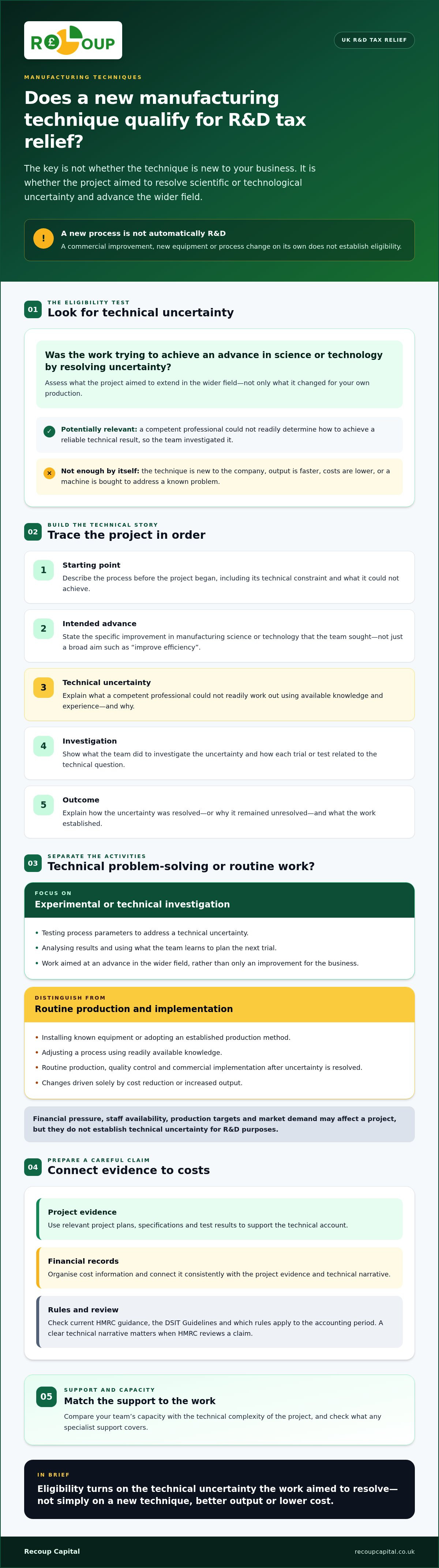
- Assess whether the project aimed to advance the wider field, rather than simply introduce a technique that’s new to your business.
- Work through the baseline, intended advance, technical uncertainty, investigation and outcome.
- When considering claiming for developing new manufacturing techniques, distinguish technical investigation from routine production and commercial implementation.
- Connect project evidence and cost records in a consistent claim narrative, and check which rules apply to the accounting period.
- Compare your team’s capacity with the technical complexity of the work, and check what any specialist support covers.
Could developing a new manufacturing technique qualify for R&D tax relief?
It may, but a technique doesn’t qualify simply because it’s new to your company. For UK R&D tax relief, the project must seek an advance in science or technology by resolving scientific or technological uncertainty. The question is whether the work aimed to extend knowledge or capability in the wider field, not just improve your own production. The general idea of Research and development (R&D) is a useful starting point, but the tax definition is specific. If you’re claiming for developing new manufacturing techniques, assess the work against current HMRC guidance and the DSIT Guidelines.
For example, a team may find that a material behaves unpredictably during a forming process. If a competent professional can’t readily determine how to achieve a reliable result, the team might test different process parameters, analyse the results and use what it learns to plan the next trial. That investigation may be relevant to an R&D assessment. By contrast, buying a machine already known to solve the problem isn’t, by itself, evidence of technological uncertainty.
Technical advancement means resolving uncertainty in the field, not simply making a commercial improvement for your business. Lower costs or faster output may be valuable outcomes, but they don’t establish R&D eligibility on their own.
What makes a manufacturing technique an R&D project?
Start by describing the intended advance in manufacturing science or technology. Explain what the process couldn’t achieve at the outset, why a competent professional couldn’t readily determine how to achieve it, and what investigation was needed. A new product or investment in equipment may be part of a wider project, but neither is enough on its own. Check the current DSIT Guidelines and HMRC guidance when assessing whether the work meets the tax definition.
When is a process change more likely to be routine?
Installing known equipment, adopting an established production method or adjusting a process using readily available knowledge generally points towards routine work, rather than an attempt to resolve technological uncertainty. The same applies to changes driven solely by cost reduction or increased output. Routine production, quality control and commercial implementation may fall outside qualifying R&D activity, even when they follow an innovative project.
Separate the experimental or problem-solving work from what happened after the technical uncertainty was resolved. That distinction can help you form a more defensible initial view before assessing an R&D tax relief claim. Focus on what was uncertain, what the team did to investigate it and what the work established, rather than relying on labels such as “innovation” or “process improvement”.
How to assess technical uncertainty in a new manufacturing process
Trace the project’s technical story in order: establish the starting point, define the intended advance, identify what was uncertain, describe the investigation and explain how the uncertainty was resolved, or why it remained unresolved. This makes it easier to distinguish technical problem-solving from routine operational challenges.
Ask what a competent professional in the relevant field knew when the project began. Could they have readily worked out how to achieve the intended result using available knowledge and experience? If not, explain what made the solution uncertain. Keep the focus on technological uncertainty, rather than financial pressure, staff availability, production targets or uncertainty about market demand. Those factors may affect a project, but they don’t establish technical uncertainty for R&D purposes.
Set out the manufacturing baseline and intended advance
Describe the process before the project began, including the technical constraint. Then state the improvement sought in specific terms, such as achieving a consistent finish with a material that behaves unpredictably under existing process conditions. Avoid broad claims such as “improve efficiency” unless technical records show the particular advance being pursued. Input from professionals with relevant expertise can help explain what was already known and what remained difficult to resolve.
Document trials, setbacks and technical resolution
Link each investigation to the uncertainty it addressed. A useful record might connect a prototype or test run to the process parameters changed, the result observed and the next technical decision. Include unsuccessful approaches where the records explain what was tested and what the team learned.
A failed trial can evidence systematic investigation, but failure alone doesn’t make work eligible for R&D tax relief. The activity still needs to relate to a qualifying technological uncertainty, and the evidence should explain the reasoning behind the work. Once that uncertainty is resolved, later routine production or commercial implementation may need to be treated separately. HMRC’s guidance on production activities can help when drawing that boundary.
For companies claiming for developing new manufacturing techniques, contemporaneous test results, engineering notes, process specifications and project correspondence can make the technical narrative easier to support. If the records are difficult to interpret, a specialist technical assessment can help check whether the project account is clear and evidence-based before submission. You can read more about R&D tax relief claims when considering your next steps.
Which manufacturing activities and costs may belong in an R&D claim?
Assess the technical work and its costs separately. A connection to an R&D project doesn’t automatically make an activity qualifying, and a cost should only be included if it meets the rules for the company’s accounting period and circumstances. For an overview of the R&D tax relief claim process, consider how the technical account and financial records need to support one another.
Direct technical investigation: Experimental process trials, prototypes or analysis undertaken to resolve technological uncertainty may be relevant to the R&D assessment. Supporting records could include staff activity and time, trial materials used, software involved and invoices for subcontracted work. Whether an associated cost qualifies depends on the applicable rules.
Routine production: Standard production runs, routine quality checks and ordinary adjustments using known methods are generally distinct from investigative work. A production run doesn’t become qualifying simply because it uses a process developed during an R&D project.
Commercial implementation: Scaling up a resolved process for commercial use may fall outside the R&D activity. Record where the technical uncertainty ended and separate later implementation where the evidence allows.
Use HMRC’s official R&D guidelines as a reference, then check which scheme and expenditure rules apply to the accounting period. Don’t assume that staff, consumables, software or subcontracted work qualify in full simply because they relate to a project.
Separate qualifying project work from routine manufacturing
Draw a clear boundary around the investigative phase. For example, distinguish experimental runs testing unresolved process parameters from standard production runs made after the process is established. Note the project stages, activities undertaken and when the technical uncertainty was resolved. This helps explain why activities are included or excluded.
Build an expenditure schedule from project records
Match payroll information and staff time records to the people involved and the activities they performed. Bring together relevant invoices, consumables records, software details and subcontractor documentation, along with the method used to allocate expenditure to project work. Keep the link between each cost and the technical activity clear.
For a company claiming for developing new manufacturing techniques, a joined-up technical and tax review can help check whether the project boundaries and cost schedule are consistent. Have a specialist check the rules for the company’s accounting period before finalising the figures. Eligibility depends on the facts, not just the cost category.
How to prepare a robust manufacturing R&D claim, step by step
A clear claim connects the technical story with expenditure evidence. For companies claiming for developing new manufacturing techniques, explain what uncertainty the project addressed, how the team investigated it, what the work established and how the costs relate to those activities.
- Identify potential projects. List manufacturing projects and screen them for work that sought a technological advance by resolving uncertainty.
- Define project boundaries. Set out when the technical work began and ended, separating investigative activity from routine production or later commercial implementation.
- Build the technical narrative. Explain the starting point, intended advance, uncertainty, investigation and outcome in a logical sequence. Check that each project description matches the evidence.
- Gather supporting records. Collect design revisions, trial results, production data, meeting notes and technical decisions. Identify people who can explain the work and their relevant technical expertise.
- Prepare and reconcile the expenditure schedule. Link costs to the activities and people involved, then check the figures against company accounts and tax records.
- Check and submit. Confirm the applicable scheme and current submission requirements for the accounting period before filing.
Assemble contemporaneous project evidence
Use records created during the work wherever possible, including test logs, process specifications and notes explaining why technical decisions changed. A manufacturing lead or engineer may be able to clarify what the team knew and why an outcome wasn’t readily predictable. If records are incomplete, identify the gaps honestly and distinguish later explanations from evidence recorded at the time. Don’t present reconstructed details as contemporaneous records.
Review submission requirements before filing
Check current HMRC guidance for the accounting period and the company’s circumstances. Confirm which scheme applies, whether a Claim Notification Form is required and its deadline, and the requirements for the Additional Information Form, which accompanies claims. Missing a relevant notification deadline may invalidate a claim, so verify the procedure rather than relying on an earlier filing or a general checklist.
Before submission, reconcile the project descriptions, cost allocations and supporting figures. Resolve inconsistencies or document why records differ, rather than letting the technical narrative and accounts tell separate stories. For further context on terminology and schemes, see R&D tax credits explained.
A specialist technical and tax review can help check that the evidence and claim narrative align. To discuss support with preparing an R&D tax relief claim, consider speaking with Recoup Capital. Eligibility and outcomes depend on the project evidence and applicable rules.
Choosing support for a manufacturing R&D tax relief claim
Your team may have the technical knowledge to prepare a claim internally, particularly if project records are well organised and someone has the capacity to connect them with the relevant tax rules. Specialist support may be useful when manufacturing work involves complex processes, evidence is spread across departments or internal resources are limited. In either case, base the claim on the project facts, not on an expectation of a particular result.
Before deciding, consider why companies claim R&D tax relief and what a careful assessment involves. Adviser involvement can help test the technical narrative and expenditure review, but it can’t guarantee eligibility, HMRC acceptance or a particular tax benefit.
What should a manufacturer ask a prospective adviser?
Ask how the adviser assesses technical uncertainty and gets to grips with the manufacturing process, including who will speak with the people closest to the work. Clarify who drafts the technical narrative, reviews expenditure, handles submission steps and liaises with HMRC. Ask what support is available if HMRC raises questions, and request a clear explanation of the scope, responsibilities and fee basis before proceeding.
When could specialist assessment add value?
An independent review may help when a project combines engineering challenges with production systems or software, or when evidence is incomplete or difficult to interpret. A specialist can check whether the technical account is supported by records and identify gaps to address before submission. This doesn’t replace the knowledge of your engineers and production staff; it helps organise that knowledge into a coherent claim assessment.
For a limited company claiming for developing new manufacturing techniques, a joined-up technical and tax review can also help connect project evidence with relevant cost information. Check that any adviser explains how they handle both aspects, who remains responsible for decisions and submission, and what HMRC liaison involves. These details make it easier to compare internal preparation with external support on a like-for-like basis.
Recoup Capital supports limited companies with technical assessment, claim preparation and HMRC liaison, with specialist input from chartered tax accountants. If you’re unsure whether an initial assessment would be useful, you can discuss an R&D tax relief claim. A conversation can help clarify the process without assuming that the work will qualify.
Turn manufacturing innovation into a well-supported next step
A new process isn’t automatically eligible for R&D tax relief. The key is whether the work sought a technological advance by addressing uncertainty that couldn’t readily be resolved. A clear account of the baseline, investigation and outcome, supported by relevant project and cost records, gives you a stronger basis for assessing potential eligibility.
For companies considering claiming for developing new manufacturing techniques, a careful review can help separate technical investigation from routine production and identify evidence gaps before submission. The applicable scheme and expenditure rules depend on the company’s circumstances and accounting period, so check current HMRC requirements before filing.
Recoup Capital supports limited companies across sectors with technical assessment and claim preparation through to submission and HMRC liaison, with input from specialists and chartered tax accountants. No assessment can guarantee eligibility, acceptance or a particular tax benefit, but informed support can help clarify the evidence and process.
Discuss your manufacturing R&D project with a specialist to explore whether an initial assessment may be appropriate. With a clear view of the technical work and the records behind it, you can take your next step with greater confidence.
Frequently Asked Questions
Can developing a new manufacturing process qualify for R&D tax relief?
It may qualify if the project sought an advance in science or technology and addressed technical uncertainty that competent professionals couldn’t readily resolve. A process being new to your company isn’t enough by itself. Review the project’s starting point, intended advance, investigations and supporting evidence against current HMRC guidance. Eligibility depends on the specific technical work and circumstances, so assess these before including activities or costs in a claim.
Does a manufacturing technique have to be completely new to qualify?
No. The relevant question is whether the work sought an advance in the wider field of science or technology, rather than simply introducing a technique that’s new to one business. The project must also address qualifying technical uncertainty. For example, adopting a method already established in the industry may not meet the test just because your factory hasn’t used it before. Assess the project context and current guidance before preparing a claim.
Can failed production trials be included in an R&D claim?
Failed trials may form part of qualifying investigative work if they were undertaken to resolve technical uncertainty. Failure alone doesn’t make an activity eligible. Keep records showing what the team tested, why the result mattered, how it informed the next technical decision and when the uncertainty was resolved. Separate those investigations from routine production, and check whether related expenditure meets the rules for the company’s accounting period.
Are installing new machinery or automating a production line R&D?
Not automatically. Buying or installing machinery, adopting an established process or automating routine production doesn’t by itself establish R&D. A project may include qualifying work if it seeks a technological advance and addresses uncertainty that a competent professional couldn’t readily resolve. Identify and document any experimental development separately from procurement, installation and ordinary implementation, then assess the activities against current guidance.
What evidence should a manufacturer keep for an R&D tax relief claim?
Keep project records that explain the starting capability, intended advance, technical uncertainties, investigations and outcomes. Useful evidence may include test data, design revisions, trial records, meeting notes and decisions made by the technical team. Staff and cost records can help support the expenditure included. Together, the documents should tell a consistent story about the technical work and the costs attributed to it. Check current HMRC guidance for applicable requirements.
How do I claim R&D tax relief for developing manufacturing techniques?
Start by identifying potential projects and recording their technical objectives, uncertainties and investigations. Then assess which activities and expenditure may qualify under the rules for the relevant accounting period, gather supporting evidence and check current notification and submission requirements. For businesses claiming for developing new manufacturing techniques, a specialist review may help check the technical narrative and cost assessment. Eligibility depends on the facts, so verify the process against HMRC guidance or seek specialist advice.


