

A sophisticated simulation isn't automatically research and development (R&D). When claiming for simulation and modelling activities, the key question is whether the work sought an advance in science or technology by resolving genuine technological uncertainty, rather than applying established tools to routine design or analysis. The distinction can be subtle, even when the modelling is complex.
If you're unsure where your project sits, you're not alone. It can be difficult to explain in claim-ready terms what existing methods couldn't achieve, what uncertainties your team investigated and how the work progressed. A well-supported claim needs more than technical sophistication: it needs a clear account of the R&D and records that substantiate the costs.
This guide explains how to assess simulation and modelling against UK R&D tax relief criteria, what technical and financial evidence to gather, and how to distinguish qualifying development from routine use of software. It also outlines when a specialist review may help test the technical basis of a claim before preparation, so you can approach HMRC with a clearer, evidence-led position.
Key Takeaways
- Assess the purpose of the work, not just the sophistication of the model: using established software for routine design isn’t automatically R&D.
- Map the project from its technical baseline through the uncertainty investigated to what the modelling work helped establish.
- When claiming for simulation and modelling activities, show how the work aimed to advance science or technology, rather than simply creating a new workflow for your business.
- Bring project documents and cost records together so the technical account and expenditure can be considered in context.
- Use a project triage to spot evidence gaps, then consider whether internal review or specialist technical and tax input is appropriate.
When can simulation and modelling activities count as R&D?
Modelling doesn’t qualify for R&D tax relief simply because it’s complex or computationally intensive. The key is the purpose of the work: did it seek an advance in science or technology by addressing an uncertainty that couldn’t be readily resolved using established knowledge? The relevant criteria depend on the rules for the accounting period, so assess the project in that context.
Qualifying modelling is work undertaken to resolve a genuine scientific or technological uncertainty. A model may help investigate whether a technical outcome is achievable, test possible approaches or understand a process that existing knowledge can’t reliably predict. Scientific modelling provides a useful foundation: models represent real-world processes so they can be explored and understood. But using recognised software, advanced mathematics or substantial computing power doesn’t, on its own, establish that the work is R&D.
What makes a modelling activity part of R&D?
Ask what technical question the model was built or adapted to answer. If established methods couldn’t resolve it, and the team investigated possible solutions to achieve an advance in science or technology, the modelling may form part of R&D. Hypothetical example: a team models how a new material might behave under combinations of temperature and pressure for which existing data and methods can’t reliably predict its performance.
The commercial goal, project value or fact that the result is new to your company isn’t the R&D question. Focus instead on the technical challenge and why it couldn’t be readily addressed using available knowledge.
What does not qualify automatically?
Routine forecasting, standard design checks and familiar adjustments to model parameters will generally point towards applying established methods, rather than investigating uncertainty. A project can be technically complex and commercially important whilst still relying on techniques that are readily applicable. The key distinction is the work’s technical purpose, not the sophistication of its tools or the effort involved.
For example, running an established simulation to compare known design options may be routine. Developing or adapting a modelling method because existing approaches can’t represent an uncertain technical behaviour may involve R&D, depending on the facts. The same software can be used in both situations; context matters.
When considering why to claim R&D tax relief, start by describing the uncertainty and the investigation, not simply the model or desired commercial outcome. That gives you a clearer basis for claiming for simulation and modelling activities. It isn’t a definitive eligibility test: the project evidence and accounting-period rules need to be reviewed before reaching a conclusion.
How technical uncertainty shapes a simulation and modelling claim
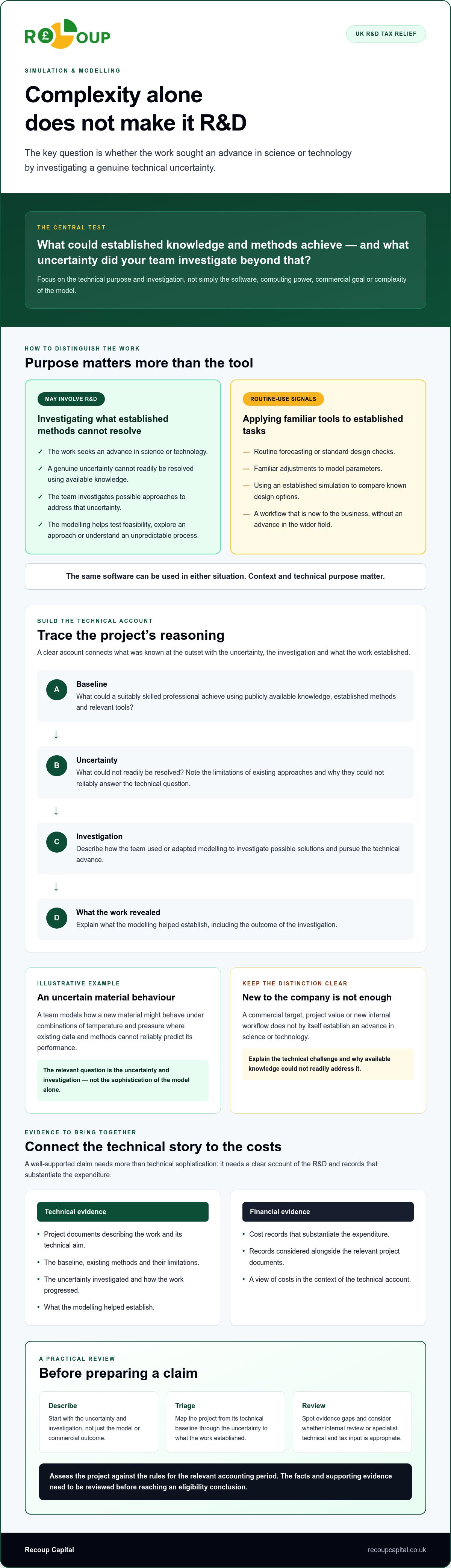
A persuasive technical account follows a clear line: establish what was already known, define the uncertainty, describe how the team investigated it, then explain what the work revealed. The model is part of that story, not proof of R&D in itself.
A model’s purpose matters more than its software or complexity. For claiming for simulation and modelling activities, the question is whether the work sought an advance in science or technology by resolving uncertainty, rather than simply creating a new workflow for the business. An outcome may be new to your company without representing an advance in the wider field.
Define the baseline and the technical advance sought
Start with the project outset. What could a suitably skilled professional achieve using publicly available knowledge, established methods and relevant tools? Note the approaches considered, their limitations and why they couldn’t readily resolve the particular problem. Then describe the intended improvement, such as greater capability, reliability, performance or understanding. This sets out the technical aim without assuming that it qualifies.
Keep the explanation grounded in what was known at the time. A commercial target, such as reducing development time, may explain why the project mattered, but it doesn’t establish a scientific or technological advance. HMRC’s R&D software project case studies offer useful context for considering how software work relates to technological uncertainty.
Show how the modelling addressed the uncertainty
Connect the work to the question it was intended to answer. A competent professional’s explanation should make clear why the existing approach fell short, how the modelling was designed to investigate the gap and what conclusions followed. A clear account can link:
- Assumptions and variables: what the team changed or held constant, and why.
- Test cases and iterations: which scenarios were examined and how results informed later runs.
- Decisions and findings: what changed in subsequent experiments, designs or technical plans.
Unexpected or negative results can be informative if they help rule out an approach, expose a limitation or reduce uncertainty. They don’t automatically demonstrate R&D, though. Explain what was learned and how it affected the investigation; routine tuning to reach a preferred output is different from testing an unresolved technical question.
If the technical narrative is hard to connect to the underlying evidence, a specialist review can help test whether the baseline, uncertainty and investigation are clearly supported before a claim is prepared. Recoup Capital’s R&D tax claim support includes technical assessment, claim preparation and HMRC liaison.
Qualifying R&D modelling or routine simulation: how to tell the difference
Technical sophistication alone doesn’t make modelling eligible for R&D tax relief. A complex simulation can use established methods to solve a familiar design problem, whilst a model used to investigate an unresolved technical question may form part of an R&D project. The purpose and evidence matter more than the tool.
The same software, including computational fluid dynamics or finite element analysis, could support R&D in one project and routine work in another. The epistemology of computer simulation explores how simulations can generate scientific knowledge; for a claim assessment, the practical question is whether the modelling addressed uncertainty that couldn’t readily be resolved using established knowledge.
| Assessment point | May support an R&D case | More likely to be routine |
|---|---|---|
| Purpose | Investigating whether a technical outcome is achievable. | Forecasting, checking or selecting between known options. |
| Uncertainty | Existing knowledge or methods can’t readily predict the result. | The behaviour is understood and expected outcomes are known. |
| Method | Testing or adapting an approach to address the technical gap. | Applying a familiar model or changing standard inputs. |
| Professional judgement | A suitably skilled professional can explain what was unknown and why. | The work follows established practice without a technical barrier. |
| Evidence | Records link iterations, results and decisions to the uncertainty. | Outputs document routine checks or configuration only. |
How examples can help you assess the work
Hypothetical example: engineers use computational fluid dynamics to investigate why airflow behaves unpredictably in a new operating configuration. If established methods can’t readily explain the behaviour, and model iterations test possible causes that inform further technical work, those activities may support an R&D case. The evidence should show what each iteration tested and how the findings affected the investigation. The method itself doesn’t establish eligibility.
By contrast, using the same tool to run a standard product configuration, complete an ordinary compliance check or perform an established design calculation is more likely to be routine. Selecting a familiar model or changing routine inputs doesn’t, on its own, demonstrate an advance in science or technology.
A project may include both types of work. Separate the investigation of technical uncertainty from standard design, testing or implementation, and assess each activity against the facts and rules for the relevant accounting period. If the boundary is unclear, specialist R&D tax claim support can help review the technical basis and evidence before a claim is prepared.
What evidence should you keep for modelling activities?
Useful records tell a coherent project story: what was already known, what remained uncertain, how the team used modelling to investigate it and what the results showed. There’s no need to assume every item below is a formal requirement. The aim is to assemble relevant evidence that supports the technical explanation and can be considered alongside the rules for the accounting period.
Technical records that help explain the project
Start with records created during the work, rather than relying solely on a claim narrative written later. Depending on the project, these could include:
- Model versions and assumptions: dated files or change logs showing how the model developed and why key assumptions were selected.
- Inputs and test results: relevant data, variables, scenarios and outputs, with enough context to understand what each run examined.
- Technical decisions: notes or correspondence explaining why an approach was chosen, changed or ruled out.
- Professional explanations: meeting notes or accounts from suitably knowledgeable staff describing why established methods couldn’t readily resolve the uncertainty.
Keep unsuccessful iterations in context. A failed run may help show how the team tested an approach and what it learned, but the output alone won’t explain its value. Record what the result revealed, whether it changed assumptions or next steps, and how it related to the unresolved technical question.
Connect evidence to the claim narrative
Organise records around the project’s technical story, not just software names or general labels such as “simulation work”. For each relevant activity, show how it relates to the uncertainty and intended advance. This makes it easier to distinguish investigation from routine design, implementation or other work that may need separate treatment.
Then align the technical timeline with staff roles and cost records. Note who contributed, what they worked on and when, and retain records that support the expenditure being considered. The types of costs that may be included, and how they’re calculated, depend on the rules for the accounting period. Check the current HMRC requirements before preparing a claim; don’t assume every project cost is eligible.
If you’re new to the subject, Recoup Capital’s overview of R&D tax relief introduces the wider framework. For practical next steps, read the guidance on claiming R&D tax credits. If you’d like a specialist to review the technical basis and supporting evidence, explore this R&D claim support.
How to assess and progress a simulation and modelling claim
A structured triage can show whether the project has a clear technical basis, what evidence is available and where further review may help. It won’t confirm eligibility on its own. The relevant rules, claim route and any HMRC forms or deadlines should be checked for the accounting period before you progress.
Questions to resolve before moving forward
- Identify the project and baseline: What technical outcome was the team seeking, and what could established knowledge achieve at the outset?
- Pinpoint the uncertainty: Can the technical lead explain what was not readily resolvable and why?
- Trace the modelling work: Can you connect model iterations and results to project records and the work undertaken by relevant staff?
- Check the boundaries: Have investigation activities been distinguished from routine or commercial work, and are costs being considered under the rules for the relevant period?
- Spot evidence gaps: Are key decisions, assumptions or findings missing, and can the team explain them clearly?
If the project is well documented, the technical team can explain the uncertainty and investigation, and the business is confident applying the current requirements, an internal review may be a sensible first step. Record any assumptions and confirm that the cost analysis and claim process reflect the rules that apply to the period.
When specialist claim support may be useful
Modelling projects can be difficult to summarise: technical teams may understand the work deeply but struggle to express the uncertainty, investigation and learning in a concise claim narrative. Specialist input may help test whether the technical explanation is supported by the records, identify gaps and consider how the activity should be assessed alongside tax requirements.
Recoup Capital supports limited companies with technical assessment, R&D tax claim preparation and HMRC liaison. If you’re claiming for simulation and modelling activities and the technical basis or evidence needs a closer review, specialist input can help you assess your position before progressing. The right next step depends on your project and the records you hold.
To understand the potential rationale, explore why businesses claim. If you’d like to discuss your circumstances, discuss your R&D claim with a specialist.
Take the next step with a clearer claim position
Simulation and modelling can support an R&D tax relief claim, but the deciding factor is the technical purpose, not the sophistication of the software or calculations. The work needs to relate to resolving scientific or technological uncertainty, assessed under the rules for the relevant accounting period.
For claiming for simulation and modelling activities, build a clear account of what was already known, what the team couldn’t readily resolve, how modelling informed the investigation and what the evidence shows. Link that technical story to project records, staff contributions and costs, taking care to distinguish investigative work from routine activity.
If the technical narrative or evidence is difficult to assess internally, specialist input can help test the basis of your position. Recoup Capital supports limited companies with technical assessment and claim preparation, with HMRC liaison as part of its end-to-end R&D claim service. Discuss your R&D claim with a specialist and explore the right next step for your business. A careful, evidence-led assessment can help you move forward with greater clarity.
Frequently Asked Questions
Can simulation and modelling activities qualify for UK R&D tax relief?
Yes, they may qualify if the work sought an advance in science or technology by resolving scientific or technological uncertainty, subject to the rules for the relevant accounting period. Claiming for simulation and modelling activities requires more than showing that a model was complex or useful. Explain what couldn’t readily be achieved using existing knowledge, how the team investigated it and what the work established. The project facts and supporting records determine whether activities may be included.
Does using computational fluid dynamics or finite element analysis make a project eligible?
No. Computational fluid dynamics and finite element analysis are methods, not automatic indicators of R&D. Either could be used for routine design calculations or to investigate behaviour that existing approaches can’t readily predict. Consider why the method was used, what technical question it addressed and how its results affected the investigation. A suitably skilled professional should be able to explain the uncertainty and why the chosen approach was needed to examine it.
Can routine design simulations be included in an R&D claim?
Routine design simulations aren’t automatically eligible. Running an established model to check a familiar design, compare standard options or adjust known parameters may be routine work. However, a project could also contain separate activities that investigate technological uncertainty. Assess the activities individually, explain where the boundary lies and consider the requirements for the relevant accounting period. Avoid treating every simulation in a complex project as qualifying simply because some work involved R&D.
What evidence should a company keep for modelling activities?
Keep relevant project records that help explain the work, such as dated model versions, assumptions, input data, test results and notes of technical decisions. Link these to the baseline, the uncertainty investigated, the modelling undertaken and the conclusions reached. Staff role and time records, alongside expenditure documentation, can help reconcile the technical account with the costs considered. The precise requirements and treatment of expenditure should be checked against current HMRC guidance for the accounting period.
Can failed or inconclusive modelling work support an R&D claim?
It may, if the work formed part of an investigation into genuine scientific or technological uncertainty. A failed or inconclusive result can help explain what the team tested, what the result revealed and how it influenced later decisions. Keep records of the relevant model run and the team’s reasoning. A negative result alone doesn’t establish eligibility: it needs to relate to the technical investigation, and the overall project must be assessed against the applicable rules.
Should we use an R&D tax specialist for a simulation and modelling claim?
Specialist support may be useful if your technical team finds it difficult to explain the uncertainty, connect model iterations to evidence or separate investigative work from routine activity. Recoup Capital supports limited companies with technical assessment, claim preparation and HMRC liaison. A specialist review can help test the technical basis and records before a claim is prepared, but it can’t replace consideration of the project facts and rules applicable to the relevant accounting period.


