

Japanese knotweed removal tax relief isn’t automatic. Paying to treat an infestation doesn’t, by itself, mean a company can claim. The route to examine is Land Remediation Relief, but whether it may apply depends on the land, the company and the remediation work. Before relying on a claim, it’s important to understand what to check.
If you’re unsure whether knotweed may qualify or which related costs to review, look beyond the removal invoice. Project records and a professional assessment can help determine whether the facts support a claim.
This guide explains the eligibility questions UK companies should consider, the evidence that can help document a project, and why treatment, disposal and associated costs need careful assessment. It also covers how specialist advice can help you evaluate a potential Land Remediation Relief claim before relying on it in your company’s tax position.
Key Takeaways
- Japanese knotweed removal tax relief isn’t automatic. Assess the company, land and remediation circumstances before relying on Land Remediation Relief.
- Review survey, treatment, removal, disposal and follow-up costs individually, separating remediation from wider project work.
- Keep clear project records as work progresses so the basis and scope of a potential claim can be assessed.
- Use a step-by-step review to identify eligibility questions and evidence gaps before preparing a claim.
- When comparing specialist support, ask how the provider assesses evidence, defines claim scope, handles HMRC correspondence and charges fees.
Japanese knotweed removal tax relief: what Land Remediation Relief may cover
Japanese knotweed removal doesn’t automatically qualify for tax relief. Whether a company can claim depends on the land, the work undertaken and the statutory conditions in force. Assess the project before treating any expenditure as eligible.
Land Remediation Relief is a UK corporation tax relief that may apply to qualifying company expenditure on remediating contaminated or derelict land. For a business considering Japanese knotweed removal tax relief, the key question isn’t simply whether the plant was present or removed. It’s whether the project facts and costs meet the relevant rules.
How Japanese knotweed can affect land and development plans
An infestation may affect how a company uses or manages a site, or plans work there. For example, it may need to be considered when preparing a development programme or deciding how to manage affected areas. This overview of Japanese knotweed (Reynoutria japonica) describes the plant and how it spreads.
Identifying the plant is only a starting point. A survey or other project record can help establish what was found and where, but it doesn’t, by itself, show that the land meets the conditions for relief. The company’s circumstances, the land’s history and status, and the nature of the work may all need review. An infestation should prompt an eligibility assessment, not an assumption that a claim is available.
What Land Remediation Relief is designed to address
Land Remediation Relief is intended to support qualifying companies carrying out remediation of contaminated or derelict land. Whether particular Japanese knotweed work falls within that framework depends on the applicable legislation, HMRC guidance and project evidence. The relief isn’t a general deduction for every cost connected with a site. Identifying a potentially relevant expense doesn’t confirm that it qualifies.
For an initial overview, read the detailed Land Remediation Relief guidance. Then consider how the general framework applies to the specific land and project. Specialist tax review can help test the position before the company relies on relief or prepares a claim. The aim is to understand the evidence and conditions, not to presume an outcome.
That distinction matters. Knotweed may raise a genuine remediation question, but a sound assessment connects the site conditions, the work carried out and the company’s position under current rules. A company weighing up its options can also review why businesses assess tax relief claims when deciding whether further professional review is appropriate.
Who may qualify for Japanese knotweed removal tax relief?
A UK company may be able to claim Land Remediation Relief for Japanese knotweed remediation, but the plant’s presence and a removal bill don’t establish entitlement. Eligibility is fact-specific. The claimant, its relationship to the land, the circumstances of the infestation and the work undertaken all matter. Treat the points below as an initial screen, not a guarantee.
Company and land conditions to check first
Start by identifying which company incurred the costs and whether it is within the UK corporation tax regime. Check whether it owns the land freehold or holds a lease of at least seven years, and establish who caused the contamination. A company that caused it may not qualify under the polluter-pays principle. Review acquisition and ownership history, including connected-party circumstances, against current rules. Japanese knotweed has a specific treatment: HMRC guidance indicates that the land need not have been contaminated when acquired for knotweed remediation to be considered.
Individuals, sole traders and partnerships aren’t companies claiming corporation tax relief. If one of these parties paid for the work, don’t assume the company relief applies. The facts need tailored review. HMRC's Land Remediation Relief guidance is a useful starting point for checking the specific treatment of Japanese knotweed.
Does the infestation meet the relevant contamination test?
Finding knotweed is relevant evidence, but it isn’t the same as proving that a particular project meets the relief conditions. Consider where it was found, how the affected land was being used or intended to be used, the company’s responsibility for the infestation, and how the proposed work responds to the site condition. A specialist should check how current statutory rules and HMRC guidance apply to those facts.
The traffic-light assessment below can help organise an initial review. It isn’t an eligibility decision.
| Initial signal | What it may indicate |
|---|---|
| Potentially eligible | A UK company subject to corporation tax owns the land freehold or under a qualifying lease, did not cause the infestation, and has documented knotweed remediation work. Each condition and cost still needs review. |
| Uncertain | Ownership has changed, connected parties are involved, the infestation’s origin is unclear, or site and work records don’t yet show how the project fits the rules. Gather the facts before reaching a view. |
| Unlikely | The claimant isn’t a company within the corporation tax regime, or the company appears to have caused the contamination. Seek advice before ruling a case in or out. |
Removal alone doesn’t settle the question. For a considered assessment, compare the project facts with Recoup Capital’s Land Remediation Relief support and obtain specialist tax review before relying on a claim.
Which knotweed remediation costs may qualify, and what may not?
There isn’t a blanket rule that every invoice linked to Japanese knotweed qualifies for Land Remediation Relief. Assess each cost against the work carried out, the project evidence and current tax rules. For a company exploring Japanese knotweed removal tax relief, separating remediation from wider site expenditure is an important part of a careful assessment.
Surveying, treatment and disposal: assess each workstream
A survey report can record where knotweed was identified, the extent of the affected area and the recommended response. The RICS professional standard for assessing Japanese knotweed provides context on surveying, but a survey alone doesn’t establish that expenditure qualifies for tax relief. Treatment, excavation, transport, disposal and follow-up work all need checking against the rules and project facts.
Keep records that show what each contractor or professional actually did. Broad descriptions such as “site works” make it harder to distinguish knotweed remediation from general preparation or construction activity. The table below is a starting point for review, not a determination of eligibility.
| Work type | Evidence to review | Eligibility question |
|---|---|---|
| Survey and assessment | Reports, site plans and recommendations | Does the work relate directly to identifying or assessing the infestation, and is its treatment under current rules confirmed? |
| Treatment or removal | Contractor scope, work records and invoices | Which activities directly addressed knotweed, and are they supported by project evidence? |
| Transport and disposal | Waste documentation and itemised charges | What happened to the material? GOV.UK guidance excludes landfill disposal costs for material containing Japanese knotweed from relief. |
| Follow-up work | Monitoring records and descriptions of further work | Is this part of remediation, or routine maintenance or another activity? |
Costs that need careful separation from remediation
Don’t simply bundle landscaping, redevelopment, general site preparation or routine maintenance into a remediation total. Professional fees, financing costs and other project charges also need separate review. Their connection to the work doesn’t automatically make them eligible. Ask for invoices to describe the actual service, dates and workstream rather than relying on a broad project label.
Keep a clear trail between each cost and the site activity it relates to. Recoup Capital’s Land Remediation Relief service provides support in assessing the relief, while specialist tax review can help test individual cost categories against current HMRC guidance before they’re included in a claim.
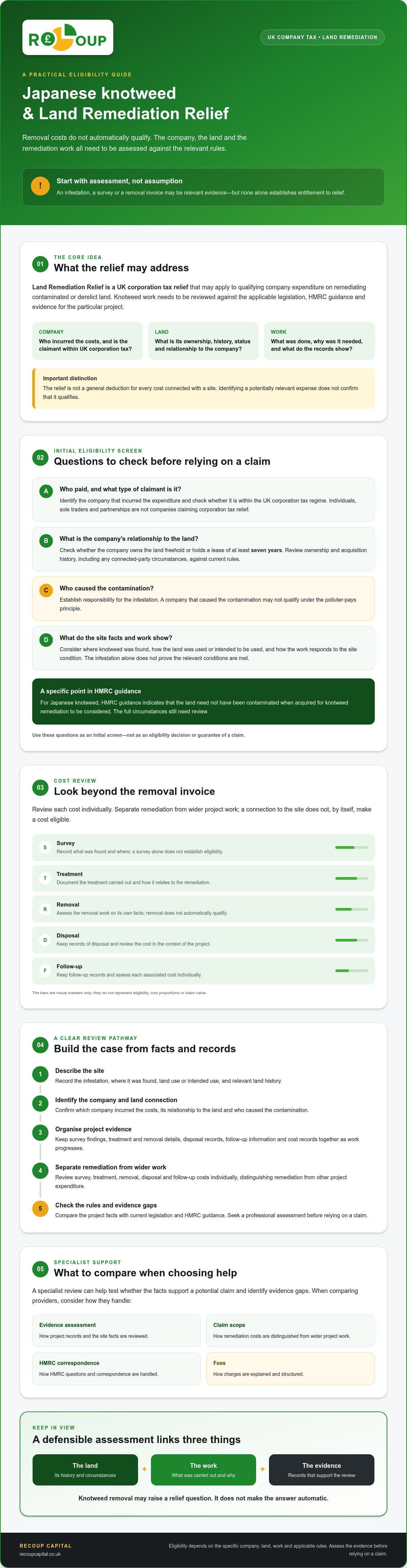
How to assess a Japanese knotweed tax relief claim step by step
A structured review connects the site work to the company’s tax position. The aim isn’t to assemble paperwork for its own sake, but to show what happened, why the work was done and how the costs relate to it.
Claim strength depends on evidence linked to qualifying work. These steps can help a company prepare for a specialist assessment of Japanese knotweed removal tax relief.
- Define the project. Identify the affected site, the company involved, the infestation and the work carried out or planned. Set out the chronology, from discovery through remediation decisions and completed work.
- Assemble the site and land records. Bring together available ownership and acquisition records, site surveys, treatment plans and dated project correspondence. These help a reviewer understand the land’s history and how the company responded to the infestation. This is a practical starting point, not a prescribed HMRC document list.
- Gather cost evidence. Collect itemised contractor invoices, payment records and descriptions of completed work. If an invoice covers several activities, seek a breakdown so knotweed remediation can be distinguished from general site preparation or other project costs.
- Reconcile the evidence. Match each invoice to the relevant treatment plan, site records and work dates, then compare the costs with the company’s accounting records. Investigate gaps or differences before deciding which expenditure to put forward for review.
- Obtain a tax review. Ask a specialist to assess company eligibility, land history, contamination circumstances, expenditure and supporting evidence together. This tests the claim against the facts rather than relying on removal expenditure alone.
- Confirm the process before submission. Check the relevant accounting periods, claim deadlines and filing procedure against current HMRC guidance. Requirements can depend on the nature and timing of expenditure, so confirm the applicable treatment before submitting or amending a claim.
Build a clear project and evidence file
Keep records created during the project where possible, including dated notes of the infestation, decisions made and work completed. Records made at the time can help explain the sequence of events and support the link between a cost and remediation activity. Ask your tax adviser to confirm which evidence is appropriate for the specific claim and current rules.
Get the tax treatment reviewed before submission
A joined-up review can reveal missing information before the company commits to a filing position. For broader context on the business rationale, see why companies claim tax relief. If you’re preparing a knotweed project for review, request a specialist Land Remediation Relief assessment from Recoup Capital.
Choosing support for a Japanese knotweed removal tax relief claim
The right adviser should help your company understand whether a claim may be supportable, not simply assemble costs and assume they qualify. For Japanese knotweed removal tax relief, look for Land Remediation Relief knowledge, careful evidence review and clear communication about uncertainties. No adviser can guarantee that HMRC will accept a claim.
Questions to ask a Land Remediation Relief adviser
Before appointing an adviser, ask how they’ll assess the project and who will handle each part of the work. Clear answers help you compare the scope and method of support, rather than relying on a promised outcome.
- How will you assess the evidence? Ask how the review will consider survey findings, land history, the company’s relationship to the site and the remediation work.
- How will costs be reviewed? Find out whether expenditure will be considered by category and how the adviser will distinguish knotweed work from wider development or maintenance costs.
- Who does what? Clarify who reviews technical records, prepares the tax analysis and responds to any HMRC questions or correspondence.
- What does the engagement cover? Request a written explanation of the work included, what falls outside scope and the fee basis, including how any additional work would be agreed.
A reliable assessment should explain the reasoning behind its conclusions and identify evidence gaps, not just provide a headline estimate. Ask what assumptions have been made and what further records may be needed before the company decides how to proceed.
When to seek a specialist assessment
Consider seeking advice early if the infestation’s history is unclear, ownership has changed, records are incomplete or invoices combine remediation with other site work. Early review can help identify questions to resolve while project information is still available. It can also help the company assess its position before relying on relief in its tax reporting.
Recoup Capital supports UK companies with Land Remediation Relief assessments and claims. Its Land Remediation Relief guidance provides further context on the service. A discussion can help establish which project facts and records need closer review. It doesn’t imply that the company qualifies or guarantee a claim outcome.
If your company is weighing up a potential claim, you can discuss a potential Land Remediation Relief claim with Recoup Capital and explore whether a specialist assessment is appropriate.
Turn your project records into a clear next step
Japanese knotweed removal tax relief isn’t determined simply by the fact that work took place. The company’s relationship to the land, the circumstances of the infestation and the nature of the remediation all need to be considered against current rules. A careful review can help establish whether a potential Land Remediation Relief claim is worth exploring.
Keep the project evidence connected: site records, treatment details and itemised costs should tell a consistent story. Distinguish work directly related to remediation from wider development or maintenance expenditure, and confirm the treatment of each cost before relying on it.
Recoup Capital supports UK companies with Land Remediation Relief assessments and claims, including specialist tax and claim support and a review of the project facts. An assessment can clarify questions and evidence gaps, but no adviser can guarantee HMRC will accept a claim.
If your company is considering its options, discuss whether your project may qualify for Land Remediation Relief with Recoup Capital. A well-informed review can help your business decide what to do next with greater confidence.
Frequently Asked Questions
Can a company claim tax relief for Japanese knotweed removal?
Yes, a UK company may be able to claim Land Remediation Relief for qualifying Japanese knotweed remediation expenditure, provided the relevant conditions are met. The company’s tax status, relationship to the land, responsibility for the infestation and nature of the work all need consideration. Paying for removal alone doesn’t establish entitlement. Japanese knotweed removal tax relief should be assessed against current rules and supported by records that link costs to remediation work.
Does Japanese knotweed count as contamination for Land Remediation Relief?
Japanese knotweed is specifically addressed in HMRC guidance on Land Remediation Relief, so its presence can raise a potential claim. That doesn’t mean every infestation or removal project meets the conditions automatically. The company and land circumstances, the work undertaken and the costs claimed need to be assessed together. A knotweed survey can help describe the site condition, but specialist review is needed to determine whether the facts support a claim.
Which Japanese knotweed removal costs may qualify for tax relief?
Depending on the facts and current rules, survey or assessment work, treatment, excavation, removal and related remediation costs may merit review. Assess each cost individually and support it with evidence of the work completed. GOV.UK guidance excludes landfill disposal costs for material containing Japanese knotweed from Land Remediation Relief. Landscaping, redevelopment, routine maintenance and general site preparation shouldn’t be assumed to qualify simply because they form part of the same project.
Can a property developer claim relief if knotweed was present before buying the land?
Potentially. HMRC’s specific treatment of Japanese knotweed means the land doesn’t need to have been contaminated when acquired for remediation to be considered for relief. That doesn’t guarantee eligibility: the developer’s company status, relationship to the land, responsibility for the contamination and expenditure still need review. A specialist should check the acquisition and project facts against current legislation and HMRC guidance before preparing a claim.
What evidence should a company keep for a Japanese knotweed tax relief claim?
Keep records that explain the site condition, why remediation was undertaken and how each cost relates to the work. Useful material may include ownership and acquisition information, surveys, treatment plans, dated correspondence, itemised contractor invoices, payment records and descriptions of completed work. These examples aren’t a universal mandatory list. Organising records as the project progresses can help a tax specialist assess the facts and identify gaps.
How do you claim Land Remediation Relief for Japanese knotweed?
Start by reviewing the company’s eligibility, land history and infestation circumstances, then organise site records and itemised costs. Have a specialist assess the work and expenditure against current rules before deciding what to include. The claim must follow the relevant Corporation Tax reporting process and applicable deadlines, which should be checked against current HMRC guidance. Don’t treat a removal invoice or initial assessment as confirmation that HMRC will accept a claim.
Can a landlord or property owner claim Japanese knotweed removal tax relief?
A landlord or property owner may be able to claim if the claimant is a qualifying company and the relevant conditions are met. Owning the land or paying for remediation alone isn’t enough. The freehold or lease position, the company’s responsibility for the infestation and the nature of the expenditure may all be relevant. Individuals and sole traders can’t claim this company Corporation Tax relief in their own right, so they should seek advice on their circumstances.


