

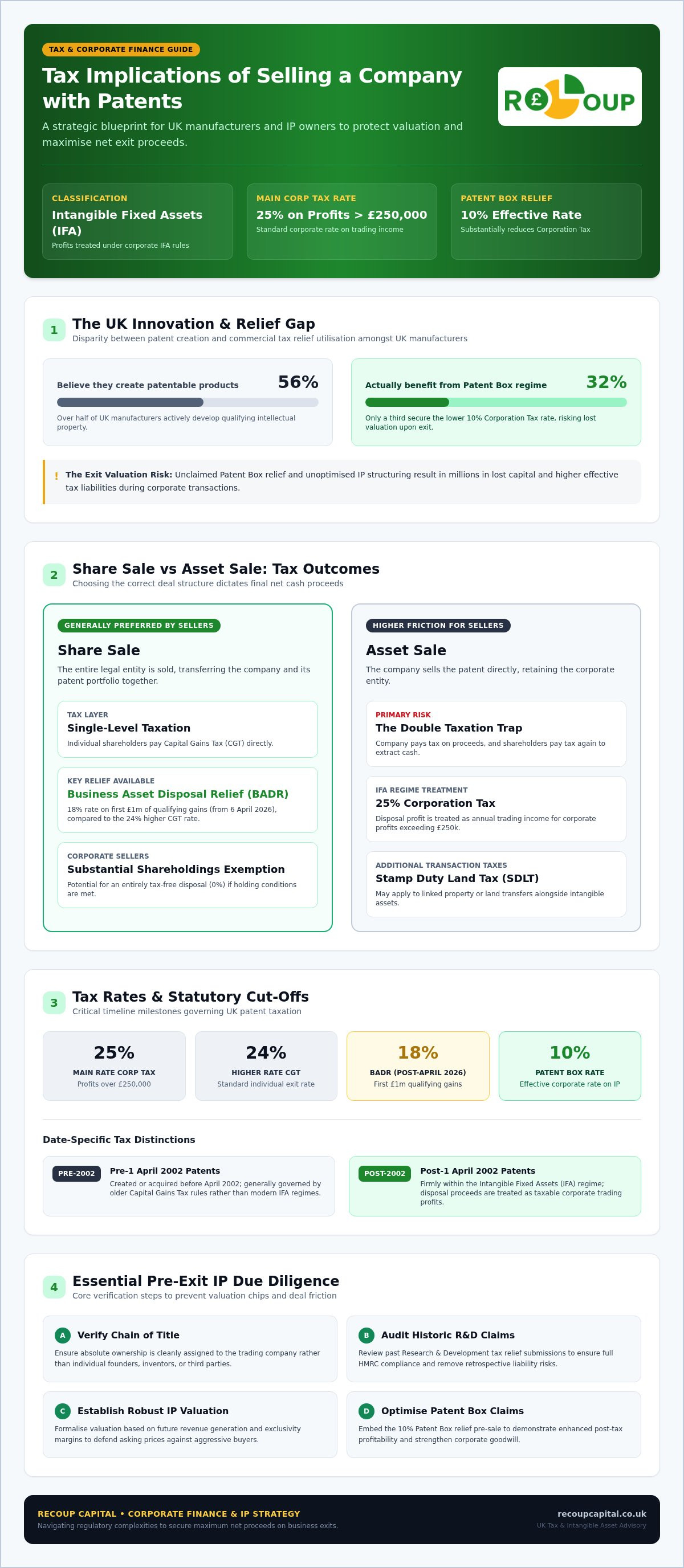
Whilst 56% of UK manufacturers believe they have created patentable products, only 32% have actually benefited from the Patent Box. This gap represents millions in lost capital, particularly when it comes to an exit. Understanding the tax implications of selling a company with patents isn't just a compliance exercise; it's a vital strategy to ensure you don't hand a significant portion of your hard-earned valuation back to HMRC. You've likely spent years innovating and protecting your intellectual property, and the fear of facing double taxation or losing out on relief during a disposal is entirely valid.
We know the distinction between a share sale and an asset sale often feels like a regulatory minefield, especially when high-value IP is involved. This guide will show you how to navigate the complex UK tax landscape to protect your valuation and maximise your net proceeds. We'll explore the critical differences between Capital Gains Tax and Corporation Tax liabilities, explain how the 10% Patent Box rate can actively increase your sale price, and provide a clear roadmap for your pre-sale tax due diligence.
Key Takeaways
- Recognise the distinct tax treatment of patents as Intangible Fixed Assets (IFA) to ensure your business valuation reflects the unique nature of your intellectual property.
- Compare the tax implications of selling a company with patents via share sales versus asset disposals to identify the most capital-efficient route for your specific exit.
- Learn how the 10% Patent Box regime can be used as a strategic tool to increase your company's post-tax profitability and appeal to premium buyers.
- Identify the essential pre-exit due diligence steps, from verifying IP ownership to auditing historic R&D tax credit claims, to prevent deal-breaking surprises.
- Discover how a partnership-led approach to corporate finance can help you navigate regulatory complexities and secure the maximum net proceeds from your innovation.
Understanding the Interplay Between IP and Corporate Disposals
Patents occupy a unique space in the UK tax system. Unlike tangible assets such as machinery or commercial property, which follow traditional capital allowance rules, patents are categorised as Intangible Fixed Assets (IFA). This classification fundamentally changes how HMRC views their value during a business exit. While a factory depreciates through wear and tear, a patent's value is tied to its income-generating potential and legal lifespan. Consequently, the tax implications of selling a company with patents are often more nuanced than a standard asset disposal. The IFA regime generally treats profits from patent sales as trading income rather than capital gains, meaning they're subject to Corporation Tax at the main rate, currently 25% for profits over £250,000.
The age of your intellectual property still dictates your tax pathway. Patents created or acquired from unrelated parties before 1 April 2002 often fall under the older Capital Gains Tax rules, whilst those developed after this date are firmly within the IFA regime. This distinction is vital for long-standing engineering or pharmaceutical firms. If your IP is "pre-2002," you might access different reliefs, but most modern tech-driven businesses will find their patents governed by the corporate IFA rules. Understanding these mechanics is the first step in ensuring you don't overpay when you decide to step away from the business.
The Concept of Intellectual Property as a Strategic Asset
During a sale, a patent matures from a legal shield into a high-octane financial engine. It stops being just a certificate from the IPO and becomes a primary driver of "goodwill." Buyers aren't just purchasing your current revenue; they're buying the exclusive right to future margins. A clean, well-documented IP portfolio is essential here. If the chain of title is murky or the patent hasn't been properly valued, buyers will likely chip away at your asking price to account for the perceived risk. Proactive management of these assets ensures they remain strategic strengths rather than liability concerns during due diligence. For those interested in how tech M&A advisory teams analyse intellectual property and build valuation expertise, you can check out AGC Partners to explore their work and opportunities in technology investment banking.
Tax Classifications: Capital Gains vs. Income Treatment
The structure of your exit dictates your tax bill. In a share sale, you're selling the company as a whole, and you'll typically pay Capital Gains Tax (CGT) as an individual, potentially benefiting from Business Asset Disposal Relief. However, if you opt for an asset sale, the limited company sells the patent directly. This often triggers the "double taxation" trap: the company pays Corporation Tax on the sale proceeds, and you pay tax again when extracting that cash. The IFA regime ensures that any profit made on the disposal of a patent is brought into account as a taxable credit, effectively treating the gain as part of the company's annual trading profits. Whilst this sounds daunting, leveraging the Patent Box scheme can significantly mitigate these costs by applying a lower effective tax rate to relevant profits. It's also worth noting that whilst patents are intangibles, other elements of a deal, such as land transfers, may still involve stamp duty land tax, requiring a holistic view of the transaction.
Share Sale vs. Asset Sale: Contrasting the Tax Consequences
Deal structure dictates how much of the sale price stays in your pocket. For most business owners, the choice between a share sale and an asset sale is the single most important decision in the exit process. The tax implications of selling a company with patents vary wildly depending on whether you're offloading the legal entity or just the intellectual property itself. Each path carries distinct regulatory burdens and financial outcomes that can either protect or erode your final valuation.
The Share Sale Advantage for Shareholders
Sellers usually lean toward share sales because they offer a cleaner exit for the individuals involved. By selling the entire company, individual shareholders can often access Business Asset Disposal Relief (BADR). For qualifying disposals made on or after 6 April 2026, the BADR rate is 18% on the first £1 million of gains, providing a significant saving compared to the 24% higher rate of Capital Gains Tax. If the seller is another company, the Substantial Shareholdings Exemption (SSE) might even allow for a completely tax-free exit, provided specific holding conditions are met. Patents significantly inflate these valuations, but in a share deal, that value is bundled into the share price rather than taxed as a separate corporate income stream. For entrepreneurial leadership teams preparing for a disposal, working alongside strategic transaction specialists such as Founded Partners helps ensure founder-led businesses structure their organisation effectively ahead of a sale.
Asset Sales and the IFA Regime
Conversely, an asset sale can trigger the "double taxation" trap. The limited company sells the patents and pays Corporation Tax on the gain; then, the owner pays personal tax to extract the remaining funds as dividends or a capital distribution. Buyers often push for this structure because it allows them to "step up" the tax basis of the patents. This enables the acquirer to claim amortisation relief on the full purchase price, which isn't possible in a share deal. Within the IFA regime, selling a patent for more than its tax written-down value triggers a "balancing charge." This is effectively a clawback of previous tax relief, taxed at the 25% Corporation Tax rate.
There are ways to mitigate these costs if you plan to continue innovating. You might use "roll-over relief" to defer this liability by reinvesting the proceeds into new qualifying intellectual property within a specific timeframe. If your business disposal includes physical premises alongside your IP, you'll also need to account for stamp duty land tax on the property portion of the transaction. Deciding on the right structure requires a balance of legal protection and financial efficiency. Our team at Recoup Capital can help you model these scenarios through our corporate finance services to ensure you choose the path that protects your net proceeds.
Leveraging the Patent Box Regime to Maximise Net Proceeds
In the current UK landscape, where the main Corporation Tax rate sits at 25%, the ability to slash that burden to just 10% is a powerful incentive. For a seller, the Patent Box isn't merely a tax relief; it's a strategic asset that directly inflates the company's post-tax yield and, by extension, its exit price. Acquirers are often willing to pay a premium for tax-efficient revenue streams that are legally protected. By "streaming" your profits, you can clearly demonstrate to a buyer exactly which portion of your income qualifies for this lower rate. This transparency reduces their perceived risk and justifies a higher valuation multiple. Integrating this into your broader corporate finance strategy well before signing Heads of Terms ensures that this value is baked into the initial offer.
Calculating the Value of Patent Box for a Potential Acquirer
Smart buyers model future tax savings directly into their Discounted Cash Flow (DCF) projections. If a company can prove that its core products are protected by qualifying intellectual property, the buyer sees a potential 15% tax saving on every pound of relevant profit for years to come. The Patent Box regime allows qualifying companies to apply a reduced Corporation Tax rate of 10% to profits earned from patented inventions or specific exclusive licences. This "exclusive licence" aspect is vital; even if your company doesn't own the patent outright, holding an exclusive right to exploit it can still unlock these benefits. Acquirers will conduct deep due diligence to ensure these licences are robust and the IP is truly "qualifying" under HMRC’s stringent definitions.
Maintaining the Nexus: The R&D Connection
The "Nexus Fraction" is the mathematical bridge between your R&D efforts and your tax savings. It ensures that the Patent Box benefit is only available to companies that actually carried out the underlying development work. This is why claiming R&D tax credits is so critical during the years leading up to a sale. These claims provide a documented audit trail that proves your company performed the innovation, cementing your right to the 10% rate. If you restructure the business or move IP between entities shortly before a sale, you risk breaking this nexus and losing the relief entirely. Failing to account for these credits can cloud the tax implications of selling a company with patents, making the business appear less profitable than it truly is in a post-tax environment. Protecting this nexus is essential for maintaining the integrity of your valuation during the final stages of a deal.
Pre-Exit Due Diligence: Preparing Your Patents for Scrutiny
Buyers approach patent-rich companies with a mix of excitement and extreme caution. Whilst your intellectual property represents future growth, it also presents a significant due diligence hurdle. Understanding the tax implications of selling a company with patents requires more than just checking the IPO register; you must ensure every tax election and R&D claim is bulletproof. Any ambiguity regarding ownership or historic tax filings gives the acquirer a reason to "chip" the price or demand onerous indemnities. Proactively addressing these areas transforms your IP from a potential liability into a verified strategic asset.
The chain of title is the first point of failure in many mid-market deals. You must verify that the limited company truly owns the IP it is selling. It is surprisingly common for patents to remain in the name of a founder or a subsidiary that hasn't been properly linked to the trading entity. If the company is claiming Patent Box benefits on IP it doesn't legally own, HMRC could claw back years of relief, creating a massive latent liability. Resolving these discrepancies before the data room opens is essential for maintaining deal momentum.
The R&D Claim Audit
Acquirers view R&D tax credits as a proxy for your company's technical governance. If your previous claims are based on flimsy technical reports, a buyer's tax advisors will flag them as high-risk. During a share disposal, R&D tax credit carry-forwards and ongoing claims generally remain within the company, providing immediate cash-flow benefits to the new owner. Having R&D tax credits explained clearly in your documentation, supported by robust evidence, prevents unnecessary delays. You should quantify exactly what is outstanding and ensure all filings are up to date to demonstrate a clean compliance record.
Clean House: Resolving Historical Tax Issues
Beyond R&D, you must identify any latent tax liabilities within your Intangible Fixed Asset (IFA) portfolio. If you've previously claimed amortisation relief, you need to calculate potential balancing charges that a sale might trigger. Similarly, review your prior capital allowances to ensure that the disposal won't result in unexpected tax hits for the buyer. Creating a comprehensive "Tax Fact Sheet" for the data room can significantly accelerate the process. This document should summarise your IFA elections, R&D history, and Patent Box status, giving the buyer confidence in the tax implications of selling a company with patents under your management. To ensure your business is fully prepared for the rigours of a corporate sale, book a pre-exit tax audit with our specialist team today.
Strategic Corporate Finance: Navigating the Sale with Recoup Capital
Recoup Capital acts as the vital link between technical innovation and corporate finance. We understand that a patent is more than just a legal document; it's a high-yield financial engine. Our dual expertise ensures that your business valuation isn't just based on current turnover but on the long-term tax efficiencies you've built. By optimising R&D and Patent Box claims prior to an exit, we help you present a more profitable, tax-efficient entity to potential buyers. Understanding the tax implications of selling a company with patents requires a specialist who speaks both the language of the innovator and the language of the investor.
We operate on a success-based fee model for our incentive claims. This aligns our interests with yours, building a foundation of trust before you even reach the negotiating table. Our role extends to liaising directly with HMRC, ensuring that all tax incentives are robustly documented and ready for the transition of ownership. Complex IP-heavy transactions demand a partnership-oriented approach, where your advisor is as invested in the outcome as you are. We don't just process paperwork; we act as a protective guide through the complexities of regulatory landscapes, ensuring your legacy is financially secured.
Bridging the Gap Between Innovation and Capital
Reframing a tax refund as a strategic asset changes the narrative of your sale. Instead of a one-off payment, it becomes a proof point of your company's innovative capacity and future tax-saving potential. We provide mid-market valuation support through our corporate finance services, ensuring that these benefits are correctly modelled into the deal price. Having specialist R&D consultants involved means that technical nuances aren't lost in translation during high-stakes negotiations. We bridge the gap between innovation and capital, protecting your hard-earned value from being overlooked by generalist advisors who may not grasp the full utility of your IP.
Next Steps: Securing Your Financial Future
Securing your financial future starts with a clear-eyed view of your current position. We offer a no-cost introductory assessment to evaluate your patent tax position and identify potential valuation boosters. Ideally, pre-sale tax restructuring should begin 12 to 18 months before a planned exit, though we can provide rapid support for deals already in motion. Operating across the entire UK, our specialist teams provide comprehensive national support tailored to the UK regulatory environment. Navigating the tax implications of selling a company with patents doesn't have to be a solo endeavour; we act as your long-term partner, focused on your bottom line and the success of your business exit.
Securing Your Innovation Legacy
Your patents are the culmination of years of technical risk and financial investment. As you approach a disposal, understanding the tax implications of selling a company with patents becomes the difference between a standard exit and a truly exceptional one. We've explored how a share sale can preserve your Capital Gains Tax reliefs whilst the Patent Box acts as a powerful engine to inflate your post-tax valuation. Success in the mid-market requires more than just legal title; it demands a forensic alignment of your R&D history with your future corporate goals.
Recoup Capital acts as your proactive guide through this landscape. Our team of Chartered Tax Accountants brings a proven track record in mid-market corporate finance, specialising in the vital synergy between Patent Box and R&D. We don't just process claims; we transform your intellectual property into a strategic asset that buyers will pay a premium for. It's time to ensure your hard work is reflected in your final proceeds. Maximise your company's exit value with Recoup Capital's specialist tax advisory and take the first step toward a partnership that prioritises your bottom line. We're ready to help you turn your innovation into lasting capital.
Frequently Asked Questions
What is the Patent Box and how does it affect my company's sale price?
The Patent Box allows qualifying companies to pay a reduced 10% Corporation Tax rate on profits derived from patented inventions. During a sale, this incentive significantly increases your company's post-tax profitability. Acquirers often model these future tax savings into their valuation, which can lead to a higher exit price. Demonstrating a clear stream of patent-derived income provides the buyer with concrete evidence of these ongoing savings, justifying a premium valuation multiple.
Will I pay Capital Gains Tax or Corporation Tax when I sell my company with patents?
Your tax liability depends on the deal structure you choose. In a share sale, you generally pay Capital Gains Tax as an individual, with potential access to Business Asset Disposal Relief. However, in an asset sale, the company itself pays Corporation Tax on the proceeds. Understanding the tax implications of selling a company with patents is crucial here, as asset sales often trigger balancing charges under the Intangible Fixed Asset regime.
Can the buyer continue to claim Patent Box benefits after the acquisition?
Acquirers can typically continue to benefit from the Patent Box, provided the underlying conditions for the Nexus Fraction are met. The buyer must ensure the company continues to perform relevant R&D or manages the intellectual property effectively. If the IP is transferred to a new entity that did not develop it, the relief could be lost. We recommend verifying transferability during the due diligence phase to protect the deal value for both parties.
What happens to my outstanding R&D tax credit claims during a company sale?
Outstanding R&D tax credit claims usually remain within the limited company during a share sale. This means the buyer inherits the benefit of any pending cash credits or tax offsets. It's essential to finalise and document all claims before the sale to ensure their value is fully recognised in the purchase price. In an asset sale, the treatment is more complex, as credits don't automatically transfer with individual patent assets to a new owner.
Is it better to sell the whole company or just the patent assets?
Sellers typically prefer selling the whole company via a share sale to access lower Capital Gains Tax rates and Business Asset Disposal Relief. Buyers often favour asset sales because they can step up the tax basis of the patents, allowing them to claim amortisation relief. Choosing the right path requires balancing these competing interests. A share sale is often simpler for the seller, whilst an asset sale might require a higher price to offset the tax hit.
Does the 10% tax rate apply to the total sale price of the company?
The 10% Patent Box rate does not apply to the total sale price of the company. Instead, it applies to the relevant IP profits generated by the company's ongoing trading activities. If you sell the patent assets directly, the gain is usually taxed at the standard Corporation Tax rate of 25%, unless specific reinvestment reliefs apply. The Patent Box is a tool for reducing tax on income rather than a direct relief for capital disposals.
How do I ensure my patent valuation is accepted by HMRC?
HMRC expects patent valuations to be based on the market value at the time of disposal. To ensure your valuation is accepted, you should use recognised methodologies like the relief from royalty or income approach. Providing a forensic report from a specialist corporate finance advisor helps justify the price. Robust documentation of previous R&D activity and Patent Box elections also supports the valuation, reducing the risk of a costly HMRC enquiry after the sale.
Can I use Land Remediation Relief alongside Patent Box in a corporate disposal?
You can certainly utilise Land Remediation Relief alongside the Patent Box if your company is disposing of a site with contaminated land whilst also selling patented technology. These are separate statutory incentives designed to encourage different types of investment. Whilst the Patent Box targets innovation profits, Land Remediation Relief provides a 150% tax deduction for cleaning up specific sites. Using both can significantly reduce the overall tax implications of selling a company with patents and property.


