

What if the biggest risk to your firm's valuation isn't market volatility, but an adviser who treats proprietary code like physical inventory? If you have ever watched a generalist dealmaker struggle with software metrics or overlook intangible intellectual property, you already know the frustration. Traditional firms often fail to understand recurring revenue models, which leaves measurable enterprise value stranded and dilutes shareholder equity unnecessarily. Choosing the right corporate finance advisory for tech companies is no longer just a transaction safeguard; it's a vital strategic move to protect your balance sheet.
You shouldn't have to surrender excessive equity simply because an adviser fails to integrate non-dilutive relief alongside debt and equity financing. In this buying guide, you will discover how to evaluate and select the right corporate finance advisory partner to maximise your technology firm's valuation, capital structure, and transaction success. We examine how to assess genuine sector credentials, structure outcome-aligned engagements, and negotiate funding rounds or trade exits that truly reflect your innovation.
Key Takeaways
- Discover why generalist advisers consistently undervalue software assets, and how specialist valuation techniques protect recurring revenue multiples during deal negotiations.
- Learn the essential criteria for evaluating a corporate finance advisory for tech companies, ensuring advisory incentives directly align with your long-term commercial goals.
- Understand how integrating non-dilutive innovation tax incentives into your wider capital structure reduces equity dilution and strengthens financial runway.
- Master the strategic exit preparation and technical due diligence processes required months ahead of prospective mergers, trade sales, or institutional funding rounds.
- See how combining technical transaction advisory with forensic tax expertise provides comprehensive balance sheet protection across the entire corporate lifecycle.
Why Technology Companies Require Specialist Corporate Finance Advisory
High-growth digital firms do not operate like conventional manufacturing or logistics businesses. Their balance sheets carry intangible assets, proprietary codebases, and contracted recurring revenue rather than physical plant or property portfolios. Securing high-calibre corporate finance solutions requires an advisory team that understands these operational dynamics. A dedicated corporate finance advisory for tech companies translates underlying unit economics, such as Net Revenue Retention and churn metrics, into institutional-grade deal language. This clarity prevents prospective buyers and debt providers from applying punitive risk discounts to your proprietary software assets.
The Limitations of Traditional Corporate Finance for Tech
Traditional mid-market consultancies typically evaluate businesses through backwards-looking historical earnings and physical collateral. This retrospective approach fails high-growth technology companies entirely. Standardised reviews routinely treat ongoing software engineering as a simple operating cost rather than enterprise-grade value creation. Consequently, generalist dealmakers miscalculate underlying profitability. When conventional firms deliver corporate finance advisory engagements, they often resort to heavy equity dilution to bridge funding requirements, simply because they fail to articulate the defensive value of intellectual property to lenders.
Core Drivers of Tech Sector Financial Advisory
Managing rapid expansion whilst preserving working capital requires active financial stewardship. Specialist advisers guide technology businesses through the commercial complexities of every funding milestone:
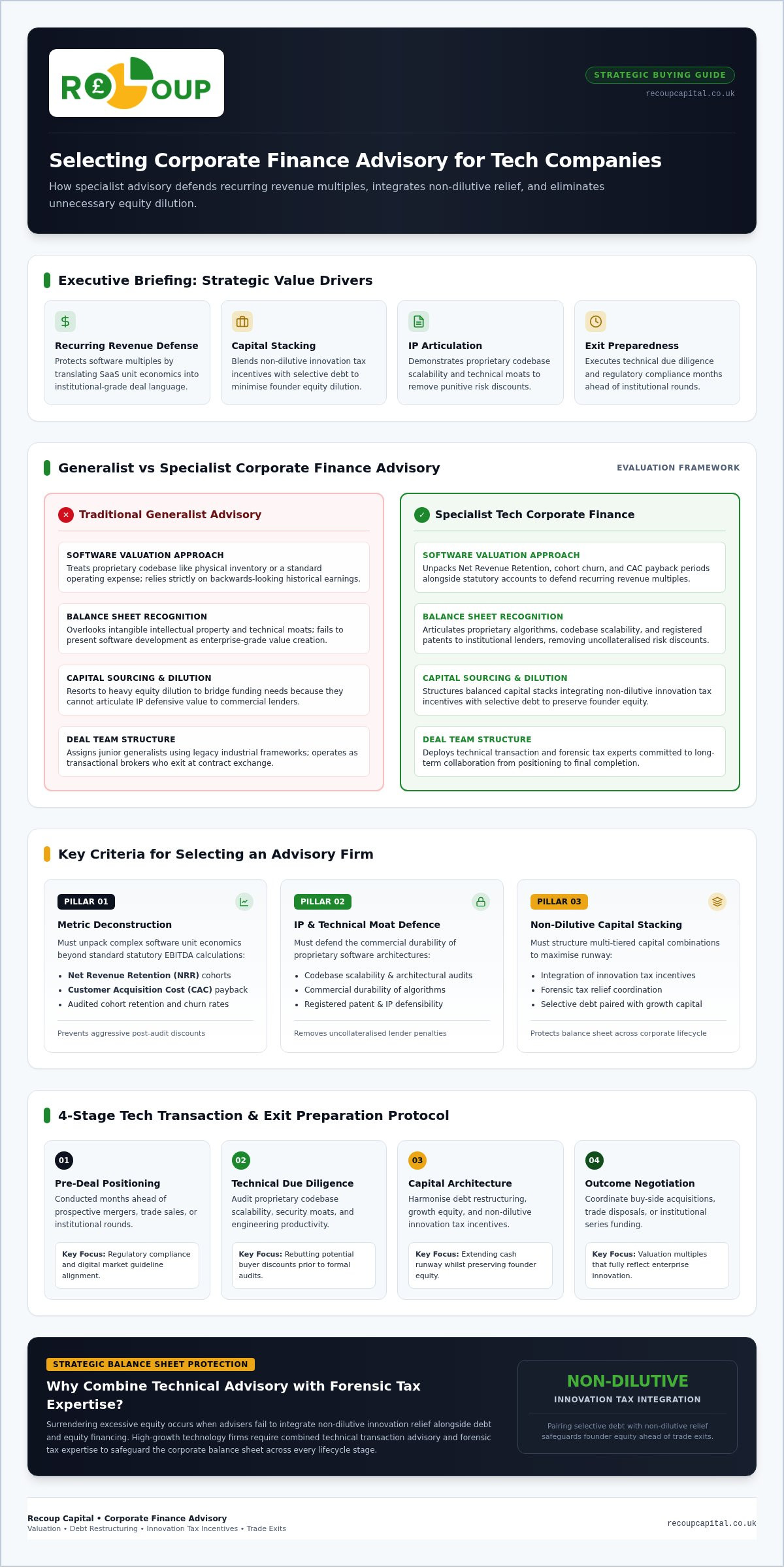
- Intangible Asset Articulation: Demonstrating codebase scalability, technical moats, and IP value to institutional lenders who might otherwise view software development as uncollateralised risk.
- Balanced Capital Stacking: Structuring growth capital to pair non-dilutive relief with selective debt, safeguarding founder equity ahead of future funding rounds or trade exits.
- Regulatory Preparedness: Ensuring transaction structures comply with evolving digital market guidelines and compliance checks well before formal due diligence begins.
Engaging a specialist corporate finance advisory for tech companies ensures that commercial positioning reflects true enterprise potential, turning everyday financial governance into a decisive strategic advantage.
Key Criteria for Selecting a Tech Corporate Finance Advisory Firm
Selecting the right deal partner directly dictates transaction velocity, valuation accuracy, and shareholder dilution. Technology leaders shouldn't rely on brand prestige alone. Many traditional consultancies assign junior generalists who apply legacy industrial frameworks to modern software architectures. An effective corporate finance advisory for tech companies must provide comprehensive support from initial enterprise positioning through to final deal completion. Prioritise teams committed to long-term collaboration rather than transactional deal brokers who disappear the moment contracts are exchanged.
Sector Expertise and Valuation Capabilities
Can your prospective advisory team defend your recurring revenue quality under intense scrutiny? Tech valuation isn't simply an EBITDA calculation; it demands deep fluency in modern software metrics. A specialist adviser should be evaluated on their ability to:
- Deconstruct Core Metrics: Unpack Net Revenue Retention, customer acquisition cost payback periods, and cohort churn alongside audited statutory accounts.
- Defend Proprietary Code: Articulate the commercial durability of proprietary algorithms, technical moats, and registered patents.
- Withstand Buyer Due Diligence: Construct institutional-grade financial models capable of rebutting aggressive post-audit discounts from institutional buyers.
Transaction Structuring and Strategic Alignment
A capable advisory team must manage both buy-side acquisitions and sell-side disposals, while coordinating complex debt restructuring during rapid scale-up phases. When navigating tech mergers under modern UK regulatory scrutiny, procedural precision protects transaction viability. Ensure your chosen corporate finance advisory for tech companies demonstrates tangible value through measurable capital optimisation rather than high-pressure sales pitches. If you are preparing for a funding round or transaction, reviewing strategic corporate finance options early ensures your capital stack is robust before opening formal talks with counterparties.
Valuation, Debt Restructuring, and Integrating Non-Dilutive Capital
Precision valuation forms the cornerstone of every successful transaction. For scaling software businesses, arriving at an accurate figure requires synthesising market transaction multiples, discounted cash flow modelling, and defensible intellectual property assessments. Traditional advisers often isolate balance sheet debt from statutory innovation relief. In contrast, an integrated corporate finance advisory for tech companies aligns commercial borrowing with available innovation incentives, transforming statutory tax recoveries into strategic business assets that reinforce working capital and protect equity.
Precision Tech Valuation Methodologies
Valuing digital enterprise demands far more than applying generic revenue multipliers. Advisers must separate routine maintenance overheads from genuine experimental development to show true operating leverage. Clear technical separation provides an unassailable negotiation footing when presenting to lenders or institutional buyers. As seen in standards maintained by UK Government Corporate Finance Advisory frameworks, institutional financial evaluations require transparent, defensible methodologies that connect underlying assets to measurable commercial outputs.
Synergies Between Corporate Finance and Tax Recovery
Debt restructuring provides vital operational runway without forcing founders to surrender substantial equity. Coupling this restructuring with innovation relief significantly reduces effective capital costs. Integrating strategic financial engineering with technical tax incentives yields decisive advantages:
- Non-Dilutive Capital Injections: Proactively claiming R&D tax credits converts qualifying technical expenditure directly into liquid cash, reducing reliance on expensive senior debt facilities.
- Balance Sheet Reinforcement: Reinvesting tax savings improves net asset positions, strengthening credit profiles ahead of covenant renegotiations with commercial lenders.
- Synchronised Growth Planning: Aligning transaction timetables with tax filing cycles ensures corporate finance advisory for tech companies captures all available relief before formal audits begin.
By blending technical debt structuring with innovation tax recovery, strategic corporate finance ensures fast-growing firms fund continuous development while keeping equity firmly in the hands of existing shareholders.
Navigating Tech Mergers, Acquisitions, and Exit Preparation
Executing an acquisition or planning an exit demands rigorous operational preparation. Deal fatigue and distracted leadership can damage quarterly performance, which immediately weakens a company's position at the negotiating table. Specialist corporate finance advisory for tech companies protects commercial focus. By managing due diligence requests, building comprehensive virtual data rooms, and coordinating technical audits, an advisory team ensures core development and sales cycles continue undisturbed throughout every stage of the transaction.
Strategic Acquisition Advisory for Growth
Acquiring complementary platforms accelerates market penetration and adds essential engineering capability. Strategic buy-side advisory, such as that provided by specialist consultancies like PP-X, ensures technology firms buy genuine capability rather than unexpected liabilities. A disciplined approach addresses three fundamental pillars:
- Commercial and Technical Synergy: Assessing whether target systems integrate smoothly with existing architectures or carry prohibitive technical debt.
- Transaction Architecture: Balancing up-front cash consideration with structured, milestone-based earn-outs that align the incoming leadership team with future commercial performance.
- Forensic Risk Auditing: Reviewing historical software contractor assignments to confirm that all proprietary intellectual property rights have formally vested with the target business.
Exit Readiness and Business Disposals
Preparing a digital business for sale begins months before reaching out to prospective purchasers. Clean governance drives valuation premiums. Corporate documentation, software licences, customer service level agreements, and historical tax filings must be structured into an audit-ready virtual data room. This documentation proves to institutional buyers that recurring revenues are secure and unencumbered by hidden contractual liabilities. To address technical debt and align data, cybersecurity, and engineering processes before scrutiny begins, leadership teams can explore Executive Technology Advisory and Fractional CTO Services to ensure their platform is exit-ready.
Multi-party negotiations require experienced representation. Specialist corporate finance advisory for tech companies ensures that warranty frameworks, indemnities, and deferred payments do not expose founders to post-completion clawbacks. If you are preparing for an acquisition, funding round, or future trade sale, explore strategic corporate finance solutions to strengthen your transactional position well ahead of formal buyer engagement.
Partnering with Recoup Capital for Tech Corporate Finance
Securing the right transaction partner shouldn't involve high-pressure sales pitches or rigid, one-size-fits-all contracts. Innovative British businesses require an advisory team that measures its own success by demonstrable commercial outcomes. Operating nationally, Recoup Capital delivers strategic corporate finance advisory for tech companies, blending high-level transaction execution with forensic tax accounting. We replace conventional transactional brokerage with long-term collaboration, ensuring tech leadership teams make decisive capital decisions backed by institutional-grade financial analysis.
Strategic Guidance Across the Corporate Lifecycle
Whether your business is executing a buy-side consolidation, preparing for a trade sale, or restructuring existing borrowing facilities, our team provides specialist end-to-end guidance. We work alongside founders and management boards across the UK to deliver:
- Authoritative Valuations: Establishing defensible enterprise valuations that capture intangible digital assets, recurring revenue predictability, and underlying software defensibility.
- Acquisitions and Disposals: Managing complex transaction pipelines, structuring milestone-based consideration, and negotiating robust legal terms that shield owners from post-deal liabilities.
- Debt Restructuring: Renegotiating facility covenants and realigning capital stacks to extend operating runway without forcing immediate equity dilution.
The Integrated Capital Advantage
What sets Recoup Capital apart is our dual capability in transaction execution and innovation tax recovery. Traditional dealmakers regularly isolate corporate transactions from statutory tax incentives. By uniting strategic corporate finance with relief mechanisms like capital allowances and innovation claims, we turn statutory entitlements into proactive strategic capital. Every tax recovery actively strengthens the balance sheet, lowers borrowing requirements, and enhances overall enterprise valuation.
Building sustainable equity value requires ongoing collaboration rather than brief transaction-driven interventions. If you are assessing prospective acquisitions, seeking debt restructuring, or planning an upcoming disposal, our dedicated specialists can review your strategic position. Connect with our advisory team to discover how a unified corporate finance advisory for tech companies can protect your equity and accelerate your commercial ambitions.
Securing Your Technology Firm's Capital Future
Achieving peak valuation requires an advisory model built specifically for intangible software assets. When you integrate non-dilutive tax relief directly into broader financing plans, your business preserves founder equity, extends operating runway, and negotiates from a position of clear strength. Our dedicated chartered tax accountants and experienced corporate finance specialists provide end-to-end expertise across mid-market valuations, strategic acquisitions, and debt restructuring. By uniting transaction execution with forensic tax recovery, we transform balance sheet management into a measurable commercial advantage.
Selecting the right corporate finance advisory for tech companies ensures your recurring revenues and intellectual property receive the market recognition they deserve. You don't have to surrender excessive equity or face complex transaction hurdles alone. Speak with our corporate finance specialists to explore strategic growth options and discover how a long-term advisory partnership will protect and accelerate your enterprise value.
Frequently Asked Questions
What does corporate finance advisory for tech companies include?
It encompasses strategic transaction planning, valuation of intangible assets, capital restructuring, and M&A execution. Specialist corporate finance advisory for tech companies covers buy-side acquisitions, sell-side exit readiness, and debt advisory. Beyond standard transaction brokerage, it aligns commercial growth with balance sheet optimisation, incorporating innovation tax recovery mechanisms to fund expansion and protect shareholder equity throughout corporate milestones.
How do corporate finance advisers value proprietary software and IP?
Advisers evaluate proprietary technology by combining forward-looking revenue multiples with deep analysis of code defensibility, gross margin profiles, and net revenue retention. Rather than relying purely on historical accounts, specialist practitioners benchmark customer lifetime value against acquisition costs. They assess the commercial durability of underlying algorithms, architectural scalability, and registered patents to build an evidence-based valuation model that buyers and lenders respect.
Can tech corporate finance help reduce equity dilution during funding rounds?
How much advance preparation is needed before selling a technology business?
Technology businesses typically require six to twelve months of advance preparation before entering the market. This runway allows leadership to clean up historical customer contracts, resolve technical debt, and ensure developer assignment agreements protect all intellectual property. Preparing early enables advisers to build an institutional-grade virtual data room, address potential due diligence red flags, and optimise revenue quality to command top-tier valuation multiples.
What is the difference between debt restructuring and raising venture debt?
Debt restructuring reorganises existing credit lines and loan covenants, whereas venture debt introduces new senior borrowing typically paired with equity warrants. Restructuring focuses on optimising current balance sheet liabilities, extending repayment terms, and freeing working cashflow without issuing warrants. Advisers evaluate your operational runway and risk profile to determine whether modifying existing commitments or securing new non-dilutive facilities represents the most capital-efficient route.
How do innovation tax reliefs integrate into corporate finance strategy?
Innovation incentives such as R&D tax credits and Patent Box function as non-dilutive strategic assets that directly strengthen enterprise balance sheets. Specialist corporate finance advisory for tech companies synchronises these tax recoveries with transaction timelines and debt covenants. Tax savings enhance cash reserves, lower external borrowing needs, and demonstrate higher net operational profitability, creating immediate leverage during formal valuation discussions and funding rounds.


