

A corporation tax refund sitting in your bank account isn't an ironclad guarantee that HMRC considers the matter closed. With the Revenue intensifying forensic compliance checks across UK industry, mitigating the risk of an HMRC clawback has rapidly shifted from a year-end accounting detail into an urgent boardroom priority.
You already know how frustrating it is to invest significant capital into complex engineering or software projects, only to face murky eligibility rules and the sudden fear of cash-flow shocks from clawback assessments. Defensible tax relief stems from real-time technical substantiation, not retrospective calculations assembled long after work finishes. In this guide, you will discover how to safeguard your corporation tax reliefs against aggressive HMRC clawbacks with defensible technical records that stand up to scrutiny. We outline the mechanics behind statutory clawback timeframes, clarify current digital filing standards, and provide a practical compliance framework to insulate your past and future claims.
Key Takeaways
- Discover why automated HMRC risk-profiling tools target retrospective accounting estimates, and identify the red flags that trigger forensic scrutiny.
- Learn a practical five-step operational framework for mitigating the risk of an HMRC clawback through robust, contemporaneous project records.
- Establish clear boundaries between routine commercial problem-solving and genuine technological uncertainty to satisfy mandatory digital submission standards.
- Master tactical protocols to manage formal enquiries calmly, ensuring historic claim files are audited before responding to compliance officers.
- Future-proof your corporation tax relief by combining chartered tax governance with sector-specific technical oversight to insulate working capital.
Understanding HMRC Clawbacks: Triggers, Powers, and Increased Scrutiny
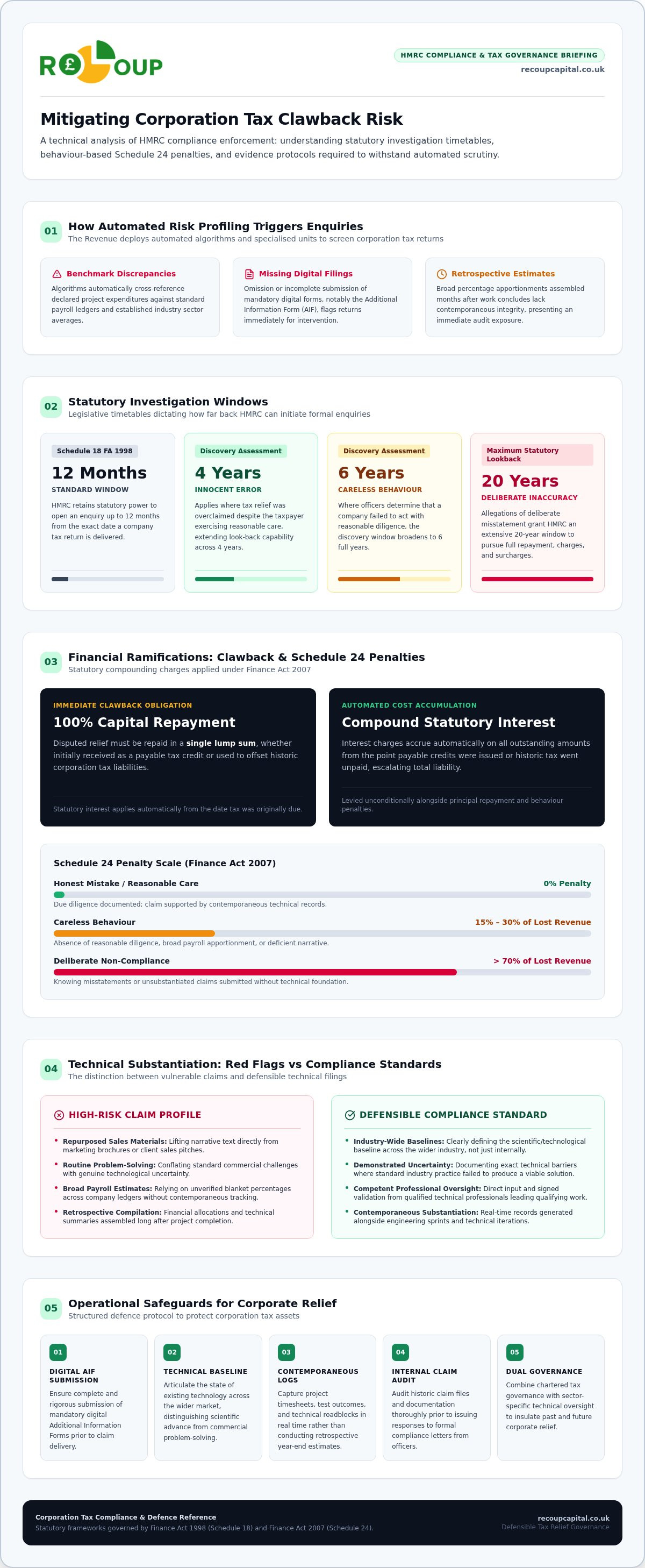
An HMRC clawback occurs when tax authorities determine that previously awarded tax reliefs or payable credits were claimed incorrectly. This triggers a formal recovery process demanding the full return of those corporate funds alongside statutory charges. For UK businesses, HM Revenue and Customs (HMRC) now deploys automated risk-profiling systems and dedicated compliance units to analyse corporation tax returns. These algorithms flag anomalies between declared project costs, payroll data, and industry benchmarks, instantly turning routine submissions into high-stakes investigations. Mitigating the risk of an HMRC clawback demands that directors understand how these statutory interventions operate before cash reserves are compromised by sudden assessment notices. You can establish a firm baseline by reviewing how rd tax credits explained under current statutory guidelines dictate allowable expenditure.
The Statutory Windows: How Far Back Can HMRC Go?
HMRC operates under defined legislative timetables when opening enquiries into corporation tax returns:
- Standard enquiry window: HMRC generally has twelve months from the date a return is delivered to open a formal enquiry under Schedule 18 of the Finance Act 1998.
- Discovery assessments for innocent error: If the standard window has lapsed, officers can look back four years if they discover relief was overclaimed despite reasonable care.
- Careless behaviour: Where the Revenue determines that a company failed to act with reasonable diligence, the discovery window expands to six years.
- Deliberate inaccuracy: Allegations of deliberate misstatement give HMRC up to twenty years to pursue repayments and adjustments.
Financial Ramifications: Relief Repayment, Interest, and Penalties
The immediate consequence of a clawback is cash-flow disruption. Businesses must repay the disputed relief in a single lump sum, whether received as a payable tax credit or used to offset historic corporation tax liabilities.
Statutory interest accrues automatically from the date the tax was originally due or the payable credit was issued. On top of interest charges, HMRC levies behaviour-based penalties under Schedule 24 of the Finance Act 2007. These fines scale significantly: honest mistakes with reasonable care carry 0% penalties, careless filings attract penalties between 15% and 30%, whilst deliberate non-compliance can exceed 70% of the potential lost revenue. Mitigating the risk of an HMRC clawback through documented due diligence remains the only certain protection against these compounding financial penalties.
Primary Vulnerabilities That Prompt Formal HMRC Clawback Investigations
Most corporate clawbacks do not originate from calculated fraud. Instead, they stem from everyday operational documentation breakdowns. When examining filings, compliance officers look for systematic gaps where financial ledgers fail to substantiate the underlying technical claims. Missing mandatory submissions, such as an incomplete digital Additional Information Form (AIF), instantly red-flags a claim within automated systems. By understanding where historic filings typically fail during official HMRC compliance checks, businesses can take deliberate steps towards mitigating the risk of an HMRC clawback before enquiry letters arrive.
Technical Narrative Deficiencies Under Project Guidelines
A frequent error is lifting narrative text directly from marketing brochures or client sales pitches rather than detailing genuine technological baselines. To satisfy statutory criteria, claims must articulate:
- The precise scientific or technological baseline existing across the wider industry, not just within the company itself.
- The exact technological uncertainties encountered where standard industry practices failed to produce a viable solution.
- Direct input and signed validation from competent technical professionals leading the qualifying work.
Conflating everyday commercial problem-solving with true scientific advance leaves a claim deeply exposed to retrospective recovery.
Cost Allocation and Expenditure Documentation Flaws
HMRC regularly rejects claims that rely on broad, unverified percentage estimates across entire company payrolls. If three software engineers are listed as dedicating 80% of their annual time to qualifying projects, inspectors expect contemporaneous project management tickets, sprint logs, or real-time timesheets proving that allocation. Similarly, claiming indirect overheads such as marketing campaigns, legal fees, or untracked third-party subcontractor invoices creates serious audit exposure. Without a traceable chain connecting the company nominal ledger directly to eligible qualifying cost centres, relief amounts collapse under inspection.
Capital and Property Scheme Misalignments
Vulnerabilities also extend across commercial property and infrastructure claims. In capital allowances submissions, categorising building expenditure into integral features without forensic surveyor analysis prompts immediate clawback demands. Maximising corporate property relief requires exploring specialist capital allowances protocols backed by detailed asset manifests. Likewise, claiming land remediation relief requires strictly verified ground condition reports rather than general development summaries. Partnering with a dedicated technical advisor at Recoup Capital ensures these property and innovation expenditure claims rest on unassailable statutory foundations, protecting your corporate balance sheet against future clawback exposure.
A Five-Step Operational Framework for Mitigating Clawback Exposure
Defending corporate tax incentives requires treating compliance as an operational discipline rather than an annual bookkeeping exercise. When businesses assemble evidence in real time, retrospective guesswork disappears. Implementing a structured internal framework ensures that every pound claimed rests on verifiable documentation, effectively mitigating the risk of an HMRC clawback before figures enter your company tax return.
Step 1 & 2: Establishing Real-Time Technical and Financial Baselines
Begin documentation at project kick-off rather than year-end. For software, engineering, and manufacturing teams, this means capturing living operational evidence as work progresses:
- Archive project sprint tickets, version control commits, architectural diagrams, and failed test reports.
- Record dedicated project hours monthly through real-time time-tracking software, establishing a direct link between qualifying development and specific payroll costs.
- Establish clear project milestones that strictly separate technical exploration from commercial production, tooling up, or routine bug fixes.
Clear boundaries protect your expenditure ledger. When inspectors challenge cost apportionments, contemporaneous records prove exact resource commitments.
Step 3 & 4: Objective Pre-Submission Stress Testing
Never file figures without rigorous peer review. Have internal technical leads or independent specialists stress-test qualifying narratives against statutory competent professional benchmarks. This internal challenge tests whether the project genuinely sought an advance in overall capability, or merely solved a commercial problem using known methods.
Following technical validation, audit every claimed invoice directly against general ledger accounts and supplier agreements. Ensure subcontractor contracts clearly assign intellectual property rights and demonstrate that your company directed the underlying qualifying work. Simulating an adversarial compliance check at this stage uncovers evidential gaps while they can still be corrected.
Step 5: Precise Digital Additional Information Form Execution
Executing your digital submission accurately forms the final line of defence. The mandatory digital Additional Information Form requires detailed technical explanations, including how each project sought an advance over existing technology and what specific uncertainties arose. Incomplete fields or conflicting entries trigger automatic risk scoring within the Revenue's intake systems.
Verify that your nominated corporate officer and accredited tax agent details match across all documents. Align every monetary figure on the AIF perfectly with the corresponding entries on your CT600 return. Following this structured procedure gives leadership confidence that every claimed relief stands on concrete, forensic evidence, successfully mitigating the risk of an HMRC clawback across the entire corporate lifecycle.
Defending Open Enquiries: Tactical Responses to Protect Corporate Assets
Receiving an opening enquiry letter from HMRC can unnerve any board of directors. Panicked replies or hasty document dumps often create more problems than they solve. A measured response begins by acknowledging correspondence promptly, confirming that your company is reviewing the questions raised, whilst avoiding any premature admissions regarding project eligibility. Before sending any legacy documentation to an inspector, conduct an independent audit of your historic files to establish the technical strength of the position. Exploring established guidelines on claiming rd tax credits helps companies benchmark their filing packs against current enforcement standards before formal replies are dispatched.
Managing Schedule 36 Information Notices Strategically
HMRC frequently issues formal Information Notices under Schedule 36 of the Finance Act 2008. These notices legally compel businesses to provide specific documentation, but that power is not unlimited:
- Assess whether each requested item is "reasonably required" to check the tax position, ensuring inspectors do not pursue open-ended speculative trawls.
- Maintain open, professional dialogue with the enquiry officer whilst preserving legal professional privilege over internal advisory consultations.
- Request formal, realistic time extensions immediately if collating complex legacy engineering logs, code commits, or historic subcontractor agreements requires extensive archiving work.
A well-ordered, precise evidentiary package signals competence and sets a constructive tone for resolution.
Mitigating Behavioural Penalties Through Prompt Disclosures
When technical adjustments prove necessary, your conduct throughout the enquiry dictates whether financial penalties are applied. HMRC classifies taxpayer conduct into distinct categories: reasonable care, carelessness, or deliberate understatement. Demonstrating that your business exercised reasonable care involves showing that claims were prepared using qualified competent professionals, contemporaneous logs, and accredited taxation advisors.
By providing structured, prompt disclosures, companies separate genuine technical disagreements from careless oversight. Full cooperation can reduce statutory penalties down to nil for non-deliberate errors, dramatically mitigating the risk of an HMRC clawback escalating into severe financial penalties. If your company is facing an active compliance check or needs to defend historic filings, partner with Recoup Capital's specialist tax defence team to manage inspector negotiations and safeguard corporate balance sheets.
Future-Proofing Tax Relief: Aligning Long-Term Strategy with Compliance
Transforming corporation tax relief from an annual scramble into an ongoing corporate governance discipline is the most reliable way to protect your business. Waiting until year-end to reconstruct why an engineering trial failed or which software architecture proved non-viable introduces substantial evidential drift. Conducting periodic health checks on prior accounting periods while statutory amendment windows remain open allows finance leaders to identify vulnerabilities early and adjust filings proactively. Adopting this structured mindset turns tax incentives into dependable capital assets while mitigating the risk of an HMRC clawback across future financial years. For direct answers on maintaining audit-ready submissions across your projects, explore our detailed faqs resource.
Generalist Accounting vs Specialist Technical Tax Advisory
Standard accountancy practices deliver vital statutory compliance, yet they rarely retain software architects, civil engineers, or forensic surveyors on staff. When the Revenue scrutinises a claim, compliance teams don't challenge the basic accounting maths; they challenge the underlying technological uncertainty. Generalist advisors often lack the sector-specific terminology needed to refute an inspector's technical objections.
Specialist advisory teams solve this problem by pairing chartered tax professionals directly with industry technical specialists. These advisers have extensive experience handling national HMRC enquiry units, understanding precisely how inspectors frame technical rejections. This dual approach ensures corporate innovation claims remain thoroughly defensible without diverting your engineering leads away from core commercial milestones.
Embedding Continuous Evidence Gathering into Corporate Operations
Sustainable tax compliance requires integrating record-keeping directly into routine development workflows rather than treating it as an afterthought:
- Integrate compliance milestone checkpoints into current project management software, sprint boards, and technical review gates.
- Mandate that lead engineers log scientific uncertainties and experimental hypotheses when scoping technical work, rather than attempting to recall them twelve months later.
- Establish quarterly financial reviews to reconcile qualifying project expenditure directly against general ledger cost centres in real time.
When you capture qualifying activities as they occur, your corporation tax filings cease to be speculative calculations. Instead, they become verifiable records of commercial innovation. Treating tax relief as a strategic corporate asset protected by continuous governance provides complete operational certainty, mitigating the risk of an HMRC clawback and insulating your balance sheet for long-term growth.
Safeguard Your Innovation Capital Against Regulatory Scrutiny
Securing corporation tax relief shouldn't expose your business to destabilising cash shocks or retrospective assessments. As HMRC sharpens its automated compliance checks, retrospective estimates are no longer viable. Mitigating the risk of an HMRC clawback requires an active compliance culture: capturing contemporaneous technical logs, separating technological uncertainty from routine development, and stress-testing every submission before filing.
When technical documentation aligns seamlessly with financial ledgers, tax incentives become dependable growth assets rather than balance sheet liabilities. Recoup Capital pairs chartered tax accountants with industry technical experts to construct comprehensive audit trails that withstand aggressive HMRC scrutiny. Backed by proven success defending corporate clients against complex regulatory enquiries nationwide, we provide end-to-end management that protects your working capital. Request a confidential claim health check with our chartered team to insulate your past and future relief with total confidence.
Frequently Asked Questions
What exactly is an HMRC clawback on corporation tax reliefs?
An HMRC clawback is the statutory recovery of tax incentives previously claimed or paid out, triggered when compliance officers find non-qualifying costs or ineligible projects. If an enquiry disallows relief, HMRC issues an assessment demanding repayment of the Corporation Tax credit or deduction. The business must repay that principal sum alongside continuous late-payment interest charges from the original due date.
How far back can HMRC investigate historic tax incentive claims?
HMRC investigates claims across different statutory windows depending on how figures were compiled. The standard formal enquiry window lasts twelve months after filing your Company Tax Return. Under discovery powers, inspectors can revisit four years for genuine mistakes where reasonable care was taken. However, allegations of careless preparation extend that lookback window to six years, whilst deliberate tax evasion permits reviews dating back twenty years.
What are the common triggers for an HMRC compliance check?
Automated risk profiles flag corporate filings displaying sudden spikes in claimed expenditure compared to turnover or prior years. Other frequent triggers include filing generic technical descriptions, high subcontractor-to-staff ratios, round-number percentage apportionments on payroll, or discrepancies between your CT600 figures and digital disclosure forms. Random sector-wide compliance sweeps also trigger checks across innovative industries.
Can HMRC charge financial penalties alongside reclaiming overpaid tax relief?
Yes, HMRC routinely issues financial penalties under Schedule 24 of the Finance Act 2007 on top of the clawed-back relief and statutory interest. Penalties depend strictly on taxpayer behaviour. Where a business demonstrates reasonable care with documented evidence, penalties are set to nil. Conversely, careless errors attract fines between 15% and 30% of the lost tax revenue, whilst deliberate inaccuracies can exceed 70%.
What is the difference between careless and deliberate behaviour under HMRC rules?
Careless behaviour means a company failed to exercise reasonable diligence when assessing eligibility or collating costs, such as relying on unsubstantiated estimates without checking statutory guidelines. Deliberate behaviour occurs when directors knowingly submit misleading technical statements or false expenditure figures to secure an unentitled tax advantage. Demonstrating proactive governance is essential for mitigating the risk of an HMRC clawback escalating into severe deliberate penalties.
How does the mandatory Additional Information Form impact clawback risks?
The mandatory digital Additional Information Form forces companies to submit detailed project descriptions, technical uncertainty logs, and accredited agent details before filing their CT600. Incomplete, vague, or missing AIF submissions cause HMRC systems to reject corporate tax returns automatically. Submitting rigorous, contemporaneous technical data via this digital gateway significantly aids in mitigating the risk of an HMRC clawback by establishing compliance upfront.
What should our business do immediately upon receiving an HMRC enquiry letter?
Acknowledge receipt of the letter professionally while strictly observing the statutory deadline for response. Do not immediately dispatch internal files or make unconsidered admissions regarding project scope. Instead, conduct an independent technical audit of your historic filing pack to evaluate the strength of your evidence, and engage specialist chartered tax advisers to manage all subsequent communications with the compliance officer.


