

What if delivering complex technical work under a commercial contract didn't mean surrendering your innovation incentives? For directors managing specialist teams, understanding the RDEC scheme for SMEs working as subcontractors has often felt fraught with ambiguity. Following legislative reforms merging the legacy SME and RDEC rules, you might legitimately worry that client agreements automatically forfeit your claim or invite aggressive HMRC compliance scrutiny. That uncertainty is understandable, particularly when untangling shifting statutory rules around contracted-out activity.
The reality is reassuring: subcontracted innovation isn't automatically off-limits, because eligibility hinges strictly on who contemplated and specified the technological advance. Discover how your SME can successfully claim R&D relief under the RDEC mechanism when delivering specialist subcontracted work. In this 2026 guide, we clarify your legal entitlements, demonstrate how to structure commercial contracts to safeguard qualifying projects, and show you how to compute net above-the-line benefits to inject dependable working capital directly back into your business cashflow.
Key Takeaways
- Pinpoint how commercial agreements dictate claim rights under the statutory intended or contemplated standard, clarifying whether your business or your client holds the relief.
- Understand how the merged RDEC scheme for SMEs working as subcontractors transforms technical problem-solving into predictable working capital for your balance sheet.
- Learn how the 20% headline expenditure credit translates into dependable net cashflow benefits following Corporation Tax offsets and statutory deductions.
- Establish rigorous technical narratives and contemporaneous evidence trails aligned with HMRC compliance standards to eliminate audit vulnerabilities.
- Master practical contracting strategies that secure your intellectual property rights and prevent costly claim disputes across multi-tier supply chains.
Understanding the RDEC Scheme for SME Subcontractors
Historically, commercial supply chains created an awkward statutory barrier for innovative engineering and technical firms. When small specialists resolved complex technical challenges under a client contract, HM Revenue & Customs (HMRC) frequently ruled that the work was subsidised or contracted out. This disqualified the spend from the legacy SME scheme's enhanced deductions. To recover these vital investments, businesses turned to the Research and Development Expenditure Credit (RDEC). Today, understanding how the RDEC scheme for SMEs working as subcontractors operates is critical, because legislative reforms have completely reshaped how contracted innovation is treated.
Why Subcontractors Were Channeled into RDEC
Under the pre-April 2024 tax framework, the primary SME relief regime contained stringent restrictions against subsidised activities. If a large corporate customer commissioned an SME to deliver technical solutions, legislation treated that project as client-funded. That interpretation effectively locked the SME out of standard relief.
RDEC offered a statutory lifeline. Originally intended for large companies, specific provisions allowed SMEs to step into the RDEC mechanism when delivering subcontracted tasks for large entities or public bodies. Instead of forfeiting relief altogether, specialist subcontractors could claim a taxable expenditure credit. It wasn't merely a tax accounting entry; it generated reliable working capital that rewarded real technical risk.
The Evolution to the Unified Merged Scheme
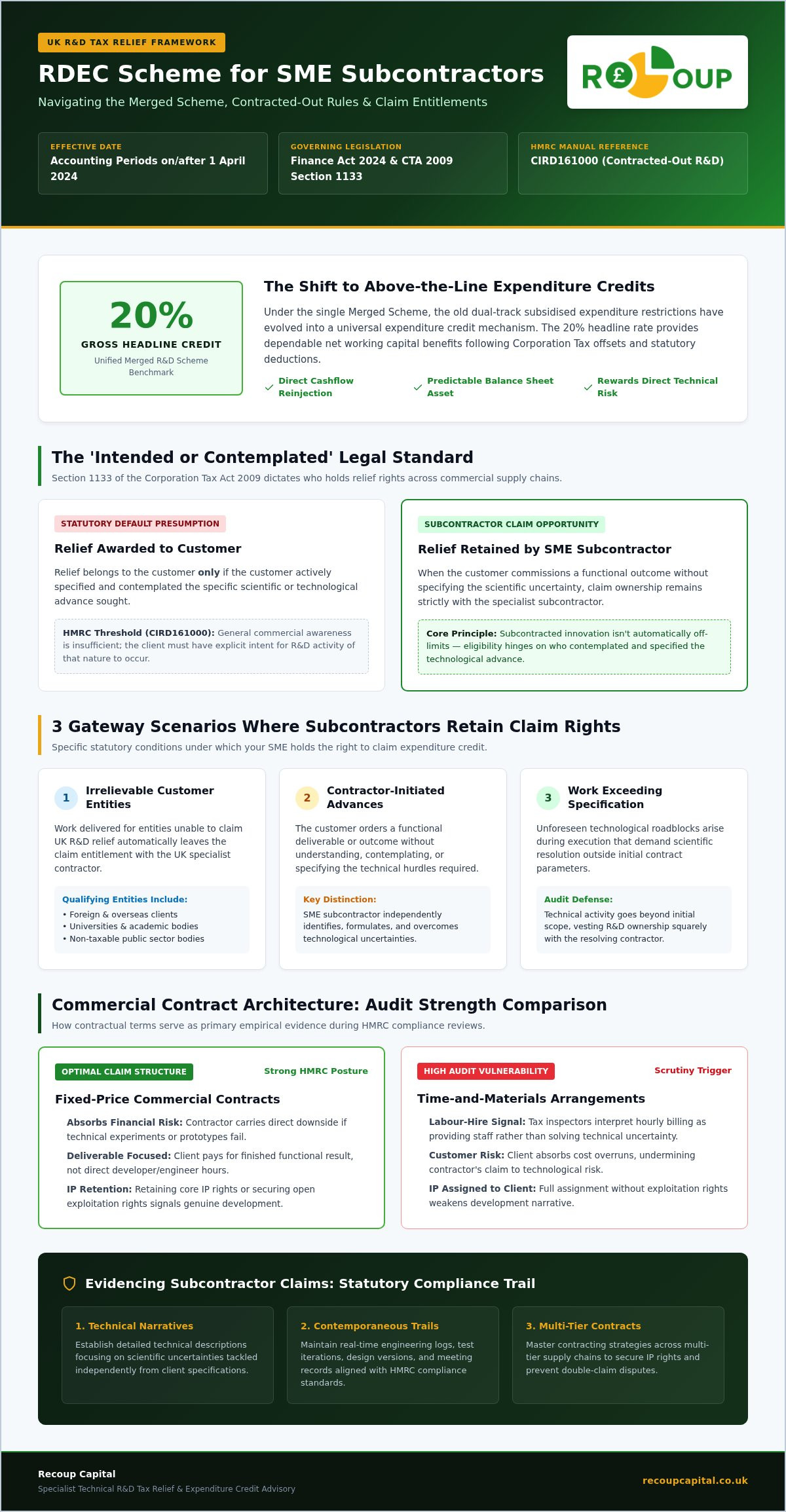
The legislative framework changed fundamentally for accounting periods beginning on or after 1 April 2024. Under the Finance Act 2024, the government merged the dual-track system into a single Merged R&D Scheme. This universal regime operates on expenditure credit principles, establishing a 20% gross credit as the default benchmark across all business sizes.
Rather than relying on old subsidised expenditure debates, current rules pivot on who intended and contemplated the underlying advance. The merged RDEC scheme for SMEs working as subcontractors now demands closer scrutiny of contractual boundaries and scientific uncertainties than ever before. For a comprehensive walkthrough of these baseline mechanics, review our R&D tax credits explained guide.
Contracted-Out R&D: Who Holds the Right to Claim?
Determining claim ownership between customer and contractor is now one of the most contentious areas in UK corporate tax. Under Corporation Tax Act 2009 Section 1133, the default presumption awards the tax relief to the customer rather than the contractor, but only if specific statutory conditions are satisfied. This makes participating in the RDEC scheme for SMEs working as subcontractors dependent on the exact commercial circumstances framing the work.
Deciphering the 'Contemplated R&D' Legal Test
To bar a subcontractor from claiming, the customer must have actively understood and specified the scientific or technological advancement sought. As detailed within the HMRC manual on contracted-out R&D (CIRD161000), general commercial awareness is insufficient; the client must have intended or contemplated that specific research of that nature would occur. An SME subcontractor retains the right to claim when:
- The customer is an irrelievable entity: Work delivered for foreign overseas clients, universities, or non-taxable public bodies leaves the relief with the UK contractor.
- Contractor-initiated advances: The client orders a functional deliverable without knowing or caring about the technical uncertainties the contractor independently overcomes.
- Work exceeds the specification: Unforeseen technological roadblocks arise that require resolution outside the initial contract parameters.
Commercial Risk, IP, and Contract Architecture
Commercial structure serves as primary evidence during HMRC audits. Fixed-price contracts significantly strengthen a subcontractor's position because your business absorbs the financial downside if technological experiments fail. Time-and-materials arrangements, conversely, often signal to tax inspectors that the client simply hired staff rather than buying an innovative result.
Intellectual property (IP) terms matter just as much. Retaining core IP rights or securing open exploitation rights signals genuine development ownership. If your business regularly negotiates bespoke engineering deliverables, reviewing contract wording before execution ensures commercial terms don't inadvertently surrender valuable relief. You can explore how we assist with these contractual nuances through our specialist R&D tax credits consultancy.
Evaluating who formulated the technological uncertainties early protects your balance sheet. When contracts remain silent on research and your engineers independently innovate to overcome physical constraints, claiming under the RDEC scheme for SMEs working as subcontractors remains a viable pathway to unlock working capital.
Calculating the Value: How Expenditure Credits Work for Subcontractors
Calculating financial returns under expenditure credit mechanics requires understanding how gross figures convert into bottom-line cashflow. Unlike traditional super-deductions that simply reduced taxable profits, an expenditure credit functions above the line as taxable income. For companies utilising the RDEC scheme for SMEs working as subcontractors, this distinction changes balance sheet presentation and corporate tax forecasting.
The Above-the-Line Accounting Mechanism
The regime operates on a gross headline credit rate of 20% applied directly to qualifying R&D spend. Because the credit represents taxable trading income, your net recovery depends on your Corporation Tax bracket:
- Profitable SMEs at the main rate (25%): Your business achieves a net return of 15% on qualifying expenditure (20% gross credit minus 25% Corporation Tax).
- Small profits rate (19%) or loss-making SMEs: Under statutory rules, the notional tax deduction applied at Step 2 is capped at the 19% small profits rate, yielding a net cash benefit of 16.2p per £1 of qualifying spend.
Releasing cash involves navigating a mandatory 7-step discharge mechanism under Part 13 of the Corporation Tax Act 2009. The gross credit first offsets your current period Corporation Tax liability. After applying the notional tax deduction, the remaining payable element faces a PAYE and Class 1 National Insurance cap of £20,000 plus 300% of the company's relevant liability. Remaining funds settle other accounting periods or outstanding HMRC liabilities like VAT, before the balance is paid as a cash sum.
Eligible Expenditure for Specialist Subcontractors
Capturing the full financial value means auditing internal costs precisely. Staff salaries, employer Class 1 NICs, and mandatory employer pension contributions form the bulk of qualifying spend for engineering and development teams. Consumable items destroyed or transformed during experimental testing, such as raw steel, chemicals, or specialised fuel and power, also qualify.
Cloud hosting and specialized computational data licences represent high-value costs for technical contractors resolving complex design challenges. HMRC requires strict adherence to HMRC Guidelines for Compliance (GfC3) when linking these costs to genuine technological advancements. You can discover the practical boundaries when claiming R&D tax credits on specialist software by reviewing our dedicated filing guidelines.
Managing the RDEC scheme for SMEs working as subcontractors accurately turns previously disregarded project costs into predictable working capital for future business reinvestment.
Step-by-Step Compliance: Evidencing Subcontractor Claims for HMRC
Submitting a successful claim under the RDEC scheme for SMEs working as subcontractors requires forensic record-keeping and clear procedural compliance. HMRC compliance officers systematically interrogate subcontractor claims, actively seeking evidence that the lead contractor dictated all technical methods. To withstand rigorous scrutiny, your technical justification must prove that experimental uncertainty was identified, tackled, and recorded by your team in real time.
Reviewing Contracts and Statements of Work
Compliance begins long before filing Corporation Tax paperwork. Audit every client agreement, Statement of Work (SOW), and change order to distinguish commercial milestones from independent problem-solving. Review your documentation against three critical criteria:
- Deliverable specifications: Ensure contracts outline functional targets rather than step-by-step technical blueprints prescribed by your client.
- Contemporaneous communications: Retain technical emails, site notes, and sprint logs proving your team alerted the client to unexpected physical or digital roadblocks.
- Financial risk points: Highlight terms where your business remained commercially responsible for rectifying technical failures at your own cost.
Drafting Robust Technical Project Narratives
HMRC's Guidelines for Compliance demand that narratives establish industry-wide baselines rather than mere company-level novelty. State explicitly what standard tools or accepted engineering methodologies failed when attempting to meet the contract objectives. Clearly define the scientific or technological uncertainties your competent professionals resolved, outlining the hypotheses formed, testing conducted, and technical conclusions reached.
Managing Mandatory Additional Information Submissions
Filing requires submitting an electronic Additional Information Form (AIF) before or alongside your CT600 return. HMRC automatically removes R&D claims from corporate tax filings if this digital form is absent. You must identify an internal Competent Professional with verifiable qualifications, record named senior company officers approving the claim, and provide granular expenditure breakdowns mapped to specific development projects.
Timing remains critical across the submission lifecycle. New claimants or companies inactive for three consecutive years must file a digital Claim Notification Form within six months of their accounting period end date. You then have a statutory two-year claim window from that period end to finalise your submission. When you need to protect your development spend against regulatory challenges, partner with Recoup Capital to validate your R&D claim.
Structuring contemporaneous records guarantees that claims under the RDEC scheme for SMEs working as subcontractors operate as dependable working capital rather than tax enquiry liabilities.
Strategic Next Steps: Protecting and Maximising Your Claims
Protecting your entitlements under the RDEC scheme for SMEs working as subcontractors requires deliberate forward planning. In complex commercial supply chains, ambiguous agreements create severe tax exposure if multiple companies claim relief for the identical underlying technological activity. Proactive commercial structuring preserves your innovation rewards whilst insulating your balance sheet from HMRC clawbacks.
Avoiding Supply Chain Double-Claiming Traps
Disputes frequently emerge in multi-tier supply chains where tier-one contractors and specialist subcontractors operate without mutual visibility. If a main contractor treats your development work as contracted-out R&D on their Corporation Tax return while you simultaneously claim the same direct expenditure, HMRC compliance algorithms trigger automated risk inquiries across both businesses.
Preventing friction requires establishing clear communication protocols during early commercial procurement. Ensure your Statements of Work explicitly define who bears the technological risk and who directs the experimental methods. When your technical team operates autonomously to solve unforeseen challenges, contemporaneous technical logs serve as concrete proof of ownership. You can explore standard contractual boundary scenarios in our comprehensive tax relief FAQs.
Collaborating with Specialist Tax Advisors
Defending technical submissions demands a united front of engineering knowledge and specialized fiscal insight. Teaming internal engineering staff with chartered tax accountants and technical sector analysts ensures technical narratives meet HMRC's stringent evidentiary expectations without placing excessive administrative strain on internal resources.
A joined-up approach also evaluates your broader corporate tax position. Specialist advisors look beyond research credits to connect eligible capital investment with Capital Allowances or Patent Box incentives, converting fragmented expenditures into substantial working capital. Engaging partners who operate on success-based consultancy fees aligns professional incentives directly with your outcome, eliminating upfront financial exposure.
Establishing repeatable, multi-year documentation routines provides long-term peace of mind. By refining commercial agreements and embedding rigorous technical tracking today, you transform the RDEC scheme for SMEs working as subcontractors into a reliable growth catalyst for your business.
Unlocking Your Subcontracted Innovation Value
Delivering specialist technical contracts should never come at the expense of your tax relief. Under the unified rules, the RDEC scheme for SMEs working as subcontractors offers a powerful vehicle to convert unrecognised development risk into predictable working capital. Entitlement ultimately rests on who contemplated the technological advance, bore the financial exposure, and compiled the contemporaneous evidence required by HMRC.
Navigating multi-tier supply chain contracts and mandatory Additional Information Form filings doesn't have to burden your internal resources. Providing nationwide support across technical industries, our chartered tax specialists and sector analysts manage everything from initial project assessments to complete submission delivery. Operating on success-based fee models, our incentives remain entirely aligned with your financial recovery. Speak with our specialist tax team to confirm your contractual entitlements and protect the capital your technical problem-solving deserves.
Frequently Asked Questions
Can an SME working as a subcontractor claim under the standard SME R&D scheme?
No, SME subcontractors delivering client-commissioned development generally cannot claim under the legacy standalone SME scheme. Customer-funded activities were historically disqualified from enhanced SME deductions, steering businesses toward expenditure credits. For accounting periods starting on or after 1 April 2024, the standalone SME scheme has been replaced by the unified regime for most companies, requiring subcontractors to assess their eligibility under expenditure credit rules.
How do the merged R&D scheme rules impact SME subcontractors?
The merged rules establish an expenditure credit mechanism as the standard framework for all non-intensive UK companies. Under the RDEC scheme for SMEs working as subcontractors, claim rights default to your customer if that customer intended or contemplated the specific R&D. Subcontractors can claim only if the customer is an ineligible entity, or if the technical challenge was initiated and resolved independently without client direction.
What happens if both our client and our company claim for the same work?
Dual claims for identical development activity will immediately trigger automated compliance inquiries from HMRC. Because Corporation Tax Act 2009 Section 1133 dictates that only one entity can claim relief for contracted-out activities, HMRC cross-references submissions across supply chains. Inspectors will examine contracts and project documentation to determine who legally contemplated the advance, clawing back irregular payments and issuing financial penalties.
Does our client need to know that we are claiming R&D tax relief?
No statutory rule forces you to notify customers, but commercial transparency prevents conflicting tax submissions. Your Corporation Tax filing and Additional Information Form remain confidential between your company and HMRC. However, if your client mistakenly assumes they hold the claim rights for your work, duplicate claims flag both entities for review. Aligning commercial terms before starting work eliminates unexpected supply chain friction.
Can we claim under RDEC if our client is based outside the United Kingdom?
Yes, undertaking development for overseas clients provides one of the clearest routes to a compliant subcontractor claim. Non-UK businesses do not fall within the scope of UK Corporation Tax, making them irrelievable customers under statutory provisions. Because foreign clients cannot claim UK relief, the entitlement under the RDEC scheme for SMEs working as subcontractors remains with your UK business, provided the work occurs domestically.
How does HMRC determine who 'contemplated' the research and development?
HMRC investigates whether the customer actively understood and specified the technical uncertainties prior to signing the contract. Inspectors examine tender packs, commercial agreements, and technical schedules to establish who articulated the technological barrier. If the client simply contracted for a functional outcome and was indifferent to how uncertainties were resolved, the subcontractor tackling those barriers retains the statutory right to claim.
What records must an SME subcontractor maintain to defend an HMRC enquiry?
You must maintain contemporaneous technical project logs, executed commercial contracts, and granular cost breakdowns. HMRC expects clear evidence demonstrating the technological baseline, the specific uncertainties faced, and testing notes generated by internal competent professionals. Preserving emails documenting unexpected technical roadblocks and timesheets linking staff directly to experimental phases protects your submission against compliance challenges.


