

What if the specialist you hired to protect your business is actually the one painting a target on it? With HMRC now launching detailed enquiries into approximately 17% of all R&D submissions, the era of "set and forget" tax incentives is officially over. It's understandable if you feel a sense of trepidation regarding complex eligibility rules or the threat of stinging penalties; the regulatory environment has shifted significantly since the introduction of the mandatory Additional Information Form and the May 2026 adviser registration regime. You deserve the maximum relief your innovation warrants, but you shouldn't have to trade away your peace of mind to get it.
We agree that the confusion surrounding recent reforms makes it difficult to distinguish between genuine expertise and high-risk boutiques. This guide provides a comprehensive framework for vetting specialists, showing you how to identify a competent professional for your claim whilst adhering to HMRC's strict GfC3 compliance standards. We'll preview the essential markers of technical rigour, including the vital distinction between your internal technical lead and your external tax partner, ensuring your next submission is both lucrative and bulletproof.
Key Takeaways
- Understand why HMRC’s GfC3 guidelines make technical competence a legal necessity rather than a mere preference for your tax relief.
- Learn the essential checklist on how to identify a competent professional for your claim, focusing on dual-discipline teams that combine STEM expertise with Chartered Tax Adviser status.
- Discover why your year-end accountant may not be equipped for specialist claims and how a partnership with technical experts protects your long-term interests.
- Recognise the red flags of incompetent advice and why a success-based fee model is a vital sign of professional accountability.
- Master the 10-point vetting process to verify sector-specific experience and regulatory compliance before submitting your next claim.
The Landscape of UK Tax Claims: Why Professional Competence is Non-Negotiable
HMRC has fundamentally rewritten the rules of engagement for corporate tax relief. For years, the R&D tax relief market was saturated with volume-based boutiques that prioritised speed over technical accuracy. Today, the 2026 regulatory environment demands a higher standard of rigour. Defining professional competence is now a matter of statutory compliance, particularly under the Guidelines for Compliance (GfC3). A truly competent specialist understands that a claim is only as strong as its technical justification. They must bridge the gap between complex engineering and the R&D tax credits explained in HMRC's manuals. Knowing how to identify a competent professional for your claim starts with looking past the promised refund and examining the technical methodology beneath it.
The Rise of HMRC Scrutiny in 2026
The introduction of the mandatory tax adviser registration regime on 18 May 2026 marked a definitive turning point for UK businesses. HMRC now utilises a £36 million systems overhaul to flag claims submitted by unregistered agents. Under these rules, any commercial tax adviser must meet specific minimum standards or face penalties reaching £10,000. Central to this transparency is the Additional Information Form (AIF). Since August 2023, this digital submission has been mandatory for every R&D claim, requiring the explicit naming of both the senior internal official and the external adviser. Ghostwriting is effectively a thing of the past. HMRC now possesses the data to spot patterns of aggressive over-claiming across an agent's entire portfolio, making the choice of partner more critical than ever.
The Cost of Poor Advice
Cheap advice is almost always a false economy. HMRC’s Mandatory Random Enquiry Programme (MREP2) previously revealed that roughly 50% of SME claims were non-compliant to some degree. If a claim is rejected, the business remains legally liable for the tax lost, regardless of who prepared the paperwork. Directors can face penalties ranging from 15% to 100% of the tax, plus statutory interest, which can cripple a business's cash flow. This underscores why a "success-only" fee model must be supported by robust professional indemnity insurance and staff affiliated with the Chartered Institute of Taxation. Ultimately, a competent professional is an expert who balances maximum eligible recovery with absolute regulatory compliance, acting as a shield for your business centre rather than a source of risk.
When you evaluate potential partners, remember that "success-based" should signal confidence in their competence, not a lack of professional overhead. A specialist firm should be a long-term partner invested in your future growth, providing you with the peace of mind that your claims are robust enough to withstand any level of scrutiny.
Identifying Technical Rigour: Credentials and Experience to Look For
Credentials aren't just letters after a name; they're a safeguard for your business. When you are evaluating potential partners, the core question is how to identify a competent professional for your claim who can stand up to HMRC scrutiny. Technical rigour requires a dual-discipline approach. You need an advisor who understands the nuances of the tax code whilst possessing enough industry-specific knowledge to interview your lead engineers or site managers effectively. Without this combination, a claim often becomes a shallow exercise in data entry rather than a robust technical justification.
Professional Qualifications Decoded
A general accountant is vital for your day-to-day operations, but specialist tax relief requires a deeper level of accreditation. The gold standard in the UK is the Chartered Tax Adviser (CTA) qualification. CTA holders are members of the Chartered Institute of Taxation and must strictly adhere to the HMRC standard for agents. This framework mandates professional competence and due care, providing you with a layer of protection that unregulated "boutique" consultants cannot offer. Ongoing Continuing Professional Development (CPD) is also non-negotiable. With the 2024 merger of R&D schemes and the permanent 100% full expensing for plant and machinery, an advisor who isn't current is a liability.
Industry-Specific Knowledge
Your specialist should speak the language of your sector. If you operate in construction or engineering, your professional must understand what constitutes a technological uncertainty in your field. A generalist often misses "hidden" R&D because they don't recognise the difference between standard practice and a genuine advance. For example, in architectural design, R&D isn't found in standard aesthetic choices. It's found in solving complex structural challenges or environmental performance issues that aren't readily deducible by a competent professional in that field.
For property owners, this rigour extends to forensic surveying. A desk-based assessment is rarely sufficient for high-value capital allowances claims. You need a firm that can conduct physical site surveys to identify qualifying embedded fixtures that a standard depreciation schedule might overlook. Evaluating a firm’s history is equally telling. Look for a specialist that has navigated various economic cycles and legislative shifts. A firm with a multi-year track record in your specific industry is far more likely to produce an enquiry-proof submission than a generalist firm that has only recently added these services to their portfolio. You might find that a quick review of your previous filings by a specialist reveals significant untapped potential that a generalist simply couldn't see.
Specialist Consultants vs. Generalist Accountants: Who Should Handle Your Claim?
Your year-end accountant is the backbone of your financial compliance. They understand your P&L, manage your VAT, and ensure your statutory accounts are filed accurately and on time. However, specialised tax incentives like claiming R&D tax credits require a different lens. A generalist firm often views tax relief through a purely financial prism, whilst a specialist looks through a technical one. Knowing how to identify a competent professional for your claim requires recognising when a project crosses the threshold from standard accounting into specialised technical territory.
Many generalist firms actually prefer to partner with specialists. They recognise that maintaining an in-house team of engineers or forensic surveyors isn't feasible for their business model. By collaborating with Recoup Capital, your accountant ensures you receive the maximum eligible relief without compromising their focus on your core compliance. It's a complimentary partnership that leverages the strengths of both parties, transforming potential refunds into strategic business tools.
Depth of Technical Assessment
HMRC now demands granular detail. A surface-level claim that merely lists expenses is a significant red flag for compliance officers. Specialists dedicate dozens of hours to technical narratives, interviewing your project leads to extract the technological uncertainties that a generalist might overlook. This forensic approach is particularly vital for capital allowances on commercial buildings. Identifying qualifying embedded fixtures requires a physical site survey and a deep understanding of surveying principles, rather than just a desk-based review of construction invoices. High-scrutiny environments leave no room for guesswork; you need a professional who can document the "why" behind every pound claimed.
HMRC Liaison and Enquiry Support
The true test of an advisor comes during an HMRC enquiry. Generalist firms may lack the specific case law knowledge to effectively defend a challenged claim, especially when technical definitions are at the heart of the dispute. According to the HMRC guidance on choosing a tax agent, you should always verify if an agent will support you through an enquiry. A competent professional provides end-to-end support, standing by their technical assessments and handling all correspondence with HMRC on your behalf. Evaluating the "enquiry defence" track record of a potential professional is essential. You don't just want someone to file the paperwork; you need a partner who will protect your business interests if HMRC asks difficult questions. This level of accountability is what distinguishes a results-oriented specialist from a volume-based preparer.
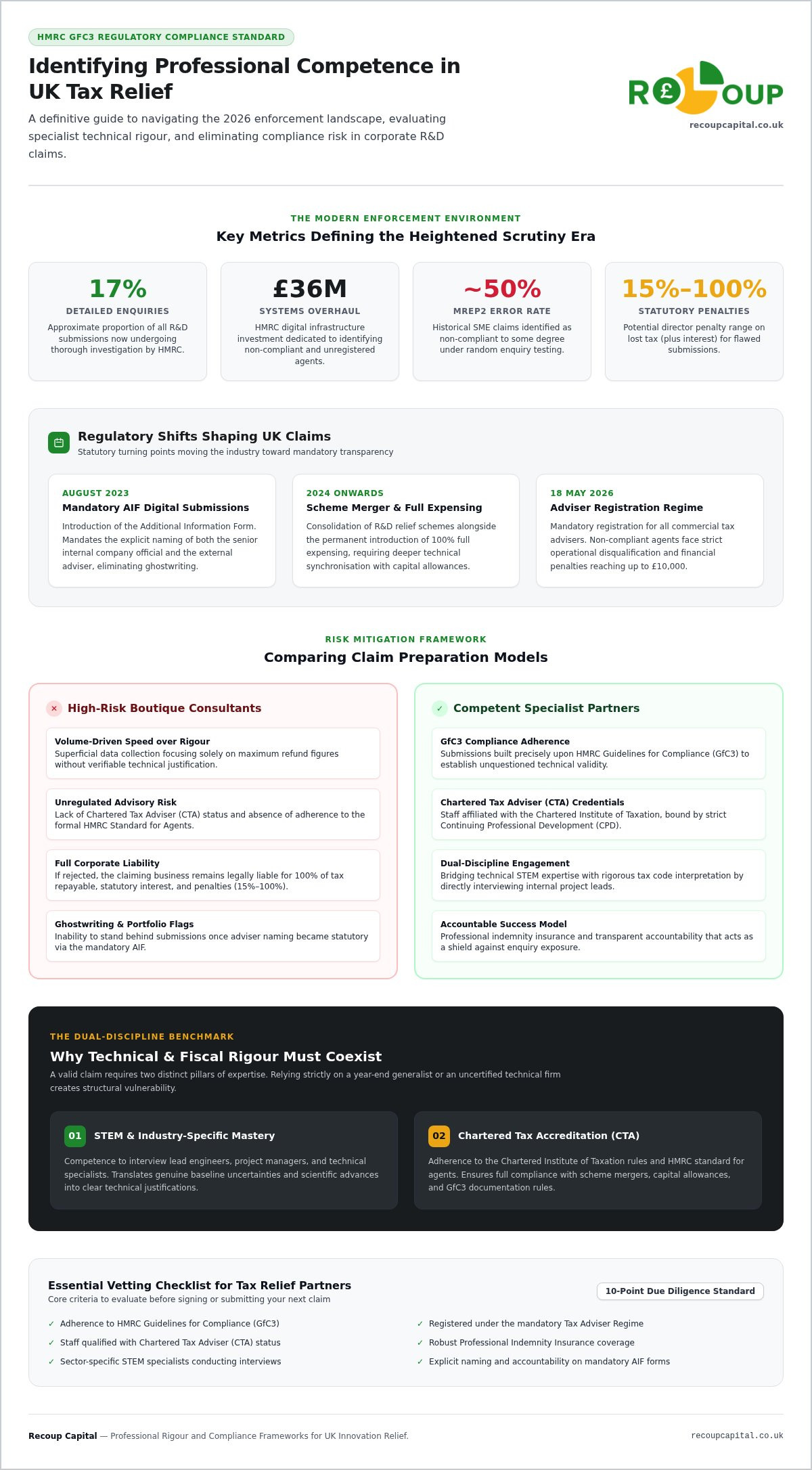
The 10-Point Vetting Checklist: Selecting Your Claims Partner
Choosing a tax partner is a strategic decision that affects your business's financial health and regulatory standing. It isn't enough to simply hire a firm that promises a large refund; you need a partner that understands the nuances of technical eligibility and HMRC compliance. Understanding how to identify a competent professional for your claim requires a structured approach to vetting. Use the following steps to ensure your chosen specialist has the rigour required to protect your interests.
- Verify professional qualifications: Ensure the team includes members of recognised bodies such as the CIOT or ATT. Professional accountability is your first line of defence.
- Ask for sector-specific evidence: A specialist in software may struggle with the complexities of a construction or engineering claim. Request case studies that mirror your specific industry challenges.
- Scrutinise the fee structure: A success-based model is standard, but it must be transparent. Avoid any firm that hides administrative costs or doesn't clearly define what "success" looks like.
- Assess the discovery call: A competent professional will spend the initial call asking technical questions about your projects rather than delivering a generic sales pitch.
- Enquire about enquiry handling: Ask for a written commitment regarding their support if HMRC challenges the claim. You need end-to-end representation, not just a submission service.
Red Flags to Avoid During Vetting
Be wary of any consultant who "guarantees" a specific credit value before they've conducted a deep technical dive into your projects. Tax legislation is nuanced, and a premature guarantee often signals a lack of rigour. You should also avoid firms that lack a physical office or professional indemnity insurance; these are basic markers of a stable, professional organisation. Perhaps the most significant red flag is a "hands-off" approach. If a consultant asks you to write your own technical reports, they aren't providing the specialist expertise you're paying for. This behaviour shifts the compliance risk entirely onto your shoulders whilst they collect a fee.
Green Flags: Signs of a Truly Competent Professional
A high-quality specialist will often be your most rigorous critic. They should ask difficult questions that challenge your assumptions about project eligibility, ensuring that only qualifying activities are included in the final submission. They will also provide a clear, documented roadmap of the claim process, detailing exactly how much time they require from your technical staff. Truly competent professionals prioritise risk management as much as the final credit value. They'll be honest about what doesn't qualify, helping you build a robust, compliant claim that stands up to the closest scrutiny.
If you're ready to partner with a team that values technical accuracy over speculative figures, you can request a technical discovery session today to see how we protect your business interests.
Recoup Capital: A Partnership Built on Results and Rigour
Recoup Capital organises its operations around a core principle: technical excellence is the only way to ensure long-term compliance. We don't just process paperwork. We act as a protective guide through the complexities of the UK tax system. Our team is a strategic blend of chartered tax accountants and industry-specific technical specialists. This structure is central to how to identify a competent professional for your claim. By pairing financial experts with engineers and computer scientists, we ensure that your technical narratives satisfy the rigorous CIRD guidelines whilst your costs are reconciled with forensic precision.
Our success-based fee model is a direct reflection of our confidence. We align our interests with your business growth, meaning we only succeed when you do. This approach eliminates the financial risk often associated with exploring complex tax reliefs. We prioritise long-term collaboration over transactional processing. We view your financial returns as strategic assets to be reinvested into your future innovation rather than one-off windfalls. This commitment to transparency and results is why we reject traditional sales tactics in favour of evidence-based communication.
Our Approach to R&D and Corporate Finance
We integrate R&D tax credits into your broader corporate finance strategy. This ensures that every pound reclaimed is utilised to its maximum potential for business innovation. For limited companies in the construction and engineering sectors, our national specialist team provides a depth of insight that generalist firms cannot match. We understand the specific technological uncertainties inherent in complex builds and structural engineering. The "Recoup Method" combines this technical industry insight with forensic accounting to build an enquiry-proof case for every client we serve across the UK.
Next Steps for Your Business
Taking the first step toward capital recovery should be seamless. We offer a time-limited, no-cost initial assessment to help you understand your potential eligibility without any upfront commitment. To prepare for your first consultation with a Recoup Capital specialist, you should have a high-level list of your most innovative projects and a general overview of your R&D-related expenditure over the last two accounting periods. We handle the technical heavy lifting from there, ensuring the process is efficient and low-friction for your team.
Our goal is to transform potentially intimidating regulatory procedures into approachable opportunities for growth and innovation. When you are deciding how to identify a competent professional for your claim, always prioritise professional integrity and a proven track record of technical rigour over the promise of the largest possible refund.
Secure Your Business Innovation with Technical Rigour
Navigating the current HMRC landscape requires more than just a passing interest in tax incentives; it demands a partner who views compliance as the foundation of every submission. We have explored the critical importance of technical justification and the necessity of sector-specific expertise in fields like construction and engineering. By following our vetting checklist, you now understand how to identify a competent professional for your claim who balances capital recovery with absolute regulatory safety. The right specialist doesn't just process paperwork; they act as a protective guide for your business innovation.
Recoup Capital remains committed to this relationship-first approach, utilising our team of qualified Chartered Tax Accountants to transform your technical challenges into strategic assets. Our success-based fee structure ensures our interests are perfectly aligned with your growth, providing you with the confidence to innovate without fear of HMRC scrutiny. It is time to move beyond transactional advice and secure a partnership built on transparency and results.
Book a no-cost claim assessment with our Chartered Tax Specialists to discover the untapped potential in your projects. Your business deserves the peace of mind that comes with professional accountability and expert care.
Frequently Asked Questions
What qualifications should I look for in an R&D tax specialist?
You should prioritise specialists who hold the Chartered Tax Adviser (CTA) or ATT designation. These qualifications demonstrate a rigorous understanding of UK tax law and a commitment to professional standards. It is equally important to look for a team that includes STEM-qualified professionals, such as engineers or software developers. This dual-discipline approach ensures your advisor can bridge the gap between technical innovation and complex HMRC compliance requirements effectively.
Can my regular accountant handle my R&D tax credit claim?
Professional fees are usually calculated as a percentage of the total tax benefit or cash credit recovered for your business. This success-based model aligns the advisor's interests with your own and removes the need for upfront costs. You should ensure the fee covers the entire end-to-end process, including technical interviews, forensic cost reconciliation, and full enquiry support. This transparency ensures you aren't hit with hidden administrative charges later in the process.
What happens if HMRC enquiries my claim and my advisor is incompetent?
Legal liability for any tax lost remains with your company directors, regardless of who prepared the submission. If an advisor is incompetent or lacks professional indemnity insurance, your business may be left to face HMRC penalties and interest alone. This reality underscores why knowing how to identify a competent professional for your claim is a non-negotiable step. A reputable partner provides a robust enquiry defence and stands by their technical justifications.
How do I know if a specialist has genuine experience in my industry sector?
Ask for sector-specific case studies and technical references that mirror your business challenges. A competent professional should be able to discuss technological uncertainties in your field, such as construction or engineering, using industry-specific terminology. If they can't articulate the "industry baseline" for your sector, they'll likely struggle to prove that your work constitutes a genuine advance when challenged by HMRC's specialised compliance officers.
Is a "success-based" fee model a sign of a competent professional?
A success-based model is a strong sign of confidence, as it demonstrates that the advisor is willing to invest their time and expertise upfront. It creates a partnership-oriented approach where the firm only succeeds when you do. However, this model must be supported by qualified staff and a proven track record. When you are deciding how to identify a competent professional for your claim, ensure the success fee includes comprehensive technical vetting.
What is the difference between a tax consultant and a chartered tax accountant?
"Tax consultant" is an unregulated term that anyone can use, whereas "Chartered Tax Accountant" denotes a professional who has passed rigorous examinations. Chartered professionals are members of bodies like the CIOT and must adhere to a strict code of ethics and professional conduct. This distinction is crucial for accountability; a chartered professional is required to maintain high standards of technical competence, providing your business with a significant layer of protection.
How long should a competent professional take to prepare a robust claim?
A robust claim typically takes between four and eight weeks to prepare, depending on the complexity of your projects. This timeframe allows for deep-dive technical interviews, forensic cost reconciliation, and the drafting of detailed narratives required by the Additional Information Form. Any advisor promising a 24-hour turnaround is likely cutting corners on the technical justification. A competent professional prioritises accuracy over speed to ensure your submission is bulletproof under scrutiny.


