

Is your R&D claim a retrospective paperwork exercise or a strategic financial asset? For many UK companies, the difference lies in a single, often misunderstood regulatory requirement. Adopting a formal hmrc r&d systematic approach isn't just about ticking boxes for a filing. It's about transforming the way your technical teams identify and document innovation as it happens. If you've ever felt the weight of a potential HMRC enquiry or struggled to separate "business as usual" from qualifying technical breakthroughs, you're certainly not alone.
We recognise that the complexity of tax relief can feel like a barrier to the capital recovery your business deserves. You want to focus on growth, not second-guessing whether your record-keeping will stand up to intense scrutiny. This guide will help you master the systematic framework required to ensure your innovation claims are compliant, defensible, and fully maximised. We'll examine how to build a robust documentation trail that reduces the risk of penalties, providing you with a clear roadmap to turn your research and development efforts into a secure, strategic tool for reinvestment.
Key Takeaways
- Learn why HMRC prioritises planned investigations over accidental discoveries to ensure your claim meets the latest DSIT guidelines.
- Master the hmrc r&d systematic approach by clearly defining your technological uncertainties and establishing a documented baseline of existing knowledge.
- Discover how to integrate contemporaneous record-keeping into your daily workflow to provide a robust audit trail that satisfies HMRC inspectors.
- Identify and avoid common enquiry triggers, such as failing to distinguish between innovative technical leaps and routine "business as usual" updates.
- Understand how partnering with specialist chartered tax accountants can help you institutionalise a defensible methodology for long-term capital recovery.
Defining the HMRC R&D Systematic Approach for UK Businesses
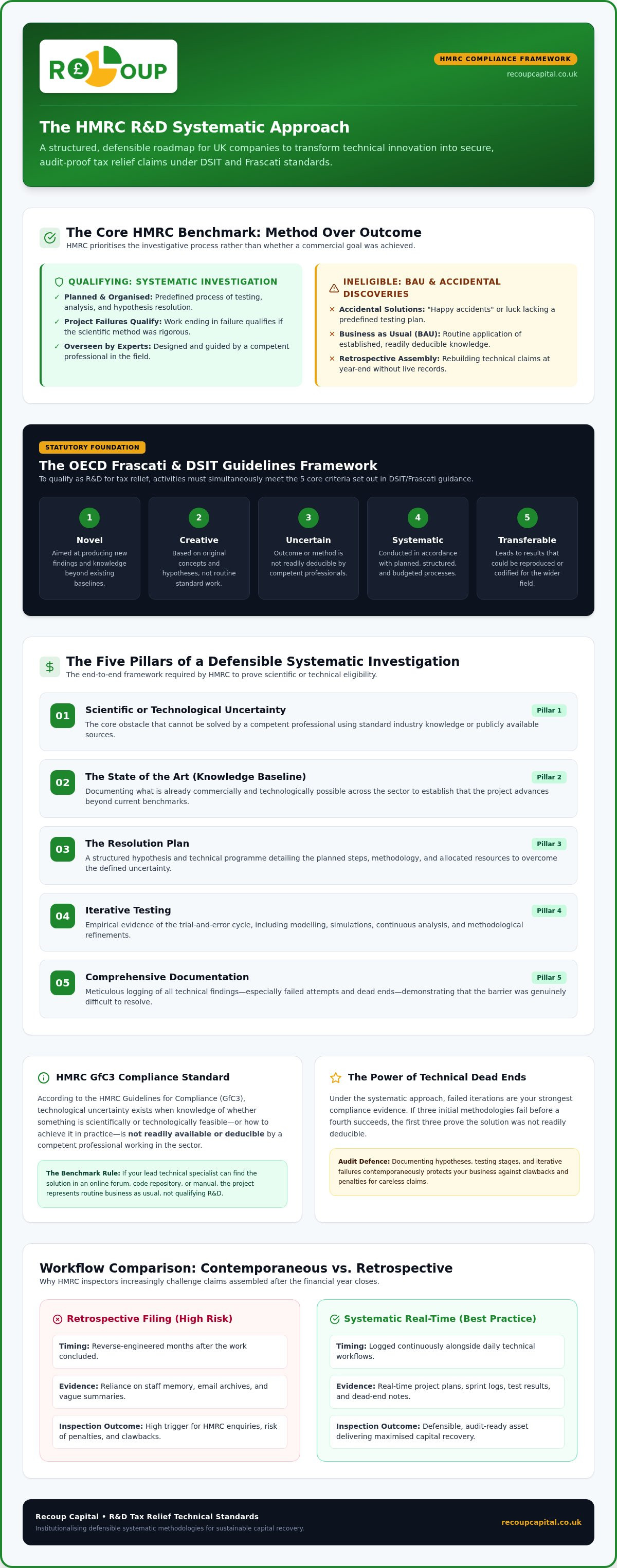
Success in tax relief claims hinges on a single, vital concept: the hmrc r&d systematic approach. HMRC doesn't merely look for technical breakthroughs; it looks for the methodology behind them. A systematic investigation is a planned, organised search for new knowledge or technical improvements. It's the opposite of a happy accident or a stroke of luck. If your team stumbles upon a solution without a predefined process of testing and analysis, HMRC may view the activity as ineligible. They prioritise the "how" over the "what", meaning even a project that ends in failure can qualify for relief, provided the investigative method was rigorous and documented.
The Legal Framework: DSIT Guidelines and HMRC Manuals
The UK's statutory definition is heavily influenced by the OECD Frascati Manual methodology, which identifies R&D as a project that is novel, creative, uncertain, systematic, and transferable. These principles are mirrored in the DSIT (formerly BEIS) guidelines. To qualify, a "competent professional" in your field must oversee the process. This professional identifies a specific scientific or technological uncertainty and then designs a programme of work to resolve it. This systematic framework filters out "business as usual" (BAU) activities. Whilst BAU focuses on the routine application of existing knowledge, a systematic approach moves beyond the state of the art. Your documentation must show that the solution wasn't readily deducible by another expert in the field.
Why Retrospective Claims are Getting Harder
HMRC has significantly sharpened its focus on how claims are prepared. There's a clear shift away from "reverse-engineering" claims at the end of the financial year. Instead, inspectors now expect contemporaneous record-keeping that proves the hmrc r&d systematic approach was in place from day one. Relying on memory or vague technical summaries is no longer sufficient; it often acts as a red flag for an enquiry. When R&D Tax Credits explained in this context are viewed as a strategic asset, the value of real-time documentation becomes clear. It protects your business from the risk of clawbacks and penalties for "careless" submissions. By documenting the hypothesis, the testing phases, and the iterative failures whilst they happen, you build a defensible narrative that demonstrates compliance with the highest regulatory standards.
The Five Pillars of a Defensible Systematic Investigation
To secure a robust claim, you must move beyond general project descriptions. HMRC expects to see a methodology that mirrors a scientific experiment. This structure is built on five distinct pillars that transform your technical activity into a defensible financial asset through a robust hmrc r&d systematic approach. By aligning your internal processes with these pillars, you create a narrative that is difficult for inspectors to challenge.
- Pillar 1: Scientific or Technological Uncertainty. This is the core problem that cannot be solved by a competent professional using standard knowledge.
- Pillar 2: The State of the Art. You must establish what is already possible in your industry to prove your work goes further.
- Pillar 3: The Resolution Plan. A clear hypothesis or technical roadmap showing how you intended to overcome the uncertainty.
- Pillar 4: Iterative Testing. Evidence of the "trial and error" process, including analysis and refinement of the solution.
- Pillar 5: Comprehensive Documentation. Recording every outcome, especially the failures, as these prove the uncertainty was genuine.
Identifying Technological Uncertainty
According to the HMRC Guidelines for Compliance (GfC3), technological uncertainty exists when knowledge of whether something is scientifically possible or technologically feasible, or how to achieve it in practice, is not readily available or deducible by a competent professional working in the field. This definition is the benchmark for every claim. If your lead engineer can find the answer on a forum or in a manual, it isn't R&D.
You must prove that the solution was not "readily deducible". Technical dead ends are your best evidence here. If you tried three methods and only the fourth worked, those first three attempts are proof that the resolution was not obvious. Documenting these failures demonstrates that you were operating in a space of genuine uncertainty rather than routine development.
Proving the Advance in Science or Technology
An advance isn't just a better product for your customers. It must be an advance in the overall knowledge or capability in a field of science or technology. A company-specific improvement, like integrating two software packages for the first time in your office, might be difficult, but it doesn't necessarily constitute an industry-wide advance. The hmrc r&d systematic approach requires you to demonstrate how your work pushed the boundaries of standard practice. If you're unsure if your technical leaps meet these criteria, you might find it helpful to explore how R&D tax credits are defined for your specific sector. Focusing on the technical "how" rather than the commercial "what" ensures your claim remains compliant and maximised for recovery.
Practical Implementation: Organising Your Workflow for Compliance
Adopting an hmrc r&d systematic approach shouldn't require reinventing your entire business model. Instead, it's about embedding compliance into the tools your technical teams already use. Platforms like Jira, Trello, or Monday.com are perfect for capturing the iterative nature of innovation. By tagging specific tasks as "uncertainty resolution" or "technical testing", you create a digital trail that mirrors the project's progress. This method ensures that when it's time to file, you aren't hunting for details from twelve months ago; the story is already written.
The "contemporaneous" rule is perhaps the most critical factor in a modern claim. HMRC expects records to be generated whilst the work is happening, not months after the fact. According to the HMRC CIRD80560 guidance on R&D records, caseworkers look for evidence of project planning and uncertainty logs that prove the work was conducted systematically. Appointing "Technical Leads" to oversee this process is a strategic move. These leads act as the bridge between engineering and finance, ensuring that the time spent by staff on qualifying activities is captured accurately and separated from routine maintenance or "business as usual" tasks.
What Does "Evidence" Actually Look Like?
Evidence is more than just a spreadsheet of hours. It's the tangible proof of the technical struggle. High-quality documentation includes technical blueprints, meeting minutes where roadblocks were debated, and logs of failed prototypes. Even informal communication can be powerful. Email chains discussing why a specific material failed or how a software bug required a fundamental architectural change provide authentic proof of the systematic approach. Photos and videos of testing phases or site visits can also serve as visual anchors for your narrative, making the technical challenge undeniable to an inspector.
Training Your Team to Think Like HMRC
For many engineers, documentation feels like a distraction from the "real work". However, shifting the culture to value record-keeping is essential for long-term capital recovery. When your team understands why claim R&D tax credits, they're more likely to participate in the process. It's about framing documentation as a way to protect the company's reinvestment fund rather than just more red tape. By training staff to flag technical uncertainties as they arise, you institutionalise the methodology required for a successful and defensible claim.
Common Pitfalls and HMRC Enquiry Triggers
Many UK businesses stumble because they confuse commercial success with technical eligibility. HMRC's scrutiny has intensified; they no longer accept vague summaries of "innovation". A common trigger for an enquiry is the lack of technical detail in the narrative report. If you describe the "what" (the finished product) but omit the "how" (the technical struggles and resolution), you haven't demonstrated a hmrc r&d systematic approach. Inspectors are trained to spot "boilerplate" descriptions. Generic text that could apply to any company in your sector suggests your claim hasn't been built on a unique, planned investigation.
Administrative inconsistencies also cause red flags. Failing to reconcile the figures in your R&D claim with your company's CT600 tax return is a frequent mistake. Similarly, claiming for routine software updates or aesthetic design changes often leads to rejection. These activities don't resolve a technical uncertainty; they simply apply existing knowledge to a new context. To keep your claim robust, you must ensure that every pound spent is tied directly to the resolution of a specific technological challenge.
The New "Additional Information Form" (AIF) Requirements
The landscape changed significantly with the mandatory digital submission rules introduced for claims made on or after 8 August 2023. You must now submit an Additional Information Form (AIF) before your Corporation Tax return. This form is a digital hurdle that specifically asks for granular evidence of your systematic methodology. Crucially, a named senior officer within your company must take responsibility for the submission. If the AIF is missing or incomplete, HMRC will simply remove the R&D claim from the tax return. This shift towards transparency means that your internal record-keeping must be more rigorous than ever before.
Differentiating R&D from Commercial Innovation
It's vital to remember that "innovation" for a customer does not always equal "R&D" for tax purposes. You might develop a product that is entirely new to your market, but if the development used standard tools and "readily deducible" methods, it won't qualify. The "readily deducible" trap is where many claims fail. You must prove that a competent professional could not have easily reached the same conclusion. By documenting your work as a hmrc r&d systematic approach, you provide the proof that your team had to overcome genuine technical barriers. If you're concerned about whether your project hits these benchmarks, you can speak with our chartered tax accountants to verify your methodology before you submit.
How Recoup Capital Institutionalises the Systematic Approach
At Recoup Capital, we don't treat your tax relief claim as a retrospective paperwork exercise. We've built our entire consultancy process around the hmrc r&d systematic approach to ensure every project we submit is robust, compliant, and defensible. Our end-to-end service begins with a deep technical discovery. We don't just ask what you built; we dig into the specific scientific or technological uncertainties your team faced and the iterative steps taken to resolve them. This proactive stance ensures you're "enquiry-ready" from day one, with a documentation trail that stands up to the most rigorous HMRC scrutiny.
Our approach is grounded in professional authority. We employ chartered tax accountants who work alongside technical specialists to verify your methodology before any figures are finalised. We operate on a success-based fee model, which means our goals are perfectly aligned with your own; we only succeed when your claim is accepted and your capital is recovered. This partnership-oriented model removes the financial risk of exploring complex relief schemes, allowing you to focus on your core business whilst we act as your protective guide through the regulatory landscape.
Sector-Specific Expertise: Construction and Engineering
Construction and engineering projects often involve "hidden" R&D that goes unclaimed because it's woven into daily operations. Whether you're developing bespoke piling techniques for unstable ground or creating software to manage complex site logistics, we help you identify the qualifying boundaries. We specialize in translating technical jargon into clear, HMRC-friendly narratives that highlight the systematic investigation involved. This expertise is particularly valuable for companies claiming Land Remediation Relief, where technical challenges are frequent but often lack the structured documentation HMRC expects. We bridge that gap, ensuring your technical leaps are framed as the strategic assets they truly are.
A Partnership Approach to Capital Recovery
We view tax relief not as a one-off refund, but as a strategic asset for future growth. By claiming R&D Tax Credits through a structured, long-term partnership, you secure a reliable stream of capital for reinvestment. Our role is to help you move beyond reactive filing to a culture where innovation is documented as it happens. We work with your technical leads to institutionalise the hmrc r&d systematic approach, turning your technical struggles into a predictable financial tool. This collaborative rhythm ensures your business is always positioned to maximise its recovery, providing the financial fuel for your next major breakthrough.
Securing the Future of Your Innovation Funding
Mastering the hmrc r&d systematic approach is no longer an optional exercise for UK businesses; it's a fundamental requirement for long-term financial stability. By moving away from retrospective claims and embracing a culture of contemporaneous documentation, you protect your company against the rising tide of HMRC enquiries. You've seen how the five pillars of investigation and the new Additional Information Form requirements demand a more rigorous methodology. This shift shouldn't be viewed as a burden, but as an opportunity to professionalise your innovation pipeline and secure the capital recovery your breakthroughs deserve.
At Recoup Capital, we act as your protective guide through these regulatory complexities. Every claim we manage is led by chartered tax accountants, ensuring that your technical narratives are both compliant and defensible. We operate on a success-based fee model with no upfront costs, meaning we're fully invested in the positive outcome of your submission. Our specialists are ready to help you navigate enquiry defence and maximise your strategic assets.
Speak to our R&D specialists today to secure your innovation funding. Let's turn your technical challenges into a reliable engine for future growth.
Frequently Asked Questions
What is the definition of a systematic approach according to HMRC?
HMRC defines it as a planned investigation or search for new knowledge or technical improvement. It requires a methodology that starts with a clear hypothesis and follows a structured testing phase. According to official guidelines, your work must be organised rather than accidental. This ensures that the resolution of a technological uncertainty is the primary goal, distinguishing it from routine commercial activity or standard "business as usual" development tasks.
Can I claim R&D tax credits if my project failed?
Absolutely. HMRC rewards the attempt to overcome technical barriers, regardless of the commercial outcome. In fact, a project that ends in failure is often easier to defend because it provides concrete evidence that a technological uncertainty was present. By following a hmrc r&d systematic approach, you document the technical dead ends and failed prototypes that prove the solution was not readily deducible to a competent professional in your field.
What records do I need to keep to prove a systematic investigation?
You should maintain contemporaneous records that track the life cycle of the technical challenge. This includes project plans, design blueprints, testing logs, and even internal email chains discussing technical roadblocks. HMRC expects to see evidence that was created whilst the work was actually happening. High-quality documentation should clearly link the staff time spent to specific phases of the systematic investigation, providing a robust audit trail for your final submission.
How does the systematic approach differ for software development?
The core principles remain identical, but the evidence focuses on technical architecture rather than user interface or aesthetic design. You must demonstrate that you were pushing the boundaries of software engineering, such as improving data processing speeds or creating novel algorithms. Routine bug fixes or standard API integrations don't qualify. The hmrc r&d systematic approach for software requires documenting how you tested various architectural solutions to resolve a specific technical limitation.
What happens if HMRC challenges my systematic approach during an enquiry?
If HMRC opens a compliance check, they'll request detailed evidence of your methodology and technical uncertainties. They'll scrutinise your Additional Information Form to ensure a senior officer has verified the activities. This is where having a protective guide is invaluable. We provide end-to-end liaison, using our chartered tax accountants to present your evidence in a way that satisfies HMRC requirements and reduces the risk of penalties for careless record-keeping.
Is a systematic approach required for both SME and RDEC schemes?
Yes, the statutory definition of R&D is consistent across both the SME and RDEC (Research and Development Expenditure Credit) schemes. Whether you're a small business or a large corporation, you must demonstrate a planned investigation aimed at a technical advance. The specific tax benefits and calculation methods differ between the schemes, but the underlying requirement for a structured, systematic methodology to resolve technological uncertainty remains a non-negotiable threshold for every claimant.
How often should we review our R&D documentation processes?
We recommend reviewing your documentation workflows at least once a quarter or at the start of every major project phase. Regular reviews ensure that your technical leads remain aligned with current HMRC standards and that record-keeping hasn't slipped into a retrospective habit. By institutionalising these checks, you ensure that your evidence remains contemporaneous, making the final claim preparation significantly more efficient and reducing the likelihood of missing qualifying expenditure during the year.
Does the systematic approach apply to subcontracted R&D work?
Yes, it does. If your company is the claimant, you must prove that the subcontracted work was part of a systematic search that you initiated and controlled. You should ensure your subcontractors provide technical reports or logs that align with your overall project methodology. Even if the hands-on testing is done by a third party, the responsibility for defining the technological uncertainty and the systematic plan for its resolution lies with you.


