

What if the biggest warning sign in an R&D tax claim isn’t a small refund, but a large one promised before anyone understands your project? The signs of a bad R&D tax advisor can be easy to miss when eligibility feels complex and the potential benefit is attractive.
It’s reasonable to expect clear answers, a claim supported by evidence and a straightforward explanation of fees and responsibilities. A credible adviser should ask about the technical work, explain where uncertainty remains and set out how the claim will be prepared, submitted and supported if HMRC has questions. Bold promises alone don’t show whether a claim is robust.
This checklist will help you recognise warning signs before appointing an adviser and assess whether their approach puts compliance and claim quality first. It covers technical understanding, evidence, fee transparency and support after submission, so you can compare the process rather than just the headline figure. Recoup Capital’s R&D service covers technical assessment, claim preparation and submission, and HMRC liaison. Fees are calculated as a percentage of the tax benefit or cash credit recovered.
Key Takeaways
- Recognise the signs of a bad R&D tax advisor, while remembering that a red flag calls for scrutiny and isn’t proof of misconduct.
- Learn why project eligibility and qualifying expenditure need separate, fact-specific assessments grounded in technical reasoning and evidence.
- Compare an adviser’s technical review, evidence handling and follow-up support, and understand why success-based fees still need a clear written scope.
- If something concerns you, review the advice, records, calculations and submission documents before concluding that a claim is invalid.
- See how Recoup Capital’s R&D specialists and chartered tax accountants support claims from technical assessment through preparation, submission and HMRC liaison.
Signs of a bad R&D tax advisor: warning signs businesses should recognise
Choosing an R&D tax adviser can feel difficult because the work brings technical project details together with tax rules and HMRC guidance. A red flag isn’t proof of misconduct by itself. It is a reason to ask more questions, particularly if the adviser can’t explain the reasoning behind a recommendation.
Eligibility depends on what your company tried to achieve, the challenges it faced and the costs connected with that work. A sales promise can’t replace that assessment. For background on the purpose and history of the UK's R&D Tax Credit scheme, see this overview.
Does the adviser promise eligibility or a specific outcome upfront?
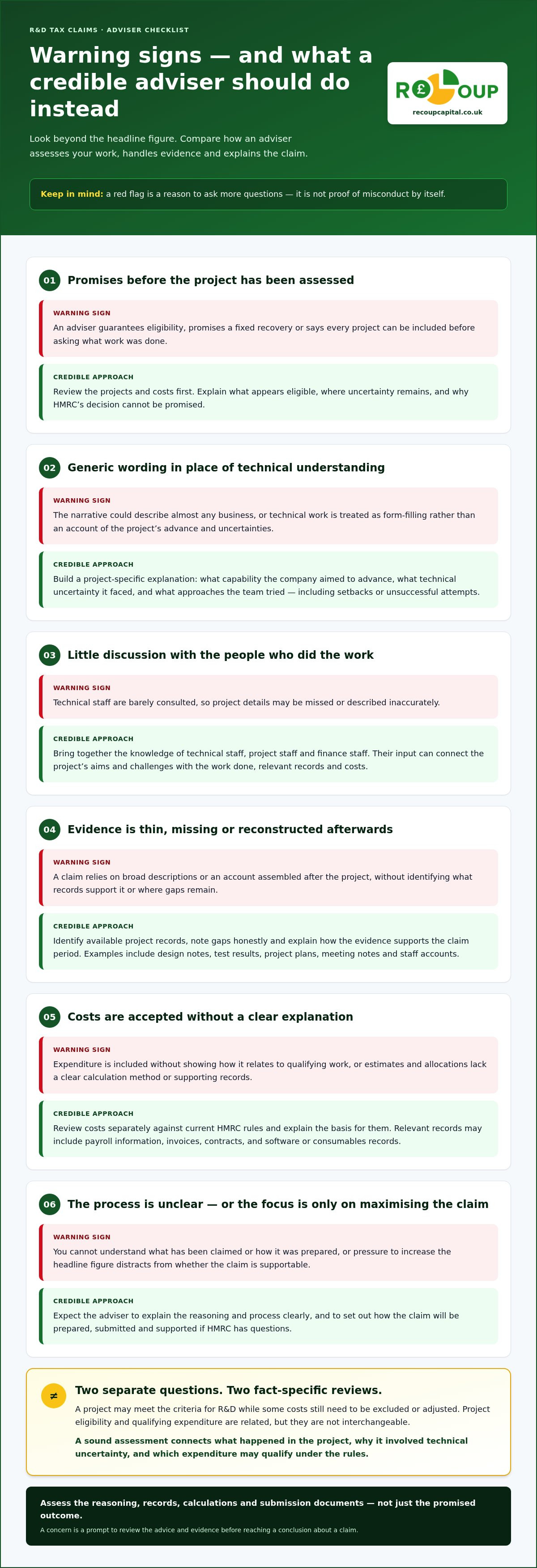
An adviser needs to review your projects and costs before reaching a view on eligibility. Pause if they guarantee that your company qualifies, promise a fixed recovery or assure you that every project can be included before asking what work was done. Those claims can encourage you to proceed on assumptions rather than a careful assessment. A credible adviser should explain what appears eligible, where uncertainty remains and why no adviser can promise HMRC’s decision.
Are technical work and claim evidence treated as paperwork only?
A claim narrative should explain the scientific or technological advance sought and the uncertainties the project addressed. Generic wording that could describe almost any business may not show how your work fits the relevant criteria. Project-specific records and input from staff involved in the work help connect the technical account to what happened in practice. Form-filling alone can leave that connection unclear.
Other warning signs to examine include:
- Little discussion with technical staff: project details may be missed or described inaccurately.
- Costs accepted without a clear explanation: the claim may include expenditure without showing how it relates to qualifying work.
- Unclear reasoning or process: you may struggle to understand what has been claimed and how it was prepared.
- Pressure to maximise the claim: a focus on the headline figure can distract from whether the claim is supportable.
Look for a tailored assessment, not a template with your company name inserted. Recoup Capital’s R&D process includes technical assessment, claim preparation and submission, followed by HMRC liaison. This gives project facts and evidence a role throughout the claim without promising a particular decision. For a separate tax topic, Recoup Capital also provides an overview of stamp duty land tax.
How a credible R&D tax adviser should assess eligibility and evidence
Evidence-led advice connects three things: what happened in the project, why the work involved technical uncertainty, and which expenditure may qualify under the rules. These points are related, but they aren’t interchangeable. A project may meet the criteria for R&D while some costs still need to be excluded or adjusted. Both questions require a fact-specific review against current HMRC guidance, not a broad assumption based on the company’s industry or the size of its claim.
The assessment should draw on people with different knowledge. Technical staff can explain the project’s aims and challenges, project staff can describe the work and decisions made, and finance staff can help trace costs to the relevant period and records. A credible adviser brings those accounts together instead of expecting one person or a generic form to tell the whole story. The HMRC standard for agents also sets out professional expectations for agents acting on taxpayers’ behalf.
What should the technical assessment establish?
Start with the baseline: what knowledge or capability was already available, and what advance did the company aim to achieve? The adviser should then explore what technical uncertainty stood in the way, why a competent professional couldn’t readily resolve it, and what approaches the team tried. For example, a project record describing tests of different engineering approaches is more informative than simply labelling a product “innovative”. Specific examples help distinguish qualifying problem-solving from routine development.
Ask whether the technical narrative reflects the actual work, including setbacks or approaches that didn’t succeed. Those details can help explain the project’s uncertainties and the attempts made to overcome them. Broad descriptions that could apply to any company are less useful than a clear account backed by project-specific information.
How should project evidence and costs connect?
Records such as design notes, test results, project plans, meeting notes and staff accounts can support the technical explanation and help show when the work took place. HMRC expects businesses to maintain records created during the R&D project, rather than reconstructing the account afterwards. An adviser should identify what evidence exists, note gaps honestly and explain how the available material supports the claim period.
Costs need their own review against current HMRC rules. Depending on the expenditure being considered, relevant records might include payroll information, invoices, contracts and software or consumables records. Estimates or allocations without a clear calculation method or supporting records deserve closer examination. The R&D tax credits explained guide provides further context on the relief rules, while Recoup Capital’s R&D claim process outlines how technical assessment connects with preparation and submission.
Compare R&D tax advisers using evidence, fees and accountability
A useful comparison looks beyond the headline claim figure or fee model. Focus on how the work is carried out, what the engagement covers and who is responsible at each stage. The signs of a bad R&D tax advisor often become clearer when you compare the process behind the advice, not just the promised result.
| Area | What a clear process should cover |
|---|---|
| Technical review | How project details are gathered, which staff contribute and how the technical account is reviewed. |
| Evidence handling | How project records support the narrative, how gaps are identified and how sensitive information is handled. |
| Submission | Who checks the claim narrative and cost calculations, who submits the claim, and what the company must approve or provide. |
| After submission | What support is included if HMRC asks for further information, and where that support ends. |
Useful comparison points include the review stages, how often progress is shared, how documents are stored and accessed, and when the company will be asked to review or approve information. Clear responsibilities matter: technical staff may need to explain project decisions, while finance staff help substantiate costs. A defined review point before submission gives the business a chance to check that the narrative and figures reflect its records.
Which questions reveal the adviser’s actual process?
Look for specific answers about how technical information is gathered and how the adviser works with project, technical and finance staff. The process should identify who reviews the narrative, checks the calculations and approves the final submission. It should also explain what happens if HMRC requests more information, including what support is covered and what the company needs to provide.
Are the fee terms and responsibilities transparent?
A success-based fee still needs a written basis. The agreement should explain how the fee is calculated, what benefit or cash credit it relates to, when payment is triggered and which services are included. It should also set out the company’s responsibilities, such as supplying accurate records and reviewing claim documents. A percentage-based fee isn’t, by itself, evidence of good or poor advice. Clarity of scope and accountability are what count.
Recoup Capital’s R&D fees are success-based and calculated as a percentage of the tax benefit or cash credit recovered. Its process covers technical assessment, claim preparation and submission, and HMRC liaison. Read more about claiming R&D tax credits to understand how these stages fit together.
What to do if your R&D tax adviser raises concerns
Spotting a warning sign doesn’t automatically mean your R&D claim is invalid. It does mean you should understand what was claimed, how the figures were prepared and what evidence supports the explanation. Separate confirmed gaps, such as a calculation with no visible basis, from open questions that may simply need a clear answer.
How can a company review an existing claim?
Start by collecting the submitted claim and its supporting file. Bring together the technical narrative, cost calculations, relevant project records and correspondence with the adviser. Review them as a set: does the narrative match the work your teams remember, and can you trace the costs to the projects and claim period described?
Make a short list of specific points that need clarification. For example, note a figure you can’t reconcile to the calculation, a technical statement that doesn’t reflect the project, or a document you expected to see but can’t locate. Record what you know and what remains uncertain. Don’t treat an unexplained point as proof that the whole claim is non-compliant.
When should the business seek a clearer explanation?
Ask for a plain-English explanation if figures are unexplained, technical wording feels generic, or it isn’t clear who approved the final submission. Request the basis for the claim, the documents submitted to HMRC and an explanation of how the figures connect to the supporting records. If the response resolves the issue, keep it with the claim file. If it identifies a genuine gap, document what’s missing and agree the next step.
For general questions about R&D claims, Recoup Capital’s R&D tax credit FAQs can provide further context. The signs of a bad R&D tax advisor are prompts to examine the advice carefully, not a substitute for checking the claim itself. A calm, documented review can help the business decide whether it needs clarification or further support.
If you’d like to understand how a claim is assessed, prepared and submitted, explore Recoup Capital’s R&D tax credit claim process.
How Recoup Capital supports a clear, evidence-led R&D tax claim
A robust claim starts with understanding the work, not estimating a headline figure. Recoup Capital brings technical assessment, claim preparation and submission together, with HMRC liaison as part of the service. R&D specialists and chartered tax accountants contribute their expertise to assess project information and the financial details behind the claim. This helps connect the technical account with the expenditure being considered, while keeping the process grounded in the company’s circumstances.
What does end-to-end claim support involve?
First, the technical assessment explores the company’s projects and the work undertaken. That understanding informs preparation of a claim using company-specific information rather than a generic description. The claim is then submitted, with Recoup Capital providing HMRC liaison as part of its support. Each stage has a distinct role: assessment informs the claim, preparation brings the information together, and liaison supports communication with HMRC. No adviser can guarantee acceptance or a particular HMRC decision.
This focus on evidence and accountability is a practical way to judge the signs of a bad R&D tax advisor. Clear explanations of the assessment and preparation process matter more than confident promises about the outcome. The aim is a claim that reflects the company’s work and information, with an adviser able to explain how it was put together.
Recoup Capital’s R&D tax credit fees are success-based and calculated as a percentage of the tax benefit or cash credit recovered. The fee basis doesn’t mean a particular recovery is assured. Understanding the written fee terms and the work covered helps set clear expectations from the outset.
What is a sensible next step for a business?
Before discussing a potential claim, organise information that can help explain your position: project records, relevant financial information and any previous R&D claim documents. You don’t need to resolve every question first. An initial conversation can start with what the business has developed, what technical challenges arose and which parts of the claim process need clarification.
To discuss your company’s circumstances and R&D tax claim questions, speak with Recoup Capital about your R&D tax claim.
Choose confidence built on evidence
The signs of a bad R&D tax advisor are reasons to pause and ask for clearer explanations, not automatic proof that a claim is invalid. Focus on whether project facts, technical reasoning and costs are properly connected, and whether the adviser is open about fees, responsibilities and support after submission.
For a claim to be considered carefully, the process matters as much as the potential benefit. Recoup Capital supports businesses from technical assessment through claim preparation and submission, with HMRC liaison as part of the service. Its team includes R&D specialists and chartered tax accountants. Fees are success-based and calculated as a percentage of the tax benefit or cash credit recovered, without guaranteeing a particular outcome.
If you’re weighing up a claim or want to understand the process, discuss your R&D tax claim with Recoup Capital. A clear conversation can help you identify the questions that matter and take your next step with greater confidence.
Frequently Asked Questions
What are the warning signs of a bad R&D tax adviser?
The signs of a bad R&D tax advisor can include promises of a guaranteed result before reviewing your projects, unclear explanations of eligibility, generic technical narratives and vague fee terms. These are reasons to ask for evidence and clarification, not automatic proof that a claim is wrong. Look at the adviser’s process as a whole: how they assess project facts, substantiate costs, explain decisions and set out responsibilities.
Can an R&D tax adviser guarantee that HMRC will accept a claim?
No. An adviser can assess the information, prepare a claim and explain the reasoning behind it, but HMRC makes its own decision. Treat assurances of acceptance before a detailed review as a warning sign. Ask how the adviser will explain areas of uncertainty, connect the claim to supporting evidence and handle follow-up questions from HMRC. A careful assessment can support a well-prepared claim, but it can’t guarantee a particular outcome.
What should an R&D tax adviser do before preparing a claim?
An adviser should first understand the company’s projects, the advance sought, the technical or scientific uncertainties involved and the work undertaken to address them. They should also review relevant expenditure and supporting records against current rules. The assessment should reflect your company’s circumstances, not rely on a broad assumption based on its sector. You should be able to understand the explanation and review the claim information before submission.
Is a success-based fee a sign of a bad R&D tax adviser?
No, a success-based fee isn’t a warning sign by itself. Focus on whether the agreement clearly explains the fee basis, calculation, payment trigger, services covered and each party’s responsibilities. Recoup Capital’s R&D claim fees are calculated as a percentage of the tax benefit or cash credit recovered. That fee structure doesn’t guarantee a specific return or HMRC decision, so make sure the written terms are clear.
What should I do if I think my R&D tax claim is inaccurate?
Gather the submitted claim, technical narrative, supporting calculations, project records and adviser correspondence. Compare the claim with the work your team carried out, then write down specific figures or statements you can’t reconcile. Ask for an explanation before assuming the claim is invalid. If questions remain, identify whether they concern missing evidence, a calculation or the technical account, and consider the claim against current HMRC requirements.
Should an R&D tax adviser explain the technical side of my claim?
Yes. Your adviser should explain the technical reasoning in language your business can understand and show how it relates to the project evidence. Staff involved in the work may need to explain the challenges, decisions and attempts to resolve technical uncertainty. If the narrative uses generic wording that doesn’t reflect your project, ask how it was developed and checked against the information your team provided.
What questions should I ask before appointing an R&D tax adviser?
Ask how the adviser assesses projects and expenditure, what records they need and who reviews the technical narrative, calculations and final submission. Clarify the written fee basis, the services included and your team’s responsibilities. Find out what happens if HMRC requests further information, and how your company can review the submission before it’s sent. Specific answers help you understand the process and compare the support being offered.


