

Could changing your R&D tax adviser put an otherwise valid claim at risk? It needn’t, but sending a termination email alone won’t protect your company’s position. Knowing how to fire your R&D tax consultant means planning for continuity: understanding your contract, securing the claim records and keeping deadlines and HMRC correspondence on track.
If you’re unsure about notice periods, outstanding fees or whether technical evidence and calculations will be handed over cleanly, you’re not alone. Switching advisers doesn’t have to mean losing sight of a live claim or an HMRC enquiry. Take practical steps before, during and after the change, and keep control of your company’s submissions and supporting documents.
This guide explains what to review in your engagement terms, which records to request and how to manage the handover. You’ll also learn how to clarify who owns each next step, so your business can keep its claim process organised and retain the evidence needed if HMRC asks questions later.
Key Takeaways
- Before deciding how to fire your R&D tax consultant, distinguish a service issue that might be resolved from a concern about claim quality or supporting evidence.
- Review your engagement letter for notice requirements, termination terms, outstanding fees and arrangements for work in progress before giving written notice.
- Request a complete, usable set of claim records, including technical reasoning, cost calculations, submitted forms and HMRC correspondence.
- Create a handover timeline that records the claim’s status, upcoming deadlines, missing evidence and who is responsible for each next step.
- A specialist-led process can bring technical assessment, claim submission and HMRC liaison together as your company moves forward.
How to fire your R&D tax consultant without rushing the decision
Unclear updates, unexplained fees, missed milestones or doubts about the claim can all make you question whether the relationship is working. Before deciding how to fire your R&D tax consultant, identify what has gone wrong. A communication breakdown may be fixable with clearer reporting or agreed responsibilities. A concern that costs lack support, or that the technical account doesn’t reflect the work, is more substantive and deserves careful review.
Changing consultants doesn’t, by itself, make a claim valid or invalid. The claim still needs to be assessed against its facts and evidence. For general background on the purpose of the Research and Development Tax Credit, see the overview, then use your company’s project records to consider whether the claim position is properly supported.
What is prompting you to change your R&D tax consultant?
Separate service concerns from technical disagreements. Slow replies, unclear explanations or delays may point to a process problem. Disagreement about which activities qualify, how costs have been treated or what evidence is needed may require closer scrutiny. If you’re unsure how the relief works, R&D tax credits explained provides useful claim context.
Keep a factual record before raising the issue. Note when you made requests, what response you received and what remains unresolved. If a cost in the calculation can’t be connected to project activity, or the technical narrative makes claims your team can’t substantiate, ask for the reasoning and supporting evidence. Record what you find without making accusations. A clear account helps you decide whether the issue can be corrected or whether you need a different approach.
When should you pause before terminating the engagement?
First establish the claim’s current status. Is a submission being prepared or awaiting approval? Has HMRC opened an enquiry? Is a filing or notification deadline approaching? Check who holds the relevant records and who can respond to HMRC. Clarify any urgent actions before changing access or responsibilities.
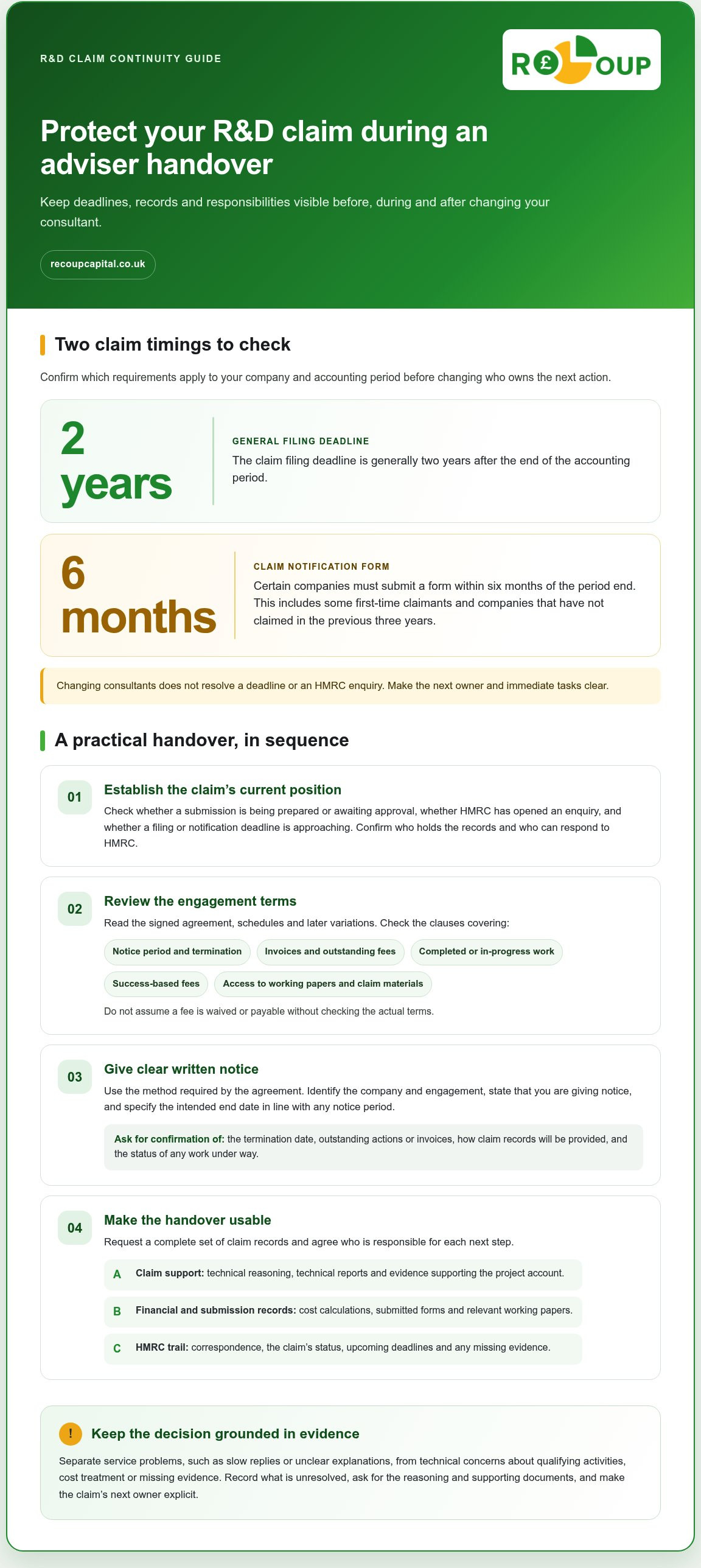
For context, the claim filing deadline is generally two years after the end of the accounting period. Certain companies must also submit a Claim Notification Form within six months of the period end, including some first-time claimants and companies that haven’t claimed in the previous three years. Confirm which requirements apply to your company and period before taking action. Changing consultants doesn’t resolve a deadline or enquiry, so make the next owner and immediate tasks clear.
Keep separate tax questions separate, too. For example, stamp duty land tax guidance concerns a different tax topic, not the merits of an R&D claim. Once you’ve identified the issue and understood urgent claim actions, you’ll be better placed to decide whether to seek a remedy or plan a careful handover.
Check your R&D consultancy contract before giving notice
Once you’ve identified why you’re changing advisers, review what you agreed before taking formal action. The engagement letter or service agreement should explain how the relationship can end and what happens to fees, completed work and an active claim. Read the full document, including schedules and later variations, rather than relying on a general understanding of the arrangement.
A practical sequence is to locate the signed agreement, review the relevant clauses, clarify any unclear obligations, then give written notice in line with the terms. If you’re unsure how the claim itself should be assessed, HMRC guidance on R&D tax relief sets out the official framework. Contractual rights and responsibilities are a separate question.
Which terms should you review in the engagement letter?
Look for the notice period, termination rights, invoicing arrangements and provisions for work already completed or in progress. Check how the agreement treats a success-based fee, particularly if a claim has been submitted but the tax benefit or cash credit hasn’t yet been received. The wording may also address access to working papers, technical reports and claim materials. Don’t assume a fee is waived or payable until you’ve reviewed the actual terms.
Make a short list of points that need clarification. For example, ask whether an invoice relates to completed work or how claim records will be provided. If the agreement is ambiguous, a fee is disputed or the parties interpret a clause differently, consider obtaining advice from a qualified legal professional before acting. A general explanation isn’t a definitive view of your contractual position.
How should you give notice to your current consultant?
When you’re ready, send a dated, professional written notice using the method required by the agreement. Identify the company and engagement, state that you’re giving notice and specify the intended end date, taking account of any notice period. Keep the tone factual. The aim is a clear record and an orderly transition, not an argument about past service.
Ask the consultant to confirm the termination date, any outstanding actions or invoices, and how claim records will be provided. If work is under way, request a status update that makes clear what remains to be done. Save the notice, evidence of delivery and replies with the company’s claim file. These records help distinguish agreed next steps from unresolved points.
With the terms and notice process clear, you can plan the next phase with less uncertainty. For technical assessment, submission and HMRC liaison, explore Recoup Capital’s R&D tax credit support.
Protect your R&D claim records and HMRC position during the handover
A smooth change depends on more than receiving a folder of documents. Your company needs records that are complete, readable and organised so someone else can understand how the claim was prepared, what was submitted and what still needs attention. As you plan how to fire your R&D tax consultant, make the handover about continuity, not just document collection.
Request the materials connected with each claim, including the versions actually sent to HMRC. A draft narrative alone may not explain why particular projects or costs were included, especially if the submission changed after review. Keep copies in a secure, company-controlled location and maintain an inventory showing what you’ve received, what’s missing and who is following it up.
What R&D claim documents should your company gather?
- Project records: project descriptions, technical narratives, evidence of the work and the reasoning used to describe technical uncertainties and advances.
- Financial support: cost calculations, workings behind eligible expenditure and the source information used to prepare them.
- Submission records: copies of claim forms and supporting forms as submitted, submission confirmations, and any drafts or revisions that explain material changes.
- HMRC and advice correspondence: letters, enquiry notices, responses, follow-up requests and records of advice received about the claim.
For each item, note its status, location and who is responsible for retrieving it. Distinguish company records from an adviser’s own working papers or internal templates. The agreement and circumstances can affect access and transfer rights, so don’t assume every internal document must be handed over, or that a claim record can be withheld. If ownership or access is disputed, get qualified legal advice on the specific position.
How do you keep HMRC communication and deadlines on track?
Build a live action list that records what has been submitted, what HMRC has asked for, the response date, what evidence is outstanding and who will respond. Check whether a submission or enquiry response is in progress before the outgoing adviser’s access changes. R&D claim notification and filing requirements can depend on the company’s circumstances and accounting period, so verify the applicable deadline and current HMRC rules rather than relying on an old timetable.
Establish the status of the existing agent authorisation and verify HMRC’s current process for changing it, including any steps through the company’s HMRC online account. Don’t assume that ending the consultancy automatically updates HMRC’s records or transfers responsibility for correspondence. The guide to claiming R&D tax credits explains the wider claim process; use it alongside a current review of your company’s live obligations.
Keep the inventory, correspondence and action list together. This gives the company and any incoming adviser a clear view of the claim’s history and the next decisions to make.
How to manage the R&D tax consultant handover step by step
A planned handover gives your company a clearer view of what has happened, what remains open and who is responsible next. Work through the change in sequence, rather than treating termination and the claim transition as separate tasks.
- Review the engagement terms. Confirm the notice requirements, end date, fee position and arrangements for work in progress.
- Send written notice. Identify the engagement and ask for confirmation of the termination date and handover arrangements.
- Map the claim. Record the accounting period, projects, cost categories, submission status and current HMRC correspondence.
- Collect and organise records. Track what has been received, what is outstanding, who holds it and who is responsible for retrieving it.
- Assign each next action. Name the person responsible for outstanding evidence, HMRC responses, deadline monitoring and any further submission work.
Share the timeline with everyone who needs to act on it, and update it as information changes. For example, distinguish a submitted claim awaiting an HMRC response from a draft claim that still needs company review. That makes the handover useful in practice, rather than simply a record of the adviser change.
What should a clear claim handover include?
Ask for a written handover summary that links each claim period to its projects, cost categories and submission status. It should identify relevant HMRC correspondence, outstanding evidence, important dates and the person responsible for each action. Record where each document is stored and whether it is complete or still being retrieved. Keep the summary with the company’s own records so it remains accessible if responsibilities change again.
How can a new review assess work already completed?
A fresh technical review should test the claim against the available facts, not presume that earlier work is wrong. This can involve examining the technical eligibility analysis, project evidence and cost calculations, and checking whether those details match the information submitted to HMRC.
Separate what is supported by records from what needs clarification. For example, if a cost figure is present but its link to a project is unclear, record the question and identify what evidence could resolve it. Document any proposed correction and the reason for it before changing submitted information. A review can help clarify risks and next steps, but it cannot guarantee HMRC acceptance or a particular repayment.
If you’re planning how to fire your R&D tax consultant and want specialist input on technical assessment, submission or HMRC correspondence, explore R&D tax claim support from Recoup Capital.
Move forward with a specialist R&D tax partner
A well-managed change comes down to three essentials: understand the agreement, secure the claim records and identify the next action. Once those are clear, your company can approach the next stage with a more reliable view of its claim, rather than simply replacing one adviser with another.
Recoup Capital supports limited companies with R&D tax claims through technical assessment, claim preparation and submission, and HMRC liaison. Bringing these elements together can help keep the technical explanation, financial calculations and communications aligned. The aim is a clear, evidence-focused process, not a promise of acceptance or a particular tax benefit.
What support can a specialist provide after a consultant change?
A technical assessment can help organise project information, examine the reasoning behind a claim and identify where evidence or explanations need further attention. Support can then extend through preparing and submitting the claim and handling HMRC correspondence. If you have process questions as you review your next steps, explore the R&D tax credit FAQs.
Understand the fee basis when agreeing a new engagement. Recoup Capital’s professional fees are success-based and calculated as a percentage of the tax benefit or cash credit recovered. The specific terms should be clear before work proceeds, so you understand how the arrangement applies to your company.
What should you prepare before discussing your claim?
You don’t need to have every detail resolved before discussing the situation. A small, organised set of records can make the conversation more useful:
- The current or previous engagement letter, including any amendments.
- The accounting periods and claim status, such as whether a claim is drafted, submitted or under HMRC review.
- Copies of submitted materials, technical evidence, cost workings and relevant HMRC correspondence.
- A brief note of why you’re changing advisers, any unresolved concerns and upcoming actions or deadlines.
These details help establish what has already been done and where attention may be needed next. They also provide a basis for discussing responsibilities and how technical assessment, submission support and HMRC liaison could fit your circumstances.
If you’re ready to discuss your company’s claim and possible next steps, discuss R&D tax claim support with Recoup Capital. A considered handover can create a clearer foundation for the work ahead.
Make your next claim step with confidence
Changing advisers doesn’t need to derail your R&D claim. The safest approach is to understand your engagement terms, keep complete records and agree who will handle each outstanding action, deadline or HMRC response. Knowing how to fire your R&D tax consultant is ultimately about protecting continuity, not simply ending a contract.
When you’re ready to move forward, Recoup Capital’s specialist team, which includes chartered tax accountants, can support your company from technical assessment through claim submission and HMRC liaison. Professional fees are success-based and calculated as a percentage of the tax benefit or cash credit recovered; no particular claim outcome is guaranteed.
Bring your claim history, submitted materials and open questions into the conversation to focus on clear, evidence-led next steps. Discuss your R&D tax claim with Recoup Capital when it suits your business. A careful transition can give your team a stronger foundation for what comes next.
Frequently Asked Questions
Can I fire my R&D tax consultant at any time?
You can generally change your R&D tax consultant, including during an active claim or HMRC enquiry, but ending the engagement may be subject to your contract. Check the notice period, termination clause and any outstanding obligations before acting. If you’re considering how to fire your R&D tax consultant, plan the change around live work and upcoming actions so the company can maintain continuity.
What should I check before ending an R&D tax consultancy agreement?
Review the signed engagement letter and any amendments before giving notice. Focus on notice requirements, termination rights, invoicing, fees for completed or ongoing work, and how the agreement treats a claim already submitted or a benefit later recovered. Check provisions about access to reports and claim materials too. If the wording is unclear or there’s a dispute, seek qualified legal advice rather than assuming what you owe or can request.
Will changing my R&D tax consultant affect my claim?
Changing consultants doesn’t, by itself, make an R&D claim valid or invalid. The claim still depends on the company’s eligibility, the activities and costs claimed, and the evidence supporting them. A change can create practical risks if records are incomplete, responsibilities are unclear or an HMRC deadline is missed. Keep a clear record of the claim’s status, outstanding actions and who is responsible for each next step.
What documents should I get from my current R&D tax consultant?
Request the technical narrative and project descriptions, supporting evidence, cost calculations and workings, and copies of the forms and information submitted to HMRC. Gather submission confirmations, HMRC letters, enquiry notices and responses, plus records of advice that informed the claim. Ask for versions or revisions where they help explain what changed. Adviser-specific working papers may be treated differently from company claim records, so review your agreement if access is disputed.
Can a new R&D tax consultant review a claim already submitted to HMRC?
Yes. A new consultant can review a submitted claim against the available project evidence, technical reasoning, cost calculations and information sent to HMRC. The review can identify points that are supported, questions requiring clarification and possible next steps. It shouldn’t assume the previous work was wrong, or that a review guarantees acceptance or a particular repayment. Keep HMRC correspondence and response dates visible during the review.
Do I need to tell HMRC when I change my R&D tax consultant?
You may need to update the company’s agent authorisation so HMRC’s records reflect who is authorised to act. Ending your contract with a consultant doesn’t necessarily update that authorisation automatically. Check the current HMRC process, including any steps through the company’s HMRC business tax account, and make sure the person responsible for correspondence is clear. Keep a record of the change and confirm access arrangements before relying on the new agent to act.
What happens if my R&D tax claim is under HMRC review when I change consultant?
You can change consultant during an HMRC review, but the enquiry and any response requirements still need attention. Establish what HMRC has asked for, the response date, what evidence is available and who will prepare or send the reply. Arrange a prompt handover of correspondence and claim records, and clarify who is authorised to communicate with HMRC. A consultant change doesn’t pause an enquiry or remove the company’s need to track its obligations.


