

What if the largest R&D claim estimate isn’t the option that delivers the best return? A headline figure can look compelling, but it doesn’t show what remains after advisory fees, staff time and the work needed to support a compliant claim. Calculating the ROI of specialist R&D advice means looking beyond potential claim value to the net benefit for your business.
Comparing support options can be difficult. An accountant, an in-house team and a specialist may involve different fees, responsibilities and demands on your employees. A success-based fee, linked to the tax benefit or cash credit recovered, is one part of the calculation, not the whole picture.
This guide shows you how to compare support options using consistent measures, estimate internal effort and account for how claim quality and HMRC scrutiny can affect value. You’ll also see how end-to-end support, from technical assessment and claim preparation to submission and HMRC liaison, can help reduce the administrative load on your team. The aim is a realistic, business-specific view of return, not a claim estimate in isolation.
Key Takeaways
- Assess the business value of an R&D claim after advisory fees and the internal time needed to prepare it.
- Use a consistent framework to compare specialist-led, accountant-led and in-house support, including expertise, capacity and responsibility for the process.
- When calculating the ROI of specialist R&D advice, consider how eligibility, evidence quality and HMRC scrutiny can affect the outcome.
- Identify projects, technical uncertainties, relevant costs and available records to make an informed assessment of your claim readiness.
- See how technical assessment, claim preparation, submission and HMRC liaison can help organise the process and reduce the administrative load on your team.
What does the ROI of specialist R&D advice actually measure?
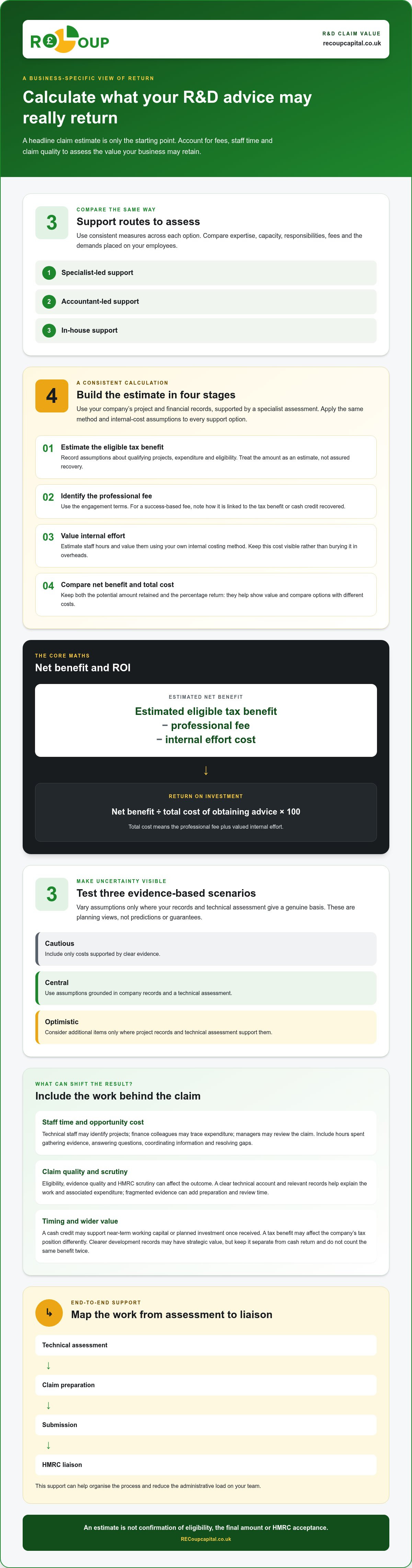
A claim estimate is only the starting point. To judge whether specialist advice creates value, compare the benefit your business may receive with the full cost of securing and using that advice. Include professional fees, employee time, evidence gathering and management attention diverted from other work. The result is a business-specific assessment, not simply a percentage applied to an estimated claim.
For a conventional calculation, compare the return after costs with the resources invested to obtain it. Return on Investment (ROI) principles offer a useful foundation, but an R&D claim also involves uncertainty: an estimate doesn’t confirm eligibility, the final amount or HMRC acceptance. For background on the claim itself, Recoup Capital’s R&D tax credits explained page covers the incentive.
Gross claim value versus net business value
A projected tax benefit and the amount your business ultimately retains are different figures. Professional fees reduce the benefit available for reinvestment. With a success-based fee, the charge is linked to the tax benefit or cash credit recovered. To estimate your likely net position, start with a supportable estimate of the benefit, then account for the applicable fee and the value of internal effort. Don’t treat a headline estimate as money already received.
Consider timing as well as the total. A cash credit may support near-term working capital or planned investment once received, while a tax benefit may affect the company’s tax position differently. Wider strategic value, such as clearer records of development work, may also matter. Keep it distinct from cash return and avoid counting the same benefit twice.
Why time and claim quality belong in the calculation
Employee effort can be spread across technical staff identifying projects, finance colleagues tracing expenditure and managers reviewing the claim. Estimate the hours each group will spend, then use your own internal method to value that time. Include the opportunity cost: time spent locating evidence or resolving gaps is time unavailable for other responsibilities.
Net ROI is the value of the benefit after professional fees and internal effort have been taken into account. Claim quality affects how realistic that assessment is. A clear technical account, supported by relevant records, helps explain the work undertaken and the expenditure associated with it. Fragmented evidence or unclear project histories can add preparation and review time, changing the net calculation even before any tax benefit is considered.
For a more grounded estimate, compare cautious, central and optimistic scenarios using your company’s records and a technical assessment. Make the assumptions visible: the costs treated as relevant, the staff hours required, the fee basis and the estimated benefit. Calculating the ROI of specialist R&D advice this way gives decision-makers a clearer view of potential value without confusing an encouraging estimate with a guaranteed outcome.
How to calculate net ROI from specialist R&D advice
A useful estimate follows the same sequence for every support option: establish a potential eligible benefit, identify the professional fee, value the internal effort, then compare the likely return with the total cost of obtaining advice. Use your own project and financial records, supported by a specialist assessment, rather than relying on a generic claim figure. The principles of understanding and calculating ROI can help frame the comparison, but your assumptions must reflect the company’s circumstances.
Build a business-specific ROI estimate
Start with a preliminary estimate of the tax benefit, and record what you have assumed about qualifying projects, expenditure and eligibility. R&D relief depends on how the rules apply to the company’s activities and costs, so treat this figure as an estimate, not a forecast of an assured recovery. Recoup Capital’s R&D Tax Credits guidance can help clarify how the relief works.
Next, apply the professional fee set out in the engagement terms. For a success-based fee, record how it is calculated against the tax benefit or cash credit recovered. Then estimate internal hours for gathering records, answering technical questions, coordinating finance information and reviewing the claim. Value those hours using your own internal costing method. Keep the amount visible rather than burying it in a general overhead.
Estimated net benefit = estimated eligible tax benefit − professional fee − internal effort cost. To express this as a return on investment, divide the net benefit by the total cost of obtaining advice, meaning the professional fee plus valued internal effort, then multiply by 100. Keep both figures: the net amount indicates potential value retained, while the percentage helps compare options with different costs. Use the same method and internal-cost assumptions for each option.
Test assumptions before relying on the result
Build cautious, central and stronger scenarios by varying assumptions that have a genuine basis in your records. For instance, a cautious case might include only costs supported by clear evidence. Another scenario could include additional items only where project records and technical assessment support them. These are planning views, not predictions or guarantees of eligibility, recovery or HMRC acceptance.
Before using the comparison to make a decision, check that project descriptions, cost records and staff-time estimates match what the company can substantiate. Note gaps separately, such as missing project documents or time records, so the estimate shows where uncertainty lies rather than disguising it as precision. An ROI estimate depends on eligibility, evidence, fees and internal effort, so changing any of these can change the result.
For a more grounded assessment, organise the records behind each assumption and consider how the claim process would work in practice. Recoup Capital’s R&D tax credit claim support covers technical assessment, preparation, submission and HMRC liaison, giving your team a defined basis for evaluating the workload alongside the potential return.
Is specialist R&D advice worth the fee? Compare the value, not just the headline
There isn’t one right way to manage an R&D tax credit claim. Compare how each approach handles the same work and what it asks of your team. A general accountant may already understand your accounts and tax position; an in-house team may know the projects in depth; a specialist may bring focused technical and claim experience. The right fit depends on the work involved, the skills available and the capacity you can commit.
Compare each model against consistent criteria:
- Technical interpretation: Who can work with project teams to explain the technological uncertainty and development activity, and distinguish that from routine work? Complexity can increase the need for careful assessment, but it doesn’t establish eligibility by itself.
- Documentation: Who gathers and organises project evidence and connects it to the costs included in the claim? Consider whether existing records can support the narrative without extensive internal reconstruction.
- HMRC communication: Who prepares and manages responses if HMRC asks questions? Set out how responsibility is shared rather than assuming a particular approach includes every task.
- Capacity and ownership: How many employee hours are needed, which colleagues provide information, and who oversees deadlines, decisions and final review?
When specialist input may add measurable value
Specialist input can be useful where projects span several technical areas, involve multiple teams or have a complicated development history, particularly if the business has limited R&D tax experience. Technical assessment and coordinated claim preparation can help organise evidence and reduce the administration handled internally. Measure that value through clearer ownership, fewer demands on project staff and a more coherent process, not an assumed increase in claim value or likelihood of acceptance.
For example, if engineers must repeatedly explain project decisions to different reviewers, a coordinated process could reduce duplicated requests and make their time easier to plan. The underlying records and facts still matter, however. Advice can help interpret and present the work; it cannot turn an activity into qualifying R&D simply because it is technically challenging.
When existing internal support may be sufficient
An accountant-led or in-house approach may suit a business with relevant technical and tax experience, well-organised project records and enough staff capacity to manage preparation and review. In that case, additional support could duplicate existing work. Assess whether specialist expertise fills a specific gap, such as technical interpretation or claim coordination, rather than adding another layer of process without a clear role.
Some businesses may use a blended model: internal staff retain project knowledge and financial records, while specialist support focuses on technical assessment, preparation or HMRC liaison. Agree responsibilities and include internal coordination time in the comparison. Recoup Capital’s guide to claiming R&D tax credits outlines the process, helping your team identify existing capability and where additional expertise could contribute.
Ultimately, calculating the ROI of specialist R&D advice means weighing expertise and process resilience against fees, workload and any overlap with existing support. Compare the models on evidence, effort and ownership, then choose the approach that fits your company’s actual needs.
What can improve or weaken the ROI of specialist R&D advice?
The return on advice can shift as the facts behind a claim become clearer. Eligibility, supported expenditure, project evidence, professional fees and staff time all affect the value retained. A preliminary estimate may look attractive, but if costs are poorly documented or the technical account needs substantial reconstruction, the work required to assess and prepare a claim can grow.
Specialist advice can help interpret and organise information, but it doesn’t guarantee that a company qualifies, that a particular benefit will be recovered or that HMRC will accept a claim. Treat advice as a way to improve assessment and preparation, not as insurance against uncertainty. A sound ROI view makes assumptions visible and allows for evidence gaps or additional review effort.
Claim evidence, eligibility and uncertainty
Technical uncertainty is not the same as commercial uncertainty. A project’s cost, market demand or delivery schedule may be uncertain without the work involving a scientific or technological advance sought through resolving technical uncertainty. Assess the project’s actual activities against the applicable rules; complexity or commercial risk alone doesn’t establish eligibility.
Records created during the work can help explain the baseline, the technical obstacle, the approaches tested and what the team learned. Project notes, design changes, test results and cost records may make assessment more efficient than relying on recollections gathered much later. Identifying a project late can mean extra interviews and time spent connecting technical activity with expenditure, while gaps may leave assumptions unresolved.
Before relying on an estimate, check the current HMRC guidance for the relevant accounting period. Scheme rules and terminology can change, so verify which requirements apply, what information must accompany the claim and how the company’s projects and costs should be treated. Recoup Capital’s guide to claiming R&D tax credits provides context on the claim process and the importance of preparing supporting information.
Fees, internal workload and the value retained
Fee arrangements affect the net result differently. A fee linked to the tax benefit or cash credit recovered changes as the benefit changes; another agreed structure may make the professional fee more predictable. Compare the engagement terms against the same benefit assumptions, then include employee hours for evidence gathering, technical input, finance coordination and management review. Don’t count only the adviser’s work.
A larger estimated claim does not automatically mean a higher net ROI. A larger figure may involve more assessment and documentation, while weak records can increase internal effort and uncertainty. Conversely, a well-supported claim with clear responsibilities may be less demanding for employees to progress. Compare the value potentially retained after fees and internal effort with the quality of the evidence and the work required to support it.
To make the assessment more useful, note which assumptions have the greatest effect on your estimate and what evidence could strengthen or weaken them. For a technically informed review of project evidence and claim preparation, read more about Recoup Capital’s R&D claim support.
How to assess specialist R&D advice and turn a claim into business value
A focused assessment starts with the work your business has actually carried out, the evidence available and the people who can explain it. Preparing this information helps a specialist consider the technical position and likely claim effort, while giving you a clearer basis for judging net value. It doesn’t establish eligibility or guarantee a claim outcome.
Prepare for a focused R&D claim assessment
Bring together a practical picture of the projects and the records behind them. You don’t need to create a polished technical report before an assessment, but clear source material helps keep the discussion specific. Recoup Capital’s R&D tax credit claiming guidance outlines the process and helps your team understand the information involved.
- Projects: List the development activities, key stages and people involved.
- Technical challenges: Note what the team was trying to resolve, which approaches it considered and what changed during the work.
- Records: Gather available project notes, designs, test results and relevant financial information, including records that help explain the costs.
- People: Identify technical employees who can describe the work and decisions, alongside finance colleagues who can help trace expenditure.
Identify gaps, too. Mark where evidence is incomplete or a project history relies on recollection, so those uncertainties can be considered openly rather than mistaken for confirmed facts.
From claim assessment to a practical next step
Recoup Capital’s process covers technical assessment, claim preparation, submission and HMRC liaison. Its R&D specialists and chartered tax accountants bring technical and tax perspectives to the review, while an end-to-end process can reduce the administration managed by your employees. Professional fees are success-based and calculated as a percentage of the tax benefit or cash credit recovered. Include the applicable terms in your net-value assessment.
Before deciding how to proceed, compare the likely benefit with professional fees and the internal time required. Consider whether the process fits your capacity, who will provide technical and financial information, and how responsibilities will be shared. A structured assessment can clarify the opportunity and the work involved, but it cannot guarantee eligibility, claim value or HMRC acceptance.
If a benefit is recovered, decide in advance how it could support business priorities. Depending on your circumstances, reinvestment might strengthen development capability, fund further testing or contribute to planned innovation. This turns a tax benefit into a considered business resource, rather than an amount with no defined purpose.
For a discussion grounded in your projects and records, read about discussing your R&D claim with our specialists. Calculating the ROI of specialist R&D advice is ultimately about understanding both potential value and the effort required to pursue it, then choosing a process that fits your business.
Turn your assessment into a confident next step
Use your ROI assessment as a decision-making tool, not a promise of a particular result. It can help your business decide what evidence to organise, who should contribute and how much internal capacity to allocate. If the potential value looks worthwhile, agree how progress will be reviewed and which assumptions need to be tested before moving ahead.
The calculation can also inform what happens beyond the claim. Consider how a recovered benefit could support a planned development project, strengthen technical capability or create room for future innovation. A clear reinvestment priority connects the decision to your company’s longer-term objectives, while keeping expectations grounded in the evidence and the net value available.
Calculating the ROI of specialist R&D advice is ultimately about making an informed choice for your business, with the likely return, effort and uncertainties in view. Discuss your R&D claim with Recoup Capital’s specialists to consider how the assessment applies to your projects and records.
Frequently Asked Questions
Can specialist R&D advice guarantee that HMRC will approve a claim?
No adviser can guarantee HMRC approval or a particular tax benefit. An assessment can help your business understand potential eligibility, organise technical evidence and prepare a claim in line with the requirements for the relevant period. HMRC reviews claims through its own processes, and the outcome depends on the facts and supporting records. Treat any projected return as an estimate, not a promised result, and avoid making spending plans that rely on approval.
How much does specialist R&D advice cost in the UK?
Fees and engagement terms vary between consultancies and can depend on the work involved. Recoup Capital’s R&D Tax Credit fees are success-based and calculated as a percentage of the tax benefit or cash credit recovered. No fee structure removes the need to assess the full workload. For a realistic comparison, include the agreed professional fee, staff time spent providing information and management effort needed to oversee the claim.
Can a company claim R&D tax relief for work completed in a previous accounting period?
Possibly, but whether an earlier period can be claimed depends on the rules and deadlines for that period, as well as the company’s eligibility and evidence. For example, a business reviewing development work from a closed accounting period should check which records remain available and whether the relevant submission window is still open. Review the period promptly against current HMRC guidance, since timing can affect whether a claim remains possible.
What happens if HMRC asks questions about an R&D tax claim?
HMRC may request further information or examine particular parts of a claim, and your company may need to provide technical and financial evidence to explain its position. The questions and outcome depend on the enquiry and the facts. Keep relevant project records and cost information organised so they can be located if needed. Specialist support can help prepare a clear response, but it cannot prevent an enquiry or assure acceptance.
Can a business calculate the ROI of specialist R&D advice before making a claim?
Yes. You can create an early estimate using a preliminary view of potential benefit, the agreed fee and expected internal effort. State the assumptions clearly, since eligibility, available evidence and the final claim outcome remain uncertain at this stage. Rather than relying on one forecast, test cautious, central and stronger scenarios using the information currently available. Revisit the calculation as project records are reviewed and the potential claim becomes clearer.
Does a company need to be profitable to make an R&D tax claim?
No, profitability alone doesn’t decide whether a company may qualify. However, the relief available and how it is received depend on the applicable scheme rules and the company’s circumstances. Eligibility and the form of any benefit are separate questions: a loss-making company shouldn’t assume that a claim will produce a cash payment. Check current HMRC guidance for the relevant accounting period and assess the company’s position before including a benefit in forecasts.
Can a company use its accountant and a specialist R&D adviser together?
Yes, the roles can be coordinated if responsibilities are clear. A specialist may focus on technical assessment, claim preparation and relevant HMRC correspondence, while the company’s accountant may handle broader accounts or tax-return work. Agree who supplies project and financial information, reviews the figures, submits the claim and keeps the supporting records. This can reduce duplicated effort, although a business with suitable in-house expertise may not need both advisers.


