

What if the strongest R&D case doesn’t promise a guaranteed return, but shows how the board can manage uncertainty? Presenting R&D investment to a sceptical board means distinguishing what’s known, what needs testing and what the business stands to learn. Directors are right to question open-ended spending, especially when short-term financial measures don’t capture the full strategic value of innovation.
A persuasive case doesn’t hide technical or commercial risks. It connects the proposed work to business priorities, sets out the evidence that would support progress and makes clear when funding should continue, change direction or stop. This article will help you build a concise, evidence-led case for a funding, scope or discovery-stage decision without overstating likely returns.
We’ll look at how to frame strategic fit, define measurable milestones and agree decision gates before work begins. We’ll also consider potential R&D tax relief as a separate funding consideration, not as proof that a project is worthwhile or a guaranteed return.
Key Takeaways
- Define the specific decision you need from the board, whether that’s approving discovery, funding a stage or stopping work.
- Build the case from a business challenge to an R&D question, intended outcome and the evidence supporting each step.
- Compare R&D with alternatives, delay and doing nothing to show the choices and trade-offs clearly.
- When presenting R&D investment to a sceptical board, match measures to the project’s stage and set clear decision gates.
- Turn approval into action by assigning ownership, recording assumptions and setting the first review date.
Why a sceptical board questions R&D investment, and what it needs to decide
Uncertainty is part of research and development, not proof that a proposal is poorly planned. The board needs to see whether that uncertainty has been made visible and whether the company can make sound decisions as evidence develops. A useful case doesn’t claim to know the outcome in advance. It explains what the business hopes to learn, what resources that learning requires and how directors will judge the next step.
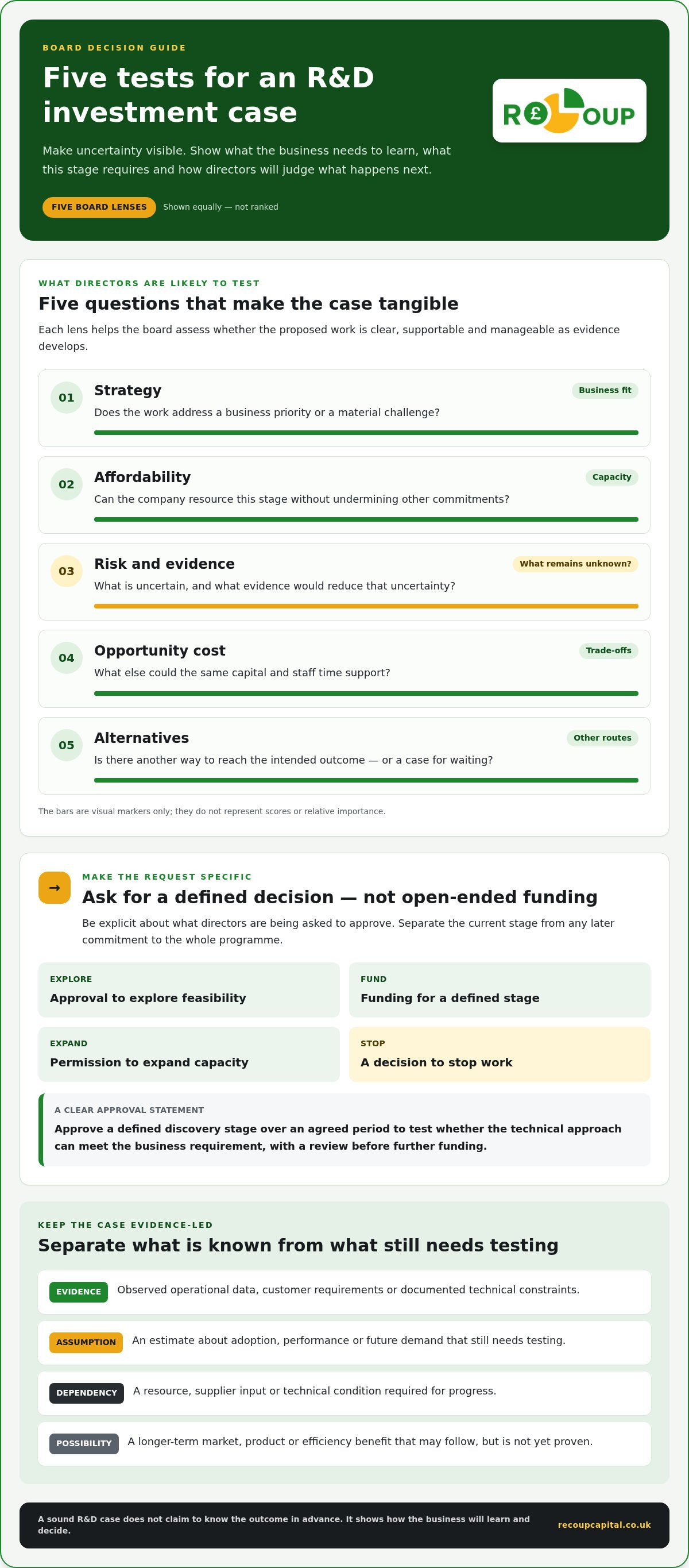
Before presenting R&D investment to a sceptical board, be explicit about the decision required. Is it approval to explore feasibility, funding for a defined stage, permission to expand capacity, or a decision to stop? An investment proposal isn’t a request for unrestricted funding for an entire programme. Give directors a clear choice, with a defined scope and a timeframe for review.
Boards are likely to test the proposal against several practical questions:
- Strategy: Does the work address a priority or a material business challenge?
- Affordability: Can the company resource this stage without undermining other commitments?
- Risk and evidence: What is uncertain, and what evidence would reduce that uncertainty?
- Opportunity cost: What else could the same capital and staff time support?
- Alternatives: Is there a different route to the intended outcome, or a case for waiting?
What is the board really being asked to approve?
Put the request in one sentence: “Approve a defined discovery stage over an agreed period to test whether [technical approach] can meet [business requirement], with a review before further funding.” Replace the brackets with project specifics. Separate approval for this stage from any later commitment to the whole programme. Name the project owner, the senior sponsor responsible for oversight and who must be informed if the evidence, scope or resources change materially.
Why R&D can appear difficult to justify
Technical uncertainty is easier to assess when expressed as a practical question. For example: can a revised component withstand a particular operating condition without compromising performance? Near-term sales may not answer that question, even if the work could later support a new product, improve a process or build capability. These possibilities matter, but label them as potential outcomes rather than established benefits.
Capital and skilled staff committed to R&D can’t be used elsewhere at the same time. Make that opportunity cost visible alongside the potential benefits, and describe what the business gives up if it delays or declines the work. Industry funding is one part of the wider research-financing picture; the Industry Funding of Academic Research overview offers broader context. For the board, the central issue remains the company’s own decision: what it will fund, what it expects to learn and who is accountable for reviewing the evidence.
Build the R&D investment case from strategic fit to commercial potential
A strong proposal gives directors a traceable line from a business challenge to the work being funded. Start with the challenge, identify the technical question, explain which product, process or capability the project could improve, then state the intended business outcome. This keeps the technical detail connected to the reason for investing.
For example, an engineering business might need a component to perform reliably under a demanding operating condition. The R&D question could be whether a redesigned material or process can meet that requirement. The case should then explain how the answer might support a strategic priority, such as product differentiation or operational resilience. Treat the consequences of not investing as possibilities supported by evidence, not as certain losses.
The strategic rationale is to test whether improving [specific capability] can help the business meet [strategic priority], with further investment dependent on evidence from this stage.
Connect the technical question to business strategy
Use the company’s priorities and project evidence to make the connection credible. Customer feedback, tender requirements, recurring production issues or internal performance records may help show why the challenge matters. Be precise about what each source demonstrates, and don’t suggest that interest guarantees demand. If the link to strategy is weak, clarify whether the work builds a capability the business expects to need, or reconsider its priority.
Separate what is supported from what remains conditional. A simple evidence register can help:
- Evidence: observed operational data, customer requirements or documented technical constraints.
- Assumption: an estimate about adoption, performance or future demand that still needs testing.
- Dependency: a resource, supplier input or technical condition required for progress.
- Longer-term possibility: a market, product or efficiency benefit that may follow, but isn’t yet proven.
Present value as evidence and scenarios
Presenting R&D investment to a sceptical board is more persuasive when commercial potential is expressed through scenarios rather than a single precise forecast. Use available evidence to explain the assumptions behind each case, and distinguish direct financial outcomes from strategic learning, such as gaining a capability that could inform later product decisions. Don’t present option value as guaranteed revenue.
For a project testing a new production method, the scenarios might be:
- Base: the method meets the minimum technical requirement, but further work is needed before any commercial benefit can be assessed.
- Upside: test results support a viable route to improved output or a differentiated offer, subject to customer demand and delivery requirements.
- Downside: the method fails the agreed test or relies on an impractical dependency, so the business stops, revises the approach or investigates an alternative.
State what evidence would move the project between scenarios. If the board wants to understand potential tax relief, assess it separately from the project’s underlying merits; relief shouldn’t be treated as a guaranteed return. Once the investment case is clear, specialist R&D tax credit claim support can help assess potential funding implications.
Address R&D uncertainty, risk and alternatives without overselling
Returns from R&D are uncertain. A credible board case doesn’t disguise that fact or replace it with a confident forecast. It explains how the business will test what it doesn’t yet know, limit exposure and respond to results. Managed uncertainty means a defined learning plan with review points, not an unbounded commitment to spend.
For each assumption that could change the decision, state what evidence would support or challenge it. This might include whether a technical approach can meet a performance requirement, whether customers value the proposed improvement, or whether the team can deliver with available resources. Use conditional language: if testing supports the technical case, the next stage could assess customer demand; if it doesn’t, the team would stop or revise the approach.
Make material risks visible and manageable
Pair each material risk with an assessed likelihood, potential impact and named owner. Ratings such as low, medium or high are useful only when the team explains the reasoning and planned response. For example, if an essential supplier’s input could delay testing, the project owner might assess the likelihood using current delivery information, explain the impact on the review date and identify a mitigation. The board can then see both the exposure and who is accountable for monitoring it.
Presenting R&D investment to a sceptical board means comparing the proposal with real alternatives, not treating it as the only route to progress. Adapt this comparison to the project and support each assessment with evidence:
| Option | Strategic contribution | Evidence and resources | Decision timing |
|---|---|---|---|
| R&D investment | Could create or improve a relevant capability. | Evidence develops through testing; needs specialist time and defined resources. | Stage funding allows review before further commitment. |
| Alternative investment | May address the same priority by a different route. | Compare its evidence base, resource demands and limitations with the R&D case. | Assess whether it can be evaluated or implemented sooner. |
| Delay | Preserves resources for now, but may postpone learning or a response to a documented need. | Identify what information or capacity the business expects to gain by waiting. | Set a review point, rather than leaving the choice open indefinitely. |
| Do nothing | Avoids project commitment but retains the current position. | Describe the known consequences and distinguish them from possible future effects. | No project decision is required, though the underlying issue may remain. |
Compare options on their actual merits
Consider scale or low appropriability only where they apply to the project. For instance, if other businesses could readily benefit from the knowledge, explain why that affects the company’s ability to capture value. Don’t present general industry risks as if they automatically apply. Include the cost of delay in practical terms, such as a postponed test or deferred decision, without claiming a specific financial loss unless there’s evidence for it.
Design a board presentation with milestones, measures and decision gates
A board pack should make the decision easy to find and the reasoning easy to test. Lead with what you’re asking directors to approve, the funding or resource scope, the period covered and the strategic rationale. Then set out the evidence, assumptions, scenarios, risks, alternatives and governance. Keep technical detail in an appendix, but explain in the main presentation what it means for cost, feasibility and the next decision.
For presenting R&D investment to a sceptical board, a clear sequence helps keep the discussion focused on the decision:
- Decision: State the approval sought and what it covers.
- Rationale: Connect the work to a business priority.
- Evidence: Summarise what is known and what remains to be tested.
- Delivery: Set out milestones, resources, ownership and material risks.
- Review: Explain the measures and criteria for continuing, adapting or stopping.
Use a decision-first board pack
Keep the main presentation focused on the choices directors need to make. Give each assumption and risk its own clear place, so they aren’t blended into projected benefits. Put detailed methods, test results or technical terminology in an appendix, then explain their implications in plain language. For example, rather than leading with a test specification, explain what passing or failing it would mean for feasibility and the proposed next stage.
Make progress measurable without false precision
Choose indicators that fit the work underway. An early technical stage might be measured by whether a prototype meets defined performance conditions; customer discovery might track the quality of feedback against a stated need. Set a milestone date, accountable owner and evidence record for each review. Revenue may be a later measure, not a useful test of early-stage learning.
Agree continue, adapt and stop criteria before work begins. A continue decision might require the technical test to meet an agreed threshold; an adapt decision could follow partial progress where there’s a credible route to resolving the gap. Stop criteria should identify evidence that would make further investment unjustified. If scope, resources or findings change materially, define what must return to the board rather than allowing the project to drift beyond its original approval.
At the next decision gate, the board will decide whether to release the next stage only if the agreed technical evidence has been recorded, reviewed by the project owner and shown to meet the stated threshold. Replace this example with a project-specific threshold and review date. That gives directors a firm basis for action without pretending the outcome is certain.
Where potential R&D tax relief is relevant, keep it distinct from the project’s technical and commercial case; it shouldn’t be treated as guaranteed funding or a return. For support assessing an R&D tax credit claim as a separate consideration, explore R&D tax credit claim support.
Turn board approval into a governed R&D investment and practical next steps
Approval is the start of delivery, not a blank cheque. Convert the board’s decision into a working project mandate while the scope, assumptions and evidence threshold are still clear. Assign a named sponsor to oversee alignment with business priorities and a project owner to manage delivery, resources and reporting. Set the first review date before work begins, so progress is assessed against the case the board actually approved.
Set up governance after the board meeting
Record the decision in a short project brief and use it as the reference point for delivery and review. Capture the approved scope, resource plan, dependencies, funding boundaries, decision criteria and reporting responsibilities. If an assumption changes or a delay puts a milestone at risk, the brief should make clear who assesses the impact and when the issue must be escalated to the sponsor or board.
A practical record might include:
- Accountability: the sponsor, project owner and people responsible for technical and financial reporting.
- Boundaries: approved activities, resources and any changes that require further approval.
- Evidence: dated test results, project decisions, relevant technical records and financial information, stored in a way that connects them to the work undertaken.
- Review: the next meeting date, required progress information and criteria for continuing, adapting or stopping.
Keep technical records and financial evidence aligned with the project plan. If the work changes, record what changed, why, who approved it and how it affects the original assumptions. This makes later reviews more useful: directors can compare actual evidence with the approved case, rather than relying on a refreshed narrative that obscures how the project developed.
Consider tax relief as part of the wider funding picture
Potential R&D tax relief is a separate tax consideration, subject to the applicable rules and the facts of the company’s activities. It shouldn’t be counted as guaranteed funding or used to make an uncertain project appear commercially sound. First assess the project on its strategic and technical merits, then consider whether a claim may be relevant. Eligibility and any benefit depend on the circumstances, so don’t build the investment decision around an assumed outcome.
For an accessible overview of the topic, see R&D tax credits explained. If a project merits further consideration, guidance on claiming R&D tax credits can help clarify the claim process. Recoup Capital’s specialists and chartered tax accountants support limited companies with technical assessment, submission and HMRC liaison. This is a practical next step for evaluating potential relief separately, not a promise that a project will qualify or receive a particular benefit.
Clear governance lets the business act on approval with discipline. That’s the lasting value of presenting R&D investment to a sceptical board: a decision linked to accountable delivery, evidence and an agreed route back to directors when the facts change.
Make the next board decision easier
The first approval can set a better pattern for future innovation decisions. Treat the next review as a chance to show not only what the project has achieved, but whether the original assumptions still hold and what the business has learned. That gives directors a reasoned basis for adjusting direction, releasing further resources or closing the work, without confusing a change of course with failure.
Over time, this approach can make presenting R&D investment to a sceptical board less about persuading directors to accept uncertainty and more about giving them a disciplined way to assess it. Keep project evidence and potential funding considerations distinct, so each can be judged on its own merits.
If you’re considering how R&D tax credits fit your company’s position, Recoup Capital’s specialists and chartered tax accountants can support the claim process. Discuss your R&D tax credit position with our specialists and take a considered next step.
Frequently Asked Questions
How do you convince a sceptical board to invest in R&D?
Show how the proposal addresses a strategic priority, then make the decision straightforward to assess. When presenting R&D investment to a sceptical board, explain what the business will learn, what evidence it already has and what would change the recommendation. Tailor the discussion to directors’ concerns: a finance director may focus on affordability, whilst an operations director may want to understand disruption to existing work.
What should an R&D investment business case include?
An effective business case should identify the business need, the proposed work, expected resource commitments and how progress will be assessed. Add a concise explanation of why existing solutions don’t answer the project question, where relevant, and identify dependencies such as specialist skills or supplier input. Keep supporting material easy to trace: directors should be able to see which claims rely on evidence and which still need investigation.
How do you measure the return on R&D investment?
Measure return against an appropriate baseline and time horizon, rather than attributing every later improvement to the project. For process development, compare relevant operational records before and after implementation, accounting for other changes that may have affected performance. Financial outcomes such as sales or cost savings may be useful once they can be measured credibly. Earlier in the work, assess whether the project resolved its key technical or customer questions.
How can a business reduce the risk of R&D investment?
Reduce exposure by identifying the assumptions most likely to undermine the project and testing the most decision-critical ones early. For example, if a component’s performance is uncertain, define a suitable test before committing resources to wider development. Keep a record of emerging issues, their possible effect and who is responsible for responding. This helps the team address problems while options remain open, rather than allowing commitments to grow unchecked.
Should R&D projects have revenue targets from the start?
Not necessarily. An early-stage project may have no credible basis for a revenue target because technical feasibility or customer demand is still unknown. Set measures that reflect the work underway, such as whether a test answers a defined question or whether customer research identifies a genuine need. As evidence improves and a route to market becomes clearer, the business can develop commercial measures without presenting early estimates as reliable forecasts.
Can R&D tax relief be included in an investment proposal?
Yes, but present potential R&D tax relief separately from the project’s commercial case and don’t treat it as guaranteed funding or a certain return. Whether a company or activity qualifies depends on the applicable rules and circumstances. Recoup Capital’s specialists and chartered tax accountants support limited companies with technical assessment, claim submission and HMRC liaison, helping them consider the claim process as a separate funding matter.
What should happen if the board rejects an R&D proposal?
Ask which part of the case fell short: strategic fit, evidence, affordability, timing or confidence in delivery. Use the feedback to decide whether to narrow the proposal, gather specific evidence, consider another approach or pause the work. If the board’s concerns can’t be addressed, record the decision and avoid restarting the same proposal without new information. A rejection can clarify what the business needs to demonstrate before reconsidering investment.


