

Could the timing and type of a business purchase affect how quickly you receive tax relief? For 2026/27, the annual investment allowance (AIA) has a £1 million limit, but not every asset qualifies, and the same limit may not apply to every business. This annual investment allowance (AIA) guide explains the key decisions in plain English.
AIA can allow eligible businesses to deduct the cost of qualifying plant and machinery from taxable profits. It isn’t a cash payment from HMRC, and eligibility depends on the asset, its use and the circumstances of the purchase. The limit may also be reduced for a shorter accounting period, and associated companies may need to share it.
Here, you’ll learn which investments may qualify, what exclusions and claim conditions to consider, and how AIA compares with full expensing and writing-down allowances. You’ll also find a practical checklist of the purchase details and records to review when assessing a claim.
Key Takeaways
- This annual investment allowance (AIA) guide explains how eligible capital spending may reduce taxable profits, subject to the rules.
- Assess the asset and its use: machinery and equipment may qualify, but cars are excluded from AIA.
- Compare AIA with full expensing and writing-down allowances. The appropriate route depends on the asset and your business circumstances.
- Check which business bought the asset, when the expenditure was incurred and which accounting period applies. Keep invoices, contracts and asset records to support your assessment.
- For property fixtures or mixed expenditure, specialist capital allowances analysis can help clarify how costs and potential relief fit together.
What is the Annual Investment Allowance, and what can it do for a business?
The Annual Investment Allowance (AIA) is a UK capital allowance that lets a business deduct the cost of qualifying plant and machinery from its taxable profits, subject to eligibility rules and an annual limit. For the 2026/27 tax year, the limit is £1 million. It is lower for an accounting period shorter than 12 months. By bringing tax relief forward, AIA can be relevant when planning business investment.
AIA isn’t a grant, a guaranteed saving or an automatic cash refund from HMRC. A claim may reduce the profit on which a business is taxed, but the actual tax effect depends on factors such as taxable profits, legal structure, accounting period and the rules for the expenditure. Businesses can choose to claim all, some or none of the available allowance.
How does AIA provide tax relief?
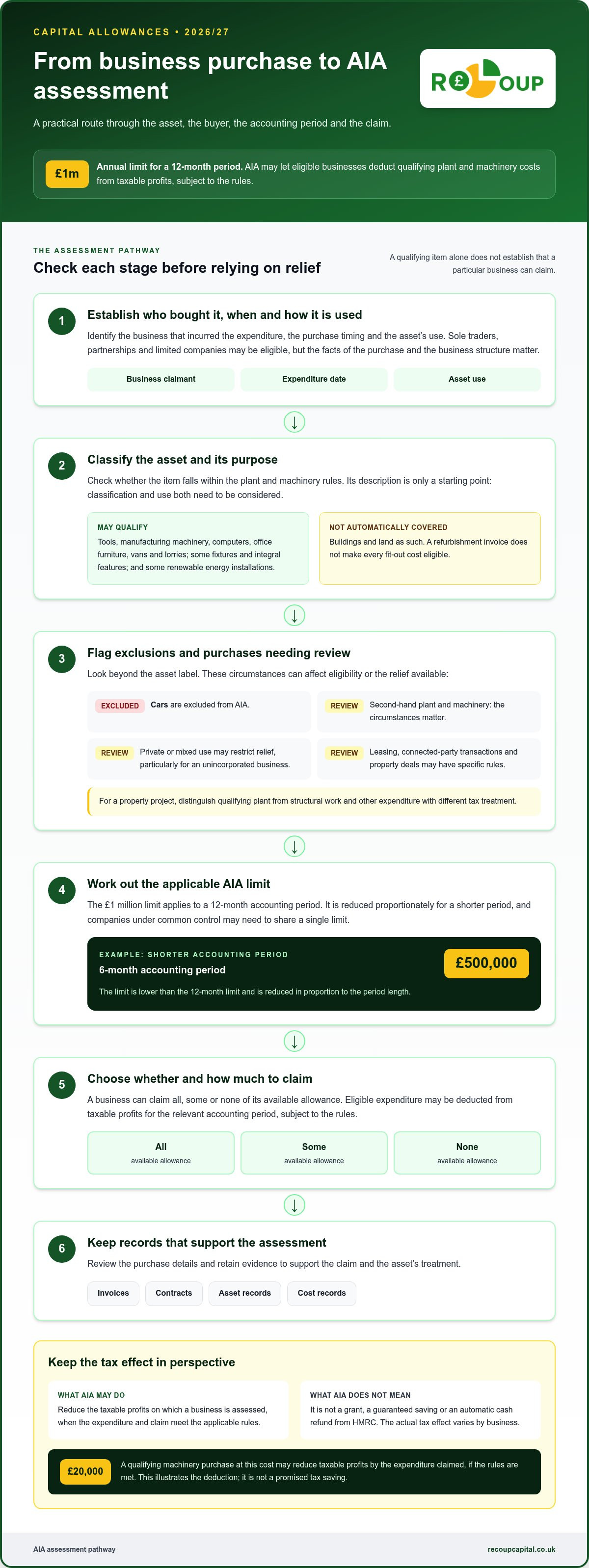
Eligible capital spending may be deducted from taxable profits for the relevant accounting period. For example, if a business buys qualifying machinery for £20,000, an AIA claim may allow that expenditure to reduce its taxable profits, provided the purchase and claim meet the applicable rules. This illustrates how the deduction works, not a promised tax saving. The resulting tax position varies by business.
This distinction matters for cash-flow planning. A deduction changes the amount of profit subject to tax; it doesn’t mean HMRC repays the purchase price. The value and timing of relief depend on the business’s circumstances and the treatment of the asset. AIA is part of the wider capital allowances framework, so consider how an investment fits into the business’s overall tax position rather than treating the allowance as a stand-alone payment.
Which businesses should consider the allowance?
Businesses investing in qualifying plant and machinery are the main audience for AIA. Sole traders, partnerships and limited companies may be eligible, but the business structure and facts of each purchase affect the assessment. The allowance isn’t automatic: the asset, its use and the circumstances of the expenditure all matter.
Accounting periods also need attention. The £1 million limit applies to a 12-month period and is reduced proportionately for a shorter one. For example, a six-month accounting period has a £500,000 limit. Companies under common control may also have to share a single AIA limit, so don’t assume that each associated company has its own full allowance.
Use this annual investment allowance (AIA) guide as a starting point, then assess the specific purchase and accounting period. Before relying on potential relief in an investment decision, establish which business incurred the expenditure, what was bought and when. These details help identify whether a claim may fall within the rules.
AIA eligibility: which assets and expenditure may qualify?
Eligibility depends on more than an item’s name. The asset must fall within the plant and machinery rules, and the expenditure and claimant must meet the relevant conditions. A laptop bought for business operations, for example, may be treated differently from a car or an item used partly for private purposes. The HMRC guidance on Annual Investment Allowance sets out the official rules and exclusions.
What types of plant and machinery may qualify?
Everyday business equipment can include tools, manufacturing machinery, computers, office furniture, vans and lorries. Some fixtures and integral features, such as electrical systems, heating and air conditioning, may also qualify as plant and machinery. Solar panels and other renewable energy installations can be eligible too, depending on the facts. These examples are a starting point: check the asset’s precise classification and use.
Buildings and land aren’t automatically qualifying assets, and a refurbishment invoice doesn’t make every fit-out cost eligible. A project may include qualifying plant alongside structural work or other expenditure with different tax treatment. Commercial property fixtures can be particularly complex. Identifying what was bought, installed or acquired with a building may require a detailed review of contracts and cost records.
Which purchases need extra care?
Some cases need closer scrutiny before a claim. Cars are excluded from AIA, even though many other commercial vehicles may qualify. Second-hand plant and machinery can qualify, but the circumstances of the purchase matter. Private use may restrict the relief available, particularly for an unincorporated business. Leasing arrangements and transactions between connected parties can also be subject to specific rules, so don’t assume they receive the same treatment as an ordinary purchase.
Keep three questions separate: does the item qualify as plant and machinery, when was the expenditure incurred, and which business is entitled to claim? A qualifying asset alone doesn’t establish that a particular business can claim AIA. The contract, invoice, payment or financing arrangement, ownership, use and accounting period can all affect the assessment. If a purchase is shared, acquired from a connected party or included in a larger property transaction, review the details rather than relying on the item description alone.
As a practical first step, sort expenditure into two groups:
- Potentially qualifying: business plant and machinery such as tools, computers, manufacturing equipment, some commercial vehicles and eligible fixtures or integral features.
- Excluded or requiring review: cars, land and buildings as such, private or mixed-use assets, and expenditure affected by leasing, connected-party or property transaction rules.
This annual investment allowance (AIA) guide can help structure an initial review, but borderline classifications need care. For commercial property or mixed fit-out costs, specialist capital allowances analysis can help distinguish fixtures and expenditure that may qualify from costs requiring different treatment.
AIA compared with full expensing and writing-down allowances
AIA isn’t the only route to tax relief on business investment. Full expensing may provide a 100% first-year deduction for eligible company purchases, while writing-down allowances spread relief over time. The appropriate treatment depends on the asset, who owns or uses it, the business’s legal structure and when the expenditure is incurred. A headline percentage alone won’t tell you which route is right.
| Allowance | Broad purpose | Key point for 2026 |
|---|---|---|
| AIA | Deducts qualifying plant and machinery expenditure from taxable profits, subject to the allowance limit and rules. | Up to £1 million for a 12-month accounting period; available for qualifying new and second-hand assets, but not cars. |
| Full expensing | Provides a 100% first-year deduction for eligible investment by companies. | Applies to new and unused main-rate plant and machinery, has no monetary cap, and isn’t available to sole traders or partnerships. |
| Writing-down allowances | Give tax relief over time on qualifying expenditure allocated to a capital allowances pool. | From 1 April 2026, the main-pool rate is 14%; the special-rate pool rate remains 6%. |
How does AIA differ from full expensing?
The main differences are who can claim, the asset’s condition and the annual cap. AIA can cover qualifying second-hand plant and machinery and certain special-rate assets, within its limit. Full expensing is for companies investing in new and unused main-rate plant and machinery, with no upper monetary limit. Neither allowance is a blanket deduction for every business purchase, and the same expenditure can’t be claimed twice. Where the rules permit, separate qualifying purchases may use different routes.
For example, a company investing in new main-rate machinery and eligible second-hand equipment may need to assess each purchase under the relevant rules rather than assume one allowance applies to the whole investment programme. The government’s Annual Investment Allowance Efficacy Review provides further context on AIA’s purpose and how it sits among investment allowances.
When might writing-down allowances be relevant?
Writing-down allowances may apply where qualifying expenditure remains in a capital allowances pool instead of receiving full relief through AIA or another first-year allowance. The business claims relief on the pool balance at the applicable rate, so deductions are generally spread over time. For instance, expenditure above the available AIA limit may need different treatment, depending on the asset and the business’s circumstances.
This annual investment allowance (AIA) guide is a starting point for comparing options, not a calculation of your claim. Consider accounting-period dates, asset eligibility and the business’s wider tax position together. A review of capital allowances for business expenditure can help clarify how different assets and costs should be assessed.
How to assess an AIA claim: a practical business checklist
A sound AIA assessment links the item purchased to the business claiming relief, the relevant accounting period and the supporting evidence. Review these details before preparing the tax return. This can flag excluded or mixed-use expenditure and make it easier to explain how the figures were reached.
Review the purchase in order
- Identify the asset. Record what was bought, its function and whether it is a standalone item, a fixture or part of a wider project.
- Identify the purchaser. Confirm which business incurred the expenditure and check that the invoice and contract support this.
- Establish the use. Note whether the asset is used for business, privately or for both, and keep evidence of its business use where relevant.
- Record the date. Use the purchase agreement, invoice and transaction records to trace when the expenditure was incurred. The date can affect which accounting period is relevant.
- Set the accounting period. Confirm the period covered by the tax return and assess the available AIA limit for that period, including any group-sharing rules that apply.
What records should a business assemble?
Organise the evidence by asset, not just by supplier or project. Useful records include purchase invoices, signed contracts or purchase agreements, payment records, asset-register entries and information showing where and how equipment is used. For installations, retain relevant project documents, specifications and cost breakdowns. Each record should connect the amount being considered for relief to the particular asset and the business that acquired it.
If an invoice bundles equipment, installation and building work into one figure, a clear breakdown can be important. Mixed expenditure or complex property fixtures may require supporting technical or accounting analysis, rather than an unsupported estimate of which costs relate to qualifying plant and machinery.
What should be checked before submitting?
Reconcile the proposed claim to the business’s accounting records and tax computation. Check that the asset cost is recorded consistently, any excluded or private-use element has been considered, and the allowance limit and accounting period are correct. Then follow the claim procedure for the business’s tax return. Keep the working papers and evidence with the relevant accounting records.
For example, a business that buys production equipment and has it installed during the year would identify the purchaser and asset, review the purchase and installation documents, establish the relevant date and period, and reconcile the amount being considered with its accounts. It would then review eligibility and the applicable rules before deciding whether and how to include the expenditure in its return. This is a process, not a prediction of the claim outcome.
This annual investment allowance (AIA) guide can help organise the initial review, but property fixtures and bundled project costs may need closer assessment. Recoup Capital’s capital allowances analysis combines forensic surveying and accounting to help businesses understand expenditure and potential relief. This support is particularly relevant when costs need to be separated and assessed in detail.
AIA and capital allowances: when specialist analysis can help
AIA is one part of a wider capital allowances review, not a label that applies to every cost in a property or investment project. Reviewing the expenditure as a whole can help distinguish assets that may qualify for AIA from fixtures or other costs requiring different tax treatment. The aim is to understand what was acquired, how each cost is categorised and which rules may apply before finalising the claim.
When can a wider capital allowances review add clarity?
Commercial property acquisitions, refurbishments and substantial fit-outs can involve many types of expenditure. A purchase price or contractor invoice may cover building fabric, services, equipment and fixtures together. Some fixtures may form part of the plant and machinery analysis, but their presence alone doesn’t establish that they qualify for AIA or another particular allowance. Ownership history, contracts, cost allocation and the nature of the work can all affect the assessment.
It helps to separate two questions. First, which items in the property may be qualifying fixtures for capital allowances purposes? Second, can the business claim AIA on particular expenditure, given the claimant, timing and relevant rules? Identifying a fixture is an important step in understanding the costs, but it doesn’t by itself determine the allowance or the amount of relief available.
A broader review can also bring current investment into context alongside earlier property expenditure. For instance, a refurbishment may involve replacing building services as well as installing new equipment. Separating those elements and tracing them to supporting records can give the business a more considered view of how the expenditure should be treated. Not every property cost will qualify, and the appropriate analysis depends on the facts.
How can businesses take a confident next step?
By this stage of the annual investment allowance (AIA) guide, the key questions should be clear: what is the asset, which business incurred the cost, how is it used, when was the expenditure incurred, and what evidence supports the treatment? For property-related spending, also ask whether individual fixtures and costs can be identified clearly in the acquisition or project records.
Recoup Capital’s capital allowances work brings together forensic surveying and accounting to identify tax-deductible fixtures in commercial buildings and help businesses understand their expenditure and potential relief. This can be valuable where property records are complex, costs are bundled or the physical assets need to be considered alongside accounting information. The analysis supports an informed assessment; it doesn’t guarantee a claim or a particular tax outcome.
If your business is reviewing a commercial property purchase, refurbishment or fixture expenditure, Recoup Capital can help you assess the related capital allowances position.
Make your next investment decision with greater clarity
Tax planning is most useful when it informs decisions before expenditure is committed, not just when a return is being prepared. Use this annual investment allowance (AIA) guide to bring investment plans, asset records and tax considerations into the same conversation. A clear view of the costs can support more confident decisions about business priorities and future projects.
Where commercial property or complex fixtures are involved, specialist analysis can make the underlying expenditure easier to understand. Recoup Capital’s capital allowances consultancy combines forensic surveying and accounting to identify tax-deductible fixtures in commercial buildings. The findings can inform a careful assessment of potential relief without assuming every cost qualifies or promising a particular tax outcome.
Explore Recoup Capital’s capital allowances support to understand how your property expenditure may fit into future business planning.
Frequently Asked Questions
Can unused Annual Investment Allowance be carried forward to another accounting period?
No. An unused AIA limit can’t be carried forward. If a business claims less than its available allowance, the unused portion doesn’t increase the limit in a later accounting period. The business may choose to claim only part of the allowance, but should consider how the remaining expenditure will be treated under the relevant capital allowances rules. The right decision depends on its wider tax position, not just the current year’s figures.
Does AIA reduce a company’s tax bill or its taxable profits?
AIA reduces taxable profits, rather than directly reducing the tax bill by the amount claimed. For example, a company’s qualifying expenditure may be deducted when calculating its taxable profit, which can then affect the Corporation Tax due. The tax effect depends on the company’s profits and applicable tax rules, so a claim doesn’t guarantee a particular saving. This distinction is central to understanding the annual investment allowance (AIA) guide.
Can a business claim AIA on second-hand plant and machinery?
Yes, qualifying second-hand plant and machinery can be eligible for AIA. The fact that an asset has been used before doesn’t automatically rule it out. However, the transaction still needs to meet the relevant conditions, and special rules may apply to purchases from connected parties or assets previously owned by the business. Keep the sale agreement and asset details so the purchase and claimant can be assessed accurately.
Can a business claim AIA for equipment bought on finance or lease?
Not automatically. The finance arrangement and contract affect who is treated as having incurred the qualifying expenditure, and lease payments aren’t necessarily treated like the cost of buying an asset. Distinguish a purchase funded through borrowing from an arrangement where the equipment is leased, then review the agreement and ownership terms. Before including the cost in a claim, establish which party may claim and how the specific arrangement is treated.
Can a sole trader or partnership claim the Annual Investment Allowance?
Yes. Sole traders and partnerships can claim AIA for qualifying business expenditure, subject to the rules. The assessment should identify the person or partnership that incurred the cost and consider whether the asset is used privately as well as for business. For example, equipment used partly outside the business may need different treatment from an asset used wholly for business. Keep the purchase evidence and details of how the asset is used.
What happens if a business buys an asset shortly before its accounting year ends?
The timing may affect which accounting period includes the expenditure and how much AIA is available, but the invoice or payment date alone may not settle when the expenditure is treated as incurred. Check the purchase contract, delivery and other transaction details against the applicable rules. If an asset is ordered before year end but supplied later, don’t assume it belongs in the earlier period. Accurate timing matters to the claim and supporting records.
Can AIA be claimed on commercial property fixtures?
Potentially, but not every fixture or property cost qualifies for AIA. The item, how it was acquired and the transaction details all matter; the building or land itself shouldn’t be treated as qualifying plant and machinery. In a purchase or refurbishment, costs may combine fixtures with structural work or other expenditure. A detailed review of contracts, cost information and the property can help establish which items may qualify and the appropriate tax treatment.


