

Could your start-up’s software qualify for R&D tax relief, even if the work looks like product development? The deciding factor isn’t your company’s label or funding story. It’s whether the project sought an advance in technology and faced uncertainties that a competent professional couldn’t readily resolve. That distinction is central to R&D tax credits for tech startups UK, and it’s easy to blur when routine engineering and genuine technical problem-solving happen side by side.
It’s understandable to be cautious. Finance teams may have limited time to trace development work and costs, while an unsupported claim can invite HMRC scrutiny. Past estimates may also no longer reflect the rules. For accounting periods beginning on or after 1 April 2024, most companies use the merged scheme, with Enhanced R&D Intensive Support available to eligible loss-making SMEs.
This 2026 guide explains how to assess software projects against the technical criteria, which schemes and claim requirements to examine, and which costs and project records may support a credible claim. You’ll have a clearer basis for deciding what merits closer review, without relying on a guaranteed credit or unsupported estimate.
Key Takeaways
- A technology label or new product doesn’t establish eligibility. Assess whether the project aimed for a technological advance and faced genuine uncertainty.
- Use this guide to R&D tax credits for tech startups UK to understand how accounting period, company size and financial position can affect the claim route.
- Build a clearer claim by connecting the project’s scope and technical uncertainties to staff involvement, supporting records and eligible costs.
- Review claim procedures and deadlines early, particularly if the company is claiming for the first time or after a gap.
- Recoup Capital brings technical assessment and tax expertise together to support claim preparation, submission and HMRC liaison.
R&D tax credits for tech start-ups: what the relief is and who can claim
R&D tax relief is a UK Corporation Tax incentive that can provide relief for qualifying research and development carried out by a company. For a technology start-up, the key question isn’t whether the business calls itself innovative. It’s whether the project meets the technical criteria and the claim follows the rules for the relevant accounting period. A useful starting point is this: qualifying R&D seeks an advance in science or technology by resolving uncertainty that a competent professional could not readily work out.
A promising app, a first-to-market feature or an ambitious product roadmap doesn’t establish eligibility on its own. A project may qualify where the team is trying to overcome a technological barrier, even if it ultimately doesn’t succeed. By contrast, building a product using established methods or making routine improvements isn’t automatically R&D for tax purposes. The R&D Tax Credits in the UK overview provides broader background, but a claim needs to be assessed against HMRC’s current guidance and the specific work undertaken.
This guide focuses on how technology start-ups can assess project activity, understand the relevant claim route and prepare for a credible submission. It isn’t a directory of every UK tax relief. For practical context, claiming R&D tax credits means connecting the technical case to the company’s costs and tax position.
Can an early-stage technology company qualify?
Potentially. A company’s age, commercial success and profitability don’t determine whether its projects meet the R&D test. An early-stage company might have qualifying work before it has customers or revenue, while a successful technology business may have projects that are routine rather than qualifying. Assess work project by project. Identify the intended advance, the uncertainty faced and why it couldn’t readily be resolved using existing knowledge.
The claimant is the company, not its founder personally. R&D tax credits for tech startups UK concern a company’s eligible activity and Corporation Tax claim; they aren’t a personal tax relief for founders. Whether support takes the form of a reduction or a payable credit depends on the applicable scheme and the company’s circumstances. A payable credit has its own eligibility conditions.
What the 2026 UK rules mean for start-ups
For accounting periods beginning on or after 1 April 2024, the former SME and RDEC schemes have been replaced for most companies by the merged R&D expenditure credit regime. A separate route, Enhanced R&D Intensive Support (ERIS), may be available to eligible loss-making SMEs with qualifying R&D expenditure of at least 30% of total expenditure for the period. The routes have different conditions, and a “start-up” label doesn’t decide which applies.
Company size, accounting period, profit or loss and other scheme rules all matter. Don’t rely on historic estimates based on the former SME scheme or select a route because it sounds more favourable. Review R&D tax credits explained alongside current HMRC guidance, then assess the company’s circumstances before forecasting any benefit.
When software and product development count as R&D
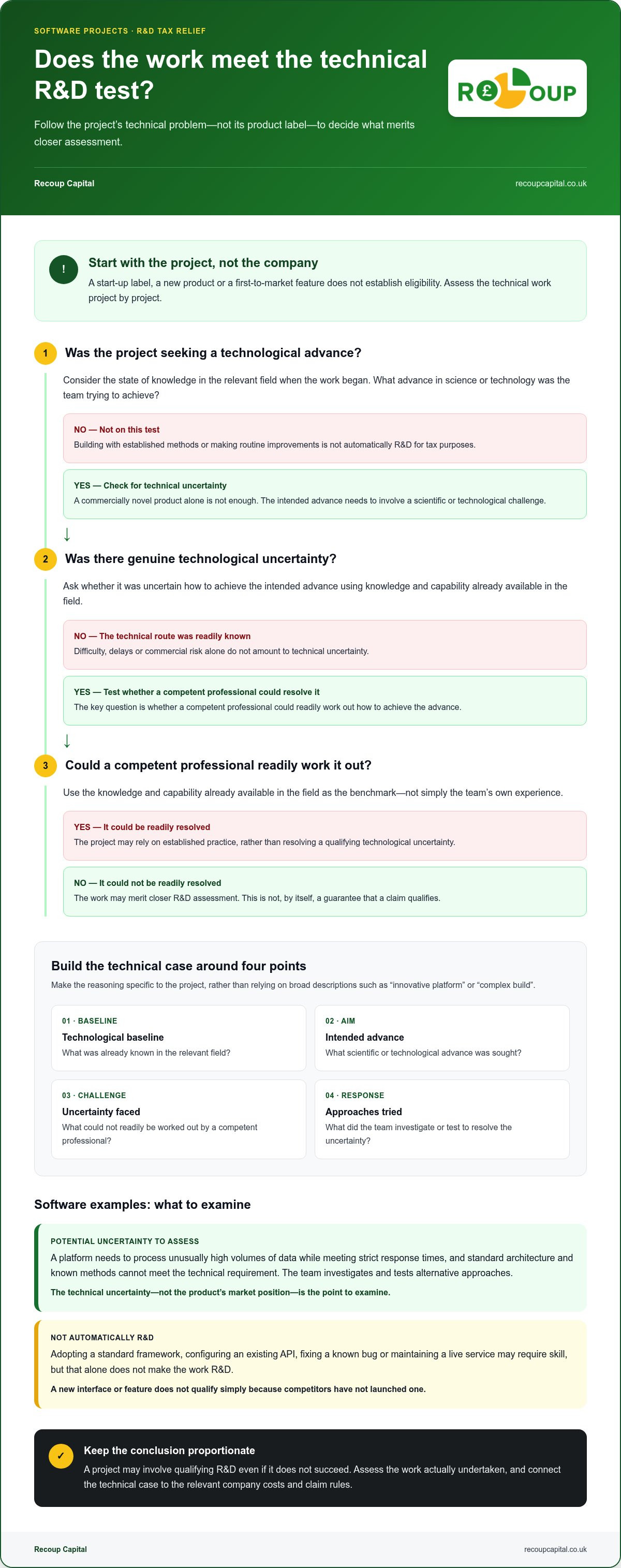
For software and product projects, eligibility turns on the technical work, not how novel the product appears to customers. Start with the state of knowledge in the relevant field when the work began. Then identify the advance the team intended to achieve and the scientific or technological uncertainty it needed to resolve. A new service in the marketplace may rely on established technology. Conversely, a technical advance may qualify even if it never becomes a commercial product.
Technical uncertainty exists when a competent professional cannot readily work out how to achieve the intended scientific or technological advance using knowledge and capability already available in the field. Difficulty, delays or commercial risk alone aren’t enough.
A practical assessment should capture four things: the technological baseline, the intended advance, the uncertainty and the approaches tried to resolve it. HMRC’s guidance on R&D Tax Relief explains the official criteria. Make the reasoning specific to the project rather than relying on broad descriptions such as “innovative platform” or “complex build”.
Examples of software R&D questions founders should examine
Consider a hypothetical start-up developing a platform that must process an unusually high volume of data while meeting strict response times. If standard architecture and known methods can’t meet the technical requirement, and the team investigates and tests alternative approaches, the work may involve uncertainty worth assessing. The same may apply where the team must resolve an unknown about interoperability or scalability that cannot readily be solved using established practice.
Contrast that with adopting a standard framework, configuring an existing API, fixing a known bug or maintaining a live service. These tasks may require skill, but that alone doesn’t make them R&D. Nor does a new interface or feature qualify simply because competitors haven’t launched one. These examples are illustrative: the technology involved doesn’t determine eligibility on its own.
How to assess the boundary between R&D and routine work
Ask what a suitably knowledgeable professional in the field could have achieved at the outset. Could they have resolved the problem by applying existing techniques, documentation or readily available products? If not, record what was unknown, why routine methods fell short and how the team tested possible solutions. A failed experiment can help explain the uncertainty, but it doesn’t automatically make every activity in the project eligible.
Separate investigative development from work that followed once the uncertainty was resolved. Routine production coding, deployment, user-interface design, customer customisation and commercial activity may sit outside the qualifying work, even when they belong to the same product project. Keep project notes, technical discussions, test results and version-control records tied to the relevant tasks. This helps distinguish experimental work from delivery.
For founders assessing R&D tax credits for tech startups UK, this project-level boundary is often the most useful place to begin. If you need support connecting the technical assessment to a claim, explore R&D claim preparation and submission.
Which R&D tax credit route and costs might suit a tech start-up?
Choosing a route starts with the company’s accounting period and circumstances, not a preference for the most attractive headline. For periods beginning on or after 1 April 2024, most companies fall under the merged R&D expenditure credit regime. Enhanced R&D Intensive Support (ERIS) is a separate route for certain loss-making SMEs with qualifying R&D activity. Each route has specific conditions, so treat this as an initial comparison, not a decision on eligibility.
Company size, profit or loss, accounting period and the nature of the work can all affect which rules apply and how relief is treated. Check HMRC’s current requirements for the period being claimed before estimating a benefit. Loss-making status alone doesn’t establish eligibility for ERIS or determine whether a payment is due.
| Decision factor | Merged R&D expenditure credit | ERIS |
|---|---|---|
| Who may need to assess it? | Companies within the merged regime, subject to the applicable rules. | Loss-making SMEs that meet the relevant R&D intensity and other eligibility conditions. |
| What to examine | Accounting period, company circumstances and qualifying expenditure. | SME status, loss position, qualifying R&D expenditure and all scheme conditions. |
| Is the route automatic? | No. Confirm the company’s circumstances against current HMRC guidance. | No. Losses alone don’t settle eligibility or payment treatment. |
How to think about the available claim routes
Neither route is universally best for a start-up. A company’s position can change between accounting periods, so review the facts for each claim instead of carrying forward an old assumption. Also examine the arrangements behind the work. Grants or other subsidies, subcontracted R&D and connected-party relationships can affect how costs are treated. Their impact depends on the relevant rules and circumstances, so check the treatment against HMRC guidance rather than assuming it is standard.
Which technology-development costs deserve a closer review?
Start with costs that can be tied to qualifying project work. Employee costs may warrant review where staff directly undertook or supported R&D activities. A job title alone doesn’t establish what proportion of someone’s work relates to those activities. Project records, task tracking and discussions with technical leads can help explain the connection.
Software used directly in R&D and consumables used or transformed through the work may also merit assessment, subject to the rules. Separate these from general software subscriptions, routine hosting, office overheads and ordinary operating costs. A cost appearing in a project budget doesn’t make it automatically claimable. Record what it was used for, which project it relates to and how it supported the qualifying activity.
Subcontractor and externally provided worker costs need particular care. The contract, working arrangement, who commissioned the R&D and where the activity took place may all be relevant under current rules. Review the underlying documents before including such expenditure. A disciplined cost review links the technical case to the numbers. The practical steps involved in claiming R&D tax credits include building that link clearly.
How to prepare a clear, evidence-led R&D claim
A credible claim tells one connected story: what the company was trying to achieve, why the technical outcome wasn’t readily known, who worked on resolving the uncertainty and how the claimed costs relate to that work. For founders preparing R&D tax credits for tech startups UK, a simple workflow can turn development activity into clear, reviewable evidence.
- Scope the projects. List the projects in the accounting period and identify the work that may have involved qualifying R&D. Separate technical investigation from routine product delivery.
- Map the uncertainties. For each project, describe the baseline, intended advance, technical obstacle and approaches the team tried. Explain why established methods weren’t enough.
- Gather records. Bring together documents from the development period. Ask technical leads to clarify decisions using those records rather than relying on memory alone.
- Reconcile the costs. Link relevant staff and expenditure to the activities evidenced, then check the calculations against the company’s accounting records.
Contemporaneous technical and financial records make a claim clearer by showing how the project’s reasoning, people and expenditure fit together.
Build a project record from development work
Useful evidence may already sit across design notes, technical tickets, test results, version-control history, meeting notes and records of failed approaches. Bring these together by project, noting when decisions were made and what the team knew at the time. For example, a dated record of a test that ruled out one architecture can explain the investigation more clearly than a general statement that development was challenging.
Ask technical leads to describe the starting point, what remained uncertain, which solutions they considered and what happened next. Keep the explanation understandable to a reader who isn’t immersed in the codebase, while retaining enough technical detail to support the reasoning.
Connect project evidence to costs and submission steps
Map team roles and available time records to the activities described in the project narrative. Then reconcile relevant costs with payroll and accounting records, investigating gaps or amounts that don’t align. A reviewer should be able to follow the path from technical activity to staff involvement and expenditure, rather than having to infer the connection.
Check the current requirements for the accounting period before filing. The Additional Information Form forms part of the claim process. A claim notification form is required for first-time claimants and companies that haven’t claimed in the previous three years. It must be submitted within six months of the accounting period end. The claim itself is generally due within two years of the period end. Confirm the applicable forms, timing and submission sequence against current HMRC guidance.
Clear records can also help founders understand the potential for tax relief to support future development, without treating any outcome as guaranteed. Explore why companies claim R&D tax relief, or get support with preparing and submitting an R&D claim.
How Recoup Capital supports a UK tech start-up’s R&D claim
A strong R&D claim needs both a clear account of the technical work and a careful tax calculation. Recoup Capital supports limited companies through technical assessment, cost review, claim preparation and submission, followed by liaison with HMRC if required. Its specialists assess project activity, while chartered tax accountants contribute to the financial and tax work.
The process starts by understanding the company’s development work and identifying projects that may merit closer assessment. The technical case is then connected to the relevant costs and supporting records. This helps founders see how the claim narrative, calculations and evidence fit together, rather than treating them as separate exercises.
What founders can expect from specialist support
Evidence gathering can be structured around information a start-up already holds, such as project timelines, technical discussions, test records and accounts. Working with the people closest to the development helps clarify why particular decisions were made and what technical challenges the team faced, without asking engineering staff to write a tax claim from scratch. It also keeps requests focused, so founders and product teams can concentrate on delivery.
A clear technical narrative explains the project’s uncertainties and the work undertaken to address them. The financial review links relevant staff and other costs to that activity, with calculations supported by company records. Together, these strands make it easier to understand how the claim was prepared and why particular amounts are included.
Submission isn’t necessarily the end of the process. HMRC may review a claim, request information or ask questions, and Recoup Capital’s support includes liaison with HMRC. The outcome still depends on the company’s eligibility, the strength of its evidence and the rules that apply to its accounting period. No claim outcome is guaranteed.
Turning potential relief into a considered next step
Before an assessment, founders can organise a few useful items: a list of development projects and their timelines, technical records from the relevant period, details of who worked on each project, and the company’s accounting-period information. These materials give the assessment a practical starting point and can help surface gaps or questions before submission. You don’t need to turn scattered engineering notes into a finished claim narrative first.
For start-ups exploring R&D tax credits for tech startups UK, any relief recovered may provide additional capital for business development, but the amount and availability depend on the claim and HMRC rules. Recoup Capital’s success-based professional fees are calculated as a percentage of the tax benefit or cash credit recovered.
If you’re ready to discuss your company’s R&D activity and claim evidence, discuss an R&D tax credit claim with Recoup Capital.
Make R&D claim readiness part of your growth plan
Good evidence can do more than support a tax claim. Recording technical decisions as development happens gives your team a clearer account of what it learned, which approaches it tested and where the next challenge lies. That record can inform future planning, even before you know whether a project’s activity could qualify.
For a start-up considering R&D tax credits for tech startups UK, a useful next step is to set a regular review point with technical and finance leads. Bring project notes and cost information together while the people involved can still explain the work. This makes it easier to spot unanswered questions and decide whether a closer assessment is worthwhile, without treating relief as certain or building plans around an unsupported estimate.
Recoup Capital can help you examine that next step with specialist R&D tax expertise and chartered tax accountants. Discuss your R&D tax credit claim with Recoup Capital and explore the evidence and project activity behind it. A considered assessment can help your team move forward with greater clarity and confidence.
Frequently Asked Questions
Can a pre-revenue UK tech start-up claim R&D tax credits?
Yes, a pre-revenue UK company may be able to claim. For founders researching R&D tax credits for tech startups UK, revenue isn’t the deciding test. The company, qualifying activity, costs and scheme conditions for its accounting period all matter. A software business still building its first product could assess development work before launch, but shouldn’t assume every early-stage cost qualifies. Project eligibility is also separate from whether the company can receive a payable credit.
Does writing software automatically count as R&D for tax purposes?
No. Writing software alone doesn’t make work qualifying. Implementing a standard payment integration or updating an established feature differs from investigating a technical problem that available methods can’t readily resolve. Assess what was known when development began, the advance the project sought and which tasks addressed the uncertainty. Distinguish routine coding, configuration and maintenance from investigative work, even if they’re recorded in the same sprint or product roadmap.
Can a start-up claim R&D tax relief if it has received grant funding?
Grant funding doesn’t automatically prevent a claim or prove that costs qualify. Its treatment can depend on the funding terms, how the project was organised, which expenditure is included and the rules for the relevant accounting period. Keep the award letter, payment records and project budget together, noting which work and costs the funding relates to. Before calculating relief, assess the arrangement against current HMRC guidance rather than assuming a blanket adjustment.
Can subcontracted software development be included in an R&D claim?
Potentially, but subcontracted software costs aren’t automatically eligible or excluded. If a start-up commissions a specialist to investigate a technical problem, the contract and statements of work are useful evidence, but don’t settle who can claim. Consider who commissioned and carried out the R&D, the parties’ relationship, payment arrangements and scheme rules. Retain invoices and technical records describing the work, then assess its treatment for the company’s accounting period.
Can a loss-making technology start-up receive an R&D tax credit?
Potentially. A loss doesn’t establish project eligibility or, by itself, determine whether a payable credit is available. The applicable route and payment conditions depend on the company’s circumstances and current rules. Consider two separate questions: did the project include qualifying R&D, and does the company meet the conditions for relief in a particular form? Verify both before treating a possible credit as cash available for financial forecasts.
When must a UK company notify HMRC about an R&D tax claim?
A company claiming for the first time, or that hasn’t claimed in the previous three years, must submit a claim notification form within six months of the accounting period end. For a period ending on 31 December, the notification deadline is 30 June, where the requirement applies. Check HMRC’s current guidance and the company’s claim history promptly. Missing a required notification can affect the company’s ability to claim for that period.


