

Could a recipe that never makes it to market still support an R&D tax relief claim? Sometimes. Claiming for new recipe development isn’t about novelty alone: routine changes to flavour, ingredients or presentation generally aren’t enough. The key question is whether the work sought an advance in science or technology and involved resolving genuine technical uncertainty, such as achieving a target texture or shelf life when existing methods couldn’t deliver it.
If you’ve spent time and resources testing formulations, it can be difficult to tell where product development ends and qualifying R&D begins. The distinction matters because HMRC expects a clear technical explanation supported by evidence. A promising concept or a series of kitchen trials, on its own, doesn’t establish eligibility.
This guide explains the UK eligibility principles for recipe development, how to identify the technical work and potentially relevant project costs, and which records can help show what you were trying to achieve and how you tackled the uncertainty. It also explains how specialist support can bring the project narrative, evidence and cost analysis together in a compliant claim. Any relief remains subject to the rules and HMRC’s assessment.
Key Takeaways
- A new recipe or strong market response doesn’t establish R&D eligibility; the technical work behind its development is what matters.
- Compare routine reformulation with work that tackles genuine technical uncertainty to identify where a potential claim may lie.
- Organise project notes, trial records and cost information so they show what work was undertaken and why.
- When claiming for new recipe development, connect the project activity, supporting evidence and relevant costs in a clear account.
- Specialist support can help assess the technical case and prepare and submit a claim, including HMRC liaison.
Could developing a new recipe count as R&D? Start with the real question
A new recipe can be exciting, distinctive and commercially successful without qualifying for R&D tax relief. Equally, a product that never reaches the shelves may have involved potentially relevant development work. The distinction depends on what the company set out to achieve and the technical challenges it had to address, not simply on the finished food or customer response.
For tax purposes, R&D broadly means work that seeks an advance in science or technology by resolving scientific or technological uncertainty. In food development, that might mean overcoming a limitation in established knowledge or methods, rather than applying familiar techniques to create a new combination. In short: “Recipe development may qualify where it seeks a scientific or technological advance and tackles genuine uncertainty, subject to current HMRC guidance.” For more on the general framework, see how R&D tax credits are explained.
What makes recipe development more than routine formulation?
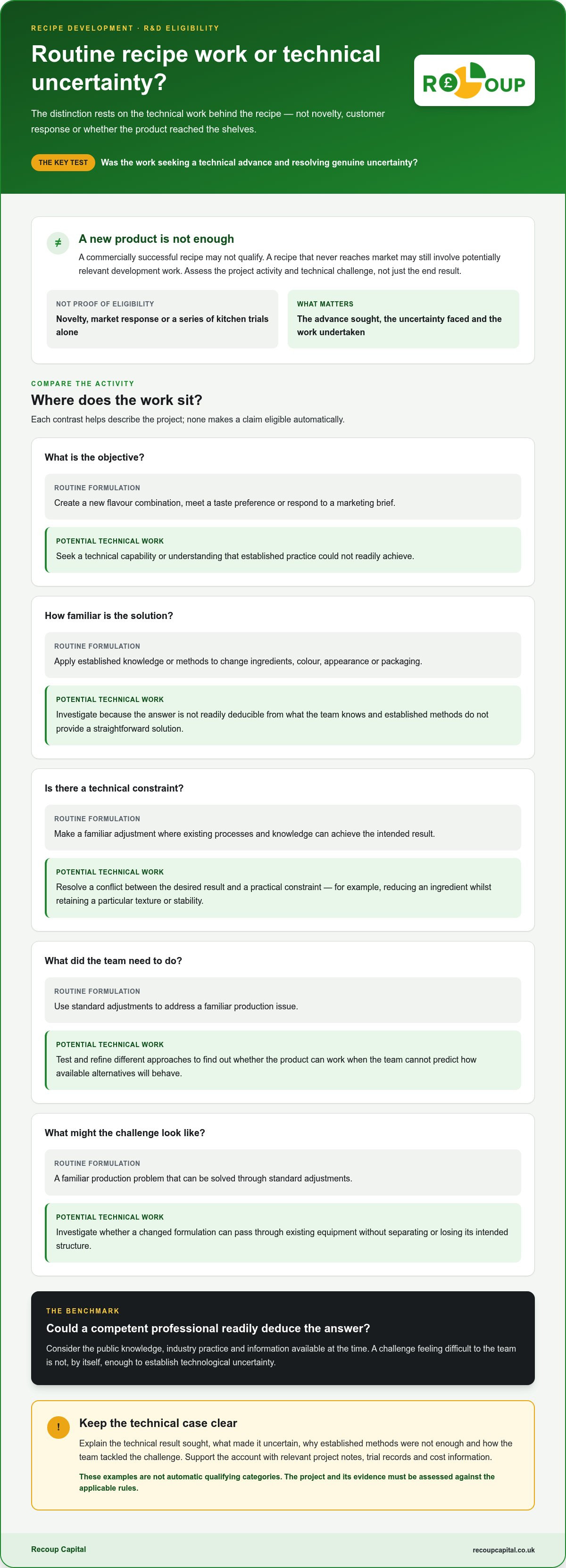
Changing a flavour, ingredient, colour, appearance or package may be routine if established processes and knowledge can achieve the result. A technical challenge arises when the desired outcome conflicts with a practical constraint and the solution isn’t readily deducible from what the team already knows. The company may need to investigate, test and refine different approaches to find out whether the product can be made to work.
For example, a reformulation might require reducing an ingredient while retaining a particular texture or stability. If the team can’t predict how available alternatives will behave in the product and must work through that uncertainty systematically, the development could involve relevant technical activity. Simply choosing a different ingredient to meet a taste preference or marketing brief wouldn’t, by itself, demonstrate an advance or uncertainty. The technical reasoning and project context matter.
Which food businesses might have relevant projects?
Manufacturers, food technology firms and other limited companies developing products may undertake work worth assessing. Technical questions might concern stability during processing, achieving a consistent texture or how ingredients interact after a formulation changes. These are examples, not automatic qualifying categories: a familiar production problem solved through standard adjustments may still be routine.
For instance, a company might test whether a new formulation can pass through existing equipment without separating or losing its intended structure. The potentially relevant issue isn’t that the recipe is new, but whether the team faced a technological uncertainty that required investigation beyond routine trials. Operating in the food sector or investing in product development doesn’t establish eligibility on its own.
A useful first step is to describe the challenge without relying on labels such as “innovation” or “new product”. What technical result was the team trying to achieve? What made it uncertain, and why weren’t established methods enough? Clear answers help separate the commercial objective from the technical work that may underpin a claim. That distinction is central to claiming for new recipe development, although the whole project and its evidence must be assessed against the applicable rules.
How R&D eligibility applies to recipe development and technical uncertainty
Once you’ve identified a technical challenge, consider whether the work falls within the R&D rules. The assessment focuses on the activities undertaken during the project, not simply the recipe produced, whether it reached production or how customers responded. A successful product isn’t automatically qualifying, and an unsuccessful one isn’t automatically R&D.
The company needs to identify an advance in science or technology that the work sought to achieve. In a food project, explain what technical capability or understanding the team aimed to improve and why existing knowledge or methods didn’t provide a straightforward answer. The benchmark is what a competent professional in the field could readily deduce at the time, not simply whether the challenge felt difficult to the team.
Identifying a technical advance in a food project
Separate the technical objective from the commercial brief. “Create a product consumers prefer” or “stand out on the shelf” describes a market goal. A more useful technical objective might be to achieve a specified texture while working within a particular processing constraint. That example isn’t a guarantee of eligibility: the company would still need to show the advance sought and the uncertainty encountered.
Ask what the project aimed to make possible that couldn’t readily be achieved using established practice. The answer should relate to technical capability or knowledge, rather than a new flavour combination, brand position or consumer preference alone. An objective may be measurable, but measurement by itself doesn’t make the work R&D. It helps explain what the team was trying to resolve.
Showing that the answer was not readily deducible
Consider what a competent professional could establish from public knowledge, industry practice and the information available at the time. If they could apply a known method to reach the result without resolving technological uncertainty, the work may be routine. If the route to the result wasn’t readily clear, explain why using the project’s actual constraints and the team’s technical reasoning.
Repeated trials alone don’t prove that qualifying uncertainty existed. A series of adjustments may be routine experimentation if the team already knew how to achieve the result. A stronger explanation links each investigation to the problem: what was uncertain, what the team thought might work, what it tested, what happened and how that finding shaped the next step. It should also distinguish technical setbacks from ordinary changes made to taste, cost or market positioning.
An advance sets the technical goal, uncertainty explains why the answer wasn’t readily deducible, and systematic investigation shows how the team worked to resolve it. Assess this relationship against current requirements. The HMRC R&D tax relief guidance sets out the official framework, which should be applied to the project’s specific facts.
For companies considering claiming for new recipe development, a specialist technical assessment can help connect the objective, uncertainty and investigation in a clear account before claim preparation. Explore support with an R&D tax claim. Any relief remains subject to eligibility and HMRC rules.
Qualifying R&D or routine recipe work? Compare the activity, not the label
The same product brief can involve routine formulation in one business and a genuine technical investigation in another. The distinction depends on what the team had to resolve, not whether the project was called “innovation”, involved many trials or produced a novel recipe. Use the comparison below as a starting point, then assess the project against current HMRC rules.
| Activity | More likely to be routine | May warrant closer R&D assessment |
|---|---|---|
| Changing ingredients | Substituting an ingredient using a known alternative and established method. | Investigating an unresolved interaction between ingredients that affects a required processing result. |
| Adjusting texture or stability | Making familiar adjustments to meet a preference or standard product specification. | Testing approaches to meet a defined texture or stability objective under technical constraints, where the answer isn’t readily apparent. |
| Creating market appeal | Developing a new flavour, recipe name, appearance or packaging concept to attract customers. | Working to overcome a technical limitation in formulation or production. Commercial appeal alone doesn’t establish eligibility. |
| Running trials | Repeating standard tests or making minor adjustments with a predictable outcome. | Using tests to investigate a defined uncertainty, record findings and decide what to try next. |
Examples that may point towards qualifying investigation
Imagine ingredients behave differently when combined, preventing a product from achieving a required result during processing. Another example is investigating whether a team can meet a defined stability or texture objective despite constraints in its formulation or production method. These situations may merit closer assessment if the solution wasn’t readily deducible and the work involved systematic technical investigation. Neither example is automatically eligible; each needs to be considered against current HMRC rules.
Work that is more likely to be routine
Standard recipe adjustments, taste-preference testing and cosmetic changes are more likely to be routine when established methods can deliver the result. Applying a known process without technical uncertainty may fall outside R&D. Customer feedback, market research and launch planning can inform product decisions, but they aren’t technical R&D by themselves.
Interpret failed trials carefully. A disappointing batch doesn’t prove that qualifying work took place. Its relevance depends on whether it tested a reasoned approach to a defined technical problem and produced findings that informed further investigation. A sequence of attempts without a clear technical question may simply be ordinary recipe iteration.
When claiming for new recipe development, describe the activity plainly: what technical result was sought, what constraint made it uncertain, and how each test contributed to resolving it. This separates the technical investigation from the wider commercial development. A specialist assessment can consider the activity and supporting evidence together, with any claim subject to eligibility and HMRC rules.
What evidence and cost records should a recipe-development claim draw on?
A clear claim brings the technical story and financial records together. Keep evidence showing what the company investigated, how the work progressed and how any expenditure being considered relates to that activity. Records created during the project are often more useful than explanations assembled long after it has finished, so gather the available material early.
Use this sequence to organise the review:
- Define the project. Set out its scope, objectives, start and end points, and which activities were part of the development work.
- Describe the uncertainty. Explain the technical question the team faced and why existing knowledge or standard methods didn’t resolve it.
- Record the investigation. Bring together trial notes, formulation versions, test results, technical decisions and project timelines.
- Gather cost information. Collect relevant accounting records and project information, then assess expenditure against the rules that apply.
- Review the claim. Check that the narrative, evidence and proposed costs are consistent and relate to the same project activity.
Build a clear technical project narrative
For each project, record the objective, what the team knew at the outset, the constraints it faced and the hypotheses it explored. Note why established methods weren’t enough, what steps the team took and how it reached its decisions. A timeline can show how the investigation developed, particularly when one finding changed the next test or approach.
Unsuccessful trials can contribute to the account when they relate to the technical question being investigated. Record what was tested, what the result showed and what the team learned. This creates a traceable explanation of the work rather than a list of attempts without context. For a broader explanation of the claim principles, see R&D tax relief explained.
Connect project activity to expenditure carefully
Gather accounting records alongside the project evidence, but don’t assume every cost associated with product development is eligible. The treatment of expenditure depends on current legislation and the company’s specific facts. Assess each item rather than including it simply because it arose during the same period.
Useful records can show who worked on the project, when the activity took place and how the figures relate to the work described. Keep a clear basis for any allocation between relevant project activity and other business operations. Avoid unsupported estimates where underlying records are available, and investigate differences between project notes and accounting information before finalising the claim.
Strong R&D claim preparation and submission connects project evidence, activity and cost analysis in a consistent account. If you’re considering claiming for new recipe development, Recoup Capital’s specialists and chartered tax accountants can assess the technical basis and support the claim process. Any relief remains subject to eligibility and HMRC rules.
How Recoup Capital can support a recipe-development R&D claim
Assessing recipe development for R&D tax relief means bringing technical activity, evidence and expenditure into a coherent claim. Recoup Capital’s specialists and chartered tax accountants support limited companies through the process, from examining the technical case to preparing and submitting a claim and liaising with HMRC.
This support can be useful when product development includes both routine formulation and more complex technical investigation. A structured assessment helps distinguish the activities, explain the project’s technical basis and identify where further records or clarification may be needed. Any potential relief remains subject to eligibility and HMRC rules.
What a specialist assessment can help establish
A specialist assessment considers the advance the project sought, the uncertainties encountered, the investigation undertaken and the records available to support the account. It can help separate technical development from routine recipe changes and commercial work, then highlight gaps that could make the narrative difficult to follow. The aim is a clear, evidence-led explanation, not to assume every product-development activity qualifies.
For example, project notes may describe trials without explaining why the team chose each approach or what the results taught them. A technical review can connect those decisions to the underlying challenge and show where the evidence supports the explanation or needs strengthening. The associated accounting information can then be considered alongside the project activity, rather than treated as a separate exercise.
Claim fees are success-based and calculated as a percentage of the tax benefit or cash credit recovered. This doesn’t guarantee that a project is eligible, that HMRC will accept a claim or that a particular outcome will follow. The technical and financial case still needs to be assessed under the applicable rules.
Practical next steps for a UK company
For an initial discussion, prepare a concise account of the project and the challenge it addressed. Trial notes, formulation versions, technical decisions, project timelines and relevant accounting information can make the discussion more specific. You don’t need every record perfectly organised before exploring whether the project merits a fuller assessment.
Review the claim procedures and time limits that apply to the company’s accounting period against current HMRC guidance. Requirements can depend on the relevant rules and circumstances, so avoid relying on general assumptions or an old claim timetable. Keeping the project explanation and financial records aligned from the outset can also make preparation more efficient.
If your company is considering claiming for new recipe development, a discussion with Recoup Capital can clarify next steps and assess whether the project’s technical work and available evidence warrant a claim.
Make your next step an informed one
Recipe innovation takes time, technical judgement and investment. Before deciding whether to pursue a claim, consider whether the project records tell a clear story about the work and its purpose. A focused review can help your company understand whether claiming for new recipe development merits further assessment and what information may be needed to support that decision. Any relief remains subject to eligibility and HMRC rules.
Recoup Capital’s specialists and chartered tax accountants support limited companies from technical assessment through claim preparation and submission, including HMRC liaison. Fees are success-based and calculated as a percentage of the tax benefit or cash credit recovered. This doesn’t guarantee eligibility, acceptance or a particular outcome. Discuss your recipe-development project with Recoup Capital to explore the technical case and available evidence.
Frequently Asked Questions
Can developing a new food product qualify for R&D tax relief?
Yes, a limited company’s food product development may qualify if the project meets the relevant R&D criteria. The product doesn’t have to reach the market, and commercial success isn’t the test. For example, a company investigating whether it can achieve a technical product specification using available processes may have work worth assessing. The project’s aims, technical challenges and activities must be considered against the rules applying to its accounting period.
Does changing ingredients or a recipe count as R&D?
Not by itself. A familiar ingredient substitution or adjustment to suit taste, cost or appearance is likely to be routine if established methods provide the answer. The position may differ if the change creates a technical problem that the team can’t readily resolve using existing knowledge. For example, replacing an ingredient might alter how a mixture behaves in production. The specific technical work, not the change alone, needs assessment.
Can failed recipe trials be included in an R&D claim?
Potentially, if the trials formed part of a qualifying technical investigation and the associated expenditure meets the applicable rules. A failed batch isn’t automatically R&D, and a poor result alone doesn’t establish eligibility. Record what the team was testing, the result and how it affected the next decision. This can help show whether the trial contributed to resolving a defined technical uncertainty or was simply part of routine product iteration.
Can a restaurant claim R&D tax relief for developing dishes?
A restaurant operating through a limited company could have a project worth assessing, but creating dishes for a changing menu won’t qualify just because the recipes are new. The relevant question is whether the company undertook work to resolve a scientific or technological uncertainty, rather than developing dishes through standard culinary practice. A restaurant’s business type doesn’t decide eligibility. The project and the company’s circumstances must be reviewed under the relevant rules.
Can a company claim for recipe development carried out by a contractor?
Possibly, but hiring a contractor doesn’t automatically give the company the right to claim for their work. Under the merged R&D scheme, generally, the company that initiates and bears the risk of the R&D can claim for subcontracted work. Contract terms and the project’s facts matter. Keep agreements, invoices and a clear description of the contractor’s work, then assess the arrangement under the rules for the company’s accounting period.
What records should a business keep for recipe-development R&D?
Keep materials that connect project decisions to the technical work and the company’s records. Useful examples include dated formulation versions, production or test observations, correspondence discussing technical decisions, project timelines and notes explaining changes in approach. Retain relevant accounting information as well, so any expenditure being considered can be reviewed. Contemporaneous records can make it easier to reconstruct what happened and distinguish project activity from ordinary production or commercial work.
Is there a deadline for claiming R&D tax relief on recipe development?
There are time limits, and the applicable requirements depend on the accounting period and claim circumstances. For accounting periods starting on or after 1 April 2023, companies must notify HMRC of their intention to claim within six months of the period end if the notification rules apply. This is separate from submitting the claim. Check current HMRC guidance promptly, as missing a relevant deadline may affect the ability to claim.


