

Could a project designed to cut waste be genuine R&D, or is it simply a more efficient way to run your operations? The distinction matters: claiming for waste reduction process improvements isn’t about the environmental goal alone. For UK R&D tax relief, the work must seek an advance in science or technology and address a scientific or technological uncertainty that a competent professional couldn’t readily resolve. Routine changes don’t qualify just because they reduce waste.
It can be difficult to separate technical problem-solving from everyday operational improvements, particularly if project records weren’t created with a tax claim in mind. This guide explains the eligibility test, how to identify potentially relevant projects and what evidence can show the technical challenges, decisions and work involved. It also covers how to connect project activity with relevant expenditure and prepare for an assessment. Existing records are a useful starting point; a structured technical review can help establish what they show and where more detail is needed.
Key Takeaways
- A waste-reduction target alone doesn’t establish R&D eligibility. Focus on the technical advance the project aimed to achieve.
- When claiming for waste reduction process improvements, distinguish unresolved technical challenges from routine optimisation or adopting standard equipment.
- Organise dated project records to show aims, technical decisions, iterations and outcomes, then connect them with relevant expenditure.
- Scope projects individually and assess each accounting period under the rules that apply to it.
- A structured technical assessment can help identify potentially eligible work and prepare a clearer, better-supported claim.
Claiming for waste reduction process improvements: what the opportunity depends on
A waste-reduction target alone doesn’t show that a project qualifies for R&D tax relief. A process improvement changes how a business carries out an activity, for example by altering production steps, equipment or controls to reduce material loss, improve recovery or make a process more consistent. The eligibility question is more specific: did achieving that change require an advance in science or technology, and was there a technical uncertainty that a competent professional couldn’t readily resolve?
Assess the work undertaken, not just the result. Lower costs, less waste, sustainability aims and improved throughput can explain why a project mattered to the business, but they don’t prove that it involved qualifying R&D. The assessment focuses on the technical challenge and the work to address it, under the UK rules for the relevant accounting period. You can start by understanding the principles behind waste minimisation strategies, then consider whether the project went beyond applying established approaches.
Why a lower-waste outcome is not enough on its own
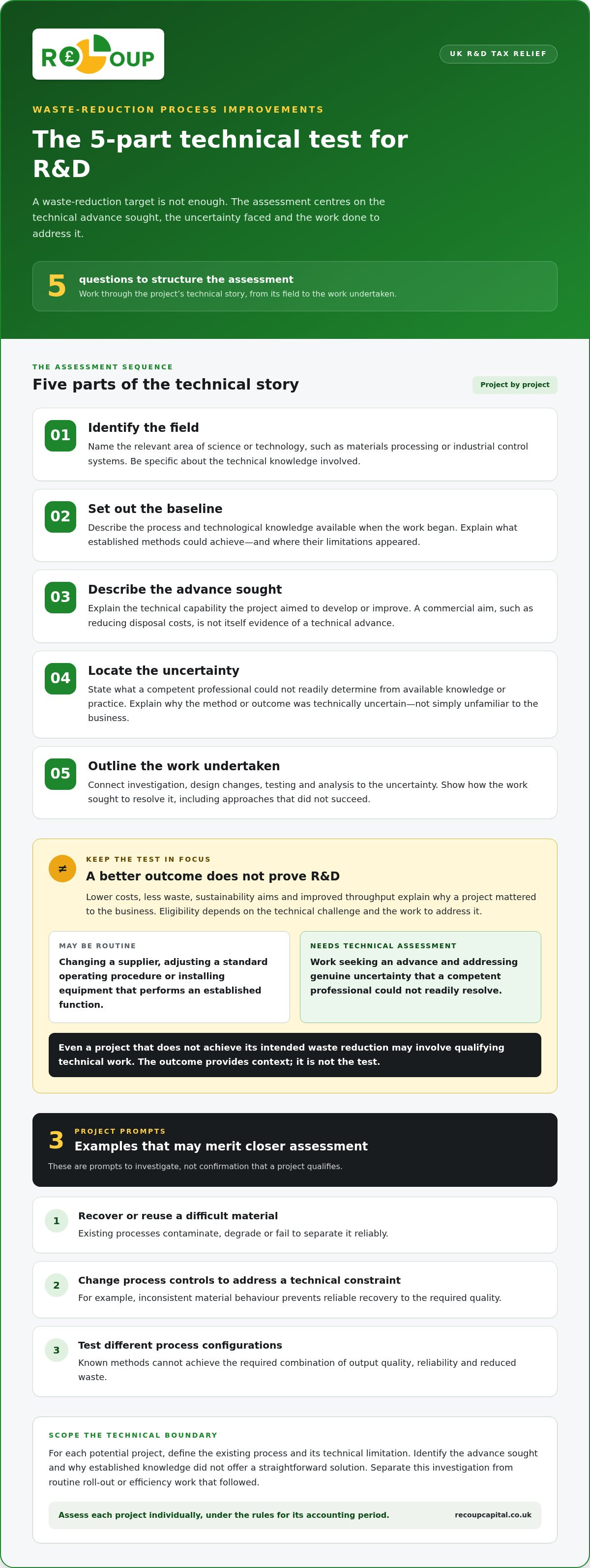
A favourable result can follow routine implementation, such as changing a supplier, adjusting a standard operating procedure or installing equipment that performs an established function. By contrast, a project that doesn’t achieve its intended reduction in waste may still involve qualifying technical work if it sought an advance and addressed genuine uncertainty. The outcome provides context; it isn’t the test. For an overview of the wider UK R&D tax credits framework, consider how the technical work fits the relevant criteria.
Technical uncertainty helps explain why the solution wasn’t readily deducible from existing knowledge or practice, and what work was needed to resolve it. Focus on what a competent professional couldn’t readily work out at the outset, rather than on how much waste the business ultimately saved.
What kinds of process changes might prompt an R&D assessment?
Some projects merit closer assessment because their technical aims suggest a problem beyond routine optimisation. These examples are prompts to investigate, not confirmation that a claim qualifies:
- Developing a method to recover or reuse a material that existing processes contaminate, degrade or fail to separate reliably.
- Changing process controls to address a technical constraint, such as inconsistent material behaviour that prevents reliable recovery to the required quality.
- Testing different process configurations because known methods can’t achieve the required combination of output quality, reliability and reduced waste.
For each potential project, define the existing process and its technical limitation. Then identify the advance sought and explain why established knowledge didn’t provide a straightforward solution. Separate this investigation from routine roll-out or efficiency work that followed. That distinction keeps the assessment focused on the technical boundary of the project, rather than treating every task linked to a waste-reduction target as R&D.
How UK R&D tax relief applies to waste reduction process improvements
For R&D tax relief, a project must seek an advance in science or technology. Improving business performance isn’t enough by itself. Assess the technical work by asking what was already possible, what the company aimed to achieve, what couldn’t readily be resolved and how the team tried to overcome it. This approach helps distinguish technical development from routine process change when claiming for waste reduction process improvements.
Work through the project in sequence. The wider UK R&D tax credits framework provides context, but eligibility depends on the project facts and the rules for its accounting period.
- Identify the field. Define the relevant area of science or technology, such as materials processing or industrial control systems. Be specific enough to explain the technical knowledge involved.
- Set out the baseline. Describe the process and technological knowledge available when the work began. Explain what established methods could achieve and where their limitations appeared.
- Describe the advance sought. Explain the technical capability the project aimed to develop or improve. Reducing disposal costs is a commercial objective; the technical advance might instead involve finding a viable way to separate a complex material stream.
- Locate the uncertainty. State what a competent professional couldn’t readily determine from available knowledge or practice. Explain why the outcome or method was technically uncertain, rather than simply unfamiliar to the business.
- Outline the work undertaken. Connect the investigation, design changes, testing and analysis to the uncertainty. Show how the work sought to resolve it, including approaches that didn’t succeed.
Identify the baseline and the advance sought
Be precise about the starting point. What process was already in use? What relevant methods were known, and why couldn’t they meet the technical requirement? Then describe the intended capability without relying on business targets such as higher output or lower costs as proof of an advance. For example, a project might aim to recover a material to a required quality when existing methods can’t do so reliably. Explain what needed to change and why that change wasn’t straightforward.
Show where the technological uncertainty sat
Technological uncertainty concerns whether or how a technical objective could be achieved. It isn’t uncertainty about profitability, timing or customer demand. A familiar improvement methodology can help teams identify inefficiencies. For instance, Lean Six Sigma for waste reduction can inform process optimisation. Applying known methods alone doesn’t establish R&D, although work to resolve a separate technical uncertainty may merit assessment.
Record the obstacle as the team understood it at the time, what knowledge was available and why a competent professional couldn’t readily reach the solution. Project-specific conclusions depend on the evidence and HMRC guidance relevant to the accounting period. A technical review can help connect the project account with the claim requirements. R&D claim preparation and support can be part of that process.
Waste reduction R&D or routine process optimisation? How to tell the difference
A waste-reduction project can involve both technical investigation and ordinary operational work. The key is to separate activity aimed at resolving technological uncertainty from implementation of a known solution. The project’s technical challenge, not its waste-reduction label, drives the R&D assessment. Savings, improved throughput and meeting an internal target don’t, by themselves, show that the work sought an advance in science or technology.
| Potential technical R&D activity | Routine process optimisation |
|---|---|
| The team encounters a technical constraint that established knowledge or methods don’t readily resolve, and investigates whether a new or improved process can overcome it. | The business selects and installs known equipment or adopts a standard procedure to improve an existing operation. |
| Trials or iterations test technical approaches. Results help the team understand why a method works, fails or needs further development. | Staff set familiar process parameters, follow supplier instructions or make routine adjustments based on established practice. |
| Records explain the advance sought, the uncertainty, the investigation and how findings shaped the next technical step. | Records focus on purchasing, installation, maintenance, staff training or operational performance without documenting a technological uncertainty. |
| Work seeks to extend capability beyond what a competent professional could readily achieve using available knowledge. | Work implements a solution whose technical outcome is already known, even if it brings commercial or environmental benefits. |
Signals that a project may involve qualifying technical work
Look for a specific technical limitation that the team couldn’t readily overcome using established knowledge. For example, a process might produce inconsistent results despite the use of known settings, prompting controlled trials of alternative configurations. The trials alone don’t establish eligibility. The project account should connect each test to the uncertainty and intended advance. Record what changed, what the results showed and how those findings informed the next step.
Changes that are more likely to be routine
Installing standard equipment, carrying out planned maintenance or applying recommended settings will often be operational activity when no technological uncertainty is being addressed. The same applies to process changes made solely to cut costs, meet a production target or improve efficiency through known methods. Context still matters: if a separate technical problem arose that established practice couldn’t readily resolve, assess that work on its own facts rather than assuming the whole project has one status.
Draw the boundary around the work. A project may include technical investigation followed by routine installation, roll-out or staff training. Identify which activities relate to resolving the uncertainty and which simply put the resulting solution into operation. Dated technical notes, test results and decision records can help make that distinction clear. Drawing the boundary supports a more accurate assessment than treating every task or cost connected with a waste-reduction initiative as R&D.
What evidence and costs to organise for a waste reduction R&D claim
A well-supported claim connects the technical account with the work and expenditure behind it. Records don’t need to have been created as formal tax evidence, but they should explain what the project set out to do, what technical obstacles arose and how the team responded. This link is particularly important when claiming for waste reduction process improvements, because routine operational changes may sit alongside technical investigation.
Build a clear technical record
Contemporaneous records help show what technical work took place and when. Gather material from across the project and organise it so a reviewer can follow the development, rather than having to piece together a disconnected folder of files. Useful evidence may include:
- Project plans or proposals describing the technical aim and starting point.
- Test results, process data and experimental notes showing what was tried and observed.
- Design changes, revised settings or process iterations, with dated explanations of why they were made.
- Records of technical decisions, including who contributed and how each decision related to the uncertainty being investigated.
- Outcome notes covering successful and unsuccessful approaches, and what the team learned from each.
An unsuccessful test doesn’t prove eligibility on its own. Record its purpose, the conditions tested, the result and how that result shaped the next step. If notes are incomplete, project emails, meeting records, production data or other existing documents may help reconstruct the timeline, provided the account remains accurate and supported.
Connect project activity with expenditure
Once the technical work is mapped, link staff time and other potentially relevant expenditure to the specific activities undertaken. Identify which staff worked on investigation or testing, when they contributed and which project records support that account. Don’t assign all time from a department or project team to R&D if some work involved routine production, installation or implementation.
Depending on the applicable scheme rules, potentially relevant categories may include staff costs, materials and utilities consumed in R&D, software, data licences, cloud computing, externally provided workers and subcontracted R&D. The conditions and treatment differ by category and accounting period. For example, the merged scheme generally restricts relief for subcontracted R&D to 65% of the cost. Don’t assume that every purchase or cost associated with a waste-reduction project qualifies. Assess whether it meets the rules and relates to eligible activity.
Claim preparation brings the technical narrative, supporting records and cost analysis together. A structured R&D tax claim assessment can help connect project evidence with relevant expenditure while keeping routine activity distinct. Explore R&D tax credit support to see how Recoup Capital’s claim support can help organise and assess your project information.
Turning Waste Reduction Projects into R&D Tax Claims
A clear claim starts with a clearly scoped project. Rather than treating a company-wide waste target as one R&D project, identify separate technical workstreams, the uncertainty each addressed and when the work took place. This makes it easier to assess eligibility, organise supporting evidence and distinguish technical investigation from routine implementation.
Prepare the project for a structured assessment
Bring together the key information: project timelines, technical records, staff roles, decisions, test results and cost details. If workstreams had different technical aims or uncertainties, document them separately so the reasoning for each assessment is clear. Relief may help eligible companies put resources towards future innovation and business growth, as explained in this guide to why companies claim R&D tax relief.
A practical preparation sequence is:
- Scope the work. Record each project’s technical objective, starting point and period of activity.
- Assess eligibility. Examine the advance sought, the uncertainty and the work undertaken against the rules for that accounting period.
- Assemble evidence. Link dated records and staff contributions to the technical investigation.
- Review expenditure. Map potentially relevant costs to eligible activities and apply the rules for each cost category.
- Prepare and submit. Complete the required claim information and supporting explanations for HMRC.
Get specialist support through submission
Each accounting period needs its own assessment. The merged R&D scheme applies to accounting periods beginning on or after 1 April 2024, while earlier periods remain subject to the rules that applied to them. Claim deadlines and notification requirements can also depend on a company’s circumstances. All claims require an Additional Information Form to be sent to HMRC before the Corporation Tax Return (CT600). First-time claimants, and companies that haven’t claimed in the previous three years, may also need to submit a claim notification within the applicable deadline.
Technical specialists can assess whether the project narrative is supported by the records, while tax specialists connect the work with potentially qualifying expenditure and the relevant claim requirements. Recoup Capital provides end-to-end support covering technical assessment, claim preparation, submission and HMRC liaison, with chartered tax accountants as part of the team. This support helps manage the detail without assuming that a project or cost qualifies automatically.
For companies claiming for waste reduction process improvements, the next step is to establish what the project evidence can substantiate. A careful review can clarify which activities may meet the technical test, what records support that view and how relevant costs should be considered. Recoup Capital can help assess your project and prepare your R&D tax claim.
Make your next project review a strategic step
A waste-reduction project can offer more than immediate operational benefits. Reviewing its technical work may also help your team identify where future experiments, decisions and project records could be documented more clearly, whatever the outcome of an R&D eligibility assessment. That makes a considered review useful beyond the claim itself.
If you’re considering claiming for waste reduction process improvements, examine the project evidence alongside the technical questions the team faced. Recoup Capital’s R&D tax specialists can help assess the project and its supporting information, building a clear, evidence-led picture without assuming a particular claim result.
Discuss your waste-reduction project with Recoup Capital to assess the technical work, evidence and potential R&D claim.
Frequently Asked Questions
Can a company claim R&D tax relief if its waste reduction project did not succeed?
Yes. An unsuccessful project may still qualify if it sought an advance in science or technology and addressed a genuine technological uncertainty. The outcome alone doesn’t determine eligibility. For example, a company might investigate whether a process can recover a material to a required specification, but find that the tested methods don’t work. The claim still needs evidence of the qualifying technical work and eligible expenditure, assessed under the rules for that accounting period.
Does a waste reduction project need a patent to qualify for R&D tax relief?
No. A patent isn’t a requirement for R&D tax relief. The assessment concerns the technical aims and work undertaken, not whether the company protected an invention or intends to do so. A process improvement may qualify without producing a patentable outcome, provided it meets the relevant R&D criteria. Equally, having a patent doesn’t prove that the work behind it qualifies, so assess the project’s technical evidence separately.
Can a small company claim for waste reduction process improvements?
Yes. A small company can claim if its project and expenditure meet the conditions applying to the relevant accounting period. Company size alone doesn’t make waste-reduction work eligible or ineligible. For periods beginning on or after 1 April 2024, the merged scheme applies to most companies; eligible loss-making, R&D-intensive SMEs may instead be able to consider ERIS. Check the company’s status, connected-company position and qualifying costs against current HMRC guidance before preparing the claim.
Can a profitable company claim R&D tax relief for process improvements?
Yes. Profitability doesn’t prevent a company from claiming. A profitable business may be able to claim under the scheme that applies to its accounting period, provided the project meets the technical criteria and the expenditure qualifies. The relief’s treatment differs by scheme and circumstances, so don’t estimate a benefit from profit figures alone. First establish which work qualifies, then review the company’s accounting period, tax position and relevant expenditure to determine the potential treatment.
Can a company claim when an external contractor worked on its waste reduction project?
Potentially, but a contractor’s involvement doesn’t automatically make its fees eligible. Establish what technical work the contractor performed, how it related to the project and which party had the relevant rights and responsibilities under the arrangements. For accounting periods under the merged scheme, subcontracted R&D expenditure is generally restricted to 65% of the cost, subject to detailed rules. Review the contract, invoices and project records against HMRC guidance for the period.
How far back can a company claim R&D tax relief?
Generally, a company must submit its claim within two years of the end of the relevant accounting period. For example, a period ending on 31 December 2024 would normally have a claim deadline of 31 December 2026. Companies claiming for the first time, or that haven’t claimed in the previous three years, may also need to notify HMRC within six months of the period end. Check both deadlines promptly, as missing one can affect the claim.


