

A new material isn’t automatically qualifying R&D. The key question is whether the project sought an advance in science or technology by resolving uncertainties that a competent professional couldn’t readily overcome. That’s why claiming for new materials research depends on the technical challenge, not simply the novelty of the finished product.
Materials projects can involve repeated trials, reformulations and process changes, but those activities alone don’t establish eligibility. The work needs to address a genuine scientific or technological uncertainty, rather than routine testing or development.
This guide explains how to identify potentially relevant activities and distinguish technical uncertainty from ordinary product development. It also covers records that can help explain the work, from test results and project notes to financial information linking costs to research activity. Bringing the technical and financial assessments together gives you a practical basis for reviewing a potential UK R&D tax relief claim.
Key Takeaways
- Assess the research activity, not just whether the material is new, to identify projects that may merit an R&D tax relief review.
- Use a four-step assessment to explain the technical baseline, intended advance, uncertainty and work undertaken.
- Organise technical, project, staff and financial records so the evidence connects clearly to the research.
- When claiming for new materials research, review potential costs against current scheme rules and the work each cost supported.
- Build a claim methodically by recording project decisions as they happen and bringing technical and financial assessments together.
Can new materials research qualify for UK R&D tax relief?
It may, but the material’s novelty alone doesn’t settle the question. The focus is the work undertaken: did the project seek an advance in overall scientific or technological knowledge or capability, and did it face uncertainty that a competent professional couldn’t readily resolve? These are central features of the UK R&D test. Check the relevant HMRC guidance and rules for the accounting period being assessed.
This distinction matters because a material can be new to your business or the market without representing an advance in the field. A different colour, finish or product specification may offer commercial or aesthetic value, but that alone doesn’t demonstrate an advance in science or technology. By contrast, a project investigating how to achieve a previously unattainable combination of material properties may merit closer technical assessment. Eligibility depends on the specific work and evidence, not the label “new materials research”.
What makes materials research different from routine development?
Start with the scientific or technological baseline: what materials, methods and capabilities were already available, and what limitation was your team trying to overcome? In materials science, questions can span composition, structure, processing and resulting properties. For example, a project might investigate whether changing a formulation or production method could improve strength without compromising flexibility, or alter heat resistance whilst preserving another essential property.
The key is what the team needed to find out. Adapting a known recipe, carrying out standard product testing or conducting quality control may not address scientific or technological uncertainty. Systematic investigation is different: the team identifies a technical problem, tests possible approaches, analyses results and adjusts the work because the answer isn’t already clear. Testing can form part of R&D, but testing alone doesn’t make a project qualifying.
What counts as technical uncertainty in a materials project?
Technical uncertainty concerns whether, or how, a particular scientific or technological outcome can be achieved. For example, the team may not know whether a new composite can withstand repeated temperature changes without cracking, or whether a coating process can produce a consistent bond on a difficult substrate. These examples don’t automatically indicate eligibility. The assessment depends on what was known in the field at the time and whether a competent professional could readily resolve the problem.
Technical uncertainty is about whether a scientific or technological solution can be achieved; commercial risk is about whether the solution will sell or succeed in the market. A project can face both, but market demand, production cost or customer preference alone doesn’t establish technical uncertainty.
Assess each project on its own facts. A clear account of the baseline, intended advance and unresolved technical questions helps show why the work went beyond routine development, without assuming that novelty alone establishes eligibility.
How to assess the technical work behind a new materials claim
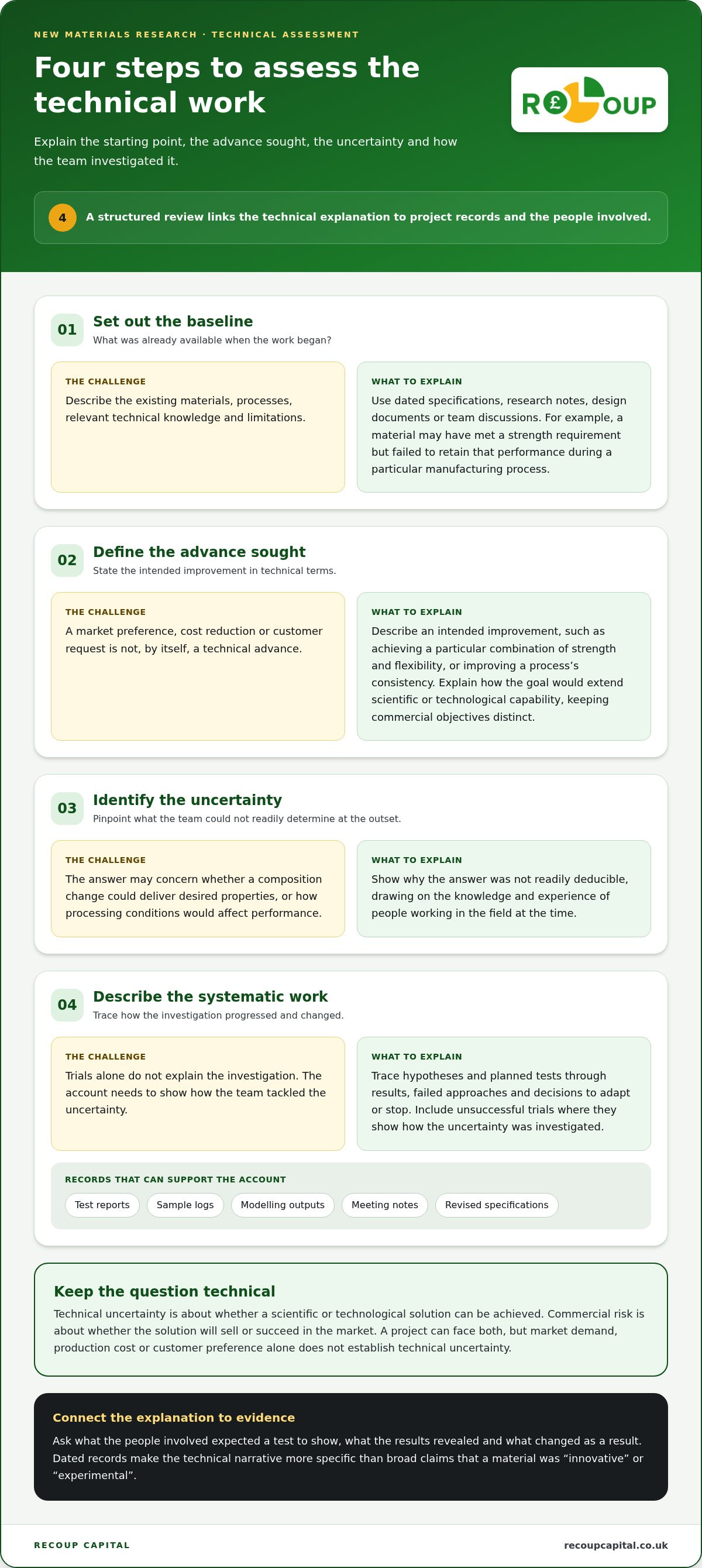
A structured review helps explain what the team set out to achieve and how it tackled the challenge. Assess the work in four connected steps, using project records alongside explanations from the engineers, scientists and technicians involved. The current UK R&D Tax Relief guidance provides the framework, but the technical case must be grounded in the project facts.
- Set out the baseline. Record what materials, processes and relevant technical knowledge were available when the work began. Use dated specifications, research notes, design documents or team discussions to explain existing limitations. Be specific about the starting point: a material, for example, may have met a strength requirement but failed to retain that performance during a particular manufacturing process.
- Define the advance sought. Describe the intended improvement in technical terms, such as achieving a particular combination of strength and flexibility or improving a process’s consistency. Explain how the goal would extend scientific or technological capability, rather than simply meet a market preference, reduce cost or satisfy a customer request. Keep any commercial objective distinct from the technical advance.
- Identify the uncertainty. Pinpoint what the team couldn’t readily determine at the outset. This might concern whether a change in composition could deliver the desired properties, or how processing conditions would affect performance. Explain why the answer wasn’t readily deducible, drawing on the knowledge and experience of people working in the field at the time.
- Describe the systematic work. Trace the investigation from hypotheses and planned tests through results, failed approaches and decisions to adapt or stop. Link each stage to records such as test reports, sample logs, modelling outputs, meeting notes and revised specifications. Include unsuccessful trials where they show how the team investigated the uncertainty, not just the final result.
Keep the technical explanation connected to evidence
Ask the people involved to explain the reasoning behind the work in clear, specific language. What did they expect a test to show? What did the results reveal, and what changed as a result? The technical narrative is stronger when those explanations connect to dated records rather than broad claims that a material was “innovative” or “experimental”.
Uncertainty gives the investigation its purpose; systematic work shows how the team tried to resolve it. Together, they explain the technical story without overstating what the project achieved.
Assess work packages on their own merits
A broad programme may include research, routine production trials, quality checks and commercial preparation. Don’t assume every activity belongs in the same assessment. Break the programme into work packages where the technical aims or uncertainties differ, then consider what each involved and where one activity ended and another began. This makes it easier to describe the relevant technical work accurately and review its associated evidence and costs separately.
Recoup Capital supports limited companies with the technical assessment, financial review and submission stages of an R&D tax credit claim. See the R&D tax credit claim process to understand how those stages fit together.
Which materials research costs and records need careful review?
A clear claim needs more than a technical account. Records should show when the work took place, who carried it out and how related expenditure was calculated. For claiming for new materials research, organise evidence by project or work package so technical activity can be traced to dates, staff contributions and financial records.
| Record area | Examples to organise | What they help show |
|---|---|---|
| Technical evidence | Project plans, laboratory notes, test results, models, specifications and design iterations | The research question, investigation and changes made as findings emerged |
| Project dates | Start and end dates, dated test logs, review minutes and milestone records | When the relevant work took place and how its stages relate |
| Staff activity | Role descriptions, timesheets where maintained, task records and technical explanations | Who contributed and how their time related to the project’s activities |
| Financial records | Payroll, invoices, purchase records and cost-allocation calculations | How reported expenditure connects to the work and how amounts were derived |
Technical evidence for materials research
Keep records close to the work. Dated laboratory notes, test reports, models and design versions can show how the project developed, rather than just describing its final outcome. Include failed trials, too. A result that ruled out a formulation or prompted a change in method can help explain how the team investigated the technical problem.
Label records by project or work package and link them to the people involved and relevant dates. If notes use technical shorthand, add a plain-English explanation while the team can still recall the reasoning. This makes the evidence easier to follow and reduces the need to reconstruct events much later.
Financial records and scheme-specific treatment
Reconcile the technical account with payroll and financial records. Staff costs, consumable materials, subcontractor or externally provided worker costs, and relevant software or data costs may need review. Their treatment depends on the rules for the accounting period and the project’s circumstances. Don’t assume every cost connected to a research department qualifies. Check current scheme requirements and document any apportionment, such as how staff time was divided between R&D and other duties.
Keep grant records distinct from tax-relief calculations. Grants and R&D tax relief are different forms of support, each governed by its own rules. Receiving a grant doesn’t by itself establish how expenditure should be treated in a tax claim. Review the funding terms and current tax rules together before deciding how costs are presented.
Scheme rules and treatment can change between accounting periods, so apply the requirements relevant to the period being claimed rather than carrying forward an old calculation. Understanding how R&D tax credits work can put the records and expenditure review in context.
How to prepare a clear, defensible materials research claim
A well-supported claim is built from a traceable account of the work, not a polished story assembled after the event. Start by listing the materials projects and work packages undertaken during the accounting period. Then assess the technical case and financial records together, keeping evidence linked to the relevant activities and dates.
- Inventory the work. Identify projects, participants, dates and technical aims. Separate research activity from routine production, quality control or commercial work where those activities formed part of a wider programme.
- Review the technical evidence. Ask the people involved to explain the starting point, intended advance and uncertainty, then link their explanations to plans, test records, models and decisions.
- Reconcile the financial information. Map relevant staff activity and other potentially qualifying expenditure to source records. Check allocations and scheme treatment for the accounting period rather than relying on assumptions or an old calculation.
- Check the claim as a whole. Compare the technical narrative, cost calculations and supporting information for consistent project names, dates and descriptions before submission.
Build a project narrative that follows the evidence
Keep the explanation concise and specific. Describe what was already possible, what technical advance the team sought and what remained uncertain. Then show how the team investigated the problem: which methods it used, what results emerged and how those results shaped the next steps. A failed approach can be relevant if the evidence explains what it ruled out or how it changed the investigation. Avoid unsupported shorthand such as “ground-breaking” or “innovative”.
Record decisions as the work proceeds. Brief, dated notes about why a formulation changed or a test was repeated can preserve the reasoning behind the project. Reconstructing those details much later is harder and can leave gaps between the narrative and contemporaneous records. For claiming for new materials research, each important statement should be traceable to a project record or a clear explanation from someone involved.
Review the claim before submission
Check that technical descriptions match the evidence and that financial calculations use the same project boundaries and dates. Confirm which rules apply to the accounting period, including the treatment of expenditure and any relevant staff, subcontractor or consumables costs. HMRC’s process also includes supplementary information: all claims must be accompanied by an Additional Information Form. Companies claiming for the first time or after a three-year gap must check whether a Claim Notification Form is required and its deadline. Verify current requirements and dates against HMRC guidance before filing.
Careful preparation can make the assessment more manageable and explain reasons to claim R&D tax relief without overstating eligibility or outcome. Recoup Capital supports limited companies with claim preparation and submission. Explore R&D claim support.
Move from materials research assessment to your next claim step
Don’t assume that a new material makes a project eligible. Assess what technical advance the team sought, what remained uncertain and how the work attempted to resolve it. Then connect that assessment to the records and expenditure for the relevant accounting period. This gives you a practical basis for deciding whether a closer R&D tax relief review is warranted.
Some projects are straightforward to explain. Others span several materials, work packages, teams or accounting periods, with technical records and financial information held in different places. Recoup Capital’s specialists and chartered tax accountants bring the technical and financial assessments together, helping organise the evidence and identify gaps as part of claim preparation.
When specialist claim support can add value
Recoup Capital’s team works with the people involved to explain a project’s aims, uncertainties and investigative steps. Its tax-accountancy specialists review how the related expenditure is analysed under the rules for the relevant period. Bringing these perspectives together helps align the technical narrative with cost calculations, so the claim presents a consistent account of the work rather than disconnected technical and financial summaries.
This support can be useful where project boundaries are difficult to define, staff contributed to different activities, or records need to be assembled across a lengthy development programme. It helps clarify what the evidence supports and where further explanation is needed. No assessment can guarantee that a project qualifies, that HMRC will accept a claim or that a particular amount will be recovered.
What to organise before starting a claim review
A focused starting pack can make the initial assessment more productive. Bring together:
- Project timelines, work-package descriptions and the accounting period under review.
- Research plans, laboratory notes, test results, design changes and records of unsuccessful trials.
- The names or roles of staff involved, with information showing what activities they carried out.
- A short list of unresolved technical questions and how the team investigated each one.
- Relevant payroll, purchasing and other financial records that can be connected to the project activity.
Note any gaps or uncertainties openly. For instance, if a test result is recorded but the reason for changing the next trial isn’t clear, identify who can explain that decision. This helps reviewers follow the reasoning without overstating what the project achieved.
Before submission, confirm the current HMRC requirements for the accounting period, including any applicable notification, supplementary-information and filing steps. Requirements can affect how a claim is prepared, so avoid relying on an old checklist or assuming that a previous period’s process still applies.
Recoup Capital supports limited companies with technical assessment, claim submission and HMRC liaison. If you’re ready to move from claiming for new materials research as a question to a structured review, explore R&D tax credit claim support.
Turn your materials research into a clear next step
Research teams often focus on what they discovered. For a potential R&D tax relief claim, the next useful step is to preserve how they reached that point: the decisions, evidence and technical reasoning behind the work. Those records can help your company assess whether claiming for new materials research warrants further review, without assuming that a novel result automatically qualifies.
If the technical story or expenditure analysis is difficult to bring together, Recoup Capital can help. The company supports limited companies across the UK, with a team that includes chartered tax accountants. Its end-to-end support covers technical assessment, submission and HMRC liaison, bringing these elements into a connected, evidence-led process. Eligibility and outcomes depend on the facts and applicable rules, but a careful assessment can clarify the next steps.
When you’re ready, explore R&D tax credit claim support and give your research a considered route to assessment. Your team’s technical work deserves a clear, well-supported account.
Frequently Asked Questions
Can research into a new material qualify for UK R&D tax relief?
Yes, it may, but the project needs to meet the relevant UK criteria; a new material alone isn’t enough. For claiming for new materials research, consider what technical capability the company aimed to extend and whether the challenge went beyond routine work. Adapting an established formulation to a familiar specification, for example, may differ from investigating an outcome that wasn’t readily achievable using existing knowledge. Assess the project against the rules for its accounting period.
Does a material need to be completely new to qualify?
No. Research may focus on improving an existing material or changing how it is processed, if the work meets the applicable technical criteria. Consider whether the project aimed to resolve a genuine technical limitation, rather than simply offer a new product to customers. Changing an established material’s composition to investigate a previously uncertain combination of properties could merit assessment, but novelty in the marketplace alone doesn’t establish eligibility.
Can failed materials tests be included in an R&D claim?
They may form part of the account of the research, but an unsuccessful result doesn’t automatically make a test or its cost eligible. Keep enough detail to identify the sample, test conditions, objective and outcome, then record what the team decided to do next. A failed trial that ruled out a technical approach may help explain the investigation. Routine repetition or quality checks still need separate consideration under the relevant rules.
What evidence should a company keep for materials research?
Keep technical and financial evidence that lets a reviewer follow the work from its initial question to the recorded outcome. Alongside laboratory and design records, retain specification version histories, meeting notes explaining key decisions and task information showing who contributed. Link these materials to the relevant project and accounting period. Financial source documents should support any cost analysis, while the precise evidence required depends on the activity and current HMRC requirements.
Can a company claim R&D tax relief if its materials research also receives grant funding?
Possibly, but grant funding and tax relief are distinct, and their interaction depends on the funding terms, accounting period and applicable scheme rules. Don’t assume a grant automatically blocks or secures relief. Keep the award agreement, payment details and project budget with the research records, and identify which activities and expenditure the funding relates to. Review the current HMRC treatment before preparing a claim, particularly if funding conditions affect project costs.
How do I show that materials research involved technical uncertainty?
Explain why the team couldn’t confidently predict the technical result or route to achieving it at the outset. Set out what an experienced professional could establish from knowledge available at the time, and where that knowledge left an unresolved question. Refer to contemporaneous technical sources and project-specific decisions where available. Avoid relying on hindsight: a successful outcome doesn’t prove the solution was straightforward, and a difficult project isn’t automatically qualifying.
When should a company document its materials research for a claim?
Document the work as it happens, and keep the accounting-period end date visible in your claim planning. This makes it easier to track project changes and consider submission requirements in good time. Under current guidance, a company claiming for the first time, or not having claimed in the previous three years, must check whether it needs to submit a Claim Notification Form within six months of the period end. All claims require an Additional Information Form; verify current HMRC instructions and deadlines before filing.


