

What if a five-year tax relief plan focused less on predicting future claims and more on building better evidence, year after year? Building a 5-year innovation tax relief strategy isn’t about assuming every planned project will qualify or that today’s rules will stay unchanged. It’s about creating a practical process that can adapt as your innovation pipeline and the UK tax regime evolve.
It’s understandable to be unsure which activities may count as R&D, how to coordinate project records with claims across financial years, and what to do if plans or rules change. A clear annual routine makes these decisions easier and helps prevent relevant evidence being left until claim time.
This guide sets out a rolling framework for identifying potentially eligible work, capturing technical and cost information, reviewing the rules for each accounting period, and preparing claims with specialist support. It also explains how a successful claim may provide funds to reinvest in innovation and growth. The aim is a strategy that responds to change, rather than one built on unsupported assumptions.
Key Takeaways
- Approach building a 5-year innovation tax relief strategy as a rolling plan, not a forecast of guaranteed claims.
- Use a consistent method to list innovation projects, describe technical uncertainties, record work and map potentially eligible costs.
- Check the relief route and rules for each accounting period. SME thresholds include fewer than 500 staff, turnover under €100 million and gross assets under €86 million.
- Build an annual cycle that brings technical leads, finance teams and senior approvers together to capture evidence and prepare claims.
- Specialist support can link technical assessment, cost review and claim preparation. Recoup Capital provides claim work on a contingency basis, with no upfront fee.
Why build a five-year innovation tax relief strategy?
Plan a rolling pipeline, not five years of guaranteed claims. A useful strategy connects the projects a business expects to undertake with activities that may qualify, the evidence needed to explain them, and the steps required to prepare a claim. This gives teams a forward view without pretending every project, cost or future tax position can be known in advance.
That distinction matters. A project roadmap helps a company plan people, budgets and technical milestones, but it doesn’t establish eligibility. For each accounting period, assess the actual work and relevant expenditure against the rules that apply to that period. The Research and Development Tax Credit has a general overview, but a company strategy needs to turn the principles into repeatable decisions and records.
A successful claim may return funds that a business can put towards further development, specialist skills or other growth priorities. Treat that potential as an opportunity, not as forecast income or a guaranteed return. Base investment decisions on the business case for the work itself.
What a five-year plan should, and should not, promise
Treat the plan as a framework to revisit as projects develop. A planned technical investigation may change direction, pause or stop. A new challenge may also emerge after the roadmap is set. Record these changes and reassess the work instead of carrying an old eligibility assumption forward automatically.
Keep business investment decisions separate from expectations of tax relief. A project should make sense on its commercial and technical merits, even if no claim is ultimately made. Eligibility depends on the qualifying activity undertaken and relevant expenditure incurred in each period, not simply on a project’s label, budget or place in a long-term plan. This also helps teams avoid treating possible relief as funding for capital purchases.
For wider tax planning, keep distinct issues separate: Stamp Duty Land Tax is separate from R&D tax relief and should not be included in assumptions about an innovation claim.
Who should contribute to the strategy?
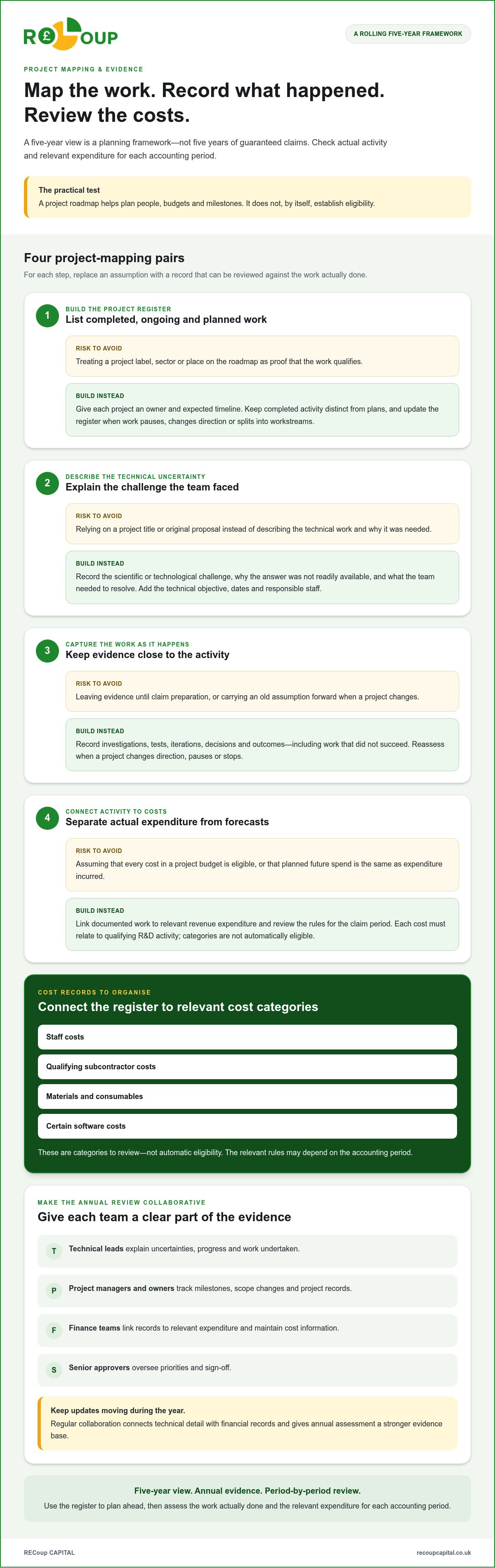
Bring technical, project, finance and senior decision-makers into the planning discussion. Each sees a different part of the picture. Technical leads can explain what was uncertain and what work was undertaken; project managers can track milestones and changes; finance teams can link records to expenditure; senior approvers can oversee priorities and sign-off.
Make ownership explicit. For example, assign a technical lead to document project uncertainties and progress, a project owner to record scope changes, and a finance contact to maintain relevant cost information. Agree how updates will be shared during the year, rather than waiting until a claim is being prepared. Regular collaboration connects the technical detail with financial records, making annual assessment more orderly and giving claim preparation a stronger evidence base.
Map innovation projects and eligible expenditure across the five-year horizon
Turn the business roadmap into a project register that can be checked against actual work and costs each year. A project’s sector or label doesn’t determine whether it qualifies. Companies across sectors may undertake eligible R&D, but operating in a particular industry neither qualifies nor excludes a business. The focus is the activity and expenditure in the relevant accounting period.
Use this four-step method to build a practical map:
- List the projects. Include completed, ongoing and planned work, with an owner and expected timeline for each.
- Describe the uncertainties. Record the scientific or technological challenge, why the answer wasn’t readily available and what the team needed to resolve.
- Record the work. Capture investigations, tests, iterations, decisions and outcomes as they happen, including work that didn’t succeed.
- Map the costs. Connect documented activity to relevant expenditure, separate actual costs from forecasts, and review the rules for each claim period.
This sequence keeps a five-year view useful without mistaking planned activity for completed work. For example, a development project may be forecast to continue next year, but its register should show what the team actually did this year, what changed and which costs relate to that work.
Create a project register that can be reviewed annually
Give each project a concise record of its technical objective, uncertainty, work undertaken and outcome. Add dates, responsible staff and links to existing project records where practical. Distinguish completed activity from plans, and update entries if a project pauses, changes direction or splits into separate workstreams. Reviewing the register against actual activity helps ensure the evidence describes what teams did, not just what the original proposal expected.
Connect project records with qualifying cost categories
Finance teams can use the project register to organise relevant revenue expenditure, including staff costs, qualifying subcontractor costs, materials, consumables and certain software costs. These categories aren’t automatically eligible: each cost must relate to qualifying R&D activity, and the rules may depend on the accounting period. Most overseas R&D expenditure, including subcontractors and externally provided workers, is no longer eligible under the merged scheme for periods beginning on or after 1 April 2024.
Keep capital expenditure separate. The cost of buildings and fixed assets isn’t eligible for R&D tax relief, even if an asset is used in an innovation project. The UK Government R&D Tax Relief Guidance sets out the official rules, while R&D tax credits explained can help clarify the relief basics. As you build the register, specialist R&D tax credit claim support can help connect technical descriptions with cost records and claim preparation.
Compare the R&D relief routes before setting annual assumptions
A five-year forecast shouldn’t assume that one relief route will apply throughout. The rules have changed, so the accounting period matters. For periods beginning on or after 1 April 2024, the merged R&D scheme is the main route, with Enhanced R&D Intensive Support (ERIS) available to eligible loss-making SMEs. The former SME and RDEC schemes are relevant to earlier periods, not options to select for every future claim.
Route | How to understand it in a multi-year plan
Former SME relief | Applied to eligible SMEs under the rules for relevant earlier periods. SME status uses fewer than 500 staff, turnover under €100 million and gross assets under €86 million. This relief is state aid.
Former RDEC | Applied under the rules for relevant earlier periods, including to large companies. RDEC is not state aid.
Current routes | For periods beginning on or after 1 April 2024, assess the merged scheme or, where the conditions are met, ERIS. Don’t carry a former scheme assumption into a later period.
This comparison is a planning aid, not a menu. Company size, financial circumstances, project activity and accounting period all inform which treatment applies. A company can’t select a route simply because it prefers a particular rate or because a previous claim used that route. For example, a forecast spanning periods on both sides of a rule change should flag each period for separate review, rather than applying one assumption to the entire five-year horizon.
How SME relief and RDEC differ
For historical periods, the SME criteria help distinguish the former SME route from RDEC, which was used for large companies and could also apply in other circumstances under the rules then in force. Meeting the SME thresholds alone doesn’t establish eligibility for a claim: qualifying activity, relevant expenditure and the rules for the accounting period still matter. Confirm the applicable treatment period by period before including expected relief in financial forecasts.
When building a 5-year innovation tax relief strategy, keep a dated record of the assumptions behind each projected claim. If rules or company circumstances change, update the forecast rather than treating earlier estimates as commitments. This makes uncertainty visible to decision-makers and helps prevent potential relief being mistaken for secured funding.
Where other tax reliefs fit, and where they don’t
Keep R&D tax relief separate from Capital Allowances and Land Remediation Relief. These are distinct tax reliefs, each with its own rules and qualifying conditions. They don’t make property or capital expenditure eligible R&D claim expenditure. Don’t include buildings or fixed assets as R&D costs simply because they support an innovation project.
Once you’ve identified the route and period, connect the assessment to the claim process. The R&D tax credit claim process sets out the claim-focused steps to consider.
Turn the strategy into an annual evidence, review and claim cycle
A five-year roadmap becomes useful when it feeds a repeatable annual routine. Set a regular review date, assign owners and assess each project against what actually happened during the accounting period. This keeps the forward plan connected to evidence and gives finance and technical teams time to resolve gaps before claim preparation.
- Forecast projects. At the start of the period, identify planned technical work, anticipated milestones and project leads. Treat these as forecasts, not proof that qualifying activity or expenditure will occur.
- Capture evidence. As work progresses, record technical decisions, tests, setbacks, changes in direction and newly discovered uncertainties.
- Review costs. Finance should connect relevant expenditure to documented project activity, using actual records and keeping non-qualifying costs separate.
- Assess eligibility. Technical and finance leads should review the work and costs against the rules for the accounting period. Update the assessment if project scope or circumstances change.
- Prepare the claim. Bring the evidence and cost analysis together, complete the required claim steps and arrange appropriate senior review before submission.
Give each role a clear part. Technical leads explain the challenge and work undertaken; project owners flag changes and maintain records; finance teams review expenditure and accounting-period information; senior approvers oversee the final submission. This shared responsibility helps the claim reflect both the technical reality and the financial records.
Maintain clear project evidence throughout the year
Keep dated records close to the work: design decisions, test results, meeting notes, failed approaches and explanations of why the next step was uncertain. A project doesn’t need a successful technical outcome to be considered. Failed or unfinished work may still be relevant if it meets the applicable eligibility requirements. Clear records show what was attempted and why, rather than relying on memory at year-end.
Review the roadmap at each financial year-end
Compare planned innovation with completed work and expenditure actually incurred. If a project expanded, paused or changed direction, update its description and evidence trail. A forecast shouldn’t be treated as a claim simply because the work appeared in the original plan.
Claims may cover eligible activity from failed, ongoing or unfinished projects, subject to the requirements for the relevant period. A claim can generally be submitted up to two years after the end of the accounting period in which the expenditure was incurred. However, some companies must notify HMRC of their intention to claim within six months after the period ends, and claims require an Additional Information Form. Include these checks in the annual calendar so the planning process doesn’t overlook a time-sensitive step.
For practical submission steps, the R&D tax credit claim process can help frame the year-end workflow. Recoup Capital’s specialists support technical assessment, claim preparation and submission on a contingency basis, with no upfront fee. Discuss your R&D claim process as part of establishing a consistent annual cycle.
Put expert R&D tax relief support into your five-year plan
A well-run annual process gives your five-year innovation strategy a practical foundation. Specialist input can connect the technical account of what a team was trying to achieve with a review of relevant costs and preparation of an evidence-led claim. It can also help your business revisit assumptions as projects evolve, rather than treating forecast claims as certain.
Recoup Capital supports UK-registered limited companies and PLCs with technical assessment, claim preparation, submission and HMRC liaison. Its chartered tax accountants and R&D specialists bring technical and tax perspectives together, so the project narrative and financial analysis are considered as part of the same claim. The consultancy works on a contingency basis, with no upfront fee.
What Recoup Capital supports during the claim process
Support can begin with reviewing projects and evidence, then assessing activities and expenditure against the rules for the relevant accounting period. Claim preparation brings the technical explanations and cost information together for submission, with support through submission and HMRC liaison. The aim for claim processing is six to eight weeks, often two to four weeks when accelerated.
This expertise can complement your company’s annual cycle. Technical leads stay close to the work, finance teams maintain cost records and senior approvers oversee decisions, while specialist review helps bring those strands together. This can be especially useful when a project has changed direction, several teams contributed, or the evidence needs to explain why a technical challenge was uncertain. It supports a consistent approach, not a promise that a project or a particular amount of expenditure will qualify.
Recoup Capital has facilitated over £80 million for UK businesses since inception. This is a company-wide track record, not a forecast of what an individual business will receive. Any claim outcome depends on the company’s circumstances, eligible activity and expenditure, and the rules for its accounting period.
Choose a low-friction next step
If you’ve established a project register and annual review process, an eligibility check can help you assess how those records fit into a potential claim. Recoup Capital offers a free eligibility checker and a free 15-minute consultation, with no obligation. Use the conversation to discuss your project activity, evidence and next steps without treating future relief as a guaranteed part of your budget.
Building a 5-year innovation tax relief strategy is ultimately about making good decisions with the information available, then reviewing them as the business and rules change. If a claim is successful, the resulting funds may support further innovation and growth. They are a potential strategic asset, not a guaranteed return. Arrange your free 15-minute consultation to discuss how specialist support could fit into your annual process.
Make your next innovation decision with confidence
A five-year plan works best when it stays open to change. Treat each year as a fresh opportunity to test assumptions against the work your teams have actually carried out, the records they’ve kept and the rules that apply. That way, building a 5-year innovation tax relief strategy becomes part of sound business planning, not a bet on future claims.
Your next step needn’t be a major commitment. A focused discussion can help you consider how your current project pipeline and evidence fit into an annual R&D tax relief process, and where specialist input could help. Any potential relief depends on the facts of your work and the relevant requirements, but a clear process gives your business a stronger footing as innovation evolves.
Explore your options in a free, no-obligation 15-minute consultation, and take a practical step towards supporting your next stage of innovation.
Frequently Asked Questions
Can a company claim R&D tax relief if an innovation project failed?
Yes. A failed project may still qualify if the work undertaken met the relevant R&D criteria. A successful technical outcome isn’t required: the claim concerns the qualifying investigation and eligible expenditure, not whether the team solved the problem. For example, testing an approach that ultimately proves unworkable may be relevant. Keep records of the uncertainty, tests, decisions and results so the claim reflects the work actually carried out.
Can a loss-making company claim R&D tax relief?
Yes. Making a loss doesn’t automatically prevent a company from claiming. The applicable relief depends on the accounting period, company circumstances and scheme conditions. For periods beginning on or after 1 April 2024, the merged scheme is the main route, while Enhanced R&D Intensive Support may be available to qualifying loss-making SMEs whose R&D expenditure is at least 30% of total expenditure. Assess the relevant route before including any potential benefit in cash-flow forecasts.
How far back can a UK company claim R&D tax relief?
A company generally has up to two years after the end of the accounting period in which it incurred the R&D expenditure to submit a claim. Don’t leave a review until that window is close to closing: first-time claimants, and companies that haven’t claimed in the previous three years, may also need to notify HMRC within six months of the period end. Claims require an Additional Information Form, so check the requirements for the relevant period.
Can a company claim for an R&D project that is still ongoing?
Yes. A company may claim for qualifying work on an ongoing project; the project doesn’t need to be complete. The assessment should cover eligible activity and expenditure incurred in the accounting period being claimed, not forecast work or future costs. For instance, if development continues into another financial year, keep period-specific records so work and expenditure can be considered in the correct claim period.
Which UK companies can consider R&D tax relief?
UK-registered limited companies and PLCs with R&D activity can consider relief, subject to the rules for their accounting period and the nature of the work. Sector alone doesn’t determine eligibility. For periods where SME status is relevant, the thresholds are fewer than 500 staff, turnover under €100 million and gross assets under €86 million. Group relationships and other circumstances can affect the assessment, so don’t rely on headcount alone.
Is RDEC considered state aid?
No. RDEC is not state aid. However, RDEC has been replaced by the merged R&D scheme for accounting periods beginning on or after 1 April 2024, so the period being claimed matters. Earlier accounting periods may need to be assessed under the rules then in force, while later periods require consideration of the current scheme and any applicable enhanced support. Don’t carry a previous claim’s treatment forward without reviewing the period.
Can capital expenditure be included in an R&D tax credit claim?
No. Capital expenditure, including the purchase of buildings, land or fixed assets, isn’t eligible R&D tax credit expenditure, even if it supports an innovation project. Distinguish those purchases from potentially eligible revenue costs. An asset’s use in R&D doesn’t make its purchase cost claimable. Building a 5-year innovation tax relief strategy should keep these cost categories separate from the outset, then review relevant revenue expenditure against the rules for each period.


