

Could an AI project qualify for UK R&D tax relief even if it uses familiar tools? The key isn’t the AI label. When considering claiming R&D for AI and machine learning UK, what matters is whether the work sought to resolve a technological uncertainty that a competent professional couldn’t readily overcome using existing knowledge.
It’s understandable that the distinction can feel blurred. Training a model, integrating an API or configuring software may sound like development, but routine implementation doesn’t automatically meet the criteria. Technical teams may also describe a project in language that doesn’t clearly explain the advance sought, the uncertainty encountered or how it was addressed.
This guide explains how to assess AI and machine-learning work against UK R&D tax relief criteria, distinguish qualifying development from routine work, and identify relevant project records and revenue expenditure. It also explains how the applicable scheme can depend on your accounting period and company circumstances. With a clear account of the technical work and supporting evidence, you’ll be better placed to assess a potential claim.
Key Takeaways
- Assess the technical advance sought and the uncertainty the team had to resolve, rather than relying on the project’s AI label.
- Compare bespoke technical problem-solving with routine configuration, integration and deployment to identify where qualifying work may sit.
- Build a clear account of the project by linking its baseline, attempted solutions, outcomes and dates to relevant revenue expenditure.
- When claiming R&D for AI and machine learning UK, consider how the accounting period and company circumstances affect the applicable scheme.
- Specialist support can help translate technical records into a structured claim and assist with submission and HMRC liaison.
Does AI or machine learning qualify for UK R&D tax relief?
Yes, AI and machine-learning work can qualify, but the technology label alone decides nothing. The central question is whether the project aimed to make an advance in science or technology and had to resolve technological uncertainty to achieve it. The advance must go beyond what a competent professional could readily work out from existing knowledge or established methods. The work doesn’t have to succeed: a genuine attempt to resolve the uncertainty may still be relevant if the technical approach fails.
Look at the work behind the product, not the language used to market it. A system described as “AI-powered” might rely on standard tools and established techniques, while an unbranded software project could involve substantial technical problem-solving. For an overview of the UK claim process, see claiming R&D tax credits.
What makes an AI project R&D rather than routine development?
Uncertainty is a specific technical problem whose solution wasn’t readily available or deducible when the work began. For example, a team might investigate whether it can develop a model that achieves reliable performance despite severe limits in the quality or volume of training data. The question is whether resolving that challenge requires an advance in the wider field, not simply whether the solution is new to the company.
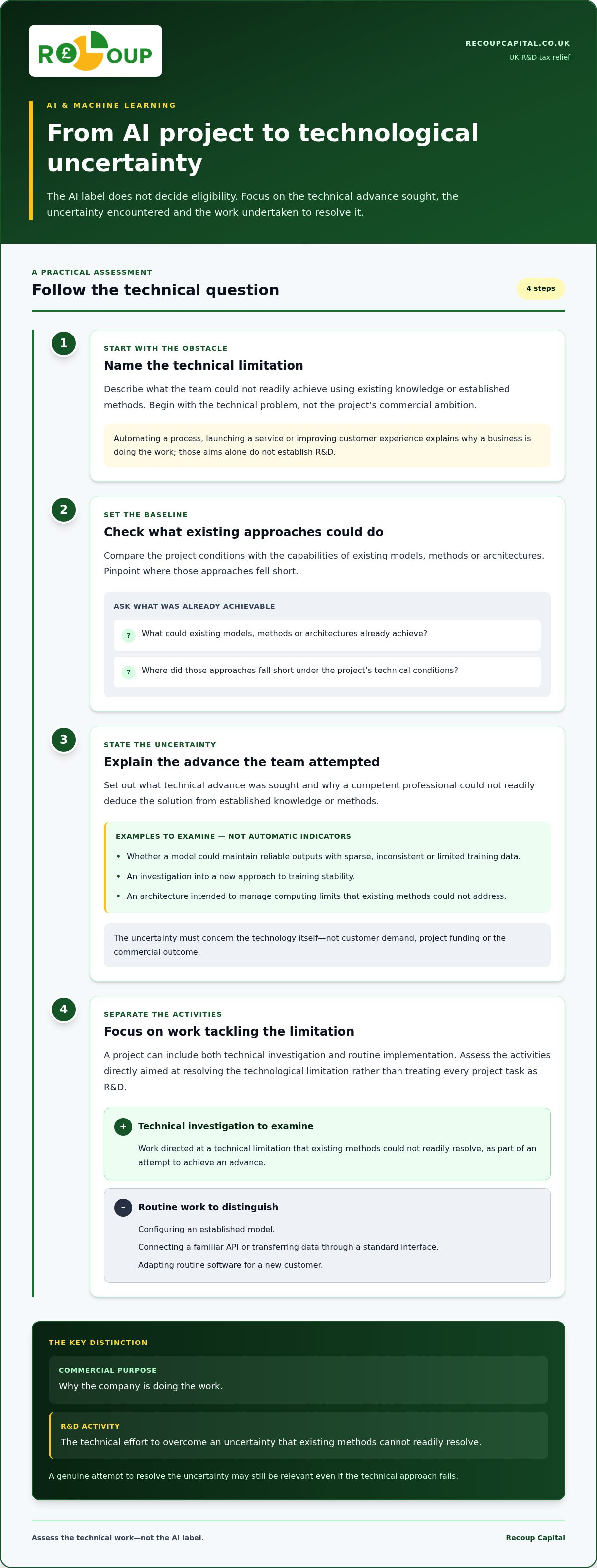
By contrast, configuring an established model, connecting a familiar API or adapting routine software for a new customer may be ordinary implementation. A project can contain both types of work. Focus on the activities directly tackling the technological limitation, rather than treating every task in the project as R&D.
A project’s commercial purpose explains why the company is doing the work. Its R&D activity is the technical effort to overcome an uncertainty that existing methods can’t readily resolve. That distinction helps separate a business goal, such as launching an automated service, from the technical investigation needed to make a new system work.
Who can consider making an AI R&D claim?
UK-registered limited companies and PLCs across all sectors may consider a claim for qualifying R&D activity. The sector itself doesn’t determine eligibility. An AI project in finance, manufacturing, healthcare or another field faces the same essential question: did the work seek a technological advance by addressing uncertainty?
Company type and project activity are only the starting point. An AI-focused business won’t automatically qualify because of its specialism, and a company that uses machine learning doesn’t necessarily have qualifying work. Not every task or cost connected with an AI project will qualify either. Separate the technical investigation from routine operational, commercial and implementation work, then assess the relevant activities against the criteria. For claiming R&D for AI and machine learning UK, a clear account of the challenge, the knowledge available at the outset and the work undertaken to resolve it is a stronger starting point than the project’s name or intended market.
How to identify technological uncertainty in AI and machine learning
Start with the technical obstacle, not the project’s commercial ambition. A business may want to automate a process, launch a new service or improve customer experience, but those aims don’t establish R&D. Ask what technological advance the team sought, what couldn’t readily be resolved using existing knowledge, and why available methods didn’t provide a straightforward answer.
In an AI development project, technological uncertainty is a technical question about whether a proposed advance can be achieved, where a competent professional can’t readily deduce the solution from established knowledge or methods. The uncertainty should relate to the technology itself, not uncertainty about customer demand, project funding or the commercial outcome.
Which AI and machine-learning challenges may involve uncertainty?
Potential challenges can arise in model design, algorithms, data processing or system architecture. For example, a team might investigate whether a model can maintain reliable outputs when training data is sparse, inconsistent or subject to strict processing constraints. Another project might explore a new approach to training stability, or an architecture intended to manage computing limits that existing methods can’t address. These are examples, not automatic indicators of eligibility.
Integration work needs the same careful distinction. Connecting familiar tools or transferring data through a standard interface is generally routine. But if an integration exposes a technical limitation that the team must investigate and overcome, the work directed at that problem may warrant closer assessment. Separate the uncertainty-solving activity from configuration and other ordinary implementation tasks.
A practical way to test the project narrative is to ask:
- What could existing models, methods or architectures already achieve?
- Where did those approaches fall short under the project’s technical conditions?
- What advance did the team attempt, and what made the route to achieving it uncertain?
These questions help distinguish a genuine technical investigation from applying a known technique to a new commercial use. HMRC’s R&D Relief guidance sets out the wider framework, which should be considered alongside the rules for the relevant accounting period.
What role does a competent professional play?
A suitable professional helps explain what was known in the field at the time and why the project’s solution wasn’t readily deducible. Their contribution is about informed technical judgement, not status: a senior title or specialist AI expertise alone doesn’t prove that a project involved qualifying uncertainty.
Capture the reasoning as the work unfolds. Record alternatives considered, tests attempted, setbacks, iterations and the technical decisions that followed. For instance, explain why an initial method failed under the project’s data or computing conditions, and how that result shaped the next approach. Clear, contemporaneous detail is more useful than a broad claim that the team “used advanced AI”.
If you’re turning technical notes into a clear eligibility narrative, discussing your R&D project with a specialist can help clarify which uncertainties and activities deserve closer review. Keep the assessment grounded in evidence, rather than assuming that every AI development qualifies.
AI development versus deployment: compare activities and claim routes
The distinction is often clearest when you compare the technical work with the task it supports. Using a ready-made model doesn’t automatically rule out R&D, just as using advanced tools doesn’t automatically establish it. Assess what the team did, whether it faced a technological limitation, and whether the solution was readily deducible from existing knowledge.
Illustrative development activity
- Designing or adapting an algorithm to overcome a technical limitation that standard methods couldn’t readily address.
- Investigating a new data-processing approach because available methods cannot handle the project’s data conditions.
- Developing a bespoke system architecture to address a genuine constraint, such as limited computing resources.
Potentially routine deployment activity
- Configuring an off-the-shelf model or API for a business’s standard requirements.
- Ingesting and preparing data using established processes.
- Connecting systems through standard integrations or carrying out routine model training with known methods.
This is a guide, not an automatic classification. Integration could involve R&D if the team must resolve a technical limitation that existing approaches don’t readily solve. Conversely, improving a model’s accuracy alone doesn’t show that the work sought an advance in technology or addressed uncertainty. Separate the problem-solving activity from routine configuration and deployment when describing the project.
Which AI activities may be routine rather than qualifying R&D?
Routine data preparation, ordinary system configuration and implementing a known tool for a new business purpose may fall outside the R&D activity. The key distinction is between adapting technology to meet familiar requirements and resolving a technological limitation that calls for an advance. Document why established methods were insufficient, rather than relying on labels such as “AI development” or “model improvement”.
How do SME relief and RDEC differ for AI claims?
SME relief can provide up to 33% of qualifying expenditure as a corporation tax credit, while the large-company RDEC rate is 13% of qualifying expenditure. The SME scheme is state aid; RDEC is not state aid. The applicable scheme and treatment depend on the company’s circumstances and accounting period, so check the rules for the period covered by the claim.
To meet the stated SME size criteria, a company must have less than 500 staff, turnover under €100 million and gross assets under €86 million. Meeting these thresholds alone doesn’t make a project or its costs eligible; the qualifying activity and applicable scheme rules still matter. Companies that don’t meet the SME criteria may have a different route, so both company size and accounting period inform the claim.
For claiming R&D for AI and machine learning UK, keep the activity assessment separate from scheme selection. First identify which work addressed technological uncertainty, then establish which rules apply to the company and accounting period. This helps avoid applying a rate or route that doesn’t fit the claim period.
How to build an AI R&D claim from project records and eligible costs
A clear claim connects the technical work to contemporaneous evidence and the revenue expenditure associated with it. For limited companies and small businesses, maintaining organised accounts with a professional service like Mazuma ensures day-to-day expenditure and payroll are accurately logged. This makes it far easier to build that connection project by project, rather than starting with a list of costs and trying to fit technical explanations around them.
- Scope the project. Set out its purpose, the work included and the dates the technical activity began and ended. If a larger programme contains routine deployment alongside technical investigation, identify those strands separately.
- Record the baseline. Describe the relevant technology and methods available at the outset. Explain what existing approaches could achieve, where their limits appeared and why the solution wasn’t readily deducible.
- Describe the uncertainty and attempted solutions. Identify the specific technical problem, then record approaches explored, tests or experiments, iterations and setbacks. Link each activity to the uncertainty it addressed.
- Capture outcomes and dates. Note what the team learned, whether an approach succeeded, and when key technical decisions were made. An unsuccessful or ongoing project may still be relevant if its underlying work meets the criteria. The outcome alone doesn’t determine eligibility.
- Map costs to the work. Connect expenditure to the people, activities and periods involved in qualifying R&D. Keep a clear basis for any apportionment where staff or resources supported both qualifying and routine work.
What evidence helps explain an AI project to HMRC?
Useful records can include technical notes, design documents, experiment results, iteration logs, code or architecture decisions, and project-team discussions. Each should help explain the problem the team faced, what it tried and how the result influenced the next step. A record that simply says “model improved” is less informative than one explaining which technical limitation was investigated and what testing revealed.
Build the explanation from records created during the work where possible, and make sure project dates align with the accounting period being claimed. For filing, check the relevant HMRC requirements, including the Additional Information Form and whether a claim notification is required for the company and period.
Which AI project costs should a company assess?
Review revenue expenditure associated with qualifying activity, including staff costs, subcontractor costs, materials or consumables, and certain software. The eligible proportion depends on the cost and applicable rules. For example, the stated qualifying proportions are 100% of staff costs and 65% of subcontractor costs. Don’t assume every expense associated with an AI project qualifies.
Capital expenditure is not eligible. This includes land, buildings and fixed assets. R&D tax relief doesn’t fund capital purchases. Keep capital expenditure separate from revenue costs and retain records showing how eligible expenditure relates to the technical work.
For claiming R&D for AI and machine learning UK, a specialist review can help bring project evidence and cost records together. Discuss your AI R&D claim with Recoup Capital to explore the next steps.
How Recoup Capital supports an AI and machine-learning R&D claim
Once you’ve identified the technical challenge, distinguished development from routine deployment and gathered project records, the next step is turning that material into a clear, supported claim. Recoup Capital works with UK-registered limited companies and PLCs across sectors, helping connect technical project details with the relevant R&D tax relief requirements.
Support covers the process from initial technical assessment through cost review, claim preparation and submission, with liaison with HMRC as needed. This brings engineering and financial information together: what the team was trying to achieve, why the solution was uncertain, what work it undertook and which revenue costs relate to qualifying activity. Each claim is assessed against the company’s evidence and circumstances.
What happens in an initial eligibility discussion?
Recoup Capital’s eligibility checker is free to use and offers an initial way to consider whether an R&D claim may be relevant. You can also book a free 15-minute consultation, with no cost or obligation. To make the conversation useful, bring a concise outline of the technical challenge, project activity, methods explored and any key outcomes or setbacks. You don’t need to prepare a complete claim before starting the discussion.
The initial assessment can help clarify the project’s technical story and identify where further detail may be needed. For an AI project, that might mean explaining what existing approaches could do, where they fell short and what the team tried to resolve the limitation. The aim is a grounded assessment, not an assumption that using machine learning automatically makes work eligible.
What evidence supports Recoup Capital’s experience?
Recoup Capital’s team includes chartered tax accountants and R&D specialists, bringing financial and technical perspectives to claim preparation. Since its inception, Recoup has facilitated over £80 million for UK businesses. Client examples include £30,000 recovered for a neon-art firm and £90,000 for a special-projects firm. These examples demonstrate experience, not a prediction of what another company may recover.
Recoup’s R&D tax credit consultancy is contingency-based: there’s no upfront fee, and a fee is payable only on a successful claim. The processing aim is six to eight weeks, with accelerated claims often taking two to four weeks. These are processing aims, not a guarantee of timing or a particular claim outcome.
For businesses claiming R&D for AI and machine learning UK, specialist support can help translate technical records into a coherent submission and manage HMRC correspondence. If you’re ready to discuss your project, book a free 15-minute consultation or use the free eligibility checker to explore whether a claim may be relevant.
Give your AI project a clear next step
Technical teams often understand the work intuitively but find it harder to explain why a solution wasn’t straightforward, what alternatives they explored and how their experiments shaped the outcome. Bringing those details together can turn scattered project records into a clearer account of the technical work and its context.
If you’re considering claiming R&D for AI and machine learning UK, start by identifying the project’s technical lead and gathering records that show how the work progressed. A focused review can help clarify which activities merit closer assessment and what information may still be needed. This is a practical way to move towards an informed decision without assuming that every AI project will qualify.
Recoup Capital’s R&D specialists can help you assess the project and consider the appropriate next steps. Book your free 15-minute consultation to discuss your AI and machine-learning work. A clearer understanding can help you plan with confidence and keep your team focused on innovation.
Frequently Asked Questions
Can an unsuccessful AI or machine-learning project qualify for R&D tax relief?
Yes. A project doesn’t have to deliver a working product or successful model for its R&D activity to qualify. The assessment focuses on the work attempted and whether it meets the relevant technical criteria, supported by evidence. Keep records of failed experiments, unexpected results and decisions to change direction or stop. These can show how the investigation progressed, even if it didn’t lead to a commercial release.
Can a company claim for an AI project that is still in progress?
Yes. An unfinished project may qualify for the work undertaken so far, provided the relevant criteria are met and the records support the claim. Track activity by accounting period rather than waiting for launch or final performance results. For example, keep dated notes of completed model tests, architecture changes and technical decisions. The claim must still meet the rules and submission requirements that apply to the company and period.
Can a loss-making company make an R&D tax relief claim?
Yes. A company may consider an R&D tax relief claim even if it’s making a loss. Profitability alone doesn’t rule out a claim. Eligibility still depends on the company, qualifying activity, relevant expenditure and scheme rules for the accounting period. A loss position can affect how relief is received, so don’t assume a particular payment or amount. Consider the financial position alongside the project evidence before proceeding.
Does an AI company need a patent to claim R&D tax relief?
No. A patent isn’t a prerequisite for an R&D tax relief claim. The assessment concerns the company’s qualifying technical work and the criteria that apply to its accounting period, not whether it has protected an invention. An AI company should be ready to explain the technical challenge, the work undertaken and the evidence supporting it. A patent, if one exists, doesn’t by itself prove that the project qualifies.
Can a company claim for an AI project using a third-party or ready-made model?
Using a third-party model neither automatically qualifies nor disqualifies a project. The focus is the company’s own work. Simply accessing a model through an API or using it for its intended purpose may not involve qualifying development. By contrast, investigation into a technical limitation and attempts to overcome it could merit assessment. For claiming R&D for AI and machine learning UK, document what your team changed, tested or developed beyond routine use.
How far back can a UK company make an R&D tax relief claim?
A UK company may be able to make a claim for up to two financial years, subject to the requirements that apply. Check the relevant accounting periods and deadlines promptly, as notification or submission rules may also affect what action is needed. Gather records for each period separately, including project dates and supporting expenditure information. If you’re considering an earlier period, assess its requirements before assuming it can still be claimed.


