

Could the work behind a circular-economy business model support an R&D tax relief claim, even if your business focuses on reuse, repair or remanufacturing? Circularity itself does not qualify for tax relief, but qualifying innovation may. For UK companies exploring tax relief for circular economy business models, the distinction is practical: a credible claim needs to show the technical work and challenges, not simply describe routine activity as sustainable.
Improving recycling processes, trialling alternative materials or developing ways to extend a product’s life may involve genuine technical challenges. But environmental aims alone do not make work eligible. The activity, the technical uncertainties faced and the evidence recorded all matter, so clear project documentation is essential.
This guide explains how circular innovation may connect to R&D tax relief, which activities and revenue costs could merit assessment, and how to distinguish experimental development from day-to-day operations. It also covers accounting-period rules and the records that can support a claim, giving you a practical starting point for reviewing completed or ongoing work.
Key Takeaways
- A circular business model alone does not establish eligibility for R&D tax relief. The focus is on the innovation and technical challenges involved.
- Assess whether work on repair, reuse, remanufacturing or material recovery sought a technical advance beyond routine operational improvements.
- For tax relief for circular economy business models, useful records include the project baseline, uncertainties investigated, tests carried out and outcomes.
- Keep R&D tax relief separate from wider environmental tax measures, and consider which scheme rules apply to your accounting period.
- Recoup Capital supports technical assessment, claim preparation and HMRC liaison. Its claim work is contingency-based, with no upfront fee and a fee payable only if a claim succeeds.
What tax relief can a circular economy business model actually access?
A circular business model alone does not establish eligibility for R&D tax relief. A UK-registered limited company or PLC may be able to claim through the applicable R&D route if its work meets the relevant conditions. The claim is assessed on the innovation undertaken, not on whether the business describes itself as sustainable.
Circular activity can include repairing products to extend their useful life, reusing components, remanufacturing goods or recovering materials from waste. These approaches aim to keep products and resources in use for longer. For a concise overview of the concept and how it contrasts with a linear economy, see What is a Circular Economy?
Circular activity and qualifying innovation are not the same thing
Routine repair or reuse may be part of normal operations. For an R&D assessment, the question is whether the company sought a technological advance and faced technical uncertainty that could not readily be resolved using existing knowledge or capability. The project and its evidence need to be assessed against the rules for the company’s accounting period.
For example, imagine a company trying to recover a useful fibre from a mixed waste stream—a challenge often encountered in textiles circularity, where advisory specialists such as Symolem examine sustainable material practices. If established methods cannot separate it without damaging its performance, the company might investigate new separation conditions, test different process settings and record the results. That work could merit closer assessment, but the example does not guarantee eligibility. By contrast, adopting a known sorting process or following standard repair procedures does not become R&D simply because it reduces waste.
Relief depends on qualifying R&D, not a sustainability label. This is the central distinction for any business considering tax relief for circular economy business models. The aims may be environmental, but the assessment focuses on the technical work and the rules that apply to the claim.
Policy proposals versus relief a company may claim
Discussion about VAT, resource taxes and waste measures concerns the wider design of the tax system and the incentives it creates. Policy proposals or calls for reform are not, by themselves, tax relief a company can claim. Keep those debates separate from an assessment of work already undertaken: a company claim needs to be grounded in the relevant relief rules and evidence.
The R&D route is distinct from other tax obligations a business may face. For instance, a property transaction may involve stamp duty land tax, which is separate from an R&D claim. For an overview of the R&D claim route, Recoup Capital’s R&D tax credits explained page provides relevant background. A practical first step is to identify the project, the advance sought and the technical questions the team investigated, rather than relying on broad circular-economy terminology.
How R&D tax relief could apply to circular-economy innovation
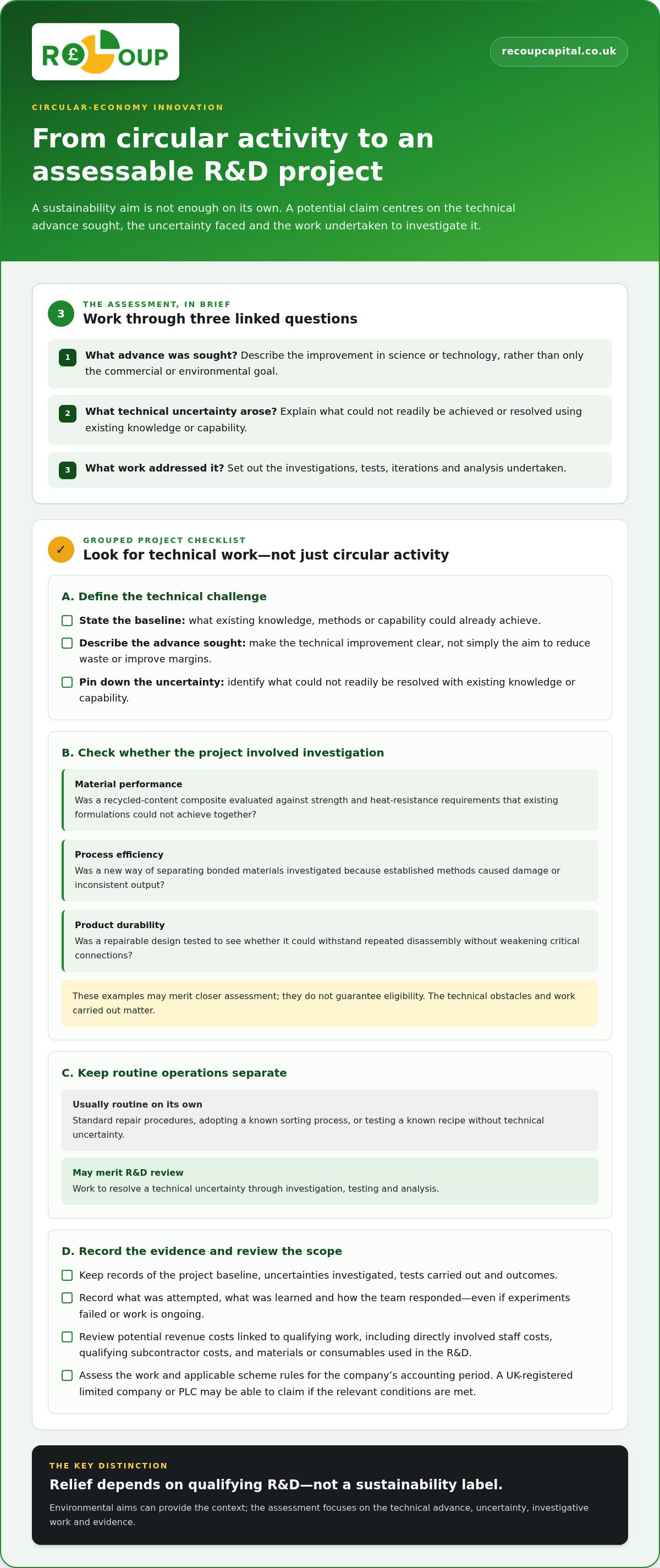
For a potential claim, connect the technical work to the challenge the company was trying to solve. An assessment generally looks at three linked questions:
- What advance was sought? Describe the improvement in science or technology, not just the commercial or environmental goal.
- What technical uncertainty arose? Explain what could not readily be achieved or resolved using existing knowledge or capability.
- What work addressed it? Set out the investigations, tests, iterations and analysis undertaken to resolve that uncertainty.
Reducing waste, improving margins or meeting a customer’s sustainability preference can be valuable business outcomes, but none proves R&D eligibility on its own. Assess the technical work against the rules for the company’s accounting period.
Which circular-economy projects might merit an R&D review?
Material performance: A business may investigate whether a recycled-content composite can meet strength and heat-resistance requirements that existing formulations cannot achieve together. Testing a known recipe without technical uncertainty is different from developing and evaluating new formulations.
Process efficiency: A company might trial a new way to separate bonded materials for recovery when established methods cause damage or produce inconsistent output. The investigations and technical obstacles matter, not simply the aim of recovering more material.
Product durability: A team could test a repairable product design intended to withstand repeated disassembly without weakening its critical connections. A project can merit review even if the experiments fail or work is ongoing. Record what was attempted, what was learned and how the team responded.
Routine circular operations are not R&D; work to resolve technical uncertainty may be. For instance, while businesses sourcing equipment through circular supply specialists such as HGC Technologies UK Ltd. participate directly in sustainable reuse, tax relief only applies when overcoming genuine scientific or technological unknowns. That distinction helps prevent everyday repair, production or process optimisation from being treated as innovation without evidence.
Which project costs may be relevant?
Once you have identified the technical project, review its revenue costs and link each amount to the qualifying work. Potential categories include staff costs for people directly involved, qualifying subcontractor costs, materials or consumables used in the R&D, and certain software. As a broad cost-treatment guide, 100% of eligible staff costs and 65% of qualifying subcontractor costs may be included, subject to the applicable scheme rules and the nature of the engagement. These percentages do not mean every cost in those categories qualifies.
Keep project records alongside payroll information, invoices and a clear explanation of how resources were used. Capital expenditure, including land, buildings and fixed assets, is not eligible for R&D tax relief. Separate it from revenue expenditure rather than including equipment purchases in the claim.
If a project appears to involve genuine technical uncertainty, a specialist assessment can help connect the technical account with the cost review. Recoup Capital’s R&D tax credit consultancy covers technical assessment and claim preparation. You can also explore an eligibility assessment as a practical next step, without assuming that a claim will be accepted.
How do R&D tax relief and wider circular-economy tax measures differ?
These measures can all influence decisions about reuse, repair and resource recovery, but they do different jobs. R&D tax relief is a company claim linked to qualifying innovation and eligible expenditure. VAT, customs and environmental taxes belong to the wider tax framework. They do not become an R&D claim simply because they affect a circular business.
| Measure | What it relates to | How to view it |
|---|---|---|
| R&D tax relief | Qualifying R&D activity and relevant expenditure | A company-level claim assessed under the rules for its accounting period |
| SME R&D relief and RDEC | Separate routes for companies that meet the relevant conditions | Eligibility and relief depend on the company, accounting period and applicable scheme rules |
| VAT, customs and environmental taxes | Tax treatment of transactions, goods or activities | Distinct tax obligations or policy measures, not automatic relief for R&D |
SME relief and RDEC: separate routes, not sector-specific incentives
SME relief and the Research and Development Expenditure Credit (RDEC) are separate routes, and R&D tax relief is not restricted to one company size or sector. The SME criteria include fewer than 500 staff, turnover under €100 million and gross assets under €86 million. A qualifying SME may receive up to 33% of qualifying expenditure as a corporation tax credit, while the large-company RDEC rate is 13% of qualifying expenditure. These rates do not guarantee a particular claim outcome, and the applicable conditions depend on the accounting period.
The SME scheme is state aid; RDEC is not state aid. Company size and scheme conditions shape the route, not whether a business operates in the circular-economy sector. For each claim, assess the project, costs and accounting-period rules together.
Where VAT and other tax-policy discussions fit
VAT treatment, customs rules and environmental taxes may influence the cost or commercial appeal of repairing, importing, reusing or recovering materials. They are separate from R&D tax relief, which concerns qualifying development work rather than the general tax treatment of a product or transaction. A change proposed in a policy debate should not be treated as an available company relief unless it has been implemented and applies to that business.
For a practical decision, separate the questions: is there a qualifying technical project, which claim route applies to the accounting period, and what other tax rules affect the underlying activity? This helps prevent broad discussions about tax relief for circular economy business models from being mistaken for a single circular-economy tax incentive. Keep the claim assessment focused on R&D evidence and the rules that apply to the relevant period.
How to assess a circular-economy R&D claim before proceeding
A disciplined review can help separate a technical project from routine operations before you prepare a claim. Start with the project, build its technical narrative, review the associated costs, then assess the company’s eligibility and the rules for the relevant accounting period. The aim is a clear, evidence-led case, not a claim based on the business’s sustainability credentials alone.
- Identify the project. Define its boundaries, dates, people involved and technical objective.
- Explain the challenge. Record the starting point, advance sought and uncertainties the team needed to resolve.
- Describe the work. Link investigations, trials and decisions to the technical challenges.
- Review the costs and claim route. Match relevant revenue expenditure to the project, then check company eligibility, applicable scheme rules and timing.
Build a clear technical project record
Bring together contemporaneous records wherever possible. These might include design notes, test plans, laboratory results, prototype changes, production data and internal discussions explaining why a particular approach was chosen. Note who was responsible for the work and when key investigations took place. If a trial failed, record what it showed and how the team adapted its next step.
A useful project evidence trail connects the baseline, the advance sought, the technical uncertainty, the investigations and the outcomes. Be specific: describe what the team was trying to achieve and why existing methods were not sufficient, rather than relying on labels such as “green innovation” or “circular project”.
Review eligibility, costs and claim timing
Check that the claimant is a UK-registered limited company or PLC, then assess the applicable SME or RDEC route against the accounting-period rules. Scheme conditions and rates can depend on the period, so do not assume that a route applying to one period will apply to another. Claims may relate to failed, ongoing or unfinished projects if the relevant conditions are met. An unsuccessful outcome does not by itself rule out qualifying work.
Then reconcile project records with payroll, subcontractor invoices, materials and consumables, and any other potentially relevant costs. Keep revenue expenditure distinct from capital purchases: land, buildings and fixed assets are not eligible for R&D tax relief. Check that each cost included is supported, allocated appropriately and connected to the qualifying work.
Timing matters. Claims may generally be made for accounting periods up to two financial years back, subject to the applicable rules and deadlines. Review the position for each period before proceeding, particularly if records are incomplete or the company has previously submitted a claim.
Recoup Capital can help bring the technical narrative and cost review together through a specialist assessment. Its free, no-obligation eligibility check is a practical way to establish whether a project merits a closer review, without promising HMRC acceptance.
How Recoup Capital supports circular-economy R&D tax relief claims
For a circular-economy project, the technical account and tax treatment need to fit together. Recoup Capital supports UK-registered limited companies, including PLCs, with technical assessment, claim preparation and HMRC liaison. The work focuses on identifying and explaining qualifying activity clearly, rather than treating a sustainability objective as proof of eligibility.
Recoup Capital has facilitated over £80 million for UK businesses since inception. Client testimonials report £30,000 recovered for a neon-art firm and £90,000 for a special-projects firm. These are reported outcomes for those clients, not a prediction of what another company may recover. The value of a claim depends on its facts, eligible expenditure and the rules that apply.
What the claim-support process involves
Specialists assess the company’s technical activities, the advance sought and the uncertainties investigated, then consider whether the work and associated revenue expenditure may meet the relevant criteria. This helps distinguish experimental development from routine circular operations and connect the claim narrative to the project evidence.
Support can continue through claim preparation and submission, with HMRC liaison as needed. Claims are processed in six to eight weeks, often in two to four weeks when accelerated. A well-organised account of the work, people involved and relevant costs helps keep the assessment and preparation focused.
The service is contingency-based: there is no upfront fee, and a fee is payable only if a claim succeeds. This arrangement does not remove the need to establish eligibility or mean every claim will succeed. It gives you a clear basis for working together while the claim is assessed and prepared.
Take a low-friction next step
If you are unsure whether a project could support tax relief for circular economy business models, an initial eligibility check can help establish whether it merits a closer review. Recoup Capital offers a free eligibility checker and a free, no-obligation 15-minute consultation. You can outline the project and its technical challenges, then decide whether specialist support is right for you.
The free, no-obligation 15-minute consultation gives you an opportunity to discuss the project and consider a practical next step. Any claim decision remains grounded in the evidence and applicable rules.
Turn your innovation into a clear next step
Circular-economy innovation can create value beyond the immediate project, but its tax treatment deserves the same care as its technical development. For a business considering tax relief for circular economy business models, turn project knowledge into a clear, evidence-based assessment: what was the technical goal, what proved difficult, and what did the team learn along the way?
This perspective can help you make an informed decision, whether you are planning future development or reviewing work already completed. Recoup Capital’s chartered tax accountants and R&D specialists bring technical and tax assessment together to help you understand the potential claim position.
To discuss your project, book a free, no-obligation 15-minute consultation. Recoup Capital can help you assess the next step while keeping your claim grounded in the evidence.
Frequently Asked Questions
Can a circular-economy business claim R&D tax relief?
Yes, a UK-registered limited company or PLC may be able to claim if it undertakes qualifying R&D and meets the conditions for the relevant scheme and accounting period. A circular business model alone is not enough. Separate a project’s technical development from routine repair work in your records, then assess the development activity and its costs. That is the practical starting point for tax relief for circular economy business models.
Do repair and remanufacturing activities qualify for R&D tax relief?
Not automatically. Repairing a product using an established method or remanufacturing it to a familiar specification will not qualify simply because it extends the product’s life. A project may merit assessment if the company sought a technical advance and had to investigate uncertainties. For a repair-focused project, distinguish standard replacement work from development aimed at overcoming a technical limitation, and keep records showing why the usual approach was not sufficient.
Can a company claim for an unsuccessful circular-economy R&D project?
Potentially, yes. A project does not have to produce a successful product or process for its activities to be assessed. Keep evidence of the decisions made, such as test reports, technical notes and records explaining why an approach was stopped or changed. Then review the work and costs against the applicable conditions. A failed experiment is not automatic proof of eligibility, but its documented findings can help explain what the team investigated.
Can a loss-making company claim R&D tax relief?
Yes, a company may be able to claim while making a loss, subject to the rules for its scheme and accounting period. A loss does not establish eligibility or rule it out. The company must still meet the claimant requirements and have qualifying R&D activity. Assess the technical project separately from the company’s profit or loss position, then review expenditure and scheme conditions together before making a claim.
Can businesses in any industry claim R&D tax relief for circular innovation?
Potentially, yes. The relief is not restricted to a shortlist of industries. UK-registered limited companies and PLCs across sectors may qualify if their activity meets the R&D criteria and other applicable conditions. A construction, engineering or manufacturing company, for example, should describe the technical challenge in its own work rather than rely on its sector label. Environmental aims do not establish eligibility by themselves.
How far back can a circular-economy business make an R&D tax claim?
Claims may generally cover periods up to two financial years back, subject to the applicable rules and the company’s circumstances. List the accounting periods you want to review, then gather project records and cost information separately for each one. Account for the relevant deadlines and rules when reviewing the time limit, as claim timing can depend on the period.
Does an R&D tax relief claim provide money for capital purchases?
No. R&D tax relief is not funding for capital purchases, and capital expenditure such as land, buildings and fixed assets is not eligible for an R&D tax credit claim. Keep purchase records for those assets separate from revenue costs. For example, distinguish the acquisition of a machine from consumable materials used during qualifying development work. Assess each cost under the rules for the relevant accounting period rather than grouping all project spending together.


