

Could a satellite system, launch component or in-orbit service qualify for R&D tax relief? The answer depends less on being part of the space sector and more on the technical uncertainty your team sought to resolve. For UK space businesses, that distinction is central to assessing UK space industry R&D tax incentives.
It’s understandable to find the rules difficult to apply. Space projects can involve complex engineering, long development cycles and varied costs. That can make it challenging to identify qualifying work, separate revenue expenditure from capital spending and determine which scheme to assess.
This 2026 guide explains how to assess space-sector projects against the R&D criteria, compare the relevant relief routes and identify costs that may qualify. It also covers the technical and financial evidence to organise for an HMRC submission. With a clearer view of the requirements, your business can assess its position and make an evidence-led decision about next steps.
Key Takeaways
- UK space industry R&D tax incentives depend on the technical uncertainty a project addresses, not simply the sector your business operates in.
- Assess whether your work sought a scientific or technological advance, what uncertainty arose and how your team attempted to resolve it.
- Compare the SME relief and RDEC routes against your company’s size and circumstances, then check the rules for the relevant accounting period.
- Build a clearer claim by linking project records and technical explanations to qualifying revenue expenditure, keeping capital costs separate.
- Specialist support can help bring technical and financial evidence together for an HMRC submission.
What UK space industry R&D tax incentives are, and what they are not
Developing space technology can involve substantial technical work, but a project’s sector label doesn’t decide whether its costs qualify for tax relief. UK space industry R&D tax incentives are tax relief available to companies for qualifying research and development, subject to the rules for the relevant accounting period. The assessment focuses on the project: what advance was sought, what technical uncertainty had to be resolved and what work was done to address it.
That distinction matters because tax relief is not a grant or an automatic benefit for every space business. Public funding and other industry support are separate from R&D tax relief and have their own purposes and criteria. The UK Research and Development Tax Credit scheme provides a general overview of the relief’s history and purpose. A claim should be assessed against the rules that apply to its accounting period.
Tax relief: A tax treatment or credit that may be available to a company for qualifying R&D expenditure when the relevant conditions are met.
Grant: A separate form of funding. R&D tax relief is not a grant, and the two shouldn’t be treated as interchangeable.
Broader industry support: Other initiatives may support the space sector, but participation in them doesn’t itself establish eligibility for R&D tax relief. Other tax matters, such as stamp duty land tax, have separate rules and apply in different circumstances.
Why a space-industry label does not decide eligibility
Assessment starts with a project’s technical aims and uncertainties, not its market category. For example, a company developing satellite communications technology or a payload can consider whether its work sought a scientific or technological advance and involved uncertainty that competent professionals could not readily resolve. These are scenarios to assess, not automatic examples of qualifying work. Routine product adaptation, maintenance and commercial activities don’t qualify simply because they support a space mission.
The practical question is what the team needed to learn or overcome technically. A project may carry commercial risk, such as uncertainty about customer demand or launch timing, without involving qualifying technical uncertainty. Keeping these issues distinct helps make the project assessment more accurate and the supporting explanation clearer.
Which kinds of UK company can assess a claim?
UK-registered limited companies and PLCs across sectors can assess whether their projects meet the conditions. An early-stage business isn’t excluded solely because it is new, and an established company isn’t eligible solely because it is experienced. A company making a loss may also be able to claim. The company’s circumstances and R&D activity must be considered under the rules for its accounting period.
Scheme routes and conditions can vary with company circumstances, so a space business should establish its position rather than assume that size or profitability settles the question. For a broader introduction to the terminology and mechanics, see R&D tax credits explained. The following sections show how to assess technical uncertainty and compare the relevant routes.
How to assess technical uncertainty in space-sector R&D projects
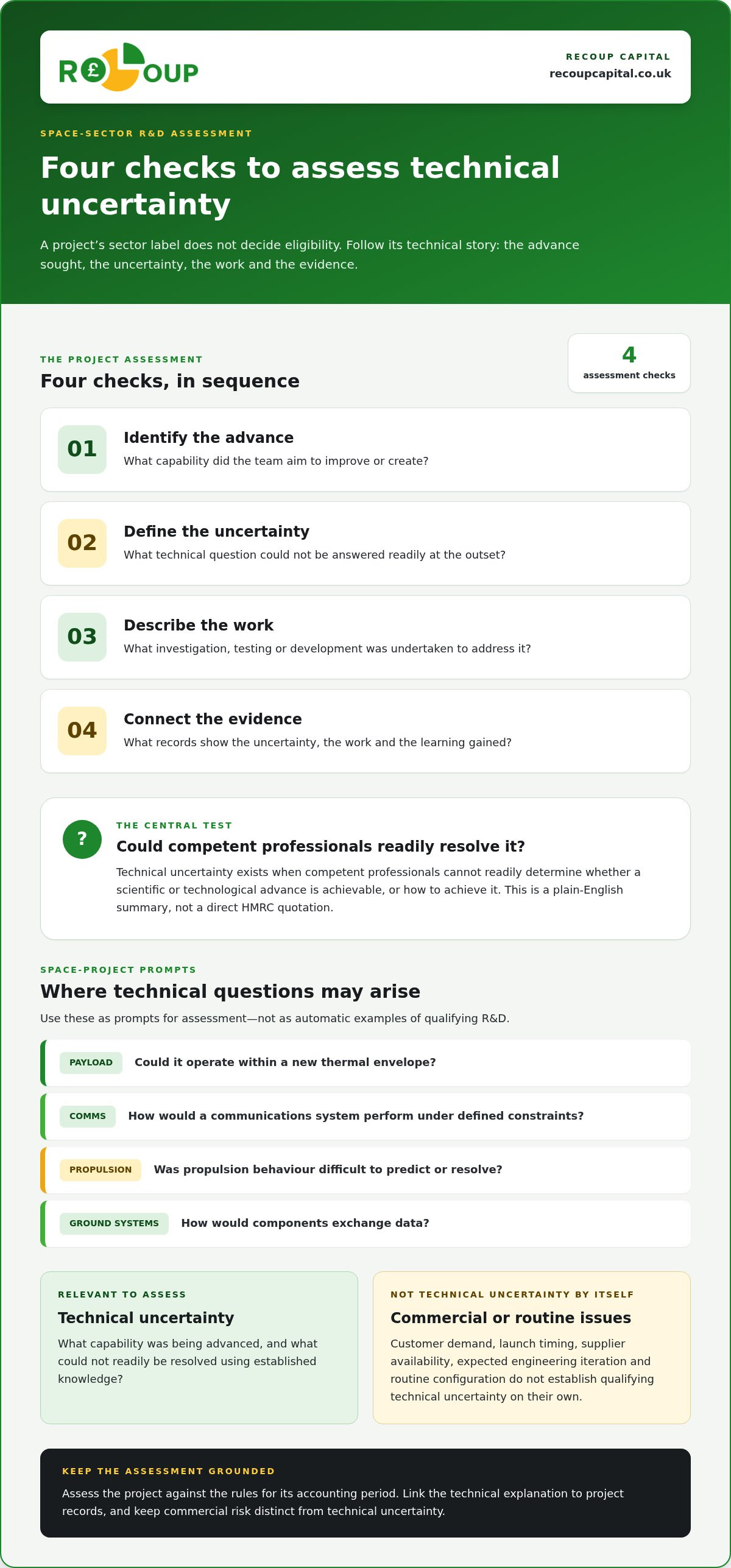
A useful assessment follows the project’s technical story, not just its timeline or budget. For each activity, identify the advance sought, the uncertainty that stood in the way, the work undertaken to address it and the evidence of what happened. This gives technical and finance teams a shared framework for deciding whether a project may fit the rules behind UK space industry R&D tax incentives.
A useful working definition: “Technical uncertainty exists when competent professionals can’t readily determine whether a scientific or technological advance is achievable, or how to achieve it.” Treat this as a plain-English summary, not a direct HMRC quotation. Compare the project with official GOV.UK guidance on R&D tax relief when assessing or preparing a claim.
- Identify the advance. What capability did the team aim to improve or create?
- Define the uncertainty. What technical question couldn’t be answered readily at the outset?
- Describe the work. What investigation, testing or development was undertaken to resolve it?
- Connect the evidence. What records show the uncertainty, the work and the learning gained?
What technical questions might arise in a space project?
Questions could concern a payload’s ability to operate within a new thermal envelope, a communications system’s performance under defined constraints, propulsion behaviour or how ground-system components exchange data. These are prompts for assessment, not automatic examples of qualifying R&D. Ask what capability was being advanced and what competent professionals couldn’t readily resolve using established knowledge.
Expected engineering iteration is not necessarily technical uncertainty. Nor is a delay caused by launch scheduling, supplier availability or customer demand. For example, a team might test a satellite subsystem because its performance under combined operating conditions is not readily predictable. If the work only applies a known design through routine configuration, the technical case may be different. This example is illustrative, not a guarantee that a project qualifies.
How to document the work and its outcomes
Build a timeline linking each project stage to the uncertainty faced, the investigation attempted and the knowledge gained. Include changes in direction: an unsuccessful test or revised design can help explain what the team learned, provided the activities meet the criteria. A project doesn’t have to succeed or be finished for its work to be considered, but failure or incompletion alone doesn’t establish eligibility.
- Gather design records, test results, technical notes and staff accounts where available.
- Record why a test was chosen, what its results showed and what the team did next.
- Use precise project language, distinguishing technical unknowns from commercial or delivery risks.
Clear records help turn complex development into an understandable account. If you’d value support organising a project narrative and its evidence, discuss your R&D claim with Recoup Capital.
SME relief or RDEC: comparing UK space R&D tax routes and costs
Choosing between SME relief and the Research and Development Expenditure Credit (RDEC) depends on the company’s size and the scheme rules that apply, not on whether its work involves satellites, launch systems or another space-sector activity. The routes have different rates and state-aid treatment, so identifying the right route is an important step before estimating potential relief. These are scheme rates, not a guarantee of an individual claim outcome.
How to distinguish SME relief from RDEC
Use the comparison as a starting point, then review the rules for the accounting period being claimed. The SME limits are less than 500 staff, turnover under €100 million and gross assets under €86 million. Assess the company’s circumstances against the applicable criteria. Being a space start-up or working on a particular technology doesn’t determine its route.
| Route | Eligibility route | Stated rate | State-aid status |
|---|---|---|---|
| SME relief | For companies meeting the SME criteria and relevant scheme rules | Up to 33% of qualifying expenditure | State aid |
| RDEC | For large companies and other cases where the relevant rules direct a company to this route | 13% of qualifying expenditure | Not state aid |
Scheme rules can change, and the applicable route depends on the accounting period and company circumstances. Review current HMRC guidance when preparing a claim, particularly if the period crosses a scheme change or the company’s status is not straightforward. This helps avoid relying on a headline rate without confirming which treatment applies.
Which space-project costs may be considered?
Once you’ve identified a route, connect costs to the qualifying R&D activity. Potential categories include staff costs, qualifying subcontractor costs, materials or consumables used up during the work, and certain software. The stated proportions are 100% of eligible staff costs and 65% of qualifying subcontractor costs. These proportions don’t make every payment eligible: costs must relate to qualifying R&D and meet the rules for the relevant period.
For example, a project team can map engineers’ time to the technical work described in its project narrative, then reconcile that record with payroll information. Identify subcontractor expenditure separately, with enough detail to explain its connection to the R&D activity. Technical and finance records should tell the same story.
Capital expenditure is excluded. Land, buildings and fixed assets don’t qualify as R&D revenue costs, even if they support a space development programme. Keep capital purchases distinct from eligible revenue expenditure rather than including equipment investment in the claim.
For an overview of the claim process and records involved, see claiming R&D tax credits. Clear cost classification, paired with a well-supported project explanation, gives a stronger basis for assessing UK space industry R&D tax incentives.
What evidence and preparation can make a space R&D claim clearer?
A well-prepared claim connects the technical work, the people who carried it out and the revenue expenditure associated with it. Organising these strands project by project helps show how costs relate to the R&D being described, rather than relying on broad company-level estimates. It also gives technical and finance teams a shared basis for reviewing the facts before preparing a submission.
Use a practical sequence:
- Identify the projects. Set out each project’s purpose, boundaries, relevant accounting period and the people responsible for its technical work.
- Map the uncertainties. Link each technical unknown to the investigations, tests or decisions made as the work progressed.
- Classify revenue costs. Separate potentially relevant expenditure from costs outside the rules, and keep capital items out.
- Organise the records. Match project evidence to cost information and review the complete picture against current HMRC requirements.
Build a project-level evidence file
Create a concise file for each project rather than treating the company’s entire development programme as one activity. Include a project description and technical objectives, then add records showing what was uncertain, how the team investigated it and what it learned. Design notes, test data, decision logs and technical updates can help show how the work progressed.
Record who contributed to each activity and how their work related to the project. Staff accounts can provide context, but they should sit alongside project records and be consistent with them. Keep two connected strands of evidence: technical material explaining the R&D, and financial records supporting the expenditure. The narrative should show the link between them without assuming that every cost associated with a project qualifies.
Organise eligible expenditure without overstating it
Ask finance and technical leads to review cost categories together. Separate staff, subcontractor, consumable and software records so each can be assessed under the rules for the relevant period. Keep invoices, payroll information, time records and project allocations organised, with explanations of how amounts have been attributed. For growing firms that need structured financial oversight to manage these processes, outsourced accounting advisory providers such as SD Mayer offer controller and CFO services to help maintain robust tracking. If a cost can’t be clearly linked to qualifying work, don’t present that link as established without supporting information.
Capital expenditure, including costs for land, buildings and fixed assets, is excluded from R&D tax credit claims. Keep those amounts separate from revenue expenditure, even if the assets were used during development. An accurate claim is more useful than an inflated one, and careful classification helps the business explain what it has included and why.
Clear records can also help a company plan how tax relief may support future innovation. Consider how recovered funds might fit into wider development plans, without assuming a particular claim outcome.
If you’d like specialist help bringing technical and financial evidence together, book a free 15-minute consultation with no cost or obligation to discuss your R&D claim.
How Recoup Capital supports a UK space-sector R&D tax claim
Space-sector projects can combine complex technical work with long development timelines and detailed cost records. Recoup Capital’s R&D Tax Credit consultancy supports UK-registered limited companies and PLCs from initial technical assessment through claim preparation, submission and liaison with HMRC. The aim is to present a clear, evidence-led account of the project and relevant expenditure, not to assume that every development activity will qualify.
What happens when a company explores a claim?
Start with Recoup Capital’s free eligibility checker and a free 15-minute consultation, with no cost or obligation. These are an opportunity to discuss your company’s circumstances, projects and technical work. Recoup Capital’s specialists assess the relevant activity and expenditure against the rules for the accounting period and identify evidence to support a potential claim.
Technical and financial details are considered together. Project explanations need to show the nature of the work, while cost records need to connect relevant expenditure to that activity. Recoup Capital’s chartered tax accountants and R&D specialists help organise these elements into a coherent submission and manage liaison with HMRC as part of the process.
Eligibility and potential relief depend on the company, project evidence and applicable rules. No individual claim amount or HMRC outcome can be guaranteed. Recoup Capital works on a contingency basis, with no upfront fee and a fee payable only if a claim is successful. The fee is linked to a successful claim, but a robust assessment and accurate supporting information remain essential.
Turn potential relief into capacity for continued innovation
For a space business, a successful claim may provide funds that can go towards future research, technical development or wider growth plans. The amount and timing of relief depend on the specific circumstances, so it’s best viewed as a possible source of business capacity rather than a fixed funding outcome.
Recoup Capital has facilitated over £80 million for UK businesses since inception. The claim processing aim is six to eight weeks, often two to four weeks when accelerated. These are processing aims, not a promise of HMRC acceptance, a particular payment date or a specific recovery. The quality of the supporting information and the claim’s individual circumstances remain important.
Understanding how UK space industry R&D tax incentives may apply can give your team a clearer basis for deciding what to do next. If you’re considering a claim, book a free 15-minute consultation with no cost or obligation to discuss your company’s projects and evidence.
Make your next R&D decision with confidence
Turn your project assessment into a practical decision: is the technical case and supporting record ready for a claim review, or does your team need to organise more evidence first? A methodical assessment can help your business consider UK space industry R&D tax incentives without treating potential relief as an assumed outcome.
Recoup Capital has facilitated over £80 million for UK businesses since inception. Its chartered tax accountants and R&D specialists support claim preparation and HMRC submissions, bringing technical and financial information together for review. Every claim depends on the company’s eligibility, evidence and the rules that apply.
If you’d like to explore your company’s position, book a free, no-obligation 15-minute consultation. It’s an opportunity to discuss your project and possible next steps, with no pressure to proceed. A clear, evidence-led assessment can help your team plan ahead with confidence.
Frequently Asked Questions
Can a UK space company claim R&D tax relief if a project fails?
Yes, work on a failed project may still be considered for R&D tax relief. The result alone doesn’t determine eligibility; the assessment focuses on the qualifying work and evidence. Keep records of the technical objective, test methods, results and decisions taken after an unsuccessful test. These can help explain what the team investigated and learned. Any claim must meet the rules for the relevant accounting period and be supported by evidence.
Can a company claim R&D tax relief for an unfinished space project?
Yes, a space project doesn’t need to be complete before its work can be considered. Identify the activities carried out during the accounting period and link them to the technical uncertainties and relevant costs. For an ongoing development programme, a dated progress record can help distinguish completed investigations from planned work. Being unfinished doesn’t automatically make a project eligible, so assess the work against the applicable rules.
Can a loss-making space company claim R&D tax relief?
Yes, a company may be able to claim while making a loss. Loss-making status alone doesn’t rule out relief, but it doesn’t establish eligibility either. The company must meet the applicable conditions, and the treatment depends on its circumstances and accounting period. Before forecasting whether a claim could reduce tax or result in a payable credit, the finance team should assess the relevant scheme. Don’t assume a particular outcome before reviewing the details.
How far back can a UK company claim R&D tax relief?
Claims may be backdated by up to two financial years. Which periods remain available depends on the applicable rules and the company’s circumstances, so review each accounting period separately rather than assuming all past work can be included. Gather technical records and financial information for the periods under consideration, and take account of the relevant timing requirements when preparing a claim.
Does every satellite or space technology project qualify for R&D tax relief?
No. A satellite project doesn’t qualify simply because it uses advanced technology or operates in the space sector. For example, a software update that improves an established system through routine configuration won’t qualify on the basis of its sector or ambition alone. The assessment needs to examine the advance sought, the technical uncertainties and the work undertaken. Consider each project on its own evidence against the rules for its accounting period.
Are R&D tax credits a grant for space companies?
No, R&D tax relief is a tax incentive, not a grant. Depending on the scheme and company circumstances, it may reduce a corporation tax bill or be available as a tax credit or cash payment. It isn’t a way to fund equipment purchases. Land, buildings, fixed assets and other capital expenditure aren’t eligible costs for an R&D tax credit claim; assess revenue expenditure separately.
Do SME relief and RDEC have the same state-aid status?
No. The SME R&D tax credit scheme is state aid, while RDEC is not state aid. The company’s circumstances and the applicable scheme rules determine which route to assess, not whether it works in the space industry. Establish the company’s size and relevant status for the period before comparing routes. Check the rules for that accounting period, as the schemes aren’t interchangeable.


