

A new fintech app isn’t R&D simply because it’s innovative to customers. The key question is whether your team faced and worked to resolve technological uncertainty that a competent professional couldn’t readily answer. For businesses considering claiming R&D for developing new fintech apps, that distinction can separate a well-supported claim from routine software development that doesn’t meet the criteria.
This guide explains how to assess app development against the R&D criteria, identify technical uncertainties that may qualify, and review the revenue costs that could support a claim. It also explains how to organise evidence around the work undertaken, rather than just the product launch, and prepare a clear, well-supported claim.
Key Takeaways
- Assess whether your app work addressed a technological advance in the wider field, rather than simply introducing a new feature to market.
- Test each project by defining its scope, identifying the intended advance, explaining the uncertainty and recording how your team tried to resolve it.
- When claiming R&D for developing new fintech apps, review the rules for the relevant accounting period and connect potential revenue costs to the qualifying technical work.
- Build a claim file that links objectives, uncertainties, activities, dates and outcomes, using specific explanations from technical leads.
- Recoup Capital’s R&D Tax Credit consultancy helps eligible UK-registered companies organise evidence and prepare a supportable claim.
Could your fintech app development count as R&D? Start with the technical question
A feature can be first to market without advancing technology. A new payment flow, for example, might be commercially distinctive yet built using established methods. For R&D tax relief, the key question is whether the project sought an advance in software or technology and had to tackle an uncertainty that competent professionals could not readily resolve using knowledge available at the time.
That distinction matters in fintech, a broad field covering technology-enabled financial services such as payments, fraud detection and data processing. Whether a company is developing a niche cross-border remittance platform aimed at being the best app to send money to cuba or engineering a mainstream digital wallet, these applications are useful starting points for examining a project, not qualifying activities in themselves. Commercial success, a feature being new to your business, or a large volume of coding doesn’t establish eligibility. The technical challenge does.
What makes fintech app work a technological advance?
Ask what capability or performance improvement the team aimed to achieve, and whether it would advance the wider field rather than simply improve your own product. A new business model, interface or customer journey may be valuable, but it isn’t automatically a technological advance.
Look for the technical objective beneath the feature. Did the team need to process transactions within constraints that existing approaches couldn’t meet? Was secure integration between systems difficult because of unresolved technical limits? In fraud detection or data processing, was the challenge simply applying known methods, or did the team have to develop or adapt technology to overcome a genuine limitation? These questions help frame the evidence, but none guarantees that the work qualifies.
The Financial Technology (Fintech) overview provides wider context for the sector, but eligibility depends on the technical work in your specific project. A product’s place within fintech doesn’t replace that assessment.
Which app development is more likely to be routine?
Routine configuration of an established payments feature, standard implementation of a known interface, or ordinary maintenance will not usually demonstrate technological uncertainty on its own. The same applies to using a familiar platform to deliver a new service when the technical approach is readily understood.
Familiar tools don’t automatically rule out R&D. A team might use established programming languages or cloud services and still face uncertainty about whether a complex integration or processing approach can achieve the required technical outcome. Focus on the specific obstacle, what was already known, and why a competent professional couldn’t readily resolve it. Record the alternatives tested, including approaches that failed.
Qualifying R&D is work that seeks an advance in science or technology by resolving scientific or technological uncertainty that competent professionals can’t readily address. Use this as a practical summary, then check the HMRC guidance and rules relevant to your accounting period. When assessing the case for claiming R&D relief, ground the reasoning in technical progress, not the fintech label, customer demand or development effort alone. That’s the foundation for assessing whether claiming R&D for developing new fintech apps may be appropriate.
How to test a fintech app project against the R&D criteria
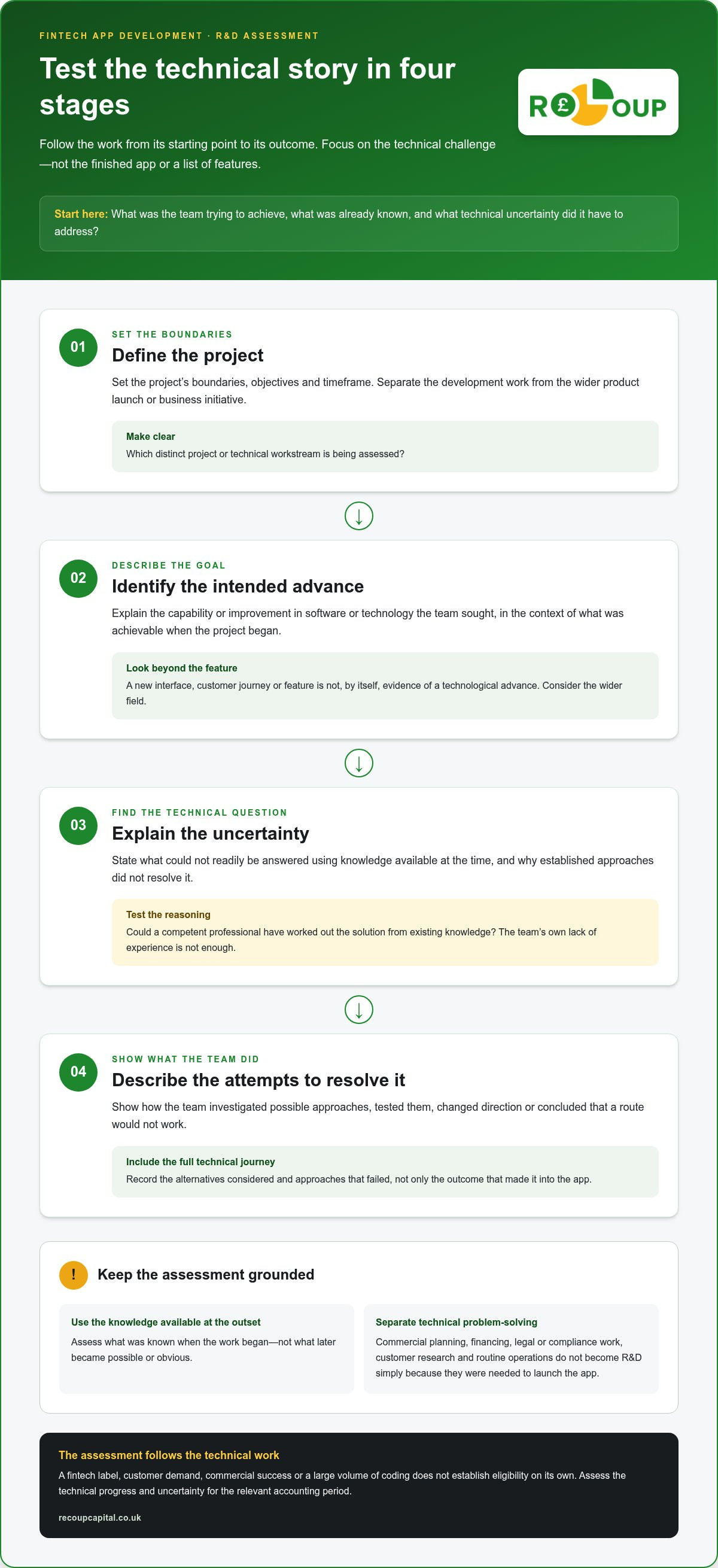
A useful assessment follows the technical story from the project’s starting point to its outcome. Don’t begin with the finished app or a list of features. Set out what the team was trying to achieve, what was already known, where the technical uncertainty lay and what work was done to address it.
Work through these steps for each distinct project or technical workstream:
- Define the project. Set its boundaries, objectives and timeframe. Separate the development work from the wider product launch or business initiative.
- Identify the intended advance. Describe the capability or improvement in software or technology the team sought, in the context of what was achievable at the project’s outset.
- Explain the uncertainty. State the technical question that couldn’t readily be answered using available knowledge, and why established approaches didn’t resolve it.
- Describe the attempts to resolve it. Show how the team investigated possible approaches, tested them, changed direction or concluded that a route wouldn’t work.
Anchor the assessment to knowledge available when the work began, not what later became possible or obvious. The team’s own lack of experience isn’t enough: consider what a competent professional could have worked out from existing knowledge. Also separate technical problem-solving from commercial planning, financing, legal or compliance work, customer research and routine operations. These activities may be part of the wider project, but they don’t become R&D simply because they were necessary to launch the app.
How do you describe uncertainty in a fintech project?
Write down the question the development team couldn’t readily answer at the outset. For instance, could the planned architecture handle a particular technical constraint, or could two systems exchange information reliably using the intended approach? Explain why standard methods or public technical knowledge didn’t provide a ready solution. Pair plain-English context with precise detail from developers, architects or other technical leads, so a reader can understand both the challenge and its significance.
What evidence can show the work to resolve it?
Build a timeline that links technical decisions to the people and activities involved. Relevant records might include design notes, architecture decisions, test results, version histories, issue logs and records of approaches that failed. A document on its own doesn’t guarantee acceptance; the evidence should support a coherent account of the uncertainty and the work undertaken.
- Connect each record to a project objective or technical question.
- Note dates, contributors, the approach tested and what the result showed.
- Explain changes in direction, including why a method was abandoned or refined.
Projects don’t have to succeed or reach completion to be considered. Failed, ongoing or unfinished work may still be claimable if it meets the relevant tests and the claim is supported by evidence of the qualifying activity. Recoup Capital’s guidance on claiming R&D tax credits can help you organise the technical narrative and claim file. Check the requirements that apply to your accounting period before preparing a submission.
Which fintech app costs and relief route should you assess?
Once you’ve identified potentially qualifying technical work, assess the company’s size, accounting period and expenditure together. The applicable relief route and cost rules can depend on the accounting period, so check the rules for the period being claimed before relying on a rate or scheme description.
At a high level, SME relief and large-company RDEC are separate routes. SME relief is state aid; RDEC is not. For accounting periods to which the stated rates apply, SME relief can provide up to 33% of qualifying expenditure, while RDEC is 13% of qualifying expenditure. These rates don’t guarantee a particular claim outcome. The amount depends on qualifying costs, the company’s circumstances and the rules for that period.
How do company size and scheme affect the assessment?
For the stated SME criteria, a company must have less than 500 staff, turnover under €100 million and gross assets under €86 million. Companies outside the SME category may assess the large-company route. Neither route is exclusive to fintech, and company size alone doesn’t establish that a project or its costs qualify. Confirm the company’s status and the relevant scheme requirements for the accounting period before calculating relief.
How should an app team review project expenditure?
Start with a project-level cost review, then connect each potential cost to the qualifying technical work. Don’t include payroll as a whole automatically: map staff activity to the project and identify the time spent on relevant development, testing or problem-solving. Keep this distinct from general management, sales, customer support and other non-qualifying activity.
- Staff costs: identify relevant team members and the proportion of their work attributable to qualifying activity. Eligible staff costs can include 100% of the relevant expenditure, subject to the rules for the accounting period.
- Subcontractor costs: review eligible costs, including the applicable 65% treatment, against the rules for the accounting period and the work performed.
- Materials and consumables: identify items used up in, or directly related to, the qualifying work.
- Software: review software costs only where the applicable rules allow them and the costs relate to the R&D activity.
Keep revenue expenditure separate from capital items. Capital expenditure, including land and buildings, isn’t eligible for R&D tax relief. A clear schedule linking costs to project records makes it easier to explain why each amount is included and exclude unrelated expenditure.
For a wider overview of how relief works, Recoup Capital’s R&D tax credits explained page can help put the cost review in context. Recoup Capital provides R&D Tax Credit claim support to help organise and assess claims. A careful review is especially useful when claiming R&D for developing new fintech apps, where technical activities and expenditure need to be linked clearly.
How to prepare a fintech R&D claim file that is clear and supportable
A clear claim file lets someone follow the technical work from its objective through to the outcome, then see how the costs relate to that work. Build it as you go where possible. Reconstructing decisions from memory later can make it harder to explain why a particular approach was taken or what the team learned.
What should technical and finance teams record?
Bring technical and financial evidence together around each project. Start with a project register that records its objectives, uncertainties, relevant activities, dates, contributors and outcomes. Keep it specific enough to distinguish the work from routine releases or general product development.
Technical leads can contribute project plans, design and architecture notes, test logs, issue records, version histories and notes on decisions or failed approaches. Finance teams can reconcile payroll and other potential revenue expenditure to the relevant project and accounting period. These records should tell the same story: the project description, evidence and cost schedule must align.
- Describe the technical objective: explain the intended advance and the project’s boundaries.
- Connect work to evidence: link technical activities and decisions to dated records and the people involved.
- Reconcile expenditure: map relevant costs to the work and period, separating unrelated activity and capital expenditure.
- Review the narrative: check that project descriptions, cost breakdowns and information submitted to HMRC are consistent.
How can teams reduce avoidable claim weaknesses?
Don’t treat every sprint, feature release or product improvement as R&D by default. Replace broad labels such as “innovative” or “complex” with the specific technical question, why it couldn’t readily be resolved and what the team did in response. Ask technical leads to explain decisions and unsuccessful approaches in direct, accessible language, while retaining the detail needed to make the account precise.
A final review should test both the technical case and the claim administration. Check current HMRC guidance for the accounting period, including any notification, additional information and filing requirements. These requirements can depend on the company’s circumstances and claim history, so verify which apply before filing.
Use this as a final sense-check: can a reader trace each claimed activity to the technical narrative, supporting records and relevant expenditure? If the account relies on unsupported general statements, strengthen it before submission. Careful preparation is especially valuable when claiming R&D for developing new fintech apps, where technical work can sit alongside routine delivery and commercial activity.
For a broader view of the business case, explore why businesses claim R&D tax relief. Recoup Capital’s specialists also support eligible UK-registered companies with organising evidence and preparing R&D Tax Credit claims.
How Recoup Capital supports fintech R&D tax credit claims
Fintech is one possible setting for R&D, but each claim must be built around the company’s own technical work and evidence. Recoup Capital provides R&D Tax Credit consultancy for eligible UK-registered limited companies and PLCs across sectors, helping teams explain their projects clearly and organise the information needed for a claim.
There’s no upfront fee. The work is contingency-based, so a fee is payable only if a claim succeeds. Recoup Capital has facilitated over £80 million for UK businesses since inception. This experience doesn’t promise eligibility, approval or a particular recovery for an individual company.
What happens when a specialist reviews a fintech claim?
The review starts with the company’s project facts. Chartered tax accountants and R&D specialists work with your team to examine the technical narrative, identify potentially qualifying activity and review costs against the requirements for the accounting period. The aim is to make the connection between the technical work, supporting records and claim information clear.
Support includes preparing the claim, submitting it and liaising with HMRC as required. Your developers and technical leads remain central: they know what the team set out to achieve, the difficulties encountered and the approaches tested. Their records and explanations help ground the claim in the work actually undertaken, rather than assumptions based on the app’s market position or commercial success.
Recoup Capital aims to process claims within six to eight weeks, with accelerated claims often taking two to four weeks. These are processing aims, not a guarantee of HMRC approval or a commitment to the timing of HMRC’s decision.
What is the low-friction next step?
If you’re considering claiming R&D for developing new fintech apps, begin with the evidence: outline the technical objective, the uncertainty, the work undertaken and the records available. This gives you a practical basis for assessing whether the project may meet the relevant criteria and what further information the claim file needs.
Recoup Capital offers a free eligibility checker and a free 15-minute consultation, both with no obligation. They provide a straightforward way to discuss your project and understand potential next steps, without an upfront consultancy fee. Any claim assessment depends on your company’s circumstances, the evidence and the rules for the accounting period.
The free eligibility checker and 15-minute consultation are available to help you understand your fintech R&D claim. Clear guidance can help turn a complex technical project into a more organised, supportable claim file.
Turn technical progress into a confident next step
Strong fintech development depends on solving difficult problems. Capturing how your team approaches those challenges as the work unfolds can also make it easier to assess a potential claim, rather than relying on explanations reconstructed long after decisions were made. Make evidence capture part of your development process by keeping technical and finance records aligned as work progresses.
If you’re weighing up claiming R&D for developing new fintech apps, a focused discussion can help clarify what to examine next and how to organise your project information, without committing your business to a claim.
Book your free, no-obligation 15-minute consultation to discuss your project and explore a practical way forward. Your technical work could be a valuable foundation for the next stage of your business growth.
Frequently Asked Questions
Can developing a fintech app qualify for R&D tax relief?
Yes, a fintech project may qualify, but neither its sector nor commercial novelty decides eligibility. The project must seek an advance in science or technology and address uncertainty that competent professionals couldn’t readily resolve. A successful launch doesn’t prove the underlying development qualifies, just as a less visible technical project isn’t automatically excluded. Assess the specific work and accounting period against current HMRC guidance before preparing a claim.
Does a new fintech feature count as R&D?
Not necessarily. A feature can be new to customers yet rely on established technology and standard implementation. The key is whether the development sought a technological advance and faced uncertainty about how to achieve it. Adding a familiar payment option through a routine integration isn’t automatically R&D; any technical obstacle needs a project-specific assessment. Configuration and maintenance alone don’t establish eligibility, so examine the work behind the feature.
Can a failed or unfinished fintech app project be included in an R&D claim?
Yes, qualifying work on a failed, ongoing or unfinished project may be considered. The company still needs evidence that it sought a technological advance, faced relevant uncertainty and undertook work to address it. A project stopping after tests show an approach won’t work doesn’t by itself disqualify the work, but failure alone doesn’t make it eligible either. Keep records of the technical attempts and check the rules for the relevant accounting period.
Which fintech app development costs may qualify for R&D tax relief?
Potential costs include relevant staff costs, 65% of eligible subcontractor costs, materials or consumables, and certain software, subject to the project and accounting-period rules. A developer’s payroll shouldn’t be included wholesale if only part of their time relates to qualifying work. Match cost records to project activity before calculating amounts. Capital expenditure, including land and buildings, isn’t eligible for R&D tax relief.
Can a loss-making fintech company claim R&D tax relief?
Potentially, yes. Making a loss doesn’t by itself prevent a company from claiming, but it doesn’t establish eligibility or guarantee a payable credit. The company must meet the relevant company, project and scheme requirements, and the treatment can depend on its size and accounting period. A loss-making app business should review its technical evidence and financial records together, then check the current rules before estimating any potential benefit.
How long does a fintech R&D tax credit claim take?
Recoup Capital aims to process claims within six to eight weeks, with accelerated claims often taking two to four weeks. This describes the consultancy’s processing timeframe, not a promise about HMRC’s decision or when any payment will arrive. Timing can depend on the claim’s circumstances and the information needed to prepare it. Allow time to gather project records and reconcile costs before submitting a claim.
Do fintech companies need an R&D tax specialist to make a claim?
No, a company may prepare its own claim, but specialist input can help connect the technical explanation with cost evidence and claim requirements. Recoup Capital’s chartered tax accountants and R&D specialists provide consultancy on a contingency basis, with no upfront fee and a fee payable only if a claim succeeds. The free eligibility checker and 15-minute consultation carry no obligation, offering a practical way to discuss a project before deciding what to do next.


