

Understanding how to leverage IP for tax efficiency starts with mapping what your business owns, who developed it and how it earns income. The same intellectual property can raise different tax questions as it moves from development to commercial use. Treating every IP-related cost or income stream alike can obscure which UK tax rules may apply.
It’s understandable if the rules feel difficult to join up. Relief for qualifying research and development (R&D) activity and Patent Box, which concerns profits from qualifying patented inventions, address different stages of the IP lifecycle. Ownership, supporting evidence and claim requirements also matter, so assumptions can create compliance risks.
This guide explains how IP ownership, development and commercialisation connect, and what to investigate before making a tax decision. It covers R&D tax relief, including the separate routes for SMEs and large companies, alongside Patent Box. You’ll also find practical steps for organising evidence around your assets, activities and records, so you can assess potential reliefs against the facts rather than assume eligibility.
How to leverage IP for tax efficiency in practice
Start by linking each asset to three things: the company that owns or controls it, the work done to develop it, and any income it generates. Then assess R&D activity and IP-related income separately. This simple distinction helps you identify which records to gather and which tax rules to investigate.
Key Takeaways
- Map each IP asset by whether your company develops, owns, licenses or earns income from it before considering tax treatment.
- Separate qualifying R&D activity from income that may qualify for Patent Box relief. Owning a patent alone doesn’t establish eligibility.
- To understand how to leverage IP for tax efficiency, build a clear picture of ownership, activity and supporting evidence before deciding which reliefs to investigate.
- Organise commercial, technical, contractual and accounting records so they support the facts behind your tax position.
- Recoup Capital assesses qualifying innovation activity for R&D claims on a contingency basis, with no upfront fee and a fee payable only if a claim succeeds.
How IP can shape tax efficiency across a UK business
Intellectual property (IP) can be a valuable business asset, but not every idea is legally protected or has the same tax treatment. Here, IP means intangible assets created by a business or protected through legal rights. Tax efficiency means identifying relevant reliefs and managing the tax consequences of business decisions in line with the rules.
Consider IP across its lifecycle: creation, ownership, development, protection, commercialisation and income. A company might develop software to solve an operational problem, protect parts of its design, then use it in a product or license it to others. Different facts matter at each stage. Begin by recording what the asset is and how the company uses it.
IP tax planning means aligning an asset’s ownership, the activities that develop or exploit it, and the income it generates with the tax rules that apply. This helps you ask focused questions before deciding whether a particular relief or treatment could be relevant.
Which business assets might count as intellectual property?
Examples include patents, software, designs, processes, brands and know-how. These descriptions do not automatically determine tax treatment. A business name, for example, doesn’t by itself establish entitlement to a particular relief. An asset may have formal legal protection, contractual rights may govern its use, or a business may have practical control over knowledge or a process.
Create an asset register with enough detail to distinguish one asset from another. For each, note who created it, who owns it, who funded its development and which part of the business uses it. Record relevant agreements and ownership changes too. This helps distinguish a protected right from underlying know-how, or a company-owned asset from work created under contract.
Why ownership and commercial use belong in the same discussion
Within a group, one company might fund development, another employ the people doing the work, and a third hold the rights or sell access to customers. Income may arise in yet another entity. This does not automatically make the arrangement inappropriate, but it raises questions about tax treatment, accounting records and whether contracts reflect what happens in practice.
Compare the development agreement, staff records, invoices, IP register and licensing terms. Do they consistently show who contributed, who controls the asset and how it earns income? Transferring IP ownership alone doesn’t guarantee a better tax outcome. Consider the commercial rationale and consequences as well. Keep other tax questions distinct: a property transaction may raise separate stamp duty land tax considerations, covered in stamp duty land tax guidance.
Commercialisation may mean using IP in a product, licensing rights to another party or selling the asset. The UK Patent Box regime is one tax mechanism associated with qualifying patented inventions and income. A patent alone doesn’t establish eligibility. Link each asset to the activity and income involved, then investigate the rules that may apply.
How UK tax reliefs relate to IP development and income
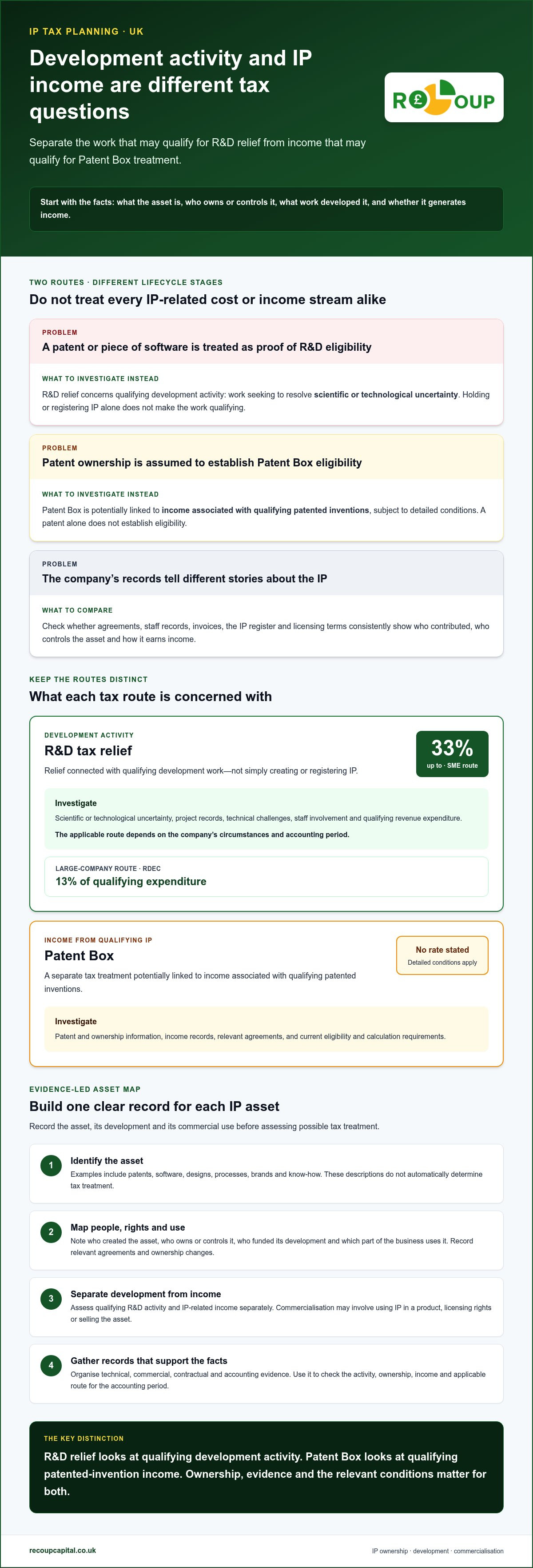
Separate two questions: did the company undertake qualifying R&D, and does it earn income that may qualify for an IP-related tax treatment? The first concerns work to resolve scientific or technological uncertainty. The second concerns income from qualifying intellectual property and the conditions attached to it. A patent alone answers neither question.
SMEs and large companies have separate routes for R&D tax relief. The applicable route depends on the company’s circumstances and accounting period. For SMEs, relief can be up to 33% of qualifying expenditure; the large-company RDEC rate is 13% of qualifying expenditure. Recoup Capital’s R&D tax credits explained resource introduces development-focused relief. R&D relief and Patent Box address different parts of an IP lifecycle.
| Route | Purpose | Activity or income to investigate | Evidence and checks |
|---|---|---|---|
| R&D tax relief | Relief connected with qualifying development activity. | Work seeking to resolve scientific or technological uncertainty, rather than simply creating or registering IP. | Project records, technical challenges, staff involvement and qualifying revenue expenditure. Check the applicable route and rules for the accounting period. |
| Patent Box | A separate tax treatment potentially linked to qualifying IP income. | Income associated with qualifying patented inventions, subject to detailed conditions. | Patent and ownership information, income records, relevant agreements and current eligibility and calculation requirements. |
R&D Tax Credits: focus on qualifying development activity
Holding or registering IP doesn’t make development work qualifying R&D. The key question is what the company did and whether the activity meets the relevant criteria. UK-registered limited companies and PLCs with R&D activity may be eligible, subject to the rules. For the SME route, the company must have fewer than 500 staff, turnover under €100 million and gross assets under €86 million. A project doesn’t have to succeed: failed, ongoing or unfinished work may qualify if the activity and evidence meet the requirements. Only qualifying revenue expenditure is relevant; capital expenditure, including spending on land, buildings or fixed assets, isn’t eligible.
Patent Box and IP income: a separate question to investigate
Patent Box is a distinct route concerning profits from qualifying patented inventions, not a substitute for relief on development activity. Its conditions relate to the IP, the company’s relationship to it and the income involved. The GOV.UK guidance on Patent Box sets out the requirements to investigate. Check the current rules against the facts; ownership alone doesn’t establish qualification.
A company could investigate R&D relief for qualifying development work and separately assess whether income may fall within Patent Box rules. Keep the analyses distinct: evidence supporting a development claim doesn’t automatically establish qualifying IP income, or vice versa. Recoup Capital helps companies assess innovation activity and supporting costs for an R&D claim on a contingency basis, with no upfront fee and a fee payable only if the claim succeeds.
Which IP tax-planning route fits your company’s situation?
Start with what the company actually does with each asset, rather than assuming that IP ownership points to a particular relief. For development, consider whether the activities meet the R&D rules. For income, assess whether profits or other receipts may fall within a separate IP-related tax treatment. Each route has different tests and evidence needs.
The relevant route depends on the company’s activity, ownership, income and the eligibility rules that apply to its circumstances. Use this table to identify what to investigate next, not as confirmation that a claim will qualify.
| What the company does | Question to investigate | Possible next step |
|---|---|---|
| Develops or improves a product, process or software | Was the work aimed at resolving scientific or technological uncertainty, and what activities addressed it? | Review the project facts and supporting records for a possible R&D claim. |
| Owns IP but does not develop it | How was ownership established, and what rights and obligations apply? | Review contracts, acquisition documents and the asset’s use before considering relevant tax treatment. |
| Licenses IP to another party | Who owns the rights, what does the licence permit, and how is income recorded? | Trace licence terms, parties and income; investigate whether the income may meet relevant IP rules. |
| Acquires IP | What was acquired, from whom, and how is the asset used or exploited? | Review the transaction and accounting treatment. Acquiring an asset raises different questions from developing it. |
| Earns income from IP | What is the source of the income, and does it relate to qualifying IP under current rules? | Assess the income and supporting records separately from any development claim. |
| Cannot yet establish the facts | Are ownership, project activities, agreements or income records incomplete? | Not enough information yet. Gather and reconcile the evidence before selecting a route. |
If the company develops or improves a product, process or software
Identify the technical or scientific uncertainty the team faced, what was not readily deducible, and the work undertaken to address it. Then distinguish that work from routine implementation, adapting established methods, commercial launch activity or general business operations. A product can contain innovative IP without every task involved in building or selling it being qualifying R&D. For a project-level view of the claim process, see claiming R&D tax credits.
If the company owns, licenses or earns income from IP
Map legal ownership alongside who funded and carried out development, which entities hold licences, and where income arises. Internal development, acquiring rights and licensing them can raise different questions. Group structures, cross-border arrangements and transactions between connected parties need careful review against the facts and current rules. Don’t assume that a transfer or licence changes the tax result by itself.
To understand how to leverage IP for tax efficiency, follow the evidence before choosing a route. If records don’t show who did the work, who controls the rights or how income is generated, resolve those gaps first. A structured review of the activity and supporting costs can help eligible companies assess whether an R&D claim merits further consideration.
How to build an evidence-led IP tax plan
A practical answer to how to leverage IP for tax efficiency starts with a clear record of what the asset is, how the business uses it and why a particular tax treatment may apply. Use a repeatable workflow to connect commercial decisions with evidence, without assuming a relief is available.
- Map the assets. Create a register of relevant software, designs, patents, processes, brands and know-how. Describe each asset, when it was created or acquired, how it is used, and which products, services or income streams it supports.
- Confirm ownership and control. Record creators, legal owners, development funders and users. Gather employment terms, assignment documents, acquisition records and licences. If different group companies are involved, map each company’s role rather than assuming the group operates as one entity for every purpose.
- Classify the activity. Separate qualifying R&D work from routine implementation, maintenance, commercialisation and general business activity. For each project, identify the work undertaken and the technical or scientific uncertainties addressed. Keep this analysis distinct from any assessment of IP income.
- Collect and organise evidence. File commercial, technical, contractual and accounting records, then link them to the relevant asset or project. This helps show what happened, who was involved, which agreements applied and how expenditure was recorded.
- Review the tax treatment. Check the current rules for the relevant accounting period, the company’s circumstances and the relief being considered. Before submitting or amending a claim, verify HMRC’s latest requirements and deadlines rather than relying on an old checklist.
What to record about each IP asset and project
For each asset, record its description, creators, relevant dates, ownership documents, development costs and commercial use. For R&D projects, keep technical records that explain the starting point, uncertainties, advances sought and work carried out, alongside evidence for potentially qualifying revenue costs. Maintain contracts, licences and group agreements so you can compare their terms with the commercial arrangements in practice.
Keep revenue and capital expenditure distinct in an R&D tax credit assessment. Only qualifying revenue expenditure is relevant; capital expenditure, including spending on land, buildings or fixed assets, must not be included as qualifying R&D expenditure. Accounting descriptions alone may not explain the purpose of a cost, so retain project-level records to support its classification.
How to manage risk without overcomplicating the plan
Avoid transferring IP or restructuring ownership solely on the assumption that it will improve the tax position. Document the commercial rationale for material decisions, including changes to ownership, licences or development responsibilities, and take appropriate advice before putting them into effect. A concise record of the decision, evidence considered and business purpose helps show that the decision was considered.
Review the register at least annually, and sooner if ownership, licensing, project scope or relevant rules change. Recoup Capital helps eligible companies assess innovation activity and supporting costs for an R&D claim. Use Recoup Capital’s free eligibility checker as a no-cost, no-obligation starting point.
How Recoup Capital can help assess R&D tax relief for IP-related work
Not every IP asset or development cost belongs in an R&D tax claim. The key is the activity behind the asset: what technical or scientific uncertainty the company sought to resolve, what work it carried out and whether the relevant costs meet current rules. Recoup Capital’s R&D Tax Credit consultancy helps UK-registered limited companies and PLCs assess qualifying innovation activity and supporting costs. IP ownership alone is not a basis for claiming.
This distinction helps businesses focus their review. A patent, software product or proprietary process may provide useful context, but the claim assessment centres on qualifying development work and evidence. Recoup Capital has facilitated over £80 million for UK businesses since inception. Each company’s position depends on its own activities, records and applicable rules.
What specialist R&D claim support involves
Recoup Capital’s team includes chartered tax accountants and R&D specialists. They assess project activity, consider which costs may qualify, review supporting evidence and help address the requirements for submitting a claim. This connects technical explanations with financial records so the basis for the claim reflects the company’s actual projects.
Preparation matters. A business may need to explain the uncertainty it faced, the work undertaken to address it and how relevant costs relate to that work. Only qualifying revenue expenditure is relevant to R&D tax relief; capital expenditure, including spending on land, buildings or fixed assets, should not be treated as qualifying claim expenditure. Recoup Capital aims to process claims in six to eight weeks, often two to four weeks when accelerated. These are processing aims, not a promise of an individual outcome or HMRC decision.
The consultancy operates on a contingency basis: there are no upfront fees, and a fee is payable only if a claim succeeds. This lets eligible companies explore an assessment without an initial fee, while the claim remains subject to the evidence and applicable rules.
A straightforward next step for eligible companies
If your company is UK-registered and has undertaken work that may involve qualifying R&D, gather a concise outline of the project, the technical challenge, the people involved and the records available. A free eligibility check can help establish whether a fuller review is worth pursuing. It won’t replace a detailed assessment, but it provides a practical starting point for investigating your position.
Understanding how to leverage IP for tax efficiency means matching the right evidence to the right tax question. Recoup Capital’s free eligibility checker and 15-minute consultation carry no cost or obligation. Book a free 15-minute consultation to discuss whether your innovation activity may warrant an R&D claim assessment.
Turn your IP records into a confident next step
Your IP register can do more than catalogue assets. It can help your business make clearer decisions about development, ownership and commercial use as it grows. Identify any gaps that could affect a tax assessment, such as unclear project records, agreements that don’t reflect how work is carried out, or costs that need closer classification.
That’s a practical foundation for deciding how to leverage IP for tax efficiency without relying on assumptions. You don’t need to resolve every question at once. Start with one asset or project, organise the evidence and establish which tax question it raises. Then assess potential opportunities against the facts and keep planning aligned with them.
If your company has undertaken innovation work and you’d like to explore whether it may warrant an R&D claim assessment, take a straightforward next step. Book a free, no-obligation 15-minute consultation to discuss your circumstances and where to focus your review.
Frequently Asked Questions
Can a company claim R&D tax relief for work that creates intellectual property?
Potentially, but creating IP doesn’t automatically make the work eligible. The company must assess whether the project meets the relevant R&D criteria and whether its costs qualify under the rules for the relevant accounting period. The claim concerns qualifying activity and supporting evidence, not simply owning a patent, software or design. Failed, ongoing or unfinished projects may also qualify if the applicable requirements are met and the records support the work undertaken.
Does owning a patent automatically qualify a company for Patent Box?
No. Patent ownership alone doesn’t establish eligibility for Patent Box. The company needs to assess the relevant conditions, the income involved and how the IP relates to its business. For example, if one group company holds a patent while another develops, licenses or exploits the invention, the arrangement and income may need closer review. This is distinct from whether development work qualifies for R&D relief. Check current rules against the company’s facts before reaching a conclusion.
Can a company claim R&D tax relief if its project did not succeed?
A project’s failure doesn’t automatically rule out a claim. The assessment focuses on the work carried out, whether it meets the relevant R&D criteria, and whether costs and evidence qualify. Records showing the technical obstacles investigated and tests performed may help explain the project, even if the intended solution wasn’t achieved. Failed, ongoing or unfinished projects can be considered, but an unsuccessful outcome doesn’t make every project eligible.
Can a loss-making company claim R&D tax relief?
Yes, a loss-making company may still be able to claim, subject to its eligibility, the applicable route and current rules. Being in a loss position doesn’t by itself settle whether a claim is available or what form any relief may take. The company’s circumstances and supporting expenditure need to be assessed before submission; don’t assume a particular payment or outcome.
What R&D costs can be included in an IP-related claim?
Potential cost categories include staff costs, eligible subcontractor costs, materials or consumables, and certain software, subject to the relevant rules. Not every cost in a category is eligible: the company must connect each amount to qualifying R&D activity and check the requirements for its accounting period. Capital expenditure, including land and buildings, isn’t eligible for R&D tax credit claims.
How long does an R&D tax credit claim take to process?
Recoup Capital aims to process claims in six to eight weeks, with accelerated claims often taking two to four weeks. These are processing aims, not a guarantee of an individual result or an HMRC decision. The assessment and submission depend on the company’s project information and cost records, so organising relevant evidence can help the process run efficiently. Clarify gaps in the project history or expenditure before submitting information.
Can an SME and a large company both claim R&D tax relief?
Yes. Eligible SMEs and large companies can both claim R&D tax relief, though they use separate routes and the applicable rules depend on the company’s circumstances and accounting period. For SMEs, the relief rate can be up to 33% of qualifying expenditure. For large companies, the RDEC rate is 13% of qualifying expenditure. Check the current eligibility and scheme rules rather than relying on an older comparison.


