

Software innovation can qualify for UK Patent Box relief when it is protected by a qualifying patent and generates eligible profits. The UK Patent Box for software patents can reduce the effective Corporation Tax rate on qualifying profits to 10%, but eligibility depends on the patent, how the software is sold or licensed, and how the company owns and developed the technology. A software product’s function alone doesn’t settle the question.
That distinction can feel complex: a software invention must meet patentability requirements, while the Patent Box calculation also considers income streams and development costs. This guide explains when software innovation may qualify, how ownership and development affect a claim, and what changes when customers access software through a hosted service. You’ll also see how qualifying profits are identified and how the relief affects the wider Corporation Tax calculation, helping you assess whether your innovation may fit your company’s tax planning.
Key Takeaways
- Separate the question of whether software is patentable from whether its profits can qualify for Patent Box relief.
- Map who owns the patent and who developed the technology, as both can affect eligibility and the calculation.
- Identify whether income comes from software sales, licensing or a hosted service; these routes can be treated differently.
- Understand how qualifying IP profits are isolated from wider trade profits before assessing the potential tax effect.
- Use the article’s worked examples to see how Corporation Tax rates and profit sources shape the calculation.
UK Patent Box tax relief for software companies
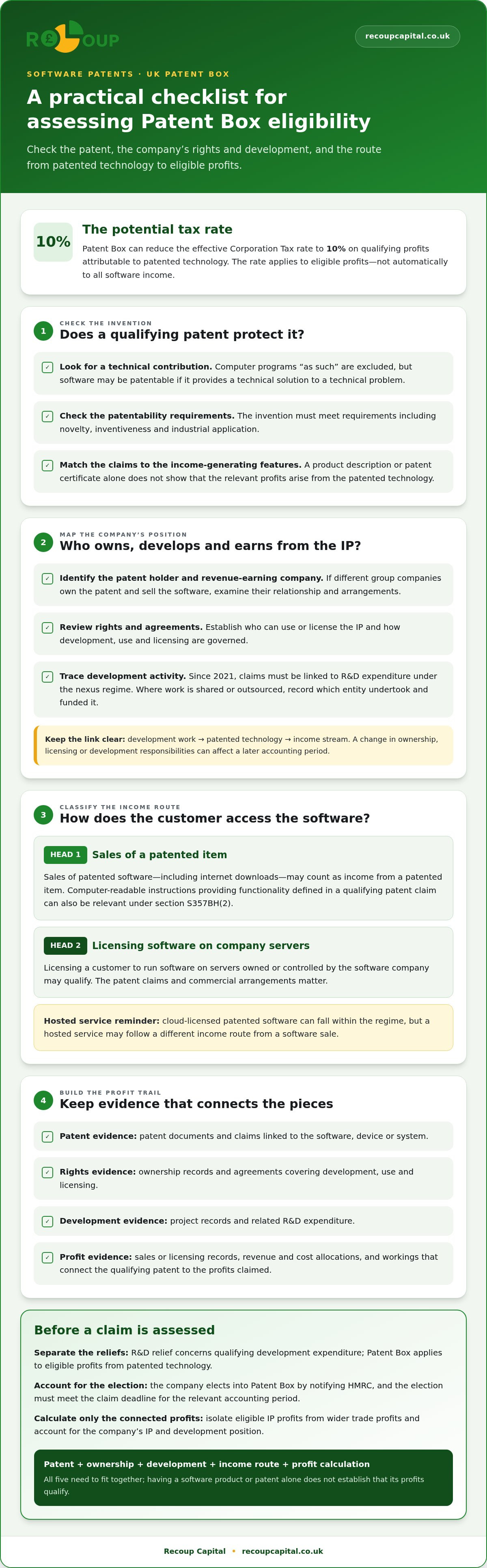
The UK Patent Box lets companies apply a lower Corporation Tax rate to qualifying profits attributable to patented technology. For a patent box for software patents claim, relief depends on eligible income and profits, not simply on having a software product or patent. The calculation must connect the patented innovation to the income earned and account for the company’s intellectual property and development position.
Software isn’t automatically excluded from UK patent protection. The UK Patents Act excludes computer programs “as such”, but an invention may be patentable if it provides a technical solution to a technical problem. It must also meet requirements such as novelty, inventiveness and industrial application. For example, software that improves how a computer system handles data may make a technical contribution; a product description alone can’t establish patentability.
Income may qualify through different routes. Under Head 1, sales of patented software, including internet downloads, can count as income from a patented item. Computer-readable instructions providing functionality defined in a qualifying patent claim can also be relevant under section S357BH(2). Under Head 2, licensing a customer to run software on servers owned or controlled by the software company may qualify. The patent claims and commercial arrangements therefore matter.
Patent Box and R&D tax relief address different parts of innovation. R&D relief concerns qualifying development expenditure, while Patent Box applies to eligible profits from patented technology. Since 2021, claims must link to R&D expenditure under the nexus regime, so expenditure records can affect the proportion of profits eligible for relief. A company elects into the regime by making a Patent Box election to HMRC; the election must meet the claim deadline for the relevant accounting period.
Build supporting evidence around the patent and income calculation. Keep patent details and claims, records showing ownership or rights to use the intellectual property, and evidence of development activity and related R&D expenditure. Retain sales or licensing records, revenue and cost allocations, and workings that connect the qualifying patent to the profits claimed. These records help explain how you arrived at the figure.
Patent costs depend on application complexity, professional support, examination and prosecution work, renewal requirements, and the territories where protection is sought. Patent protection is territorial, so seeking rights outside the UK can involve separate applications and additional maintenance work. These costs are separate from Patent Box calculations, which focus on eligible income, expenditure and profits.
For software companies, the key questions are whether a qualifying patent protects the relevant technology and whether the business can trace eligible profits to it. The UK Patent Box regime also covers patented software licensed through the cloud, although hosted services can follow a different income route. Assessing a patent box for software patents therefore means considering the patent, commercial model and profit calculation together.
IP ownership and development conditions
A patent on a software product doesn’t, by itself, establish which company can claim Patent Box relief. The company’s IP ownership structure, development activity, qualifying profits and wider Corporation Tax position all matter. If one group company owns the patent while another sells the software, the relationship between them needs careful analysis. The income, rights and development history must fit together.
Start by mapping the rights to the patented invention. Identify the patent holder, the company earning revenue, and any agreements governing use or licensing. Then compare those arrangements with the patent claims: do they protect the software functionality generating income, or a different technical feature? A device configured to execute a qualifying computer program can be treated as incorporating a qualifying item under section S357BH(2)(b). A device or system claimed directly can qualify in its own right under section S357BH(2)(a).
Development matters too. Since 2021, UK Patent Box claims must be linked to R&D expenditure under the nexus regime. This means expenditure records help connect the company’s own development work with the patented technology and the profits claimed. Where development is shared across group companies, or outsourced, record which entity undertook and funded each activity. The aim is to establish a clear link between development, the relevant patent and the income stream.
For example, a corporation may own a patent for a computer process while a related business sells applications that use it. The analysis should distinguish the patent owner’s rights from the seller’s commercial activity, then examine agreements and development records. If the patent covers a specific technical process but the applications earn revenue from unrelated functions, you can’t assume the full revenue stream arises from the patented invention. The patent claims must align with the product’s actual features.
Organise evidence around these relationships rather than relying on a single patent certificate. Useful records include:
- Patent documents and claims linked to the software, device or system.
- Ownership records and agreements covering development, use and licensing.
- Project records showing development work and related R&D expenditure.
- Revenue and cost information connecting the patented technology to profits.
Review these records together before calculating the claim. A change in ownership, licensing arrangements or development responsibilities can alter the analysis for a later accounting period. For a software group, trace each relevant patent from its legal owner, through development and commercial use, to the income included in the calculation. This makes the link between IP rights and claimed profits easier to explain and substantiate.
Patent Box feasibility and tax calculations
Feasibility depends on whether a company can connect qualifying patented technology to its profits and supporting records. A granted patent is a starting point, not the calculation itself. The company must identify relevant income, deduct attributable costs and apply the Patent Box rules to the resulting IP profits. A software invention’s commercial success alone doesn’t establish that its profits qualify.
HM Revenue & Customs gives an example applying a 10% tax rate to £500,000 of IP-generated profits. This illustrates the relief on that profit amount, rather than a reduced rate on every pound of the company’s trading income. A separate example shows a £75,000 tax saving where total trade profits are £1,000,000 and £500,000 comes from IP. The amount depends on the qualifying profit calculation.
For a software company, start by matching the patent claims to the product features that generate income. A computer program may contain several inventions or functions, but only profits attributable to qualifying patented technology enter the relevant calculation. Separate revenue from patented functions from revenue generated by unrelated services, support or other products. Use contracts, product records and management accounts to explain the allocation.
Then account for development under the nexus regime. Since 2021, Patent Box claims must link to R&D expenditure. The calculation therefore needs a defensible connection between expenditure on developing the patented invention and the IP profits included. For example, expenditure on a separate computer program shouldn’t be treated as development of the patented invention without evidence linking the work. Keep project and cost records aligned with the patent and accounting period.
Patentability and tax eligibility are separate tests. UK software patent applications are assessed for technical contribution, alongside requirements such as novelty and inventive step. The reason for a patent grant may help explain the protected invention, but it doesn’t replace the profit analysis. A patent claiming a method may also cover a different scope of income from one directed to a computer program.
What are the risks of claiming Patent Box relief for software patents, including HMRC scrutiny? A weak link between patent claims, income, ownership or R&D expenditure can undermine the calculation and lead HMRC to challenge the figures. Keep a clear audit trail showing the method, assumptions and records behind each allocation.
A feasibility review should bring together the granted patent, income streams, cost allocations and nexus evidence before preparing a claim. This helps identify which profits have a supportable connection to the invention and which should remain outside the calculation. The result is a more reasoned estimate of relief, grounded in the company’s actual software activities and accounting records.
Hosted software services and notional royalties
Cloud delivery doesn’t automatically prevent Patent Box relief for patented software. HMRC guidance covers patented software licensed through the cloud, but the service arrangement affects how income is treated. The key distinction is whether a customer obtains the ability to run the program or pays the company to operate it on their behalf. The contract and the service’s actual functionality help establish which model applies.
Where a customer is licensed to run software on servers owned or controlled by the software company, income can qualify under Head 2. The customer receives rights to use the patented program, even though the software runs remotely. For example, a business could access a licensed application through a cloud platform, with the software company hosting the servers. The licence terms and patent claims should support the connection between the payment and patented functionality.
A different analysis applies when the software company operates the patented program for its customer. Under the stated UK rules, that service income doesn’t qualify under Patent Box Heads 1 or 2. It can only be included using a notional royalty. This means identifying a hypothetical payment for the customer’s use of the patented technology, rather than treating the entire service fee as qualifying income.
The distinction turns on what the customer pays to obtain. If the contract grants access rights to run the program, the arrangement may point towards a Head 2 licence. If the provider carries out the work and supplies an outcome, the income may instead arise from operating the software. A cloud dashboard alone doesn’t decide the issue; examine the contractual rights, service obligations and how the customer uses the patented functionality.
To support a notional royalty analysis, assemble evidence that explains the software’s role in delivering the service. Relevant records can include:
- Customer agreements describing access, usage rights and operational responsibilities.
- Technical documents showing which patented functionality the program provides.
- Revenue records separating software access from support or service work.
- Comparable licensing arrangements or internal pricing evidence informing the hypothetical royalty.
Then connect the proposed royalty to the patented contribution, not the full value of the hosted service. For example, a platform may combine patented processing functionality with data storage, customer support and human review. The royalty analysis should isolate the value attributable to the patented program, while the wider Patent Box calculation accounts for relevant costs and development links. This keeps the claimed amount tied to the technology.
Hosted businesses should therefore map each income stream to its commercial substance before calculating relief. A licensing model and a managed service can use similar cloud infrastructure yet produce different Patent Box treatment. Clear contracts, technical evidence and consistent revenue records help explain whether income falls under Head 2 or requires a notional royalty within the UK regime.
Patent Box Corporation Tax rates
UK Patent Box relief applies a 10% effective Corporation Tax rate to qualifying profits from patented technology. HM Revenue & Customs identifies 25% as the current UK Corporation Tax rate in its example. The lower Patent Box rate applies only to the qualifying portion, not automatically to every profit made by a software company.
Consider a company with £1,000,000 of total trade profits, including £500,000 of qualifying IP-generated profits. The remaining £500,000, taxed at 25%, produces £125,000.
That calculation depends on what qualifies. A software invention needs a qualifying patent, and profits must be attributable to the patented technology. A European patent can qualify for UK Patent Box purposes. But patent protection alone doesn’t bring every product or service income stream into the calculation; the patent claims and commercial activity must connect to the profits.
The distinction between patentability and tax treatment matters. In the UK, a software invention may be patentable if it provides a technical solution to a technical problem and meets patent requirements. No single definition of technical effect automatically establishes eligibility. The patent’s scope, how the software is used and the income it generates all affect the relief calculation.
For a practical review, separate the company’s profits into relevant categories before applying the rate:
- Qualifying profits linked to patented technology, calculated for the Patent Box claim.
- Other trading profits, which remain subject to the applicable Corporation Tax rate.
- Income and costs requiring allocation between patented and non-patented activities.
This breakdown also helps show how the regime affects the company’s overall tax position. A business with a granted patent but limited attributable profits may see a different result from one generating substantial income directly from patented software. The amount of eligible profit, not the headline rate alone, drives the value of the relief.
For software businesses, the useful next step is to model qualifying profits alongside the wider Corporation Tax calculation, then test the assumptions against patent scope and income records. Explore corporate finance support to discuss how tax planning can fit into broader business decisions.
Recoup Capital: R&D Tax Credits
Recoup Capital can help businesses assess Patent Box eligibility when software patents, ownership structures or hosted income make the calculation complex. Its Patent Box support can help connect patent rights and development records with the profits under review. For companies also examining how innovation expenditure fits their tax position, R&D Tax Credits may be relevant alongside Patent Box, although the reliefs have different rules.
Consider specialist guidance when you need to review which software income may qualify, how development activity links to a patent, or how the calculation fits your wider Corporation Tax position. A clear analysis can help inform decisions about documenting and claiming relief. For help reviewing your position, contact Recoup Capital or visit recoupcapital.co.uk.
Turn your software innovation into a considered next step
Use your eligibility review to make a clear decision: which patented software income belongs in the calculation, what evidence supports it, and how the claim fits your company’s wider tax planning. A well-organised position can help turn intellectual property into a more strategic business asset. For companies assessing the patent box for software patents, the next step is to bring the patent, development and financial records together for a focused review.
Recoup Capital offers Patent Box support alongside R&D Tax Credits, Capital Allowances and Land Remediation Relief. These reliefs address different business circumstances, so considering them in context can help clarify which opportunities are relevant to your company. A discussion can focus on your software activity and the questions that matter to your calculation, without assuming every income stream qualifies. Contact Recoup Capital about Patent Box to discuss your position and plan your next steps with confidence.
Frequently Asked Questions
Can software innovation qualify for Patent Box in the UK?
Yes, software innovation can qualify when a qualifying patent protects it and eligible profits arise from the patented technology. A program isn’t patentable merely because it performs a useful function: the invention needs a technical contribution and must meet patent requirements. For example, a data-processing innovation may be assessed differently from software that only presents information. AI-related inventions can qualify when their use is inventive and the relevant requirements are met.
What does this mean in principle?
In principle, Patent Box links a tax reduction to profits generated by patented innovation, rather than rewarding software ownership alone. A company needs to connect the relevant intellectual property with its revenue and calculation. For example, if a software business earns money from patented functionality and unrelated support work, it must distinguish those activities. Relief concerns the qualifying profit attributable to the patented technology, not every part of the business’s trading income.
What is the ‘qualifying item’?
A qualifying item is the patented product or technology that underpins eligible Patent Box income. For software, computer-readable instructions that provide functionality defined in a qualifying patent claim can fall within Head 1 under section S357BH(2). A device configured to run that program may also be relevant. The key practical check is whether the patent claims cover the functionality associated with the item and income being included.
Can software patents qualify for the UK Patent Box?
Yes. Software-related patents can qualify, but a product description or software function alone doesn’t establish eligibility. UK patentability excludes computer programs “as such”; an invention may still be patentable if it contributes a technical solution and meets the standard requirements. For example, a technical improvement in how a computer handles data may be assessed differently from a program that simply displays information. Consider both patent protection and eligible profits.
Which UK and European patents qualify for Patent Box relief?
Qualifying UK patents can support Patent Box relief, and patents granted by the European Patent Office can also qualify. The patent must protect the relevant invention, and the company’s income must meet the Patent Box rules. A European patent doesn’t automatically make every related product sale eligible. Relate the patent’s claims to the technology earning income, and consider which company owns or commercially uses the rights.
How is Patent Box profit calculated and what is the effective tax rate?
The calculation identifies profits attributable to qualifying patented technology, then applies the Patent Box rate to the qualifying amount. HM Revenue & Customs gives an example applying 10% to £500,000 of IP-generated profits and identifies 25% as the current UK Corporation Tax rate in its example. These rates apply to different profit portions in the illustration; they aren’t a blanket reduction on all company profits.
What are the UK Patent Box eligibility rules for companies and qualifying development?
Eligibility depends on more than holding a patent. The company’s ownership or rights to the intellectual property, development activity, qualifying income and calculation all affect the claim. Since 2021, claims must link to R&D expenditure under the nexus regime. In practice, maintain records that connect the company’s development work and expenditure to the patented technology, then trace how that technology contributes to the profits included.
How does the UK Patent Box compare with R&D tax relief for software companies?
They address different parts of innovation. R&D tax relief relates to qualifying development expenditure, while Patent Box concerns qualifying profits attributable to patented technology. For instance, a company developing software may assess eligible project expenditure under R&D rules, then separately examine later income connected with a qualifying patent. The tests and calculations differ, so qualifying for one relief doesn’t automatically establish eligibility for the other.


