

The targeted R&D Advance Assurance pilot gives eligible UK SMEs an HMRC view on one project and one area of R&D relief per application. Understanding the HMRC Advanced Assurance pilot means recognising its limits: a company can seek assurance on up to two specific areas, but that does not cover its entire claim. The pilot launched on 18 May 2026.
Targeted assurance is not approval of a full claim. HMRC’s decision applies only to the area considered and the information provided. The company must still claim R&D tax relief through its Company Tax Return and complete the usual claim steps. Full-claim Advance Assurance remains available alongside the pilot, so the right route depends on whether you need guidance on a specific area or on the claim as a whole.
This guide explains which SMEs may qualify, what the pilot covers, what information an application needs, and how targeted assurance differs from full assurance. It also clarifies what a decision does and does not mean for a later R&D tax relief claim.
Key Takeaways
- Each targeted application covers one project and one area of R&D relief; an SME may apply for assurance on up to two areas.
- Prepare details about project eligibility, projected spend and the relevant targeted area. An authorised agent may need a 64-8 form.
- Check the eligibility conditions, including restrictions linked to HMRC enquiries and certain tax avoidance or serious defaulter statuses.
- Targeted assurance addresses only the area HMRC considers, while full claim assurance covers the claim more broadly.
- Assurance is not the R&D tax relief claim itself: the usual claim process still applies.
What information is required to apply for advance assurance?
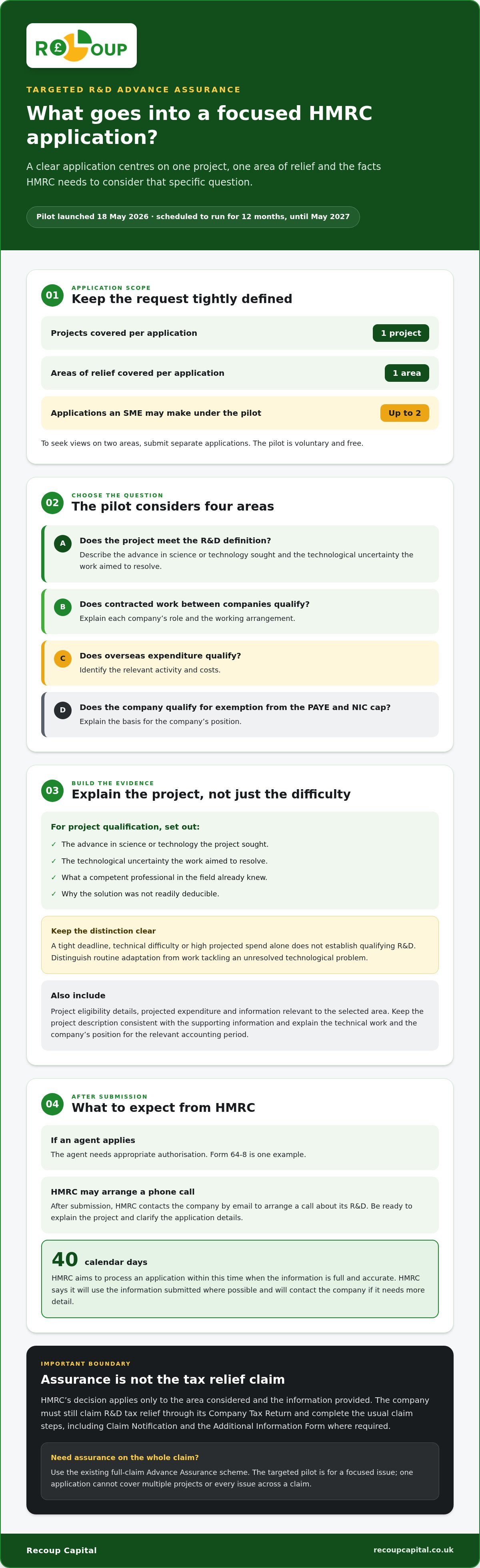
HMRC’s application asks about project eligibility and projected expenditure, as well as the specific area of R&D relief under review. Focus the application on one project and one area. Explain the project clearly so HMRC can understand the technical work and the company’s position for the relevant accounting period.
The pilot covers four areas: whether a project meets the R&D definition, whether work contracted between companies qualifies, whether overseas expenditure qualifies, and whether the company qualifies for exemption from the PAYE and NIC cap. State which area the application addresses and provide relevant information, rather than treating it as a review of every part of the claim.
For project qualification, describe the advance in science or technology sought and the technological uncertainty the work aimed to resolve. Explain what a competent professional in the field already knew and why the solution was not readily deducible. A tight deadline, technical difficulty or high projected spend alone does not establish qualifying R&D. Distinguish routine adaptation from work tackling an unresolved technological problem.
Disclose the facts relevant to the chosen area and keep the project description consistent with the supporting information. For contracted work, explain each company’s role and the working arrangement. For overseas expenditure, identify the relevant activity and costs. For the PAYE and NIC cap, explain the basis for the company’s position. HMRC says it will use the information submitted where possible; if it needs more detail, it will contact the company.
An agent needs appropriate authorisation to apply for a company. Form 64-8 is one example. After submission, HMRC contacts the company by email to arrange a phone call about its R&D. The company should be ready to explain the project and clarify details in the application.
- Each application covers one project and one area.
- An SME can make up to two applications under the pilot.
- HMRC aims to process an application within 40 calendar days when the information is full and accurate.
An SME seeking views on two areas must make separate applications. Applying is voluntary and free. A decision relates only to the information supplied and the specific area considered, so the company must still claim R&D tax relief through its Company Tax Return and complete the usual claim steps.
What is the targeted R&D Advance Assurance pilot?
Launched on 18 May 2026, HMRC’s targeted pilot lets eligible UK SMEs seek an advance view on a defined part of their R&D tax relief position. It is scheduled to run for 12 months, until May 2027. Unlike assurance covering an entire claim, each targeted application addresses one project and one area of relief. An SME can seek views on up to two areas through separate applications.
The pilot is open to SMEs planning to claim R&D relief, including companies that have claimed before. This differs from the existing Advance Assurance scheme, which was restricted to companies without a previous R&D claim. A company seeking assurance on its entire claim must use the existing scheme, not the targeted pilot. The routes serve different needs: focused consideration of a particular issue or broader assurance on the claim.
The targeted route can consider whether a project meets the tax definition of R&D, whether contracted work qualifies, whether overseas expenditure qualifies, and whether the company qualifies for exemption from the PAYE and NIC cap. These questions can involve technical work, company arrangements or costs. For example, project uncertainty concerns whether the work seeks an advance in science or technology, assessed against the knowledge of a competent professional.
Assurance is not an R&D tax relief claim. Applying for or receiving a decision does not itself claim relief or secure the full amount claimed. The company must still submit its tax relief claim through its Company Tax Return and complete the usual steps, including Claim Notification and the Additional Information Form where required. It should also keep evidence and track project eligibility throughout the claim lifecycle.
This limit matters for complex claims involving multiple projects. One application cannot resolve several projects or every issue across a claim, and HMRC can still enquire into parts not covered by its decision. Targeted assurance may address only some of the risk where projects involve different technical uncertainties, contracted arrangements or expenditure categories. Keep the area considered distinct from the rest of the claim records.
If HMRC refuses assurance, the company cannot appeal the decision or apply again for assurance. However, refusal does not prevent it from making an R&D tax relief claim. HMRC gives a yes-or-no decision with an explanation, rather than a formal route for challenging its conclusions. The claim and supporting evidence remain separate from the assurance application.
SME eligibility for targeted advance assurance
Targeted assurance is available to UK SMEs planning to claim R&D tax relief, subject to exclusions and the question submitted. The existing scheme has different eligibility rules, so the route depends on whether the company seeks a focused view or assurance on its whole claim.
SME and scheme eligibility
Unlike the existing scheme’s first-time claimant restriction, the targeted pilot includes SMEs that have claimed R&D relief before. This is relevant to established claimants seeking clarity on a specific area rather than their whole claim.
Under the existing scheme, an applicant company must have turnover under £2m and fewer than 50 employees. It must not have made an R&D tax relief claim already. For a group company, no linked company can previously have made an SME R&D claim.
The targeted route has separate exclusions. A company cannot apply while it has an open HMRC enquiry. It is also ineligible if it, or a connected person, has entered into a disclosable Tax Avoidance Scheme or been categorised as a Corporate Serious Defaulter. These restrictions can rule out the targeted route even if the business is an SME.
Pilot scope and eligible questions
The pilot covers four defined questions, not every issue in an R&D claim. It can consider whether a project qualifies as R&D, whether contracted work qualifies, whether overseas expenditure qualifies, or whether the company qualifies for exemption from the PAYE and NIC cap.
This focused scope helps an SME choose a question where uncertainty centres on one area. For example, a company working through an agency or contractor can seek a view on whether the contracted arrangement qualifies. The relevant issue is the work and contractual arrangement, not the label “agency development”.
For project eligibility, the work must seek an advance in science or technology and resolve technological uncertainty, assessed against what a competent professional already knows. A difficult project or tight deadline alone does not establish an advance. Identifying the precise area helps keep the application focused.
Availability across the UK
The HMRC pilot is available to eligible SMEs throughout the UK, including Scotland, Wales and Northern Ireland. A company’s location within the UK does not change the targeted areas the pilot considers.
Eligibility depends on the company meeting the SME condition and the application concerning an area covered by the pilot. A business anywhere in the UK can seek assurance on a relevant R&D question, including overseas expenditure or contracted work. Its project must still meet the applicable R&D criteria.
Geography does not broaden the decision: HMRC considers only the specific area and information submitted. An SME operating across the UK should identify the company and project in question, then frame its application around one eligible area. Assurance on one project does not settle separate projects or the rest of a tax relief claim.
Purpose of HMRC’s targeted R&D Advance Assurance pilot
HMRC designed the pilot to test targeted assurance and gather feedback for a future live system. Its narrow scope lets an SME seek a view on selected aspects of an R&D claim.
Pilot purpose and scope
The pilot is intended to help HMRC learn how a targeted assurance scheme should work in practice. It launched on 18 May 2026 and is scheduled to run for 12 months, until May 2027.
For an SME, the purpose is focused clarity, not a guarantee that the full claim will succeed. HMRC considers the specific area and information submitted. This distinction matters when a company has several projects or uncertainties: a decision on one issue does not resolve every aspect of its R&D position.
The scheme is voluntary and free. The number of applications accepted will initially be limited, making the pilot a test of how HMRC can handle demand and applicant needs. Its findings are intended to help shape a future live system, not establish assurance for every part of every claim.
How the pilot works
An eligible SME submits an application focused on one project and one area. HMRC considers the information provided and gives a yes-or-no outcome with an explanation. If the details are insufficient to reach a decision, HMRC contacts the company for more information.
HMRC aims to process a complete and accurate application within 40 calendar days. After submission, it contacts the company by email to arrange a phone call about its R&D. That discussion can help clarify the project or the particular issue under consideration.
The assurance outcome is not an R&D tax relief claim. The company must still submit its claim through the tax return and complete the usual steps, including Claim Notification and the Additional Information Form where required. It should continue keeping evidence and monitoring project eligibility throughout the claim lifecycle.
Targeted assurance can focus attention on an area of uncertainty, such as whether contracted work qualifies or overseas expenditure is eligible. However, HMRC can still open an enquiry into parts of a claim not covered by the decision. A complex claim involving several projects may therefore retain risks outside the selected area.
The full-claim Advance Assurance service remains available alongside the targeted pilot. A company seeking assurance on its entire R&D claim uses that existing route, rather than treating targeted assurance as a substitute. The pilot’s defined scope lets HMRC test a more specific approach, while the company remains responsible for the wider claim and its supporting records.
How the pilot differs from full advance assurance
The key difference is coverage: targeted Advance Assurance considers a defined issue, while full-claim assurance considers the company’s R&D claim more broadly. That distinction helps a company choose the route that fits its need for greater certainty about its R&D position.
Under the pilot, each application relates to one project and one area of relief. An SME can make up to two applications, allowing it to seek views on two distinct areas, but not one decision covering its entire claim. HMRC’s decision applies only to the information submitted and area considered. It does not guarantee that the full claim qualifies.
By contrast, full claim advance assurance is the route for a company seeking assurance on its entire R&D claim. The existing scheme remains available alongside the pilot. Its eligibility rules differ: the company must not have claimed R&D relief previously, must have turnover under £2m and fewer than 50 employees. Group links also matter, since no linked company can previously have made an SME R&D claim.
The distinction comes down to what each route covers:
- Targeted pilot: one project and one area per application, with up to two applications available to an SME.
- Full claim assurance: assurance sought on the company’s entire R&D claim through the existing scheme.
- Previous claim history: the targeted pilot is open to SMEs that have claimed before; the existing scheme is for companies without a previous claim.
- Claim period: a company that has applied for full claim assurance for the same period cannot also apply for targeted assurance.
Scope is especially important for a business with several projects. For example, assurance on whether contracted work qualifies does not settle whether another project meets the R&D definition. HMRC can still enquire into parts of the claim outside the decision, so the company needs evidence for all claimed work, including areas not submitted for assurance.
Advance Assurance applies to a company’s first three R&D tax relief claims. Neither route replaces the normal claim process: the company must still submit its tax relief claim through its Company Tax Return and complete the required steps. Previous claim experience may help a business identify where it needs guidance, but does not expand the pilot’s scope.
Choose the targeted route when a specific project issue needs consideration; use full claim assurance when seeking a view on the whole claim and meeting its eligibility conditions. For support with preparing an R&D claim, explore R&D tax credit claim support.
Recoup Capital: R&D Tax Credits
Recoup Capital supports UK companies with R&D Tax Credits, helping them assess innovation activity and prepare claims. Turn to the team when you are evaluating whether project work may qualify, organising technical evidence or preparing the claim that follows an assurance decision.
HMRC’s targeted assurance considers a defined area; it does not replace the Company Tax Return claim or its supporting process. Keeping project records aligned with the work undertaken can help explain the technical advance, uncertainties and expenditure included. Recoup Capital guides companies through the R&D tax relief process, helping them consider the outcome alongside wider business planning.
For support with an R&D tax credit claim, contact Recoup Capital to discuss your company’s position.
Put your R&D position to work
Understanding the HMRC Advanced Assurance pilot can help you decide what to do next: organise evidence of your innovation work and consider how it supports wider business plans. Treat that preparation as a way to make clearer decisions, not simply as a response to an HMRC process.
Recoup Capital supports companies exploring R&D Tax Credits, alongside Capital Allowances and Land Remediation Relief. A conversation can connect the technical story of your projects with the financial opportunities available to your business, helping you consider how potential relief could support future growth.
If you’re ready to discuss your company’s R&D claim and next steps, contact Recoup Capital to discuss your claim. A considered approach can help turn innovation activity into a stronger foundation for what comes next.
Frequently Asked Questions
Does advance assurance guarantee my claim will be accepted?
No. Assurance gives HMRC’s view on the specific issue and information it considered, not automatic acceptance of the full R&D claim. For example, if the project description submitted differs from the work ultimately claimed, the decision may not cover that difference. Keep project records and the claim narrative aligned, and remember that HMRC can examine claim aspects outside the assurance decision.
How does this differ from full advance assurance?
Targeted assurance considers a specific project issue; full-claim assurance is for a company seeking a view on its entire R&D claim. The existing scheme has separate eligibility criteria, including a first-time claimant condition. When choosing between routes, consider the scope of the uncertainty and whether you need a focused answer or broader consideration of the claim.
R&D Advance Assurance: clarity or complexity?
Targeted assurance can clarify a defined question, but it does not remove complexity from the rest of a claim. For example, a decision about overseas expenditure does not resolve whether a separate project qualifies as R&D. Map each project, technical issue and cost category before deciding what assurance could clarify, then retain evidence for anything outside the application.
What can HMRC provide assurance on?
HMRC can consider whether a project meets the R&D definition, whether contracted work qualifies, whether overseas expenditure qualifies, and whether a company qualifies for exemption from the PAYE and NIC cap. Clearly identify the question in the application. For example, if the concern is work contracted to another business, focus on that arrangement rather than asking HMRC to review unrelated costs at the same time.
What does this mean for the R&D tax advisory market?
The pilot is designed to gather user feedback and inform how a future live system might work. For advisers, this makes it important to frame a precise question and explain the supporting technical evidence. It also highlights that assurance advice and claim preparation are distinct tasks: companies still need a coherent claim and records supporting the work and expenditure included.
What is the HMRC Advanced Assurance pilot?
It is HMRC’s voluntary pilot for eligible SMEs seeking an advance view on selected R&D tax relief questions. Launched on 18 May 2026, it is scheduled to run until May 2027. Its targeted design means the outcome concerns the particular issue examined, rather than replacing the company’s claim process. The pilot is also intended to help HMRC gather feedback for a future system.
Who is eligible to apply for HMRC Advanced Assurance?
UK SMEs planning to claim R&D tax relief may apply, including businesses that have claimed before, subject to exclusions. A company cannot apply while it has an open HMRC enquiry, or if it or a connected person has entered into a disclosable Tax Avoidance Scheme or been categorised as a Corporate Serious Defaulter. Eligibility depends on both SME status and the company’s circumstances.
Which tax reliefs or schemes does the pilot cover?
The pilot concerns UK R&D tax relief, not a general review of a company’s tax incentives. Its targeted questions cover project qualification, contracted work, overseas expenditure and exemption from the PAYE and NIC cap. It does not provide assurance on separate reliefs such as Capital Allowances, Land Remediation Relief or Patent Box. Keep these incentives distinct when assessing the wider tax position.


