

The fee that seems safest upfront may not give you the clearest picture of the final cost. A fixed fee is agreed in advance; a success fee is linked to the R&D benefit, while a hybrid combines the two. Choosing a fixed fee versus a success fee for an R&D adviser is about more than the headline rate: it also affects cost certainty and incentives.
It’s reasonable to want a clear view of what you’ll pay and what the fee depends on. With a fixed fee, the agreed amount defines your cost; with a success fee, the charge varies with the claim outcome. A hybrid can balance these approaches, but the agreement’s terms matter.
This comparison explains how each model works, the potential trade-offs and what to check in the engagement terms. It also offers a practical guide to choosing a fee structure based on your claim, upfront-cost preferences and the support you need.
Key Takeaways
- Compare the total cost, not just the headline percentage or fee: the calculation basis and included work can change what you pay.
- A fixed fee gives you cost certainty, while a success-based fee links the adviser’s charge to the claim benefit.
- Understand how the fee model may influence an adviser’s incentives, including how any percentage is calculated.
- A hybrid arrangement can combine an agreed fee with a performance element; its value depends on how clearly each part is defined.
- Use the decision guide to weigh your claim’s complexity, budget preferences and need for support before choosing an arrangement.
Success-based percentage fees
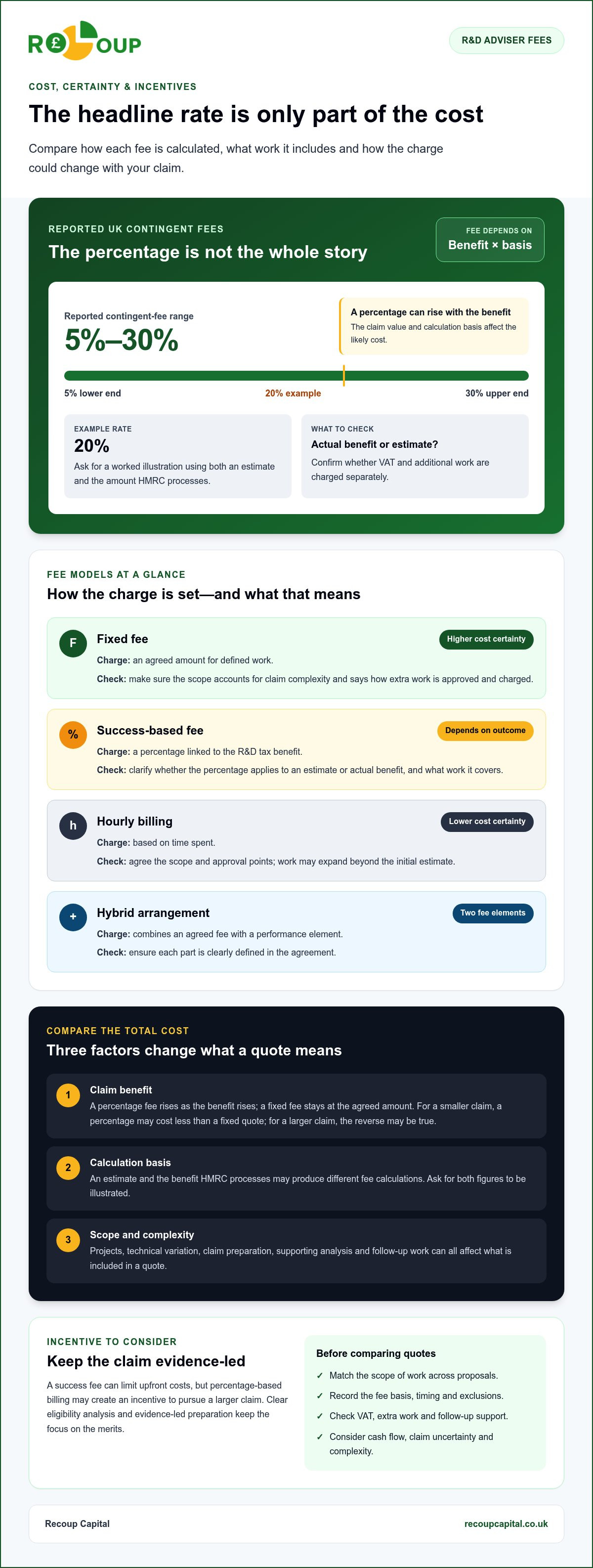
A success-based fee links the consultant’s charge to the R&D tax benefit, rather than setting the whole fee in advance. UK market rates vary: reported contingent fees range from 5% to 30% of the benefit. The percentage alone doesn’t show the likely cost; the claim value and the calculation basis matter too.
How do fixed-fee and success-fee R&D adviser costs compare for different claim sizes? A percentage fee rises as the benefit rises, while a fixed fee stays at the agreed amount. For a smaller claim, a percentage fee may cost less than a fixed quote; for a larger claim, the reverse may be true.
How do success-fee R&D tax advisers charge in the UK? They commonly calculate their fee as a percentage of the tax benefit. The agreement should specify whether that percentage applies to the actual benefit or an estimate, and whether VAT or additional work is charged separately.
For example, a 20% fee based on an estimate can diverge from one calculated on the amount HMRC processes. Ask for a worked illustration using both figures. That simple step shows how a change to the claim outcome affects the fee, without relying on the headline percentage alone.
Success fees link payment to the benefit and may limit upfront costs. However, percentage-based billing can create an incentive to pursue a larger claim, even where a cautious interpretation better fits the evidence. An asset-based fee has a similar tension: the charge rises with the value assessed. Clear eligibility analysis and evidence-led claim preparation keep the focus on the merits, not fee growth.
Compare fee structures by cost certainty, timing and how complexity affects the work. Hourly billing adds another consideration: the total depends on time spent, so scope and approval points matter. Fixed fees are agreed in advance; success-based fees vary with the benefit. Each model may suit a different budget and working preference.
| Fee option | How the charge is set | Cost certainty | Consideration |
|---|---|---|---|
| Fixed fee | Agreed amount | Higher | Scope must account for claim complexity |
| Hourly | Time spent | Lower | Work may expand beyond the initial estimate |
| Success-based | Percentage of benefit | Depends on outcome | Confirm the calculation basis |
Compare the likely claim benefit with the fixed-cost quote, then consider cash flow and complexity. If the claim is uncertain, check how the agreement treats a reduced or delayed benefit; if the scope is predictable, cost certainty may matter more.
Why not just choose the cheapest R&D tax credit adviser?
The lowest headline charge may exclude work included in another adviser’s quote. With a success-fee arrangement, the charge can rise with the claim benefit, so understand how it is calculated and what it covers before comparing quotes.
Transparent and predictable costs
Transparency means knowing how the adviser calculates the charge and what work it covers. A fixed quote sets the cost in advance, while a percentage-based fee depends on the benefit used in its calculation. For a fair comparison, set each quote against the same scope: claim preparation, supporting analysis and follow-up work. This makes differences easier to spot than comparing headline charges alone.
Upfront disclosures and extra costs
Before work begins, get the fee basis, included tasks and possible extra charges in writing. For example, an initial claim-preparation fee might not cover later correspondence or additional project analysis. A success-fee agreement should also explain whether its percentage applies to the actual benefit or an estimate. These details show how the final charge could change, unlike a fixed quote with a clearly defined scope.
Limitations of a 5% success fee
A 5% success fee can look modest, but the charge still grows with the claim benefit. Its total cost therefore depends on the value used in the calculation, not the percentage in isolation. It may suit a business seeking to limit upfront spending, yet a larger claim can make the resulting charge substantial. Compare it with a fixed quote covering equivalent work before deciding.
Ways to reduce advisory costs
Organising project records before the adviser starts can reduce avoidable work. Prepare a clear description of the technical uncertainty, the work undertaken and the people involved. This makes the claim’s complexity easier to assess. Agree the scope and approval points in writing, then provide requested materials in a structured format. These steps can reduce duplicated enquiries and keep the engagement focused.
R&D tax advice costs depend on claim complexity, the number of projects and the services included. A useful comparison records each proposal’s charge basis, scope, timing and exclusions. If one quote includes claim preparation but another also covers follow-up support, they aren’t like-for-like. Compare equivalent work first, then weigh upfront certainty against a charge linked to the claim outcome.
Fixed-fee pricing
A fixed fee sets an agreed charge for defined work, helping a business plan around a known cost. Its value depends on how clearly the contract describes the work and handles changes in scope.
Fixed-fee budget certainty
Once agreed, a fixed fee is easier to budget for than hourly billing, where the charge depends on time spent. It also differs from contingency pricing, which varies with the claim benefit. Certainty depends on a precise scope: list the projects, outputs and follow-up work included, then record how additional work will be approved and charged.
Typical UK fixed fees
UK fixed fees depend on claim complexity and project count, rather than a single standard amount. Smaller claims may involve a narrower scope; multiple or technically varied projects can require more analysis and evidence. An adviser’s quote is case-specific and follows a review of the work involved. Compare proposals by scope and included support, not by the fee alone.
For a useful comparison, prepare the same summary for each quote: projects involved, available records, expected claim work and any support needed after submission. This shows whether one fee covers more stages than another. A low fixed quote may cover preparation only, while a broader engagement may include additional review. The contract should define those boundaries in plain language.
Fixed pricing can work well when the scope can be defined in advance. It also makes it important to agree what happens if the claim changes or new information emerges. Before signing, identify how extra work will be approved, the basis for any additional charge and whether the adviser needs approval first. This reduces surprises without assuming every claim will follow the same path.
Success-fee pricing works differently: the charge is linked to the benefit, so the final amount varies with the claim outcome. This can reduce upfront spending, but it offers less certainty than a fixed agreement. Hourly billing, by contrast, tracks time spent. Each model has drawbacks, so compare how the contract allocates the cost of unexpected work.
Fixed fees can also suit a defined HMRC enquiry-support task when the adviser can scope the work against a known set of documents. Enquiry support and claim preparation are different scopes, however. Set them out separately in the agreement, with clear deliverables and a process for extending the work. Choose the model that fits your budget, claim complexity and preferred level of support.
Consultant incentives and conflicts of interest
Fee models can affect how a consultant is paid to prepare and support an R&D claim. Changes to UK R&D relief rules and HMRC compliance checks have increased attention to evidence and claim defence.
HMRC opened compliance checks on 17% of UK R&D tax claims in 2023-24; its CEO told Parliament the share is over 20%.
R&D tax consulting fee benchmarks
A useful benchmark compares the work covered, not just the quoted charge. List claim preparation, technical review, submission support and any work to defend a claim, then compare each proposal against that list. The Professional Conduct in Relation to Taxation guidance, known as PCRT, is relevant to the conduct of UK tax advisers. These criteria help distinguish a narrow, low-cost service from broader support.
UK R&D tax consultancy fee models
UK consultants may charge a fixed fee, by time spent or as a percentage of the tax benefit. Each model allocates uncertainty differently: an agreed fee defines the charge for scoped work, hourly billing tracks time, and a success fee varies with the outcome. A hybrid can combine an agreed amount with a performance element. Compare the same deliverables across models before weighing their incentives.
Percentage-based fees can create a conflict if the consultant benefits from increasing the claim value. The amount claimed should follow the evidence and eligibility criteria, not the fee calculation. Ask how the consultant handles uncertain costs, excluded projects or a reduced claim. A written explanation of the calculation helps show whether the adviser’s financial interest could conflict with a cautious, evidence-led approach.
Automation can organise records and flag missing information, but it cannot replace judgement about a project’s technical uncertainty. A human-led review can connect company documents to the work undertaken and explain how that work supports a claim. For example, software may sort project records while a specialist assesses whether they show relevant development activity. A clear division of tasks helps you understand what the fee covers.
HMRC’s increased scrutiny makes it important to distinguish between preparing and defending a claim. A proposal may cover the initial submission but not later correspondence or an enquiry. Ask for each stage to be documented separately, including who responds and how additional work is approved. This clarifies potential costs if HMRC requests further evidence, without assuming every claim will face a compliance check.
Referral arrangements can also affect incentives: UK R&D tax advisers may share 10% to 30% of their fee with a referring accountant or introducer. Ask whether a referral payment applies and how it relates to the service received. Then compare the adviser’s role, the evidence review and any ongoing support. A transparent explanation makes it easier to assess the commercial relationship alongside the claim work.
Hybrid fee models
A hybrid combines an agreed fee with a performance-based element linked to the tax relief achieved. It can divide payment between defined work and the claim outcome, but the contract must explain how each part is calculated.
For example, an agreement could set a fixed charge for reviewing project records and preparing the tax credit claim, then add a performance fee linked to the resulting benefit. This separates payment for completed work from payment tied to the outcome. The business needs to understand both calculations, rather than judging the arrangement by a single headline figure.
The fixed element can make part of the cost predictable; the performance element can make the final charge vary with the benefit. Compared with an entirely success-based arrangement, a hybrid pays for some work regardless of the result. Compared with an entirely fixed fee, part of the adviser’s payment remains linked to the outcome. This may suit a business seeking to share risk without making every charge contingent.
Definitions matter. The agreement should state what counts as the “benefit”, when the performance element becomes payable and how adjustments affect its calculation. For instance, if HMRC processes a claim for a different amount than initially estimated, the contract should clarify which figure applies. It should also specify whether the agreed fee covers claim preparation only or includes further work.
For complex projects, the fixed portion might cover an initial evidence review, while the variable portion reflects an agreed claim outcome. This structure can account for work required before a tax credit is known. However, a performance element can still influence incentives. The consultant should base the claim on documented eligibility and evidence, not the fee formula or a target benefit.
Before agreeing, compare each model against the same engagement scope. Write down the deliverables, payment triggers, calculation basis, exclusions and process for approving additional work. Then consider how the structure applies if a claim is reduced, delayed or subject to HMRC scrutiny. These practical scenarios reveal whether the hybrid genuinely shares risk or simply adds a variable charge to a fixed one.
The right balance depends on your cash-flow preferences, project complexity and appetite for costs linked to the outcome. A clearly scoped fixed element may suit defined preparation work; a performance component may align payment with the claim benefit. Neither replaces careful evidence. The contract should preserve independent judgement, especially when project eligibility requires detailed technical review.
To map the work and payment stages clearly, explore the steps involved in preparing an R&D claim before comparing engagement structures.
Recoup Capital: R&D Tax Credits
Recoup Capital helps limited companies assess and prepare R&D tax credit claims, making it a relevant next step if your business has undertaken innovative work and needs specialist guidance. Its team can help you understand the claim process and how potential tax relief could support future investment.
If you’re comparing adviser fee structures, bring the same project details and questions to your discussion: the work undertaken, available records and support you need. This gives you a clearer basis for understanding the proposed scope and how it fits your business.
Recoup Capital also works with Capital Allowances, Land Remediation Relief and Patent Box for businesses exploring other eligible tax incentives. Contact Recoup Capital to discuss your R&D tax credit requirements.
Make your next decision with clarity
Your adviser’s fee structure is part of a wider business decision: how to resource an R&D claim while protecting time, cash flow and confidence in the evidence. Treat the agreement as a working document. Before proceeding, make sure its scope, payment triggers and responsibilities match how your team will manage the claim.
The fixed-fee versus success-fee R&D adviser decision also connects to what your business does with any tax relief. A well-supported claim can inform future investment planning, rather than serving only as a one-off recovery. Recoup Capital offers R&D Tax Credits, Capital Allowances and Land Remediation Relief, helping businesses consider relevant tax incentives alongside their wider plans.
If you’re ready to discuss the fee structure and R&D claim support that fit your circumstances, discuss R&D adviser fees with Recoup Capital. A clear conversation is a practical next step towards making an informed decision and putting your business’s innovation plans first.
Frequently Asked Questions
Choosing an R&D Tax Credit Expert: What’s the Bottom Line?
Choose an adviser whose technical review, claim preparation and ongoing responsibilities are clear. For example, ask how they assess project evidence and who handles HMRC correspondence if questions arise. Professional indemnity insurance and anti-money-laundering supervision are also useful credentials to consider. The adviser should explain their reasoning in plain language so your finance and technical teams understand how the claim reflects the work undertaken.
Fee Structures: Which R&D Pricing Model Works For You?
The suitable model depends on whether you prioritise cost certainty, limited upfront spending or a direct link between payment and the claim outcome. A fixed agreement may fit a well-defined scope; hourly billing can suit work that changes as it progresses. A success-based arrangement ties the charge to the benefit. Compare fixed-fee and success-fee R&D adviser options against your cash-flow needs and the work included.
How Much Does an R&D Tax Claim Really Cost in the UK?
The total depends on the adviser’s pricing structure, claim complexity, number of projects and included support. A quote for preparing a straightforward claim may cover different work from one that includes substantial technical analysis or later correspondence. Costs depend on the case; compare proposals with the same scope and note which tasks could incur additional charges.
How much does R&D tax credit advice cost and what’s the right model?
The right model depends on your preferred payment timing and the adviser’s agreed scope. Recoup Capital provides R&D tax credit consultancy on a contingency basis, with no upfront charge and a fee payable only on a successful claim. Its free 15-minute consultation and eligibility check can help you discuss whether the service fits your circumstances. Consider how the fee applies to your claim before proceeding.
Should I switch R&D Tax Credit Consultants?
Switch only after reviewing your current contract and the stage your claim has reached. Contract terms may restrict a change before the agreement ends, and outstanding fees or responsibilities can affect the handover. Map what has been prepared, submitted or queried, then arrange a clear transfer of relevant records and correspondence. This helps prevent duplicated work and establishes responsibility for each next step.
What is a fixed-fee R&D tax relief adviser service in the UK?
A fixed-fee service is an engagement where the adviser and business agree a set charge for defined work. The agreement should describe the deliverables, such as reviewing project information or preparing claim documentation, and explain how changes in scope are handled. This differs from Recoup Capital’s contingency-based claim work, where a fee is payable only if the claim is successful.
What percentage do UK R&D advisers typically charge on a success-fee basis?
There isn’t one standard percentage that applies to every UK adviser or claim. The charge may depend on the claim benefit and the agreed engagement terms. Establish whether the calculation uses the actual benefit or an estimate, and how it changes if HMRC processes a different amount. Compare the resulting charge with the work covered, rather than judging the percentage alone.
What does a UK R&D tax adviser’s fee usually include?
Included work varies by agreement, so read the service scope rather than assuming every stage is covered. Recoup Capital’s R&D tax credit consultancy covers an end-to-end process, from technical assessment through final submission and HMRC liaison. For any engagement, clarify whether later enquiry support, additional project analysis or revised claim work is included. This helps you understand the adviser’s role after submission.


