

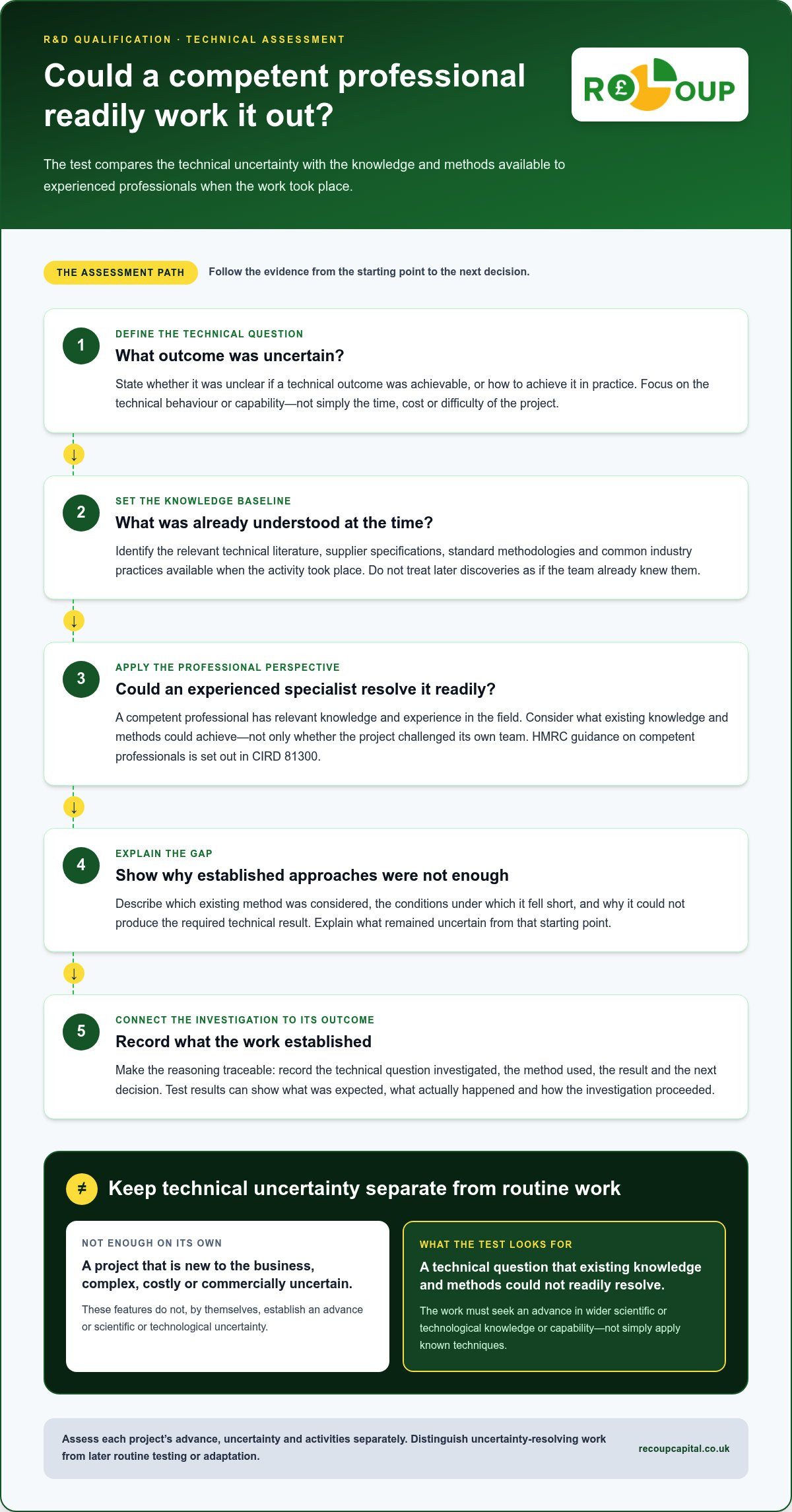
A difficult or costly project doesn’t automatically qualify as R&D. The key question is whether a competent professional could have readily resolved its scientific or technological uncertainty using existing knowledge and methods. To show how to prove a project was not readily deducible, explain what was already known, what remained uncertain and why the answer could not readily be worked out from that starting point.
A novel solution, demanding development process or problem your business hasn’t faced before may seem sufficient. But the test looks beyond what’s new to your organisation: the work must seek an advance in the wider field of science or technology.
This guide explains what qualifying R&D means, how the competent professional test helps assess whether an answer was readily deducible, and which technical records can make your reasoning clear. It also covers why routine adaptation, commercial uncertainty and trial and error alone may not establish qualifying R&D.
Key Takeaways
- Qualifying R&D seeks an advance in wider scientific or technological knowledge, not simply something new to your business.
- The competent professional test considers whether existing knowledge, methods and industry practice could readily resolve the technical uncertainty.
- Routine development, complex implementation and commercial uncertainty do not establish qualifying R&D on their own.
- Technical records are more persuasive when they show the question investigated, the method used, the result and the next decision.
- Assess each project’s advance, uncertainty and activities separately, and distinguish uncertainty-resolving work from later routine testing or adaptation.
What is an advance in science or technology?
For UK R&D tax relief, an advance means improving overall scientific or technological knowledge or capability, not simply creating something new for one business. Unexpected results can support your explanation, but the key question is whether they reveal and help resolve genuine technical uncertainty.
Scientific and technological uncertainty
Scientific or technological uncertainty exists when it isn’t readily clear whether a technical outcome is achievable, or how to achieve it in practice. This matters because qualifying R&D must seek an advance and directly contribute to resolving that uncertainty.
For example, an engineering team may know a lightweight component’s required performance but not whether a material can meet it under operating conditions. The uncertainty concerns the material’s technical behaviour, not simply the time or cost of producing prototypes. A project difficulty alone doesn’t establish scientific or technological uncertainty.
Routine questions that a professional could settle through brief discussions with peers differ from uncertainties that require investigation. Your evidence should explain the technical question, what was already understood and why established methods didn’t provide a readily deducible answer.
What qualifies as an advance?
A qualifying advance improves knowledge or capability across a field, rather than only improving a company’s own processes. It might involve creating a process, material, device, product or service that extends what the field can achieve.
The improvement must be appreciable, not a minor refinement using known techniques. A solution may still represent an advance even if another organisation has achieved it, if the method or relevant knowledge wasn’t publicly available to the professionals undertaking the work. Explain the starting capability, its limitations and the improvement sought.
From 1 April 2023, mathematical advances can be treated as science for these purposes, whether or not they advance representation of the nature and behaviour of the physical and material universe, according to the Department for Science, Innovation and Technology.
Examples across technical fields
In software, a project might investigate whether a new processing method can handle data within technical constraints that existing approaches can’t meet, such as real-time tracking in round-the-clock safety platforms like The Wellbeing App. Building a website with established software libraries and a new layout, by contrast, generally applies known techniques rather than advancing technological capability.
In life sciences, researchers might investigate whether a formulation can remain stable under a defined production process when existing knowledge doesn’t explain how to achieve that result. The relevant question is the scientific uncertainty, not the potential product’s commercial appeal.
In engineering, a team could test whether a new material or component design can meet performance requirements that current methods cannot satisfy. Prototyping or simulation may contribute when each investigation examines a technical question and informs the next decision.
Unexpected results and technical advantages
An unexpected result is an outcome that established knowledge or the project’s technical hypothesis didn’t predict. A technical advantage is a measurable improvement in capability, such as greater reliability or performance. Either can help explain why the work challenged existing understanding.
For example, test results might show that a material behaves differently under a particular process, prompting a revised hypothesis and further investigation. Record the test conditions, expected and actual results, and the decision that followed. An unexpected outcome supports your account, but doesn’t prove qualification on its own: the project must still address genuine scientific or technological uncertainty. This is an R&D tax relief assessment, not a separate patent test of whether an invention was obvious.
The competent professional test for readily deducible solutions
The test asks whether a knowledgeable, experienced professional could resolve the uncertainty using knowledge and methods available at the time. Their perspective helps distinguish an advance from demanding work that applies established techniques.
The competent professional’s role
A competent professional has relevant knowledge and experience in the scientific or technological field being assessed. Their role is to judge what existing knowledge could achieve, not simply whether the project challenged its own team.
HMRC’s CIRD 81300 provides guidance on competent professionals. Their field expertise helps identify relevant published material, standard methodologies and common industry practices available when the work took place. For example, a software specialist would consider established programming methods before concluding that a new system’s technical behaviour was uncertain. Bridging technical engineering insight with tax incentive claims is a recognised practice internationally, with firms such as engineeredtaxservices.com illustrating how engineering evaluations help establish industry baselines and substantiate qualifying work.
Knowledge available to professionals
The comparison uses information available when the activity took place. This may include relevant technical literature, supplier specifications, standard methods and common industry practice. Don’t treat later discoveries as though they were available to the project team at the time.
Evidence is stronger when it identifies the specific knowledge considered and explains its limits. Saying “no one knew how” is less informative than showing which existing method failed, under what conditions, and why it couldn’t achieve the required technical result.
Professional judgement should distinguish genuine uncertainty from a question peers could settle through brief discussion. If established documentation explains how to integrate a component, a difficult implementation may still be readily deducible. The issue is whether existing knowledge could resolve the technical question, not whether the work took considerable effort.
Applying the inventive-step test
The Windsurfing/Pozzoli test is a patent-law framework for assessing inventive step, not the test for UK R&D tax relief. Broadly, it identifies the inventive concept, considers the skilled person and their common general knowledge, compares the concept with the prior art, then asks whether the difference would have been obvious.
That comparison can help explain why an invention seems technically surprising, but it cannot replace the R&D tax assessment. For tax relief, the focus remains the advance sought and whether a competent professional could readily resolve the scientific or technological uncertainty.
Examples from UK cases
UK patent cases can illustrate how courts examine obviousness, but patent decisions don’t determine whether project activities qualify for R&D tax relief. Commercial success or a long-felt need may provide context in an inventive-step argument; neither establishes qualifying R&D on its own.
For an R&D tax example, AHK Recruitment lost its appeal in 2020 after no project participant or field expert gave evidence, and the named person’s résumé didn’t establish competence. The case shows why technical explanations need credible field knowledge and evidence tied to the work. To explain how to prove a project was not readily deducible, connect the professional’s expertise to the specific knowledge gap and investigation.
A clear R&D tax credit claim explains the advance, the uncertainty and why existing knowledge couldn’t readily resolve it.
What counts as qualifying R&D?
UK R&D tax relief is assessed project by project, based on the advance sought and activities addressing scientific or technological uncertainty. Routine implementation, integration or commercial adaptation doesn’t qualify simply because it takes time or expertise.
Evidence that may undermine a claim includes supplier documents showing an established solution, standard methods that achieve the result, or records indicating routine configuration. A project description that omits the technical question, existing limitations or investigation also makes the case harder to assess.
Project boundaries and qualifying activities
A project boundary identifies the technical goal, the uncertainty under investigation and the activities that contribute to resolving it. This matters because a broad company initiative can include both qualifying investigation and ordinary delivery work.
For example, a manufacturer might investigate whether a new process can produce a material with a required property. Trials addressing that uncertainty may qualify, while later production runs, routine quality checks and customer-specific adjustments may not. Record when the uncertainty is resolved, or when attempts to resolve it stop, so later activity isn’t treated as part of the same qualifying work.
Some indirect activities can be included when they contribute to the R&D goal, even if they don’t directly resolve uncertainty. Project records should explain that connection rather than treating every task under one project name as qualifying.
Routine development often applies existing methods in a new commercial setting. For instance, building a website with established software libraries and a different layout doesn’t usually advance technological capability. Integrating familiar components can also remain routine, even if configuration takes careful planning. The key question is whether the work investigates a technical limitation that existing knowledge can’t readily resolve.
When unoriginal work may qualify
Work doesn’t have to be novel across the whole industry to qualify. It may qualify when the solution or method isn’t readily deducible to competent professionals undertaking the project. This can apply when another organisation has achieved an advance but its precise method or relevant knowledge isn’t publicly available.
For example, a team may need to investigate how to achieve a known performance outcome when published information doesn’t reveal the necessary process. The project’s technical question and supporting evidence still matter. Merely repeating a known method, or adapting an existing solution to meet commercial requirements, doesn’t become qualifying R&D because the business hasn’t used it before.
Allocate costs according to the work performed, not just the project budget. If an engineer divides time between uncertainty-focused trials and routine production, use a reasonable basis, such as task records or timesheets linked to project stages, to separate the activities. An invoice for equipment or materials doesn’t by itself show that the purchase supported qualifying R&D; connect the expenditure to the technical investigation and its purpose.
A clear record can link each activity to the uncertainty it addressed, the method used and the resulting decision. For example, distinguish prototype testing that investigates a technical constraint from acceptance testing that checks a finished product against known specifications. This makes the project boundary, qualifying work and related expenditure easier to understand.
How does HMRC approach this area in practice?
HMRC assesses whether a project pursued a genuine scientific or technological advance and how the team investigated uncertainty. A tax relief claim is clearer when your records connect the technical problem, each investigation and the decisions that followed.
Evidence of uncertainty
Evidence of uncertainty explains which technical outcome was unknown and why existing knowledge couldn’t readily provide the answer. This matters because a difficult problem alone doesn’t show that a project sought to resolve scientific or technological uncertainty.
For example, a design note might describe why a component repeatedly failed under specified operating conditions despite following supplier guidance. Add the technical literature, supplier specifications, calculations or results from earlier work that informed the investigation. These records help explain the starting point and the limits of known methods.
Useful evidence may include project plans, design reviews, test protocols and correspondence about technical constraints. A general statement that a product was challenging to develop carries less weight than a documented question about performance, reliability or feasibility.
Systematic work to resolve uncertainty
A systematic approach records the question tested, the method used, the result and the next decision. This matters because it shows that project activity was directed towards resolving uncertainty, rather than repeating routine trial and error.
For instance, an engineering team might document a hypothesis about a material, test a prototype under defined conditions, compare its performance with acceptance criteria and revise the design after a failure. Each result should explain why the next test was necessary. A failed approach can demonstrate the investigation, but failure alone doesn’t prove that the work qualifies.
Keep dated test records, meeting notes and design revisions in sequence. If the team stops investigating because the uncertainty is resolved, record when that happened. Later routine testing or production may fall outside the uncertainty-resolving work.
Records, prototypes and experiments
Contemporaneous records are documents created as work happens, such as laboratory notes, test results and prototype logs. They matter because they preserve the project’s original reasoning, conditions and outcomes.
A measurement is more meaningful when linked to its hypothesis, equipment configuration and acceptance criteria. For example, a prototype’s output reading alone may not show why it mattered. A test record explaining the expected result and technical constraint provides context. Experiment reports can also show whether results were repeatable or prompted further investigation.
Retrospective explanations can help organise the evidence, but distinguish them from records created during the work. Identify the original records supporting each later account, and explain any limitations. This helps HMRC understand what the team knew at each project stage.
Project work and design decisions
Evidence of project work links specific activities and design decisions to the uncertainty they addressed. This matters because a tax relief claim must distinguish investigative work from ordinary implementation and delivery.
For example, retain design versions showing why a familiar configuration failed, calculations comparing alternatives and notes explaining why the team selected a new approach. A design change is more useful when the record identifies the technical result that prompted it and the question the revised design was intended to test.
When staff worked across technical investigation and routine tasks, retain a reasonable basis for separating their time. Link relevant purchases to the work they supported, since an invoice alone doesn’t explain its technical purpose. Together, project records and design decisions show how the investigation progressed and when uncertainty remained unresolved.
Definition of not readily deducible
“Not readily deducible” describes a solution that a competent professional couldn’t readily work out using relevant knowledge and methods available when the work took place. It isn’t a standalone test: it helps assess whether a project sought to resolve scientific or technological uncertainty.
HMRC’s R&D tax relief guidance doesn’t give a specific definition of “readily deducible”. In practice, consider whether the answer could be found through existing knowledge, published literature, supplier documentation or standard industry methods. The assessment concerns the particular technical uncertainty, not whether the project felt difficult to its own team.
That distinction matters. A complex integration may still be routine if established methods explain how to achieve it. Conversely, a valid technological uncertainty may exist when another organisation has resolved the problem but its precise method isn’t publicly available to the professionals undertaking the work.
Cost, duration and effort aren’t substitutes for technical analysis. A costly prototype programme doesn’t show that its outcome was not readily deducible if supplier specifications already explain the solution. An unsuccessful test can help explain the investigation, but failure alone doesn’t show that existing knowledge was insufficient.
Use the project’s circumstances to make the reasoning precise:
- Identify the question. Describe the scientific or technological outcome the team needed to achieve.
- Set out relevant knowledge. Explain which publications, supplier information, standard methods or common practices informed the work.
- Show the gap. State why that knowledge didn’t provide a practical answer under the project’s technical conditions.
- Connect the investigation. Explain how the tests, calculations or design changes addressed that gap.
For example, a manufacturer may need a component to withstand a particular operating environment. If supplier guidance covers the required conditions, adapting the component may be routine. If the guidance doesn’t explain whether a new configuration can work and technical tests investigate that unanswered question, the evidence may support a different conclusion. The details and context matter.
Claims are easier to assess when each project description explains the starting knowledge, the unresolved technical question and the work undertaken. Avoid relying on labels such as “innovative”, “bespoke” or “first for our business”. These descriptions don’t explain whether competent professionals could readily find the solution.
The practical takeaway is to compare the actual technical problem with relevant knowledge available at the time, then show why that knowledge couldn’t readily resolve it. To apply this reasoning to a UK R&D tax relief claim, connect each claimed project to its technical uncertainty and supporting evidence.
Recoup Capital: R&D Tax Credits
Recoup Capital supports UK limited companies with R&D Tax Credits, helping assess project eligibility and prepare claims. Consider its support when your team has investigated scientific or technological uncertainty and needs to explain the advance, the competent professional’s perspective and the evidence behind the work.
A clear technical account can link project records to the relevant tax treatment, separating uncertainty-resolving activity from routine development. This is particularly useful when projects involve several stages, teams or types of expenditure and the supporting evidence needs careful organisation.
If you’re considering an R&D tax relief claim, contact Recoup Capital to discuss your project.
Put your technical evidence to work
Understanding how to prove a project was not readily deducible can shape how you document future development, not just how you prepare a claim. Build brief technical checkpoints into project reviews, recording unresolved questions, test assumptions and decisions prompted by results. This keeps the reasoning connected to the work as it happens and gives teams a clearer starting point when assessing future projects.
A useful next step is to review a project’s technical narrative alongside its supporting records. Consider whether someone outside the team could follow the knowledge gap, investigation and outcome without relying on broad claims of innovation. Recoup Capital offers R&D Tax Credits, Capital Allowances and Land Remediation Relief, helping businesses consider relevant tax reliefs and explain the work behind a claim.
If you’re ready to discuss your claim, contact Recoup Capital. A clear, evidence-led approach can help your business move forward with confidence.
Frequently Asked Questions
What documentation does HMRC expect?
A claim’s project information should explain the advance sought, uncertainties and work undertaken. Submit the form before or on the same day as the Company Tax Return. Useful supporting records include design documents, test results, technical calculations, supplier specifications and project correspondence. Keep records showing how staff time and other claimed expenditure relate to the activities described.
What does qualifying R&D look like in practice?
Qualifying R&D involves work directed at an advance in science or technology and resolving related uncertainty. For example, a team developing a sensor might investigate whether it can reliably distinguish a faint signal from background interference in a particular operating environment. The investigation may qualify if established knowledge doesn’t readily provide the answer. Routine calibration against known specifications, by contrast, is ordinary testing rather than uncertainty-resolving work.
What happens if HMRC opens an enquiry?
An enquiry means HMRC is examining aspects of a tax return or claim, so organise the relevant project and accounting records promptly. Match each project description to contemporaneous documents, including the technical rationale, staff activity and expenditure records. Distinguish original records from later summaries, and use a clear index to show which evidence supports each technical statement. This can help keep your response focused and consistent.
What is technological uncertainty?
Technological uncertainty arises when it isn’t readily clear whether a technical outcome can be achieved, or how to achieve it in practice. For example, a team may not know whether a proposed manufacturing control system can maintain consistent output with a changing input. The uncertainty is technical, not simply whether the project will be commercially successful or customers will buy the finished product.
What does “not readily deducible” mean in UK patent law?
In UK patent law, the central issue is whether an invention would have been obvious to a person skilled in the relevant field, considering prior art and common general knowledge. “Not readily deducible” isn’t a substitute for that patent-law question. In the R&D tax context, it concerns whether a competent professional could readily resolve scientific or technological uncertainty.
What legal test determines whether an invention is obvious to a person skilled in the art in the UK?
UK patent inventive step is assessed by considering the invention against relevant prior art from the perspective of a person skilled in the field. The analysis identifies the inventive concept, the skilled person’s background knowledge, the differences from the prior art and whether those differences would have been obvious. This patent assessment is distinct from deciding whether project activities meet the R&D tax relief criteria.
How is the person skilled in the art and their common general knowledge defined?
The person skilled in the art is a notional practitioner with ordinary expertise in the relevant technical field, rather than a named project participant or exceptional inventor. Common general knowledge means the background technical understanding attributed to that practitioner. For example, a patent concerning industrial sensors would be assessed from the perspective of someone familiar with relevant sensor technology and established knowledge in the field, not every publication ever produced.


