

Are you viewing your Corporation Tax bill as an unavoidable expense or a strategic asset for growth? For many directors, the evolving landscape of innovation tax incentives uk feels more like a regulatory hurdle than a genuine opportunity. It's natural to feel uneasy about the transition to the Merged R&D Scheme or to worry that a claim might inadvertently trigger a time-consuming HMRC enquiry. You might even suspect that generalist accountants are overlooking the technical nuances that separate a standard filing from a high-value, specialist recovery.
We understand that your priority is running your business, not decoding complex tax legislation. This guide provides a definitive roadmap to the 2026 corporate incentive landscape, ensuring you can identify, calculate, and claim every pound you're entitled to with total confidence. You'll discover how the latest shifts in R&D credits, Patent Box rates, and Capital Allowances can be harnessed to secure significant cash injections for your company's future. It's time to move beyond simple paperwork and start treating these incentives as the powerful strategic tools they are.
Key Takeaways
- Learn to distinguish between tax reliefs and cash-back credits to optimise your business's financial recovery and cash flow.
- Master the 2026 Merged Scheme to unlock the maximum value from innovation tax incentives uk without increasing your risk of an HMRC audit.
- Uncover significant capital hidden within your commercial premises by identifying qualifying plant, machinery, and land remediation expenditure.
- Discover how to apply a reduced 10% Corporation Tax rate to profits derived from patented inventions using the Patent Box scheme.
- Shift from one-off claims to a multi-year strategy that transforms tax incentives into a reliable source of reinvestment capital.
Understanding the Landscape of Business Tax Credits in the UK
The UK government views your business as an engine for national economic growth. This isn't just political rhetoric; it's backed by a sophisticated framework of innovation tax incentives uk designed to reward risk-taking and capital investment. By 2026, the landscape has shifted to favour companies that demonstrate tangible technical progress and sustainable development. These incentives aren't loopholes or handouts. They are strategic tools used to lower the cost of innovation, making the UK a more attractive base for globally competitive enterprises.
Limited companies stand at the centre of this opportunity because the system is intrinsically linked to Corporation Tax. With the main rate of Corporation Tax holding steady at 25% in 2026, the potential value of these credits has never been more significant for your bottom line. Whether you're developing new software, improving manufacturing efficiency, or remediating contaminated land, these credits transform your operational costs into capital assets. Identifying these opportunities early allows you to reinvest in talent and technology without the burden of external debt.
Tax Relief vs Tax Credits: Identifying the Difference
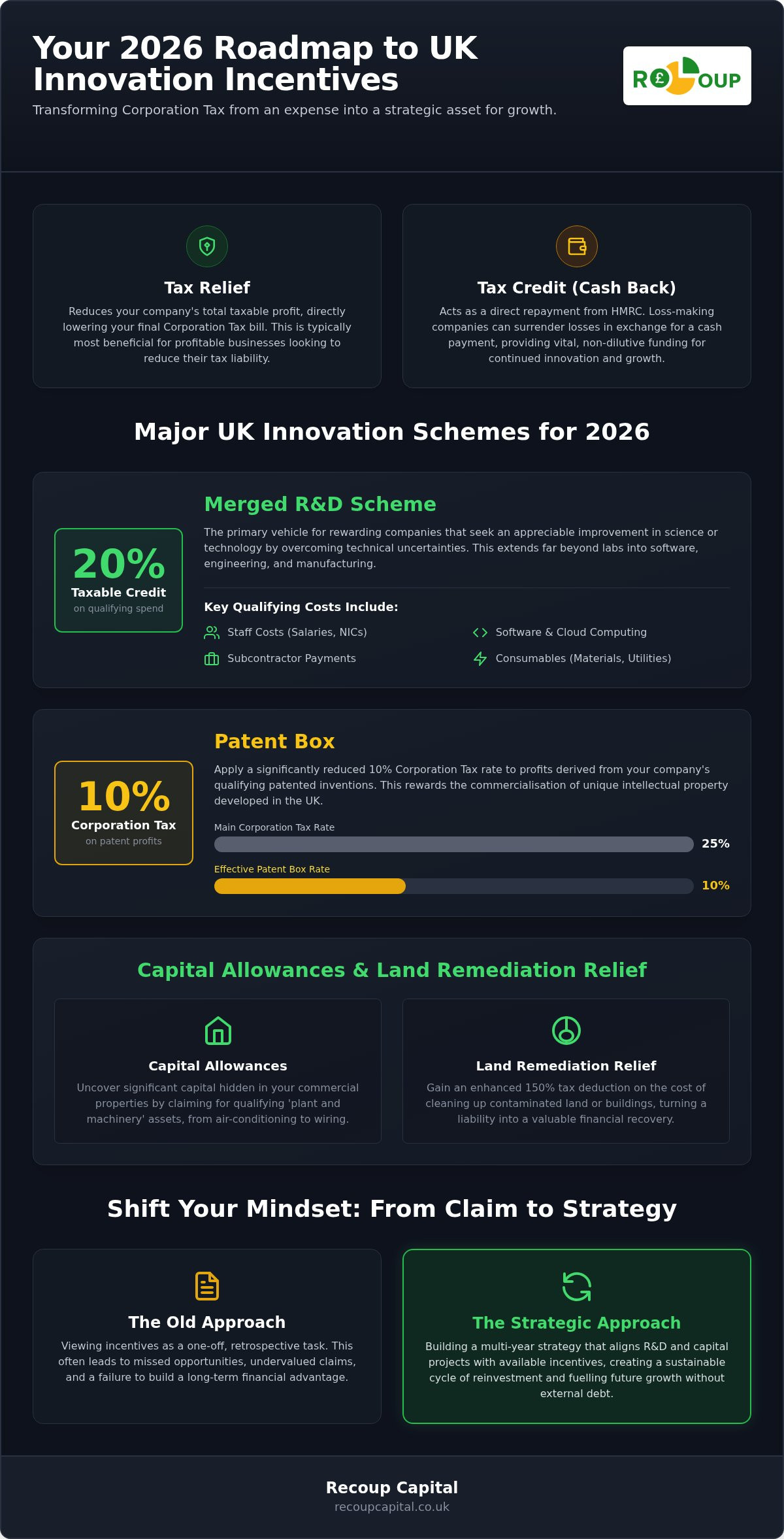
Understanding the mechanics of your claim is vital for accurate financial forecasting. Tax relief works by reducing your company’s total taxable profit, which in turn lowers the amount of tax you owe. In contrast, tax credits act as a more direct intervention. A Tax Credit is a direct reduction in tax liability or a cash payment from HMRC.
Your company's current financial health dictates the best path forward. Profit-making businesses usually use these incentives to offset their tax bills, whilst loss-making entities can often surrender their losses for a vital cash injection. This flexibility ensures that even during intensive development phases where profits are low, your business remains liquid and capable of continued growth. You can find more details on how these mechanisms function in our guide to R&D tax credits explained.
The Strategic Importance of Incentives for UK Growth
Incentives provide a form of non-dilutive funding, allowing you to fuel expansion without giving up equity. The history of R&D tax credits shows a steady evolution from niche benefits to a cornerstone of UK industrial policy. By the mid-2020s, the government sharpened its focus, ensuring that rewards are channelled toward genuine, documented innovation rather than routine business activities. This means the quality of your technical submission is now the primary driver of your claim's success.
Staying competitive in a global market requires constant evolution. These credits provide the financial cushion needed to experiment, fail, and eventually succeed. When managed correctly, they aren't just a yearly rebate; they become a predictable part of your long-term investment strategy. By aligning your development roadmap with available innovation tax incentives uk, you create a sustainable cycle of reinvestment that keeps your business at the forefront of your industry.
Maximising R&D Tax Credits: Beyond the Science Lab
Research and development is often mistakenly confined to the imagery of white lab coats and test tubes. In the reality of the 2026 fiscal year, the reach of innovation tax incentives uk extends far into the physical world of infrastructure, software engineering, and manufacturing. The Merged Scheme now serves as the primary vehicle for most businesses, providing a 20% taxable credit on qualifying expenditure. This unified system simplifies the landscape, but it also places a higher premium on the technical quality of your submission. To succeed, you must demonstrate that your project sought an appreciable improvement in science or technology by overcoming a specific technical uncertainty.
Identifying qualifying costs requires a forensic eye. It's not just about the final product; it's about the iterative process of trial and error. HMRC allows you to claim for a variety of expenditures, including:
- Staff Costs: Gross salaries, Employer NICs, and pension contributions for those directly involved in the R&D.
- Subcontractors: Payments to external specialists who helped resolve technical challenges.
- Software: Licences for tools used specifically for the R&D project, including data processing and cloud computing.
- Consumables: Materials or utilities, such as power and water, that were transformed or used up during the development process.
The "uncertainty test" remains the most critical hurdle. You must prove that the solution to your problem wasn't readily deducible by a competent professional in your field. If you've encountered a problem that required bespoke testing or multiple failed prototypes, you're likely sitting on a valid claim. If you're unsure whether your latest project qualifies, a quick review of your technical activity can often reveal significant untapped value.
Innovation in Traditional Sectors: Construction and Engineering
Construction and engineering firms often overlook R&D because they view complex challenges as "just part of the job." However, bespoke engineering solutions designed to overcome site-specific constraints are prime candidates for recovery. Examples include developing modular building techniques that exceed standard thermal efficiency or creating innovative soil stabilisation methods for difficult terrain. These aren't just standard projects; they're technical advancements that qualify for innovation tax incentives uk. You can find more specific examples in our guide to R&D tax credits explained.
The Merged Scheme Requirements: Staying Compliant in 2026
Compliance in 2026 is more rigorous than in previous years. Every submission must be accompanied by an Additional Information Form (AIF), which requires a detailed technical justification for each project. There's also a strict notification requirement. If you haven't claimed in the last three years, you must notify HMRC of your intent to claim within six months of the end of your accounting period. Missing this window can invalidate your entire claim, regardless of how innovative your work is. This makes proactive planning and robust documentation more than just a best practice; they're essential for protecting your claim from HMRC enquiries.
Unlocking Capital Allowances and Land Remediation Relief
Many businesses focus solely on their operational output when considering innovation tax incentives uk, yet the very buildings they occupy often hold the greatest potential for capital recovery. If your company owns or has significantly refurbished commercial property, you're likely sitting on substantial unclaimed tax savings. Whilst generalist accountants are adept at claiming for mobile equipment, the complex world of embedded fixtures and land-based reliefs requires a more forensic approach to ensure no value is left on the table.
Property-rich businesses often overlook the fact that these reliefs aren't just for property developers. Any limited company that has incurred expenditure on commercial premises may be eligible. By integrating property-based claims with your broader innovation strategy, you create a comprehensive shield against Corporation Tax, transforming your physical infrastructure into a source of reinvestment capital.
Identifying Embedded Fixtures in Commercial Property
It's a common misconception that a building's structure is entirely ineligible for tax relief. Whilst the shell (walls, floors, and ceilings) generally doesn't qualify, the sophisticated systems that make the building functional certainly do. These are known as embedded fixtures. We are talking about heating and cooling systems, security installations, fire alarms, and even complex electrical circuitry. In 2026, with the main pool Writing Down Allowance (WDA) at 14% and the Annual Investment Allowance (AIA) at £1 million, the timing for a deep dive into these assets is particularly beneficial.
Because these items are literally built into the fabric of the property, they're often overlooked during standard bookkeeping. Uncovering these requires more than just an invoice review; it necessitates a forensic survey conducted by specialists who understand both tax law and surveying. By performing a deep dive into your property’s history and structure, you can identify Capital Allowances that significantly reduce your Corporation Tax liability, often years after the initial purchase or renovation.
Reclaiming Costs from Contaminated or Derelict Land
The UK’s industrial heritage means many development sites are hampered by historical contamination. Land Remediation Relief is a powerful, yet underutilised, incentive that allows companies to claim a 150% Corporation Tax deduction for the costs of cleaning up these sites. This isn't just for heavy industry; any company remediating asbestos, radon, or industrial pollutants during a renovation or new build can qualify. Even the removal of invasive species like Japanese Knotweed or the treatment of long-term derelict land can trigger a claim.
If you have spent £100,000 on making land safe for use, the 150% deduction means you can reduce your taxable profit by £150,000. For loss-making companies, HMRC offers the option to surrender this loss for a 16% payable tax credit, providing an immediate cash injection when it's needed most. You can check your eligibility for these specific Land Remediation benefits to see if your recent site works qualify for this high-impact relief.
Combining these property-based reliefs with your R&D claim creates a multi-layered recovery strategy. By addressing your physical assets and your innovative activity simultaneously, you maximise your total return and transform your business's tax position into a strategic advantage for long-term growth.
Navigating the Compliance Landscape and HMRC Enquiries
HMRC's stance on innovation tax incentives uk has undergone a significant transformation. We are seeing a marked increase in volume compliance checks, where HMRC uses automated systems to flag claims for closer inspection. This isn't necessarily a cause for alarm, but it does mean that the days of submitting light documentation are over. Your claim must now be bulletproof from the outset. If you receive an enquiry letter, the key is to remain calm and transparent. HMRC inspectors aren't looking to penalise genuine innovation; they're looking for evidence of a robust methodology. Providing data-backed answers and clear project timelines usually resolves most queries quickly. However, without a specialist to act as a protective guide, these enquiries can become a significant drain on your senior team's time.
The Importance of Forensic Technical Reports
A successful submission relies on a narrative that bridges the gap between science and accounting. It's no longer enough to provide a spreadsheet of costs; you must explain the technical challenges your team faced and how they attempted to overcome them. The latest guidelines require explicit proof of Technical Lead involvement, ensuring that the person actually directing the R&D is the one justifying the claim. This forensic level of detail is exactly what our technical specialists provide to ensure your claim stands up to the closest scrutiny. If you want to ensure your documentation meets these rigorous standards, you can learn more about our specialist approach to technical reporting.
Avoiding Common Pitfalls in Specialist Tax Claims
The 2026 regulatory environment carries stiffer penalties for careless errors or over-claiming. One frequent stumbling block is the treatment of subsidised R&D and grants. Under the merged scheme rules, the interaction between external funding and your tax credit calculation is complex. It requires precise handling to avoid double-counting or invalidation. Generalist accountants often struggle here because they lack the technical depth to interpret how a specific engineering hurdle translates into a qualifying tax expense. Partnering with a specialist doesn't just maximise your recovery; it provides a necessary layer of protection. By ensuring every project narrative is technically precise and compliant with the latest HMRC standards, you can focus on your next breakthrough whilst we handle the regulatory complexities.
Building a Strategic Claim Strategy for Long-Term Success
Viewing innovation tax incentives uk as a yearly administrative task is a missed opportunity for your board. To truly fuel growth, these incentives must be integrated into a multi-year tax efficiency strategy. This shift in perspective transforms a one-off rebate into a predictable stream of capital that can be used to fund future acquisitions or improve your balance sheet strength. When you align your technical roadmap with your financial planning, you create a sustainable cycle where innovation pays for itself. Integrating corporate finance principles into your claim process ensures that the cash injections you receive are used as strategic assets rather than just covering operational overheads.
The Patent Box: The Logical Next Step for Innovators
If your R&D efforts result in a granted patent, you can significantly lower your tax burden through the Patent Box scheme. This incentive allows you to apply a reduced Corporation Tax rate of 10% on profits derived from those patented inventions. Compared to the standard 25% rate, this represents a substantial saving that rewards long-term commercial success. However, the "Nexus approach" is vital here. You must prove a direct link between your R&D expenditure and the resulting patent income. Timing your patent applications is a strategic decision. Applying too early or too late can impact the value of your claim, so it's essential to plan your intellectual property filings alongside your 2026 tax strategy to maximise these innovation tax incentives uk.
Specialist Consultants vs General Accountants
Your general accountant is an essential partner for your daily bookkeeping and standard tax returns. However, they may lack the forensic technical expertise required to justify complex innovation claims to HMRC. Forensic tax specialists employ chartered accountants and technical leads who can translate engineering or scientific challenges into the specific language HMRC inspectors expect. This specialist depth is what protects your business from the rising tide of compliance checks we discussed earlier.
Choosing a specialist who operates on a success-based fee model is often the most efficient route for a growing business. This approach aligns the consultant's goals with your results, ensuring that you don't face upfront costs or financial risk during the process. It's a relationship-first model that focuses on delivering measurable value before any fees are incurred. If you're ready to move beyond basic filings and build a robust recovery plan, you should speak to a Recoup Capital specialist today to uncover the hidden capital within your business and secure your company's financial future.
Transforming Your Tax Position into a Competitive Advantage
The window for securing your company's financial future through innovation tax incentives uk is always open, but the requirements for success have never been more rigorous. By moving beyond basic bookkeeping and embracing a forensic approach to your technical and property assets, you transform your tax liability into a powerful engine for reinvestment. We've explored how the shift to the Merged Scheme and the rising scrutiny of HMRC make specialist guidance essential for protecting your claims and avoiding time-consuming enquiries.
Our team of in-house chartered tax accountants and forensic surveyors specialises in uncovering value within the construction, engineering, and manufacturing sectors. We operate on a success-based fee structure, which ensures our goals are perfectly aligned with your results. This partnership-oriented approach removes the financial risk of exploring your eligibility, focusing instead on delivering a robust and compliant technical submission. It's time to stop viewing tax as a burden and start treating it as a strategic tool for growth.
Ready to identify your unclaimed capital? Book a free consultation with our tax specialists today. We look forward to helping your business innovate and thrive in the years ahead.
Frequently Asked Questions
Can I claim R&D tax credits if my innovation project failed?
Yes, you can claim regardless of the project's outcome. HMRC rewards the process of seeking a technical advancement, not just the successful result. If your team encountered technical uncertainties and attempted to resolve them, the costs incurred qualify for innovation tax incentives uk. This ensures that the financial risk of ambitious, experimental projects is partially mitigated by the tax system.
How far back can my business claim for tax credits in the UK?
You can generally claim for the two previous accounting periods. This typically means you have up to two years from the end of your financial year to submit or amend a claim for R&D or capital allowances. It's important to review your historical expenditure as many companies find they have significant unclaimed relief sitting in their past two years of accounts.
What is the Merged Scheme for R&D tax credits in 2026?
The Merged Scheme is a unified R&D tax relief system that replaced the separate SME and RDEC schemes for accounting periods starting on or after 1 April 2024. In 2026, most companies claim under this single framework, which offers a 20% taxable credit. This credit is accounted for "above the line", providing a clearer picture of the financial benefit on your balance sheet.
Do capital allowances apply to second-hand commercial properties?
Yes, capital allowances frequently apply to second-hand commercial properties. When you purchase an existing building, you aren't just buying walls and a roof; you're acquiring the embedded fixtures within it. A forensic surveyor can identify these hidden assets, such as electrical systems and plumbing, allowing you to reclaim tax on a portion of the purchase price that your general accountant might miss.
Is my business too small to claim for Land Remediation Relief?
No, there's no minimum size requirement for a company to claim Land Remediation Relief. As long as your business is a limited company and has incurred costs to clean up contaminated or derelict land, you can claim the 150% tax deduction. This applies whether you're a small developer or a large manufacturer improving your existing site for future expansion.
How long does it typically take for HMRC to process a tax credit claim?
HMRC typically aims to process R&D tax credit claims within 40 days of submission. However, this timeline can fluctuate based on the volume of claims being handled or if your submission is selected for a compliance check. Working with a specialist ensures your technical report is robust from the start, which often helps streamline the review process and reduces the likelihood of delays.
Can I claim both R&D tax credits and the Patent Box relief simultaneously?
Yes, you can and should claim both R&D tax credits and Patent Box relief if you qualify. Whilst R&D credits reward the investment in developing new technology, the Patent Box rewards the commercial success of that technology with a reduced 10% Corporation Tax rate. These innovation tax incentives uk are designed to work together, supporting your business from the initial research phase through to market profitability.
What happens if HMRC disagrees with my technical report?
If HMRC disagrees with your technical report, they will usually open an enquiry to seek further clarification. This is a formal process where you'll need to provide more detailed evidence of the technical uncertainties your project addressed. Having a specialist partner to manage this communication is vital, as they can provide the technical justifications and data-backed answers required to defend your claim successfully.


