

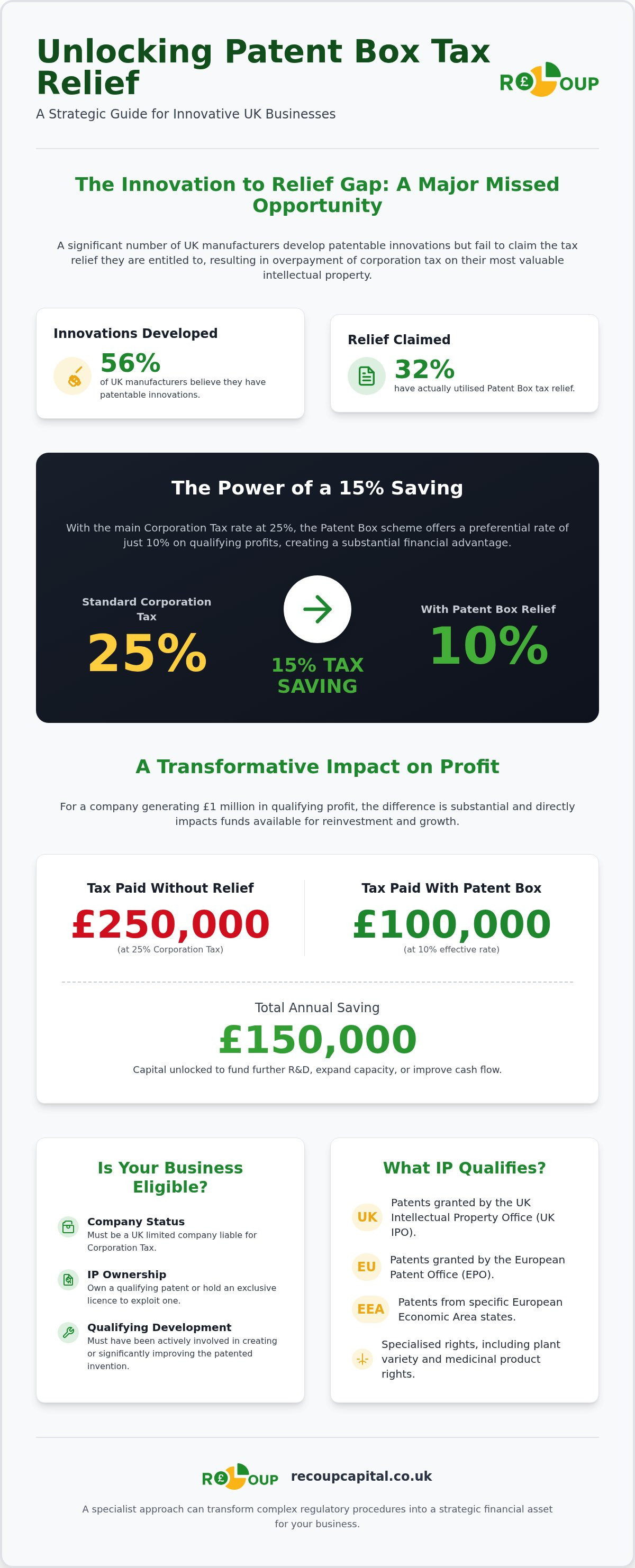
Did you know that whilst 56% of UK manufacturers believe they've developed patentable innovations, only 32% have actually utilised patent box tax relief? This significant gap suggests that thousands of businesses are currently overpaying their corporation tax by 15% on their most profitable intellectual property. It's a missed opportunity that often stems from the perceived complexity of the regime.
We understand that the intricacies of the Nexus fraction calculation and the fear of HMRC enquiries can be daunting. It's natural to feel uncertain about whether your specific IP qualifies, especially with the 2026 main corporation tax rate sitting at 25%. However, this relief shouldn't be an intimidating hurdle; it's a strategic tool designed to reward your ingenuity. This article will show you exactly how to navigate the eligibility requirements and commercialise your innovations more effectively.
By the end of this guide, you'll have a clear framework for calculating potential savings and the confidence to start your claim. We'll explore the synergy between R&D tax credits and the Patent Box, ensuring your business treats its financial returns as the strategic assets they truly are.
Key Takeaways
- Identify which intellectual property, from UK IPO patents to exclusive licences, qualifies your business for the reduced 10% tax rate.
- Learn how to bridge the gap between your R&D activities and patent box tax relief using the mandatory Nexus fraction.
- Discover the methodology for isolating "Relevant IP Income" to ensure every qualifying pound of profit is accurately accounted for.
- Understand the strict election deadlines and compliance standards required to protect your claim from HMRC scrutiny.
- Recognise how a specialist approach can transform complex regulatory procedures into a strategic financial asset for your business.
Understanding the Patent Box: A Strategic Tax Incentive for UK Innovation
The UK government introduced the Patent Box scheme in 2013 with a clear objective: to encourage companies to keep the commercialisation and manufacture of their patented innovations within the UK. It isn't just about rewarding the invention phase; it's about supporting the long-term profitability of the products or processes that arise from that invention. By offering a significantly reduced tax rate, the regime ensures that innovative firms remain globally competitive whilst anchoring high-value jobs and intellectual property on British soil.
In 2026, the financial impact of this incentive is more pronounced than ever. Most UK limited companies with profits over £250,000 face a main Corporation Tax rate of 25%. However, qualifying profits under the patent box tax relief regime are taxed at an effective rate of just 10%. This creates a massive 15% saving gap that acts as a direct injection of capital back into your business. Since its inception, the regime has evolved from a simple election into a more robust "Nexus" regime. This mandatory framework ensures the tax relief is directly linked to the R&D activity performed by the company itself, preventing the relief from being exploited by entities with no real technical footprint in the UK.
Why the 10% Tax Rate is More Valuable in 2026
As the main rate of Corporation Tax has climbed to 25%, the "spread" between the standard rate and the Patent Box rate has widened significantly. This makes the relief a top-tier priority for any board of directors focused on fiscal efficiency. Patent Box is a tool that turns intellectual property into a 15% tax saving. This reclaimed capital isn't just a refund; it's a strategic asset that can be used to fund further R&D, expand manufacturing capacity, or improve cash flow during scaling phases. For a company generating £1 million in qualifying profit, the difference between paying £250,000 and £100,000 in tax is transformative for annual reinvestment potential.
Who Can Benefit From the Regime?
The scheme is available to UK limited companies that are liable for Corporation Tax and make a profit from exploiting patented inventions. To qualify, your company must either own the patent or hold an exclusive licence to it. Crucially, you must also meet the "Qualifying Development" test. This means your business must have been actively involved in creating or significantly improving the patented invention, or the product that incorporates it. It's not enough to simply own the IP; you must demonstrate a proactive role in its development or management to satisfy HMRC's compliance standards. This ensures the patent box tax relief rewards genuine innovators who are driving technical progress.
Eligibility Criteria: Which Patents and Rights Qualify?
Many business owners assume that patent box tax relief is reserved for pharmaceutical giants or global tech firms. This is a costly misconception. In reality, the criteria are broad enough to encompass various sectors, from bespoke engineering to agri-tech. To qualify, your company must hold a qualifying right or an exclusive licence to use one. Understanding the nuances of these rights is the first step toward transforming your intellectual property into a high-yield financial asset.
Defining Qualifying Intellectual Property
HMRC maintains specific standards for what constitutes qualifying intellectual property (IP). It's not limited to standard UK patents; the scope includes several international and specialised rights:
- Patents granted by the UK Intellectual Property Office (UK IPO).
- Patents granted by the European Patent Office (EPO).
- Rights granted by specific EEA states, such as Austria, Denmark, or Finland, that meet the same criteria as UK patents.
- Specialised rights, including plant variety rights and medicinal product rights.
It's vital to note that the relief only applies to profits generated after a patent is granted. Whilst you can't claim for the period your patent is "pending", you can track the relevant profits during this time. Once the patent is officially granted, you can then claim retrospectively for the profits made during the pending period, provided you elected into the scheme early. If your business doesn't own the patent outright, you can still qualify if you hold an exclusive licence. This means you must have the sole right to exploit the IP in at least one country, and standard non-exclusive permissions won't suffice.
The "Qualifying Development" Requirement
Simply owning a patent isn't enough to satisfy HMRC. Your company must also meet the "qualifying development" test. This means you must have been actively involved in creating or significantly improving the patented invention. If you're part of a larger group, this requirement can often be met if another group company performed the development work, provided your company manages the IP on an ongoing basis.
In sectors like construction and complex engineering, patentable technology is often "hidden" within larger projects. You might have developed a unique technical solution or a bespoke component to solve a specific onsite challenge. These innovations are frequently patentable, even if they aren't your primary product. If you suspect your technical solutions might meet these criteria, it's worth exploring how these incentives align with your current and past projects to ensure no capital is left on the table.
The Synergy Between Patent Box and R&D Tax Credits
R&D tax credits and patent box tax relief are frequently viewed as separate entities, yet they are actually two sides of the same innovation coin. Whilst one rewards the high costs of discovery, the other rewards the commercial success that follows. If your company is already claiming R&D tax credits, you are the prime candidate for the Patent Box regime. You have already done the heavy lifting by documenting your technical challenges and innovation; now it is time to secure the reward for the resulting profits.
This relationship is formalised through a mechanism known as the Nexus fraction. This calculation ensures that the tax relief you receive is proportional to the amount of R&D your company actually performed in-house. It is a mandatory requirement that prevents the regime from being used as a simple tax haven for acquired intellectual property. By aligning your R&D claims with your patent strategy, you create a seamless pipeline of capital recovery that supports your business from the initial concept through to global sales.
Understanding the Nexus Fraction Simplified
The Nexus fraction is the bridge that connects your research spend to your tax savings. The formula is essentially: (Qualifying R&D Expenditure / Total R&D Expenditure) x IP Profit. HMRC uses this to verify that the innovation happened within your business. If you handle your development internally, your fraction will likely be 1.0, meaning you can apply the 10% tax rate to 100% of your qualifying IP profits. However, outsourcing R&D to connected parties or purchasing IP can reduce this fraction. Focusing on internal innovation is therefore a strategic financial decision that directly protects your future patent box tax relief.
Avoiding Double-Counting Whilst Maximising Relief
A common concern amongst business owners is the fear of "double-dipping" or falling foul of HMRC compliance. It is vital to distinguish between R&D "cost recovery" and Patent Box "profit relief." R&D credits act as a subsidy for your development outgoings, such as staff wages and software. Patent Box, conversely, reduces the tax you pay on the income those developments generate. They are complementary, not contradictory. To maximise both, your accounts must be structured to isolate IP-related income from routine commercial revenue. Using a specialist to synchronise these incentives ensures your financial data is robust enough to support both claims simultaneously, transforming your tax strategy into a powerful business tool.
Identifying and Calculating Your Patent Box Profits
Calculating patent box tax relief is often perceived as a labyrinth of accounting jargon. It's the primary reason many eligible firms hesitate to claim. However, once you isolate your "Relevant IP Income" (RIPI), the path to a 10% tax rate becomes much clearer. The goal is to separate the profits generated specifically by your innovations from your routine commercial activities. This ensures the relief is applied only to the value added by your unique intellectual property.
What Counts as Qualifying Income?
Your RIPI is the foundation of the entire claim. It isn't just limited to the direct sale of a patent. It includes:
- Sales of products that incorporate at least one patented item. Crucially, if you sell a complex machine where only a single internal component is patented, the income from the entire machine usually qualifies.
- Licensing fees or royalties received for allowing third parties to use your IP.
- Damages or insurance payouts resulting from patent infringement.
This "whole product" rule is particularly valuable for manufacturers and engineering firms. It ensures that your tax strategy reflects the true commercial value of your technical breakthroughs. If you're selling a process rather than a physical item, such as a patented industrial method, the income derived from providing that specific service also falls within the scope of the regime.
The Five-Step Calculation Process
HMRC requires a structured approach to ensure only the "innovation profit" receives the lower rate. Following these steps helps maintain compliance and provides a clear audit trail. It's a logical progression that builds institutional credibility with the tax office.
Step 1: Calculate RIPI. Identify all income streams linked to your qualifying IP and deduct the direct costs associated with those sales.
Step 2: Remove the "Routine Return". HMRC assumes a portion of your profit comes from standard business operations. You must deduct 10% of specific costs to account for this baseline profitability.
Step 3: Deduct the Marketing Asset Return. This step removes profits attributed to your brand name or "goodwill" rather than the technology itself. For many specialised B2B firms, this deduction is relatively small.
Step 4: Apply the Nexus Fraction. This adjusts your relief based on your in-house R&D expenditure, as we explored in the previous section.
Step 5: Apply the 10% Rate. The final figure is your Patent Box Profit, which is taxed at 10% instead of the 25% main rate.
Whilst these steps are logical, the nuances of cost allocation and income separation require technical precision. If you're unsure how to categorise your income streams or handle the routine return deductions, it's beneficial to consult our corporate finance specialists to ensure your calculation is both accurate and maximised.
Navigating the Claim Process: Why Specialist Guidance is Essential
Securing a 10% corporation tax rate through the Patent Box is a significant financial victory, but it requires meticulous attention to detail. Many companies find that their general accountants, whilst excellent at day-to-day compliance, often lack the technical depth to bridge the gap between complex engineering and tax legislation. This is where patent box tax relief claims can falter. Specialist guidance ensures that every technical nuance is captured and every regulatory requirement is met, transforming a complex filing into a streamlined opportunity for growth.
The landscape of innovation incentives is shifting. HMRC has recently increased its scrutiny of claims, notably with the release of Guidance for Compliance (GfC9) on 7 November 2024. This guidance outlines the detailed information now expected with every submission. By partnering with a specialist, you gain a protective guide who understands these evolving standards. Understanding why claim through a specialist is the first step toward ensuring your technical documentation is robust enough to withstand any enquiry.
Common Pitfalls in Patent Box Submissions
Even the most innovative firms can miss out on substantial savings due to procedural errors. One of the most common mistakes is failing to elect into the regime within the strict two-year window. Missing this deadline results in a permanent loss of relief for that accounting period. Other frequent issues include:
- Incorrectly calculating the routine return, which can lead to over-claiming and subsequent HMRC penalties.
- Failing to adequately document the "qualifying development" activity required to satisfy the Nexus fraction.
- Inconsistencies between the R&D tax credit claim and the Patent Box submission.
These pitfalls highlight why a DIY approach is often a false economy. A single error in the five-step calculation can trigger an enquiry, causing unnecessary stress and potential financial loss.
How Recoup Capital Secures Your Innovation’s Value
Our approach begins with a forensic assessment of your IP portfolio. We don't just look at what you have; we look at the commercial reality of how your patents drive your profits. This results-oriented specialist mindset allows us to find claimable value that others might overlook. We manage the entire process, from the initial election to the final HMRC liaison, ensuring your patent box tax relief works in perfect harmony with your broader corporate finance goals.
We believe in demonstrating value through results rather than traditional sales tactics. This is why we operate on a success-based fee model, removing the financial barriers to entry and allowing you to explore your eligibility with total confidence. We view ourselves as your long-term partner, dedicated to helping you reinvest your tax savings back into the innovations that will define your company's future.
Transform Your Intellectual Property into a Strategic Financial Asset
Transitioning from the development phase to commercial success shouldn't mean losing a quarter of your profits to tax. By utilising patent box tax relief, you're not just reducing a liability; you're securing a 15% saving that can be reinvested into your next breakthrough. We've explored how the Nexus fraction and qualifying development criteria ensure this incentive remains a reward for genuine UK innovation.
Navigating these regulations requires precision and a proactive approach to compliance. Our team of chartered tax accountants and technical specialists understands the unique challenges of high-growth sectors like engineering and tech. We operate on a success-based fee structure, meaning we only succeed when you do. It's about building a long-term partnership that protects your bottom line whilst you focus on what you do best.
Ready to see how much your innovation could save? Book a no-obligation Patent Box assessment with Recoup Capital today. Your ingenuity has already created the value; it's time to ensure your business retains it.
Commonly Asked Questions
What is the Patent Box rate for 2026?
The effective Corporation Tax rate for qualifying profits under the regime is 10% in 2026. This provides a significant 15% saving compared to the main Corporation Tax rate of 25%. It's a powerful incentive designed to keep high-value commercialisation activities within the UK.
Can I claim Patent Box if my patent is still pending?
You can't receive the tax reduction whilst the patent is pending, but you can track the relevant profits during this period. Once the UK IPO or EPO officially grants your patent, you can then retrospectively apply the 10% rate to the profits made whilst it was pending. This ensures your early-stage commercial success is still rewarded.
Do I need to own the patent to claim Patent Box tax relief?
Ownership isn't the only route to qualification. Whilst many claimants own their IP outright, you can also benefit if your company holds an exclusive licence. This means you must have the sole right to exploit the patented invention in at least one country or territory, and your patent box tax relief claim will reflect this specific commercial right.
How does Patent Box interact with R&D tax credits?
These incentives are complementary and work together to support the entire lifecycle of an innovation. R&D tax credits provide relief on the costs incurred during the development phase; Patent Box provides relief on the profits generated once that innovation is sold. They don't conflict, but they do require careful accounting to ensure data is synchronised across both claims.
What is the "Nexus" requirement in Patent Box?
The "Nexus" requirement is a mandatory formula that links your tax relief to the amount of R&D work actually performed by your company. It's calculated as a fraction: your qualifying in-house R&D expenditure divided by your total R&D expenditure. A higher fraction means more of your IP profit can be taxed at the lower 10% rate.
Can software companies benefit from the Patent Box?
Software companies can certainly benefit, provided their technology is protected by a patent rather than just copyright. In sectors like fintech, AI, and cybersecurity, novel algorithms or technical processes are frequently patentable. If your software solves a specific technical problem in a unique way, it may qualify for the 10% tax rate.
How far back can I backdate a Patent Box claim?
You must elect into the Patent Box scheme within two years of the end of the accounting period in which the relevant profits were generated. This is a strict statutory deadline. If you miss this window, you permanently lose the opportunity to apply the relief to those specific profits, making early planning essential for your tax strategy.
What happens if my company makes a loss instead of a profit?
If your company makes a loss on its patented products, these "Patent Box losses" must be tracked separately. You can't use them to reduce your standard Corporation Tax bill immediately. Instead, you carry these losses forward to offset against future qualifying IP profits, ensuring that your long-term innovation strategy remains tax-efficient as you return to profitability.


