

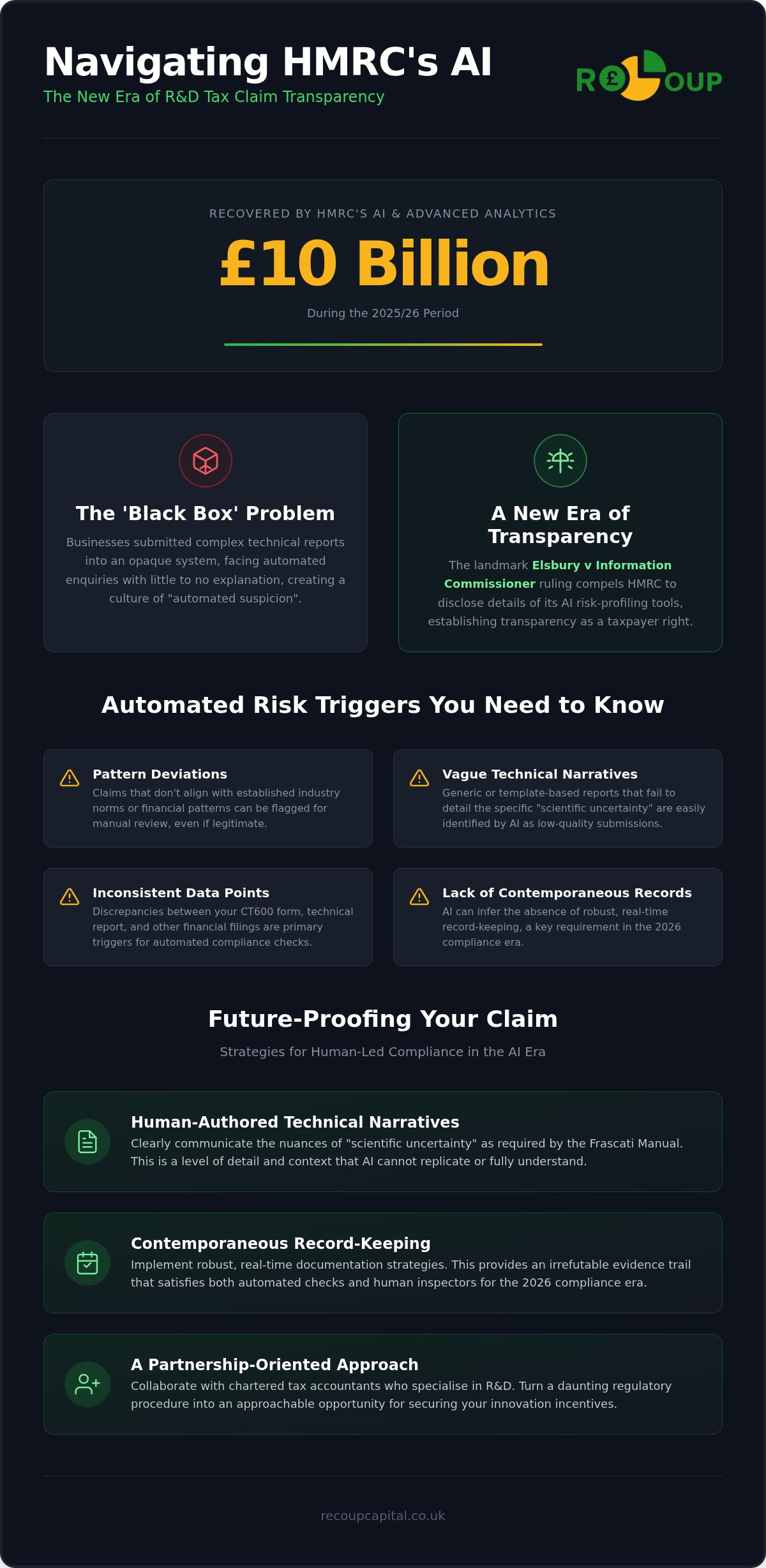
Did you know that HMRC’s AI and advanced analytics systems recovered a staggering £10 billion in tax during the 2025/26 period? This massive leap in automated enforcement has naturally caused concern for businesses trying to maintain hmrc r&d tax claim transparency ai whilst navigating increasingly complex filing requirements. It’s daunting to think that your hard-won innovations might be flagged by an algorithm before a human caseworker even reviews your technical report.
We agree that the shift toward digital-first compliance often feels like a "black box" that threatens the stability of your capital recovery. This guide provides the clarity you need to move forward with confidence. You will learn how HMRC’s evolving technology impacts your R&D tax credits and how to ensure your claim remains both transparent and compliant in this new era. We’ll preview the latest 2026 regulatory standards, the vital role of human-led technical assessments, and the strategies required to secure your innovation incentives without the fear of an automated enquiry.
Key Takeaways
- Discover how the landmark Elsbury v Information Commissioner ruling is reshaping the landscape for HMRC’s disclosure of automated assessment methods.
- Identify the specific risk-profiling "red flags" that affect hmrc r&d tax claim transparency ai and learn how to navigate automated pattern-matching checks.
- Understand why human-authored technical narratives remain the only way to effectively communicate the nuances of "scientific uncertainty" required by the Frascati Manual.
- Learn how to implement robust, contemporaneous record-keeping strategies that future-proof your innovation incentives against the 2026 compliance era.
- See how a partnership-oriented approach with chartered tax accountants can turn a daunting regulatory procedure into an approachable opportunity for business growth.
The Landmark Tribunal: HMRC Ordered to Disclose AI Use in R&D Claims
The Elsbury v Information Commissioner case represents a watershed moment for UK innovation. For years, businesses felt they were operating in the dark, submitting complex technical reports into a "black box" only to receive automated enquiries with little explanation. This changed in 2025. The First-tier Tribunal’s decision finally prioritised hmrc r&d tax claim transparency ai over institutional secrecy, forcing a fundamental shift in how the Revenue interacts with innovative companies.
HMRC’s reliance on automated risk profiling has grown exponentially. By the 2025/26 tax year, these systems helped recover £10 billion in tax, yet the logic behind these flags remained hidden. The tribunal ruling challenges this "automated suspicion" model. It asserts that for the UK's R&D Tax Credit scheme to function fairly, taxpayers must understand the criteria used to judge them. For businesses filing in 2026, this means the era of silent algorithms is ending, replaced by a requirement for clearer communication from the authorities.
Understanding the Elsbury v Information Commissioner Ruling
The case began when a tax practitioner used a Freedom of Information (FoI) request to ask how HMRC identifies "high risk" R&D claims using AI. HMRC initially refused, supported by the Information Commissioner’s Office (ICO), claiming that disclosure would give a "roadmap to fraudsters". The First-tier Tribunal overturned this. They ruled that HMRC must disclose specific details about their AI risk-profiling tools, including the types of data points that trigger a manual review. This ruling effectively ended the ICO’s previous stance that tax-enforcement algorithms should be exempt from public scrutiny. It’s a victory for any business that has ever felt unfairly targeted by a faceless system.
Transparency as a Taxpayer Right
We believe that moving from a culture of secrecy to one of collaborative compliance is essential for a thriving economy. When you understand the "why" behind a compliance check, you can provide better evidence and resolve issues faster. This transparency helps businesses avoid the high costs and stress of unnecessary enquiries. Understanding the technicalities is easier when you have R&D tax credits explained in plain English, allowing you to align your records with HMRC’s expectations before you even hit submit.
R&D transparency is the fundamental right to understand exactly how your proprietary data is being processed and evaluated by government algorithms. By demanding this clarity, the tribunal has ensured that the relationship between the taxpayer and the state remains a partnership rather than an interrogation. This shift is particularly vital as we see more businesses integrating their own AI tools into their workflows, creating a complex environment where both sides must speak the same digital language.
How AI Risk Profiling Impacts Your R&D Tax Credit Submission
HMRC’s compliance strategy has moved far beyond random spot checks. The department now employs sophisticated data mining tools to scrutinise every line of your CT600. As detailed in HMRC's annual report, the Revenue is aggressively leveraging advanced analytics to identify discrepancies across all tax heads. For innovative businesses, this means your submission is first "read" by a machine looking for patterns that deviate from industry norms. Maintaining hmrc r&d tax claim transparency ai is no longer just about honesty; it’s about understanding the digital lens through which your business is being viewed.
The danger for many legitimate claimants lies in "false positives". These occur when an algorithm flags a valid project as high-risk simply because the data structure doesn't match a narrow pre-defined template. Generalist accountants often treat R&D as a purely financial entry. They might miss the technical nuances that trigger these automated filters, leaving your business vulnerable to a stressful and time-consuming enquiry. If you are concerned about how your records might look to an automated system, claiming R&D tax credits through a specialist lens can help ensure your data is presented in a way that satisfies both the algorithm and the human inspector.
Automated Risk Triggers You Need to Know
HMRC’s AI focuses heavily on "R&D intensity" ratios. If your R&D expenditure as a percentage of total spend is significantly higher than your sector's benchmark, the system may flag it for manual review. For example, under the Enhanced R&D Intensive Support (ERIS) scheme, the 30% intensity threshold is a clear mathematical trigger. Beyond the numbers, the AI looks for a lack of contemporaneous evidence. If your documentation structure appears "template-driven" or relies on generic industry terminology like "optimisation" or "bug fixing", the system often categorises the work as routine maintenance rather than qualifying innovation.
The Problem with Pattern Matching
AI is essentially a blunt instrument when it comes to complex engineering or construction projects. It relies on pattern matching, which often ignores the unique context of a specific technical challenge. A machine might interpret a project "failure" or a scrapped prototype as a lack of technical advancement. In reality, the Frascati Manual defines these failures as the very essence of scientific uncertainty. Without human oversight to explain these deviations, your most innovative work could be misidentified as non-qualifying. This is why a human-led narrative is vital to bridge the gap between what the AI sees and what your engineers actually achieved. It ensures that the unique complexities of your work aren't lost in a sea of automated data points.
The Transparency Gap: Why AI Cannot Replace Human Technical Narratives
The shift towards automated auditing creates a significant transparency gap between the claimant and the Revenue. While HMRC uses algorithms to flag inconsistencies, these tools are fundamentally incapable of grasping the core requirement of a successful claim: scientific or technological uncertainty. Relying on an algorithm to evaluate human innovation is like asking a calculator to critique poetry. This disconnect is a global phenomenon, as noted in the OECD report on AI in tax administration, which highlights that even as authorities digitise, the burden of qualitative proof remains firmly with the taxpayer. For businesses, achieving true hmrc r&d tax claim transparency ai requires a narrative that speaks the language of the Frascati Manual, not just the language of data points.
Defining Scientific Uncertainty for HMRC
To qualify for tax relief, your project must aim for an advance in overall knowledge through the resolution of technical uncertainties. A machine-led review often struggles to distinguish between a genuine "headroom" advance and simple "routine maintenance". For instance, in software engineering, an AI might flag a complex refactoring project as standard upkeep because it uses common libraries. A human expert, however, can articulate the specific architectural barriers, such as complex data synchronisation issues or "Z-Mode" logic conflicts, that made the project a high-risk venture. To ensure your project meets these strict definitions, it’s helpful to have R&D tax credits explained in the context of your specific industry challenges.
The Risk of AI-Generated Reports
It’s tempting to use generative AI to draft technical reports, but this is a dangerous shortcut in 2026. HMRC caseworkers now use detection tools specifically designed to identify "cookie-cutter" narratives produced by large language models. These reports often lack the forensic detail and project-specific evidence required to satisfy a manual review. They tend to use generic descriptors that fail to capture the unique technical struggles of a construction or engineering firm. Our methodology at Recoup Capital rejects these automated templates. We believe that only a partnership between chartered tax accountants and technical specialists can produce a report robust enough to withstand both a machine’s pattern matching and a caseworker’s scrutiny. Personalised narratives are the only way to bridge the transparency gap and secure your innovation incentives.
Future-Proofing Your Claim: Strategies for Human-Led Compliance
Future-proofing your innovation incentives in 2026 requires more than just meeting the basic criteria; it demands a proactive compliance framework. As HMRC’s automated tools become more sophisticated, the burden of proof shifts towards the quality and timing of your documentation. The goal is to achieve total hmrc r&d tax claim transparency ai by providing a level of granular detail that automated systems cannot easily dismiss as generic. This human-led strategy transforms a potentially intimidating regulatory procedure into a structured opportunity for business growth.
Conducting a "pre-submission" risk assessment is a vital step in this process. By using specialist expertise to audit your own data before it reaches the Revenue, you can identify the red flags we discussed earlier, such as intensity ratio spikes or vague technical descriptors. This proactive stance is far more effective than reacting to an enquiry once it has already begun. Our success-based fee structure ensures that our interests are perfectly aligned with yours; we only succeed when your claim is robust, compliant, and successfully processed. It’s a partnership-oriented approach that treats your tax relief as a strategic asset rather than a mere refund.
Creating a Robust Evidence Trail
In a digital-first tax environment, contemporaneous record-keeping is your strongest defence. This means organising project logs, payroll data, and subcontractor invoices as the work happens, rather than trying to reconstruct the narrative months later. You must ensure that technical and financial data are perfectly synchronised. If your technical report describes three engineers working on a prototype, your payroll records must reflect that specific allocation. Building this foundation ensures your business is ready to scale without the threat of a clawback. Discover why claiming R&D is essential for growth and how it fuels your long-term strategic planning.
The Specialist Advantage
A dedicated R&D tax specialist offers a layer of protection that a generalist firm simply cannot provide. Whilst a generalist might understand the numbers, they often lack the technical engineering or construction expertise required to defend a complex claim. Specialist chartered tax accountants lead our compliance process, ensuring that every narrative is forensic in its detail. This transparency acts as a tool for faster claim processing; when HMRC caseworkers see a well-documented, human-led claim, it builds institutional credibility. If you want to ensure your innovation is protected by a robust compliance strategy, consider a specialist R&D tax credit consultation to future-proof your next submission.
Securing Your Innovation: How Recoup Capital Navigates HMRC AI
Recoup Capital operates at the intersection of technical innovation and fiscal precision. We recognise that the 2026 compliance landscape demands a higher standard of hmrc r&d tax claim transparency ai than ever before. Our methodology is built on a simple premise: a machine cannot understand the technical nuances of your engineering breakthroughs, but a specialist team can. By blending deep technical engineering expertise with the rigour of chartered tax accounting, we ensure that every claim is not just a collection of data points, but a robust narrative that reflects the true value of your work.
Many businesses view these credits as a one-off windfall. We reframe them as strategic assets that fuel your broader corporate finance objectives. This transition from a mere refund to a reinvestment tool is what sets a partnership-first approach apart from traditional transactional services. In the Elsbury era, transparency isn't just a regulatory requirement; it’s a competitive advantage. We provide the institutional credibility required to satisfy HMRC’s internal compliance processes whilst ensuring your business remains focused on its next big breakthrough.
A Partnership-Oriented Approach
We believe in demonstrating value through results rather than delivering a traditional sales pitch. Our role is to act as a protective guide through the complexities of regulatory landscapes, transforming intimidating procedures into approachable opportunities for growth. This relationship-first philosophy extends beyond tax relief. For example, our corporate finance advisory services help you leverage your successful R&D claims to secure further investment or manage long-term capital utility. We aren't just processing paperwork; we're invested in your future success.
Your Next Steps for 2026
The first step in future-proofing your business is identifying potential vulnerabilities in your current filing process. We recommend a thorough review of previous claims to check for the AI-flagged "red flags" mentioned in earlier sections, such as generic terminology or inconsistent intensity ratios. Transitioning to a more transparent, human-led filing process is the best way to avoid the "black box" enquiry trap. We invite you to speak to our R&D specialists today for a no-obligation technical assessment. This introductory offer allows us to evaluate your qualifying activities and demonstrate how a specialised, evidence-based approach can secure your innovation incentives for years to come.
Mastering the New Standards of R&D Compliance
The landscape of UK innovation is changing rapidly. We've explored how the landmark Elsbury ruling has finally shed light on the Revenue's automated processes; yet the burden of proof remains firmly with you. Relying on generic reports or automated generators is no longer a viable strategy in this high-scrutiny environment. Achieving true hmrc r&d tax claim transparency ai requires a sophisticated blend of technical insight and forensic accounting that machines simply cannot replicate.
By prioritising contemporaneous evidence and human-led narratives, you can transform your tax relief from a source of anxiety into a strategic business tool. At Recoup Capital, our team of chartered tax accountants and technical specialists brings a proven track record in the construction and engineering sectors to every partnership. We operate on a success-based fee structure; we only win when you do. It's time to move beyond the "black box" and secure the capital your innovation deserves. Book a transparent R&D claim review with Recoup Capital today and take the first step toward audit-proof recovery. Your next breakthrough shouldn't be stalled by regulatory complexity.
Frequently Asked Questions
Is HMRC using AI to review all R&D tax claims in 2026?
Yes, HMRC uses advanced analytics and AI risk profiling to screen every submission. Whilst the department stated in late 2025 that final decisions are reviewed by human caseworkers, all claims pass through the 'Connect' system first. This automated process identifies patterns and discrepancies across your CT600 before a human ever reads your technical narrative.
What did the Elsbury tribunal ruling decide about HMRC transparency?
The First-tier Tribunal ruled that HMRC must disclose specific details regarding the data points used in its AI risk-profiling tools. This 2025 decision was a major victory for hmrc r&d tax claim transparency ai, as it overturned previous secrecy. It established that businesses have a right to know why their innovation claims are being flagged as "high risk" by automated systems.
Can I use AI tools like ChatGPT to write my R&D technical narrative?
You shouldn't rely on generative AI to draft your technical reports because these tools often fail to capture the specific scientific uncertainties required. HMRC caseworkers are increasingly sceptical of "cookie-cutter" narratives that lack forensic, project-specific detail. A machine-written report often misses the unique technical barriers that prove your work qualifies as a genuine advancement in knowledge.
How does HMRC identify AI-generated R&D reports?
HMRC employs specialised detection software specifically designed to flag linguistic patterns and repetitive structures common in large language models. They look for a lack of technical depth and the absence of project-specific evidence. If a report feels generic or uses overly polished templates without mentioning specific engineering failures, it's likely to trigger a manual compliance check.
What are the most common AI-triggered red flags for R&D enquiries?
The most frequent triggers include inconsistent R&D intensity ratios and the use of "routine" terminology. If your R&D expenditure as a percentage of total spend deviates significantly from your sector's benchmark, the system flags it. AI also scans for generic words like "optimisation" or "bug fixing", which the algorithm categorises as standard maintenance rather than qualifying innovation.
How can I ensure my R&D claim is transparent enough for HMRC?
You ensure transparency by synchronising your technical project logs with your financial payroll data in a granular evidence trail. A robust claim in 2026 requires a human-led narrative that clearly defines the "headroom" advance you sought to achieve. This forensic approach bridges the hmrc r&d tax claim transparency ai gap by providing the context that automated pattern matching often ignores.
What is the difference between an automated enquiry and a manual HMRC review?
An automated enquiry is triggered by algorithmic flags based on mathematical discrepancies or sector benchmarks. A manual review involves an actual caseworker reading your technical narrative to evaluate scientific uncertainty. In the current era, most enquiries begin with an automated risk flag, which then necessitates a human-led investigation to resolve the system's "suspicion".
Should I worry about AI risk profiling if my claim is legitimate?
You should be proactive rather than worried, as legitimate claims are frequently flagged as "false positives" by blunt algorithms. These systems often struggle with complex engineering projects that don't fit a standard data template. Working with specialist chartered tax accountants ensures your claim is structured to satisfy automated filters whilst clearly communicating the unique technical challenges of your work.


