

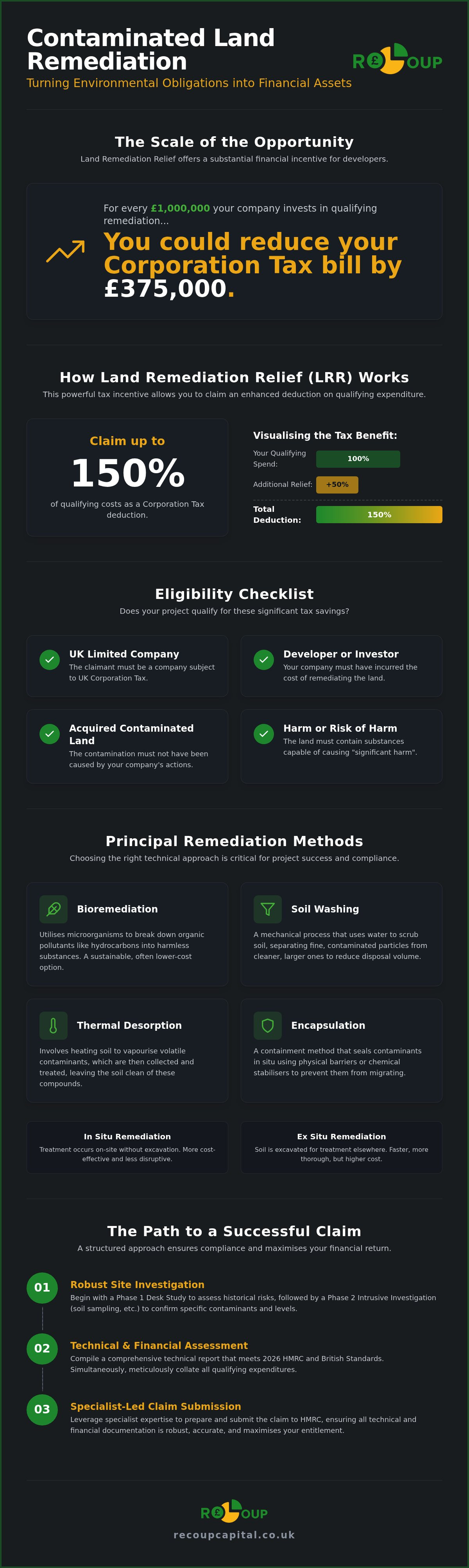
Did you know that for every £1 million your company invests in contaminated land remediation, you could be entitled to a £375,000 reduction in your Corporation Tax bill? Developing on historically industrial sites often feels like a gamble against unforeseen ground conditions and spiralling environmental costs. It's a complex landscape where regulatory compliance and high capital expenditure frequently collide, potentially stalling vital projects before they've even begun.
We understand that managing site cleanup is a significant undertaking that requires both technical precision and financial foresight. This guide is designed to help you navigate these challenges by exploring the most effective cleanup methods available in 2026, from bioremediation to advanced chemical treatments. You'll discover how to confirm your eligibility for Land Remediation Relief, allowing your business to reclaim up to 150% of qualifying costs. We'll outline the current HMRC rates, the impact of the 2026 British Standards update, and the strategic path to turning environmental obligations into a powerful engine for corporate innovation and long-term growth.
Key Takeaways
- Master the technical processes of contaminated land remediation, including bioremediation and soil washing, to navigate the complexities of modern site cleanup.
- Learn how to leverage Land Remediation Relief to secure a 150% Corporation Tax deduction, effectively turning environmental obligations into strategic capital assets.
- Identify the specific eligibility criteria for UK limited companies to ensure your brownfield development project qualifies for significant tax recovery.
- Understand the importance of a robust technical assessment to ensure your claim meets the latest 2026 HMRC compliance and British Standards.
- Discover how specialist liaison can streamline the claim process, allowing your business to focus on innovation whilst maximising your financial returns.
What is Contaminated Land Remediation in the UK?
At its core, contaminated land remediation is the technical process of removing, sequestering, or neutralising substances in the ground that pose a risk to human health or the environment. It's about restoring safety to soil and groundwater. In the UK, the primary legal framework governing this is Part 2A of the Environmental Protection Act 1990. This legislation defines land as contaminated if it contains substances that cause, or have the significant possibility of causing, "significant harm" to people, property, or protected ecosystems.
Developers must distinguish between land that is legally "contaminated" and land that is merely "derelict." Whilst derelict land is often unsightly or underutilised, it only qualifies for specific tax incentives if it meets strict criteria regarding its historical state and lack of use. This distinction is vital when assessing eligibility for land remediation relief. Effective cleanup is the gateway to unlocking brownfield sites for urban regeneration, turning neglected industrial footprints into safe, vibrant residential or commercial hubs. To understand the broader scientific context, one might ask What is Contaminated Land? and how do these pollutants accumulate over decades of industrial use?
Common Contaminants Found on UK Sites
Identifying the specific threat is the first step toward a successful project. UK sites often suffer from a legacy of industrial activity, leaving behind a cocktail of substances that require professional intervention. Common issues include:
- Chemical pollutants: Heavy metals like lead and cadmium, hydrocarbons, and industrial solvents often remain from former factories or fuel depots.
- Natural contaminants: Radon gas in certain geological regions or high concentrations of naturally occurring arsenic can pose significant health risks.
- Biological threats: Invasive species, most notably Japanese Knotweed, can compromise structural integrity and require specialist removal to satisfy lenders and insurers.
The Importance of Site Investigations
You cannot manage what you haven't measured. A robust site investigation is the cornerstone of any contaminated land remediation strategy. This process typically moves through two distinct stages. A Phase 1 Desk Study involves reviewing historical maps and records to predict potential risks based on previous land use. If this suggests a problem, a Phase 2 Intrusive Investigation follows, using soil sampling and borehole monitoring to confirm exact pollution levels. Throughout this process, the Environment Agency plays a critical role in overseeing standards, ensuring that the remediation plan is both safe and sustainable for the long term.
Principal Methods of Contaminated Land Remediation
Selecting the right technical approach for contaminated land remediation depends on the specific chemical profile of the site and the intended future use. Modern engineering offers a versatile toolbox of methods designed to neutralise threats efficiently. Bioremediation is a popular sustainable choice; it uses naturally occurring microorganisms to break down organic pollutants like petroleum hydrocarbons into harmless byproducts. It's often slower than mechanical methods but significantly reduces the need for heavy machinery.
For sites with a mix of particle sizes, soil washing provides a robust mechanical solution. This process scrubs the soil to separate contaminated silts and clays from clean sand and gravel, drastically reducing the volume of material requiring specialist disposal. If you're dealing with volatile organic compounds, thermal desorption may be necessary. By applying heat to the soil, pollutants are vapourised and captured, leaving the earth clean. Alternatively, encapsulation offers a containment strategy. This involves sealing contaminants in situ using physical barriers or chemical stabilisers to prevent them from migrating into the wider environment. This risk-based approach aligns with the UK's legal framework for contaminated land, ensuring that the chosen method is proportionate to the hazard.
Ex Situ vs In Situ Remediation
The fundamental choice often lies between treating soil where it sits or moving it. In situ remediation treats the ground without excavation, which is frequently more cost-effective and causes less disruption to the local community. However, ex situ methods, which involve removing the soil for treatment on-site or at a licensed facility, are sometimes preferred when project timelines are tight. Factors like the depth of the water table, soil permeability, and your total budget will dictate which path is most viable for your development.
Managing Hazardous Waste and Asbestos
Modern contaminated land remediation strategies focus on reducing landfill reliance. The traditional "dig and dump" approach is increasingly rare due to high landfill taxes and strict Waste Acceptance Criteria (WAC) testing. When dealing with hazardous materials like asbestos-containing materials (ACMs), specialist handling is non-negotiable. Safe removal and disposal must follow stringent health and safety protocols to protect workers and future residents. If you're navigating these high costs, we can help you identify qualifying expenditure to ensure your environmental compliance also serves your bottom line.
Financial Incentives: Understanding Land Remediation Relief (LRR)
Land Remediation Relief is one of the most generous yet underutilised tax incentives available to UK limited companies. It's designed to encourage the redevelopment of brownfield sites by allowing businesses to offset the significant costs associated with cleaning up polluted land. For every £100 your company spends on qualifying contaminated land remediation, you can deduct £150 from your taxable profits. This effectively provides an additional 50% relief on top of the actual expenditure, which is a powerful tool for protecting your project's bottom line.
If your company isn't currently profitable, the benefit doesn't disappear. Loss-making companies can choose to surrender the loss resulting from remediation expenditure in exchange for a 16% payable tax credit. For a project with £1 million in qualifying costs, this could result in a cash payment of £160,000 directly from HMRC. Despite these clear benefits, LRR is frequently overlooked by generalist accountants who may lack the technical background to identify qualifying environmental costs. This is where Land Remediation specialists excel; they bridge the gap between complex site reports and HMRC's strict compliance requirements.
Qualifying Expenditure for LRR
To maximise a claim, it's essential to understand what counts as qualifying expenditure. HMRC allows for a broad range of costs, provided they're directly related to the remediation effort. This includes:
- Direct staff costs: A proportionate share of salaries, NI, and pension contributions for employees directly involved in planning or executing the cleanup.
- Materials: The cost of chemicals, microorganisms for bioremediation, or physical barriers used in encapsulation.
- Subcontracted services: Fees paid to remediation contractors and environmental consultants for site investigations and technical assessments.
It's important to remember that you cannot claim for costs that would have been incurred anyway, regardless of the contamination. The relief is specifically for the "additional" burden of making the site safe, as outlined in the UK government guidance on contaminated land.
LRR vs R&D Tax Credits
Many construction and engineering firms are already familiar with R&D Tax Credits, but they often don't realise that LRR can be a more lucrative route for brownfield acquisitions. While R&D focuses on resolving scientific or technological uncertainties, LRR is tied specifically to the state of the land. Navigating the overlap between innovation and remediation requires a strategic approach. You cannot double-claim the same pound of expenditure, but many large-scale developments will have distinct elements that qualify for both incentives. Identifying these opportunities early in the project lifecycle ensures that your tax strategy is as efficient as your engineering.
How to Qualify for Land Remediation Tax Credits
Securing the financial benefits of contaminated land remediation involves more than just identifying site issues. It requires a rigorous adherence to HMRC’s qualification framework. The first hurdle is your business structure; only UK limited companies are eligible. This excludes sole traders and partnerships, regardless of the scale of their remediation efforts. Secondly, you must demonstrate that the land was acquired for the specific purpose of your trade or property business. This means the site must be an asset within your commercial operations, such as a site for development or a location for your own factory, rather than a personal investment.
A critical factor is the "clean hands" requirement. You must confirm that the contamination was not caused by your company or any connected party. If you are responsible for the pollutants, the tax system will not reward you for cleaning them up. Once eligibility is established, you must quantify the "additional" costs. These are the expenses incurred solely because the land was contaminated. If you would have excavated the soil for a basement regardless of the pollution, those costs won't qualify. Finally, the submission must be supported by a robust technical report. This document translates complex engineering data into a clear narrative that justifies the claim to HMRC, ensuring that the technical necessity of each expense is transparent.
The "Polluter Pays" Principle
HMRC enforces the "polluter pays" principle with absolute clarity. If your business activities, or those of a company you’ve acquired, introduced the harmful substances, you are disqualified from claiming contaminated land remediation relief. This often creates complexities during corporate acquisitions or when dealing with historical industrial sites where the source of pollution is unclear. Performing thorough due diligence during the site acquisition phase is not just good practice; it’s a financial necessity. Understanding the lineage of the contamination ensures you aren't unknowingly inheriting a liability that carries no tax benefit whilst also protecting your long-term capital position.
Common Pitfalls in LRR Claims
Many developers fail to maximise their return because they struggle to separate general development costs from remediation-specific ones. Standard site preparation, such as levelling or basic drainage, does not qualify. Only the incremental costs of dealing with the specific hazard are eligible. Another common error is inadequate documentation. Without a clear trail of site investigations, remediation strategies, and specific invoices, HMRC may challenge the validity of the claim. Why claim? Discover the impact of professional claim management and how we ensure every qualifying pound is captured through meticulous technical assessment.
Maximising Your Claim with Recoup Capital
Navigating the technicalities of contaminated land remediation often feels like a full-time job in itself. Whilst the financial rewards are significant, the administrative and regulatory burden can be a deterrent for busy development teams. Recoup Capital acts as your expert guide through this landscape, simplifying the entire process from start to finish. We don't just provide a service; we deliver a streamlined path to capital recovery that allows your business to reinvest in future growth without the distraction of complex tax negotiations.
Our end-to-end service model covers every aspect of a claim. This begins with a deep-dive technical assessment of your site reports and continues through to direct liaison with HMRC. We understand that every project in the construction, engineering, and property development sectors is unique. By aligning our success with yours through a success-based fee model, we ensure there are no upfront costs or financial risks to your business. You only pay when we successfully secure your relief, creating a relationship built on transparency and mutual achievement.
A Partnership Built on Results
We believe in long-term collaboration. Our team moves beyond the standard paperwork to become a strategic partner in your business's innovation journey. By combining the expertise of chartered tax accountants with specialist surveyors, we identify "hidden" remediation costs that generalist firms frequently overlook. Whether it's nuanced staff time or specific subcontracted environmental testing, we forensicly examine your expenditure to ensure your claim is both maximised and fully compliant with the latest 2026 regulations. Our track record is built on finding value where others see only expense.
Next Steps for Your Remediation Project
The journey toward capital recovery begins with a clear understanding of your current position. We offer a no-cost introductory consultation to help you explore your eligibility without any initial commitment. During this session, we'll outline the specific documentation required for a forensic tax review and explain how we can best position your contaminated land remediation project for success. Preparing your records early is the best way to ensure a smooth submission. Contact our specialists today to explore your eligibility and transform your environmental obligations into strategic financial assets.
Transforming Environmental Liabilities into Strategic Capital
Managing a development site with historical pollution requires more than just technical expertise; it demands a proactive financial strategy. We've explored how modern engineering methods and the robust 150% Land Remediation Relief can turn a complex cleanup into a significant tax advantage. By identifying qualifying expenditure early and ensuring your technical reports meet the latest 2026 standards, you can effectively recover substantial capital to fuel your next project.
At Recoup Capital, we act as your protective guide through these regulatory complexities. Our specialist team provides national support for developers, using a success-based fee model that ensures we only win when you do. Don't let unforeseen ground conditions stall your progress when you can secure your Land Remediation Relief with Recoup Capital.
Your commitment to contaminated land remediation is a vital step toward sustainable urban regeneration. We're here to ensure that this environmental responsibility becomes a powerful engine for your business's long-term growth and innovation.
Frequently Asked Questions
Is Japanese Knotweed removal eligible for Land Remediation Relief?
Yes, Japanese Knotweed removal is eligible for relief because it's classified as a biological threat to structural integrity. You can claim for the costs of specialist excavation, disposal, or on-site treatment, provided the infestation wasn't caused by your company. This relief applies to both the direct labour and subcontracted services required to eradicate the plant from the site whilst preparing it for development.
Can loss-making companies benefit from contaminated land tax credits?
Loss-making companies can definitely benefit by surrendering their remediation losses for a payable tax credit of 16% from HMRC. This turns what would be a future tax saving into immediate liquid capital for your business. It's a vital lifeline for developers who are in the early stages of a project and haven't yet generated taxable profits, allowing for continued innovation and growth.
What is the time limit for making a Land Remediation Relief claim?
The time limit for making a claim is generally up to two years after the end of the accounting period in which the expenditure was incurred. This allows you to review historical projects and identify qualifying costs you might have missed during the initial construction phase. It's best to act quickly to ensure all documentation is forensically accurate and within the statutory windows for capital recovery.
Does asbestos removal qualify as contaminated land remediation?
Asbestos removal qualifies for relief when the material is present in the ground or as part of a building on a site that was acquired in a contaminated state. The 150% deduction applies to the additional costs of safe handling and specialist disposal. However, you must demonstrate that these costs were necessary for the contaminated land remediation process rather than standard demolition works required for the build.
Do I need a specialist consultant to claim Land Remediation Relief?
You aren't legally required to use a specialist, but navigating HMRC's technical requirements is significantly easier with expert guidance. Generalist accountants often lack the engineering insight to identify all qualifying site investigation and remediation costs. A specialist ensures your technical report is robust enough to withstand scrutiny whilst maximising the total value of your claim through deep expertise in the construction and engineering sectors.
Can I claim LRR if I am developing land for residential use?
You can claim LRR if you're developing land for residential use, provided the site is held as part of your property development trade. The relief is designed to make brownfield sites more attractive for housing projects by offsetting the high costs of making the land safe for future residents. This applies to both the soil cleanup and the mitigation of legacy industrial pollutants found amongst historic sites.
What happens if HMRC inquires into my remediation claim?
If HMRC inquires into your claim, they'll typically request detailed evidence of the contamination and the specific remediation strategy used. This is why having a forensically detailed technical report is essential for compliance. We handle the liaison with HMRC on your behalf, providing the necessary data to justify every pound of expenditure and ensuring the process remains a low-friction experience for your internal team.
Is radon gas mitigation included in Land Remediation Relief?
Radon gas mitigation is included in the relief as it is a naturally occurring contaminant that poses a significant risk to human health. Costs for installing protective membranes or specialist ventilation systems qualify for the 150% deduction. This ensures that even sites in high-radon areas can be developed safely and cost-effectively through contaminated land remediation tax incentives, protecting both your residents and your bottom line.


