

What if the biggest risk to your business isn't the innovation itself, but how you claim for it? In 2026, the landscape for tax relief has shifted dramatically, making the choice of r&d tax specialists more critical than ever. HMRC has significantly increased compliance activity, and the introduction of the merged scheme alongside Enhanced R&D Intensive Support (ERIS) means that yesterday's filing methods are no longer sufficient. You've likely felt the pressure of more rigorous checks or the worry that you're leaving capital on the table by relying on generalist advice that lacks technical depth.
It's natural to feel cautious when the rules regarding overseas expenditure and mandatory additional information forms are so exacting. You deserve a maximised claim that reflects your true investment, but you also need the peace of mind that comes from total regulatory alignment. This guide provides a clear roadmap to identifying genuine experts who prioritise risk mitigation alongside capital recovery. We'll examine how to vet a partner's technical expertise, ensure your claim stands up to forensic inspection, and ultimately transform your tax relief into a strategic asset for your business growth.
Key Takeaways
- Identify the technical benchmarks that separate r&d tax specialists from generalist providers to ensure your claim is built on engineering reality rather than just accounting logic.
- Master the 2026 compliance landscape, including the necessity of mandatory additional information forms to safeguard your business against heightened HMRC scrutiny.
- Learn how to identify qualifying activities whilst uncovering innovation in daily problem solving that standard accounting processes often miss.
- Understand how to align your R&D tax credits with broader incentives like Patent Box and Capital Allowances to transform your claim into a powerful tool for long-term growth.
- Discover why a partnership-oriented approach to corporate finance provides more sustainable value than a simple transactional filing service.
What Defines True R&D Tax Specialists in 2026?
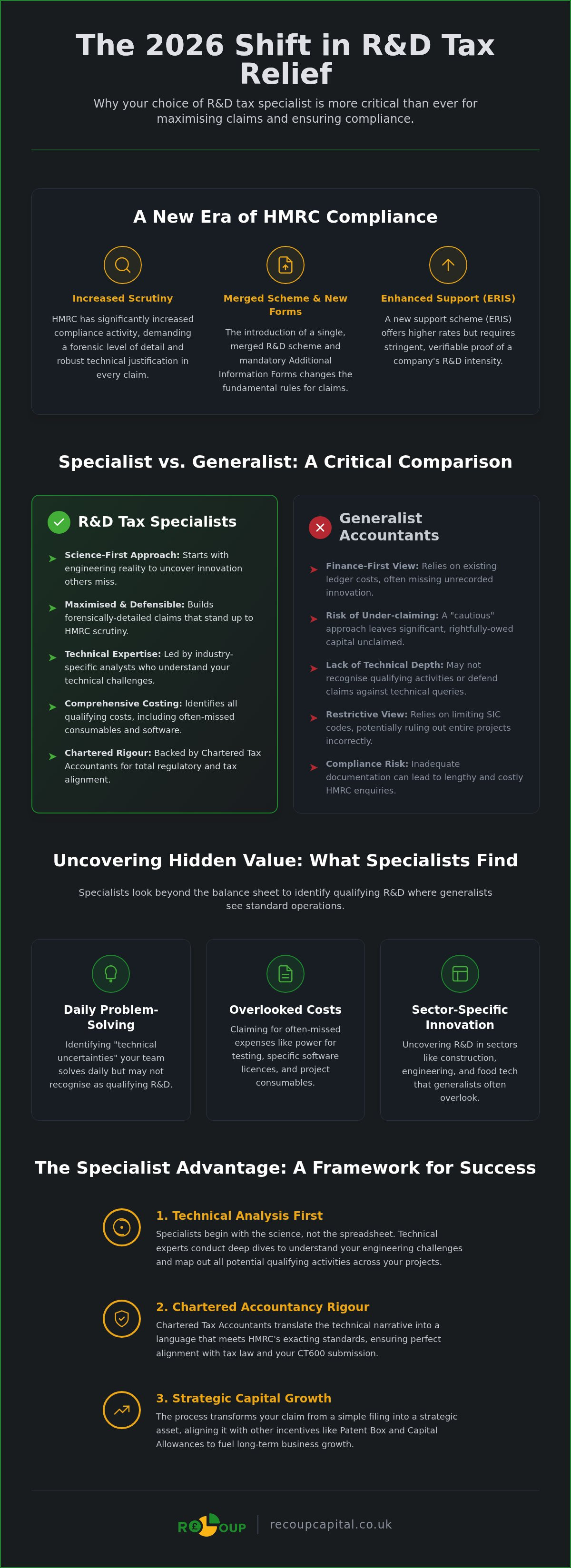
In 2026, the distinction between a generalist accountant and true r&d tax specialists has never been more pronounced. A generalist often views tax relief through a purely financial lens, focusing on costs already captured in your ledger. By contrast, a specialist begins with the science. They integrate deep technical engineering knowledge with the latest tax law to uncover innovation where others see standard operations. With the 2026 transition to a merged scheme and the introduction of Enhanced R&D Intensive Support (ERIS), HMRC demands a forensic level of detail. This requires a shift from simple filing to a robust technical assessment that justifies every pound claimed under the UK's R&D tax incentive. This forensic approach isn't just about finding more money; it's about building a claim that survives the increased scrutiny of a modern tax environment.
Technical Analysis vs. Financial Processing
True specialists don't wait for your finance team to hand over a spreadsheet. Instead, technical analysts lead the identification phase. Whether you're in construction, software, or manufacturing, these experts speak your language. They identify "technical uncertainties" that your engineers solve daily but might not recognise as qualifying R&D. By translating these complex engineering challenges into a narrative that resonates with HMRC's 2026 standards, specialists ensure your claim is both maximised and defensible. This proactive approach is why many firms choose a success-based fee model. It ensures your consultant is as invested in the accuracy and value of the claim as you are, creating a partnership rather than a mere transaction. It's a method that transforms a retrospective look at costs into a forward-facing strategic asset.
The Chartered Tax Accountant Advantage
While technical insight is the engine, chartered status is the safety belt. Choosing a provider with chartered tax accountants ensures your claim is handled with professional indemnity and institutional rigour. These specialists do more than just write reports; they act as your designated agent, liaising directly with HMRC to handle enquiries. They ensure your R&D tax credits are perfectly aligned with your CT600 and broader corporate tax strategy. In an era where HMRC uses sophisticated data matching to flag inconsistencies, having r&d tax specialists who are also chartered accountants means your claim is backed by professional liability insurance and technical authority. It's about protecting your reputation whilst securing the capital your innovation deserves.
Why Your Generalist Accountant Might Be Missing Qualifying Costs
Many businesses trust their generalist accountant for annual compliance. This trust often leads to missed opportunities. Accountants typically rely on Standard Industrial Classification (SIC) codes to determine eligibility. If your code relates to "Wholesale" or "Construction," they may assume your activities don't meet the official HMRC R&D tax relief guidance. It's a restrictive way to view innovation. R&D tax specialists look past the label. They look at the project. They find hidden R&D in the day-to-day problem solving that your team considers just part of the job.
Generalists also tend to under-claim on consumables and software. They might capture staff wages but overlook the power used in a testing facility or the specific software licences required for a development sprint. This "cautious under-claiming" isn't actually safer. It's just inaccurate. By failing to conduct a forensic identification of all qualifying costs, firms leave significant capital on the table that could be reinvested into future growth.
Sector-Specific Blind Spots
Construction is a prime example of where generalist advice falls short. While a standard accountant sees a design phase, a specialist sees the technical uncertainty of building on unstable ground or developing bespoke structural solutions. Engineering challenges on the factory floor often go unrecorded because they're seen as "maintenance" rather than innovation. In food tech, the struggle to scale a recipe or improve shelf life without compromising quality is qualifying R&D. Software development is another area where generalists often fail to distinguish between standard maintenance and genuine technological advancement.
The Cost of Inaccurate Claim Boundaries
Defining where a project starts and ends is a precise science. Generalists often cut off the claim too early, missing the iterative testing or the indirect supporting activities that are essential to the R&D process. This includes administrative support or health and safety testing specifically linked to the project. You can explore our R&D tax credits explained guide to see how these boundaries are professionally defined. If you suspect your current filings are only scratching the surface, a specialist review can often reveal significant untapped value whilst ensuring your documentation remains robust for HMRC inspection.
Specialist vs. Generalist: A Comparison Framework
Selecting the right advisor requires a clear framework for evaluation. It isn't just about who can fill out a form; it's about who understands the core of your innovation. Whilst a generalist might identify the obvious costs, true r&d tax specialists dig into the project-level uncertainties that define a successful claim. They employ sector-specific experts who can sit down with your lead engineers and speak their language. This technical depth ensures that the narrative submitted to HMRC isn't just a summary of expenses, but a robust justification of scientific or technological advancement. Without this, you risk leaving substantial capital on the table or, worse, submitting a claim that collapses under scrutiny.
A specialist also looks at your business holistically. They recognise that R&D tax credits are just one piece of a broader corporate finance strategy. By integrating your claim with other incentives like Capital Allowances or the Patent Box, they transform a simple refund into a strategic business tool. This partnership-oriented approach ensures that every penny of qualifying expenditure is captured across all available tax reliefs. It's the difference between a transactional filing and a long-term strategy for capital recovery.
Evaluating the Fee Structure
The way a consultant charges often dictates their behaviour. Fixed-fee models can sometimes lead to a "path of least resistance" approach, where only the most obvious costs are claimed to save time. Success-based percentage models, however, drive better forensic behaviour. When a consultant's reward is tied to the value they find, they're incentivised to leave no stone unturned. This alignment ensures they'll spend the extra hours identifying hidden R&D in your day-to-day operations. You should always check for hidden costs in professional service agreements, such as additional charges for technical report writing or meeting attendance, which can quickly erode the value of your claim.
HMRC Enquiry Protection
The real test of a provider comes when HMRC asks questions. You need to know exactly who will handle the communication if an enquiry is opened. A generalist may provide the data but leave you to defend the technical merits of the project. R&D tax specialists provide "enquiry-ready" documentation from day one. This means every claim is built with the assumption that it will be inspected. They act as your shield, using their experience to resolve queries efficiently and protecting your relationship with the tax office. Why choosing the right partner matters becomes clear during these moments of regulatory pressure; having an expert who stands by their work provides the peace of mind necessary to keep your focus on innovation.
Navigating New HMRC Transparency and Compliance Standards
Compliance is no longer a simple tick-box exercise. In 2026, HMRC's approach to risk has evolved significantly, moving toward a data-led model that prioritises transparency. They've integrated sophisticated AI tools designed to scan every submission for inconsistent technical narratives or financial anomalies. If your technical report doesn't align perfectly with your sector's benchmarks or your financial data, the system flags it for a manual audit. This is why r&d tax specialists are essential; they don't just process numbers, they build a defensible digital audit trail that stands up to algorithmic and human scrutiny alike.
A major shift in recent regulations is the requirement for a named senior officer within your company to sign off on all claims. This isn't just a formality; it places the legal responsibility for the claim's accuracy directly on your leadership team. When paired with the mandatory additional information form, which must be submitted alongside your Company Tax Return, the margin for error has vanished. You need a partner who ensures every detail is captured correctly before the "submit" button is even considered.
The 2026 Compliance Checklist
- Step 1: The Competent Professional. You must identify the individuals within your business whose expertise qualifies them to judge technical advancement. HMRC expects these professionals to lead the narrative.
- Step 2: Documenting the Baseline. You need to clearly define the state of the art in your industry before your project began. Without a solid baseline, you can't prove an advancement exists.
- Step 3: Quantifying Uncertainty. It's vital to document the specific technological uncertainties you overcame. This involves explaining not just what you did, but why it wasn't obvious to an experienced professional in your field.
Avoiding the "R&D Cowboy" Trap
The rise in scrutiny is a direct response to aggressive marketing tactics from providers who prioritised volume over validity. Be wary of any consultant offering "guaranteed refunds" or using high-pressure sales pitches. These are significant red flags that could put your reputation with HMRC at risk. A genuine specialist focuses on transparency and technical accuracy, ensuring your claim is built on facts rather than optimistic estimates. They act as a protective guide, helping you secure your 2026 R&D strategy whilst maintaining a clean compliance record. By choosing a partner who values long-term collaboration, you protect your business from the fallout of poorly constructed submissions.
Maximising Returns: Strategic Capital Recovery with Recoup Capital
At Recoup Capital, we reframe the traditional view of tax relief. A refund shouldn't be viewed as a one-off windfall; it's a strategic asset that fuels your next phase of growth. As r&d tax specialists, our role extends far beyond the technical report. We look at your business through a corporate finance lens, identifying how capital recovery can strengthen your balance sheet and support your long-term objectives. To demonstrate this value without initial commitment, we offer a no-cost introductory assessment. This process allows us to identify potential opportunities and show you exactly how our forensic approach differs from standard accounting practices.
Our methodology focuses on the synergy between different financial incentives. Whilst many providers treat R&D in isolation, we understand the interplay between R&D tax credits, the Patent Box, and Land Remediation Relief. This holistic view ensures that your innovation is rewarded at every stage of the business lifecycle. By aligning these reliefs, we help you build a robust capital strategy that protects your margins and encourages continuous investment in UK-based innovation.
Beyond the Refund: Corporate Finance Integration
Innovation doesn't happen in a vacuum. The capital recovered through your claim can be a powerful tool for debt restructuring or facilitating business acquisitions. When we manage your claim, we consider how the influx of cash impacts your overall financial health. For firms looking at disposals or mergers, a track record of maximised, compliant R&D claims adds significant value to the company's valuation. Our team integrates these findings into a broader Strategic Corporate Finance services framework. This ensures that your tax strategy isn't just about compliance; it's about making your business more agile and attractive to investors.
Unlocking Embedded Savings
Many businesses are sitting on significant tax savings without realising it. Our forensic surveying team often identifies missed opportunities in Capital Allowances for property owners that generalists simply don't have the technical expertise to uncover. This is particularly relevant for construction and manufacturing firms that have invested in specialised facilities or environmental remediation. By combining r&d tax specialists with forensic surveyors, we provide a comprehensive capital recovery service. We don't just process paperwork; we act as a long-term partner invested in your future, ensuring that every qualifying expenditure is transformed into a strategic business tool for your growth.
Securing Your Innovation Strategy for 2026
The shift toward forensic technical reporting and AI-driven compliance checks means the era of simple filing is over. Identifying a partner who bridges the gap between engineering reality and tax law is now essential for long-term stability. By choosing the right r&d tax specialists, you don't just secure a refund; you protect your reputation whilst unlocking capital that serves as a strategic asset for your business growth. You deserve a partner who understands that innovation is your most valuable currency.
Recoup Capital offers more than just paperwork. Our expert team of chartered tax accountants and technical analysts provides comprehensive support through every HMRC compliance hurdle and enquiry. Because we operate on a success-based fee model, we're fully invested in your success. We only win when you win. This partnership approach ensures that your claim is built on accuracy and technical merit rather than optimistic estimates.
Take the first step toward a more robust innovation strategy today. Book a No-Obligation R&D Assessment with Recoup Capital to ensure your next claim is maximised, compliant, and ready to drive your business forward. Your next breakthrough deserves a foundation of total compliance and maximised value.
Frequently Asked Questions
What is the difference between an R&D tax specialist and my regular accountant?
Specialists integrate technical engineering knowledge with tax law, whilst generalists often focus on financial processing and SIC codes. Specialists employ sector-specific analysts who identify "hidden" R&D in day-to-day problem solving. This technical depth is essential for creating narratives that meet 2026 standards. Unlike regular accountants, r&d tax specialists look beyond the ledger to the scientific uncertainty overcome in each project. They build a defensible technical case that justifies every pound claimed under current regulations.
How much do R&D tax specialists typically charge in the UK?
Fees are typically structured as a percentage of the total tax benefit or cash credit recovered for the client. This success-based model aligns the consultant's goals with your own, ensuring a forensic assessment of every qualifying cost. Since the fee is a portion of the identified saving, it removes the upfront financial barrier for many businesses. You should always ensure the fee covers end-to-end support, including technical assessment, report writing, and direct HMRC liaison.
Can I still claim R&D tax credits if my company is loss-making?
Yes, loss-making companies can still claim, often receiving a payable tax credit instead of a corporation tax reduction. Under the 2026 rules, the Enhanced R&D Intensive Support (ERIS) scheme provides more generous relief for "R&D intensive" SMEs. If your qualifying expenditure is at least 30% of your total expenditure, you could receive a total cash benefit of up to 27%. This provides vital liquidity to reinvest in further innovation and business growth.
What happens if HMRC opens an enquiry into my R&D claim?
If HMRC opens an enquiry, your specialist should manage the entire process as your designated agent. They defend the technical merits of the claim and respond to specific queries regarding project boundaries or uncertainties. Having "enquiry-ready" documentation from the start is vital. Specialists use their experience with regulatory frameworks to resolve queries efficiently, protecting your relationship with the tax office and ensuring your claim's integrity remains intact through every stage of the investigation.
How far back can an R&D tax specialist look for qualifying projects?
You can typically claim for the two previous accounting periods. The deadline to submit a claim is exactly two years after the end of the accounting period in which the R&D expenditure was incurred. R&D tax specialists conduct a retrospective review to ensure no qualifying costs were missed in those prior years. It's important to act quickly; once this window closes, the opportunity to recover that capital as a strategic asset is lost forever.
Is the success-based fee model better than a fixed fee for R&D claims?
A success-based model is generally superior because it incentivises forensic behaviour and technical depth. Fixed fees can sometimes encourage a "path of least resistance" approach where only obvious costs are captured. With a percentage-based fee, the specialist is motivated to identify every qualifying activity, including indirect supporting costs. This alignment of interests ensures you receive the maximum compliant value whilst avoiding the risk of paying upfront for a failed or significantly under-claimed submission.
Do R&D tax specialists help with the new HMRC Additional Information Form?
Specialists handle the mandatory additional information form as a core part of the submission process. All companies must now submit this form to HMRC before or on the same day as their Company Tax Return. Failure to include this detailed technical and financial breakdown results in an automatic rejection. Your specialist ensures the technical narrative is robust enough to satisfy HMRC's AI-driven compliance checks and the rigorous standards expected by manual reviewers in 2026.
What sectors do R&D tax specialists usually work with?
Specialists work across almost every industry, though manufacturing, software development, construction, and engineering are the most frequent claimers. Any sector that faces technical uncertainty whilst developing new products, processes, or services may qualify. Food technology, life sciences, and environmental remediation also offer significant opportunities. The key isn't the industry label, but the presence of a technological advancement that wasn't obvious to a competent professional in that field before your project began.


