

What if your patent portfolio could slash your Corporation Tax bill by more than half? Why are you still paying 25% on profits that could be taxed at just 10%? It's a question that many innovative UK firms overlook, often because the path to the Patent Box scheme feels like a maze of complex HMRC formulas. If you've struggled to separate IP-related income from your general revenue, using a professional patent calculator is the first step toward turning those legal costs into strategic assets.
We understand that the "nexus approach" and strict election deadlines can feel intimidating. It's frustrating to know a relief exists whilst feeling uncertain about which profits actually qualify for the reduced rate. This guide simplifies the calculations. You'll discover exactly how to calculate your potential tax savings and identify the specific data required for a successful claim. We'll provide a clear roadmap to help you secure the 10% rate for 2026, ensuring your intellectual property drives growth rather than just paperwork. We'll also examine how your R&D expenditure directly influences your final tax bill.
Key Takeaways
- Learn how a patent calculator acts as a strategic forecasting tool to help reduce your Corporation Tax rate from 25% to just 10% on qualifying IP profits.
- Master the five-step HMRC calculation process and the necessary "streaming" methods to accurately isolate patent-related income from your general turnover.
- Identify whether your intellectual property meets the eligibility criteria for the UK IPO or EPO and how your business must satisfy the vital "Development Condition".
- Understand the specific data requirements for a robust claim, including the "track and trace" records that link your R&D expenditure to your patented products.
- Discover how partnering with specialist chartered tax accountants on a success-based model can turn your tax relief into a powerful engine for reinvestment and growth.
What is a Patent Box Calculator and Why Does Your Business Need One?
Search for a patent calculator online and you'll likely find tools for sports betting and horse racing. In the corporate world, however, a patent calculator is a sophisticated financial forecasting tool designed to navigate the UK's Patent Box regime. This government incentive allows companies to pay a reduced Corporation Tax rate of just 10% on profits derived from patented inventions. For any business investing in intellectual property, this tool is the first step in transforming legal protections into tangible financial assets.
The core purpose of this calculation is to estimate your Relevant Intellectual Property Profits (RIPP). This isn't a simple percentage of your total turnover. It requires a forensic look at your revenue streams to isolate exactly which pounds were earned thanks to your patented technology. Early estimation is vital for robust corporate financial planning. When you can accurately predict your tax liabilities, you can manage cash flow with greater confidence and allocate capital to growth initiatives that would otherwise be tied up in tax payments.
The Strategic Value of the 10% Tax Rate
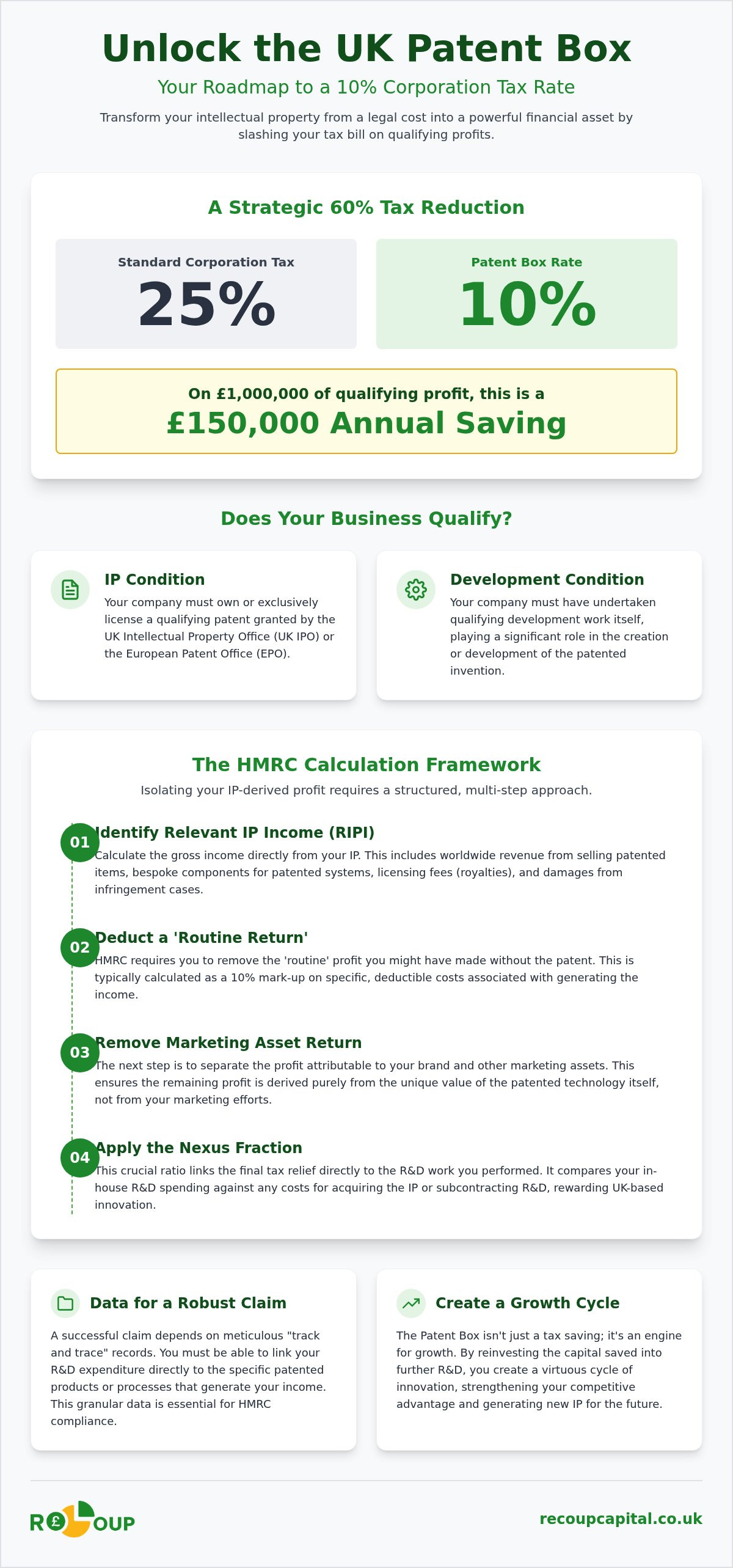
The gap between the main Corporation Tax rate of 25% and the Patent Box rate of 10% is significant. On £1 million of qualifying profit, the difference is a substantial £150,000. This capital isn't just a saving; it's a strategic resource. Smart organisations use these funds for further R&D reinvestment, creating a virtuous cycle of innovation. By rewarding companies that commercialise their ideas, the UK government encourages businesses to keep their high-value IP and manufacturing operations within the country. This incentive often works in tandem with R&D tax credits, allowing you to claim relief on the development costs whilst simultaneously reducing the tax on the resulting profits.
Why Manual Calculations Often Fail
Calculating Patent Box relief manually is notoriously difficult. The primary hurdle is the complexity of separating "routine" profits from "IP-derived" profits. HMRC expects you to strip away the profit you would have made even without the patent, such as brand value or standard manufacturing margins. If your methodology is inaccurate, you risk triggering an HMRC enquiry, which can lead to delays or penalties. Using a professional patent calculator or consultancy ensures your claim follows the "nexus approach," which links relief directly to the R&D work performed in-house. Professional oversight ensures you remain compliant whilst maximising every available pound of relief.
The HMRC Patent Box Formula: A Step-by-Step Breakdown
Unlike the simplified tools found in other industries, a professional patent calculator must account for a rigid five-step process dictated by tax law. This framework ensures that the relief is applied only to profits genuinely derived from intellectual property. A critical concept here is "streaming". HMRC requires companies to separate income and expenses for each specific patent or product line, rather than applying a blanket rate to the entire business turnover. This granular approach prevents general commercial profits from being incorrectly taxed at the lower rate.
According to official HMRC Patent Box guidance, the calculation must be performed for each trade or product stream. This ensures that the 10% rate is accurately tied to the innovation that earned it. By following this structured sequence, businesses can transform their IP from a legal protection into a high-performance financial asset.
Step 1: Identifying Relevant Intellectual Property Profits (RIPP)
The first stage involves isolating your qualifying income. This includes revenue from selling patented items or bespoke components designed for a patented system. You can also include royalties from licensing your IP or even damages won through patent infringement cases. Once you've identified this gross income, you must deduct the associated costs and a "routine return" to find the underlying profit. RIPP is the foundational figure for any patent calculation. Without an accurate RIPP, the subsequent steps of the formula will fail to provide a compliant result.
Step 2: Applying the Nexus Fraction
The Nexus Fraction is a ratio that rewards companies for performing their research and development in-house. It compares your qualifying expenditure on in-house R&D and third-party outsourcing against the costs of acquiring IP or outsourcing to related parties. If your business has a consistent history of claiming R&D tax credits, you'll likely have the necessary data to build a strong fraction. The formula also includes a "30% uplift" rule. This allows you to increase your qualifying expenditure by 30%, helping to mitigate the impact of acquisition costs or certain types of outsourcing. This step ensures that the tax benefit is directly proportional to the innovation work your company actually leads.
Navigating these ratios requires precision to avoid HMRC scrutiny. If you are looking to secure your claim, exploring the synergy between these incentives with a specialist can ensure your calculations are both maximised and compliant.
Qualifying for the 10% Rate: IP Profit Eligibility
Eligibility is the gatekeeper of the Patent Box. Simply holding a patent isn't enough to secure the 10% rate. To use a patent calculator effectively, you must first verify that your IP rights fall within the specific categories recognised by HMRC. Keep in mind that this relief applies strictly to profits, not your total turnover. If your patented product has high overheads that wipe out its profit margin, there'll be no relief to claim, regardless of how innovative the technology is.
Qualifying Intellectual Property Rights
Most claims revolve around patents granted by the UK Intellectual Property Office (UK IPO) or the European Patent Office (EPO). However, the scheme also extends to specific medicinal and botanical rights. If your patent is still "pending", don't ignore it. Whilst you cannot claim the relief until the patent is officially granted, you can track the relevant profits in the interim. Once the grant is confirmed, you can backdate your claim for up to four years, provided you made the election in your tax return during the pending period.
Exclusive Licensing and Ownership
Ownership is the most straightforward path, but holding an exclusive licence is also a valid route. To qualify, your licence must grant you rights to the exclusion of all other persons, including the patent owner, within at least one entire national territory. HMRC scrutinises these agreements closely. If your licence is non-exclusive or restricted to a tiny geographical area, it won't satisfy the criteria. This is why understanding the broader landscape of innovation incentives, such as R&D tax credits explained in our other guides, is essential for a holistic tax strategy.
The "Development Condition" is perhaps the most vital hurdle. Your company must have performed significant development work on the patented invention. You cannot simply acquire a patent from a third party and immediately benefit from the 10% rate without adding your own technical value. For companies within a larger group, the "Active Management" requirement comes into play. This means the claimant company must take an active role in the ongoing decision-making processes regarding the IP portfolio, rather than being a passive holder of the rights. When you input your data into a patent calculator, these qualifying factors determine whether your figures will stand up to HMRC scrutiny.
Preparing Your Data: What You Need for an Accurate Calculation
An accurate patent calculator is only as good as the data you feed it. You can't rely on broad estimates when HMRC requires a forensic breakdown of your income and costs. The goal is to move beyond guesswork and build a robust evidentiary trail that supports your 10% tax election. This preparation should ideally happen well before you file your CT600 Corporation Tax return, as the quality of your records directly dictates the size of your relief.
The timing of your claim is a strict regulatory requirement. You have exactly two years from the end of the accounting period in which the profits arose to make your election. If you miss this window, the opportunity to reduce your tax on those specific profits is lost forever. Effective data preparation ensures you meet these deadlines whilst capturing every pound of qualifying profit.
Financial Records for Patent Streaming
To satisfy the streaming requirement, you must isolate sales data specifically for products that incorporate your patented technology. This includes revenue from the items themselves, but also from spare parts or bespoke components designed for the patented system. You'll need to allocate both direct costs, such as raw materials, and indirect costs, such as factory rent or utilities, to these specific streams. Centring your bookkeeping around these IP value drivers ensures that your claims are both maximised and defensible during an audit.
The Role of R&D Expenditure
Your history of R&D investment is the engine behind your Nexus fraction calculation. You must maintain a precise record of qualifying R&D costs, distinguishing clearly between in-house development and third-party outsourcing. If you've acquired IP from another company, this will likely dilute your fraction and reduce the final relief amount. Understanding why claim both R&D credits and Patent Box relief is essential for long-term growth, as the data from your R&D claims often forms the backbone of your Patent Box evidence. This "track and trace" approach links your historical innovation costs directly to your current commercial success.
If you're unsure how to organise your records for a claim, our specialist chartered tax accountants can audit your current data to ensure your internal systems are ready for a robust submission.
Maximising Your Claim with Recoup Capital
Whilst a basic patent calculator can provide a rough estimate of your potential savings, the true value lies in the forensic precision of your final submission. Generalist accountants often lack the specialised depth required to navigate the nexus rules or the intricate streaming of income. At Recoup Capital, our team of specialist chartered tax accountants focuses exclusively on innovation incentives. This technical expertise ensures we don't just process paperwork; we identify the nuances that maximise your claim whilst maintaining total compliance with HMRC standards.
For property-owning innovators, there is often a powerful synergy between the Patent Box and Capital Allowances. If your business has invested in specialised labs, clean rooms, or manufacturing facilities to produce your patented goods, you could be eligible for multiple layers of relief. We provide end-to-end support, taking you from the initial technical assessment of your IP through to the final HMRC submission. This holistic approach ensures no qualifying expenditure is left on the table.
A Success-Based Partnership
We operate on a success-based fee model. This approach eliminates the financial risk often associated with exploring complex tax claims. Our fees are only payable once your tax benefit is secured, ensuring our goals are perfectly aligned with your business outcomes. This partnership-oriented style allows you to view tax relief not as a one-off windfall, but as a strategic business asset for long-term reinvestment. Our forensic approach to compliance provides the peace of mind that your claim is robust enough to withstand any regulatory enquiry.
Next Steps for Your Patent Box Claim
The journey begins with an initial discovery phase. We'll work with you to identify the hidden potential within your IP portfolio and determine which products satisfy the development condition. Once the data is gathered, we manage the entire process, including direct liaison with HMRC on your behalf. This streamlined experience allows your team to stay focused on innovation whilst we secure the capital you've earned. To move beyond a basic estimate and unlock the full potential of your intellectual property, contact Recoup Capital for a professional patent calculation today. We act as your protective guide through the complexities of the regulatory landscape, ensuring your innovation is rewarded.
Transform Your Intellectual Property into a Strategic Growth Asset
The UK Patent Box scheme represents a transformative opportunity for innovative businesses to retain more of their hard-earned profit. By reducing your Corporation Tax to 10%, you're effectively creating a sustainable engine for future R&D reinvestment. Success hinges on your ability to master the "streaming" of income and the intricacies of the Nexus fraction. Whilst a professional patent calculator provides the initial roadmap, the journey to a successful claim requires forensic precision and robust record-keeping to satisfy HMRC standards.
Recoup Capital acts as your expert guide through this complex landscape. Our team of specialist Chartered Tax Accountants and HMRC compliance specialists ensures that every claim is both maximised and defensible. We operate on a success-based fee model, which means we're fully invested in your results from day one. There is no risk in exploring what your IP is truly worth to your bottom line. Book a consultation to calculate your Patent Box savings and take the first step toward securing your company's financial future. Let's work together to turn your technical innovations into strategic capital for 2026 and beyond.
Frequently Asked Questions
How much can I save with the UK Patent Box scheme?
You can reduce your Corporation Tax rate to 10% on qualifying profits. For a company paying the main 25% rate, this represents a saving of £150,000 for every £1 million in relevant intellectual property profits. Even for smaller companies on the 19% rate, the saving is a notable £90,000 per £1 million. The exact amount depends on your nexus fraction and how much of the R&D was performed in-house.
Can I use a patent calculator for a pending patent?
Yes, you can use a patent calculator to forecast savings whilst your patent is pending. Although you cannot receive the tax relief until the patent is officially granted by the UK IPO or EPO, you can track and record qualifying profits in the interim. Once granted, you may be able to backdate the claim for up to four years, provided you made the necessary election in your tax returns during the pending period.
What is the "Nexus fraction" in a patent box calculation?
The Nexus fraction is a ratio used to ensure the tax relief is proportional to the R&D work your company actually performed. It compares your qualifying in-house R&D expenditure against the costs of acquiring intellectual property or outsourcing to related parties. A higher proportion of in-house development leads to a better fraction, allowing you to claim a larger share of the 10% tax rate. This mechanism rewards genuine UK-based innovation.
Do I need to claim R&D tax credits to use the Patent Box?
You don't strictly need to claim R&D tax credits to use the Patent Box, but the two incentives are deeply linked. The data required for a successful R&D claim often forms the foundation of your nexus fraction calculation. Most companies find that claiming both incentives provides the best financial outcome, as it allows you to recover development costs whilst simultaneously reducing the tax on the resulting commercial profits.
Can I claim Patent Box relief for an exclusive licence?
Yes, exclusive licensees can qualify for the scheme provided the licence agreement meets specific HMRC criteria. Your licence must grant you exclusive rights to the technology within at least one entire national territory, to the exclusion of all others, including the patent owner. We recommend a forensic review of your legal agreements to ensure they satisfy the "Development Condition" and the "Active Management" requirements necessary for a compliant claim.
How far back can I backdate a Patent Box claim?
You must elect into the scheme within two years of the end of the accounting period in which the profits arose. This is a strict deadline. However, if you've been tracking profits whilst a patent was pending, you can backdate the relief for up to four years once the grant is confirmed. This requires careful record-keeping from the moment you first apply for the patent to ensure no profit is missed.
What happens if my patented product only makes a small profit?
Because the relief is applied to Relevant Intellectual Property Profits (RIPP) rather than total turnover, a small profit will result in a smaller tax saving. If your manufacturing or marketing costs are high, the underlying IP profit might be lower than expected. A professional patent calculator helps you determine if the administrative effort of a claim is justified by the potential savings, especially when using a success-based advisory model.
Is the Patent Box scheme changing in 2026?
The core 10% rate remains stable for 2026, but the scheme has become significantly more valuable due to the main Corporation Tax rate sitting at 25%. This 15% gap makes the incentive a vital strategic tool for growth-oriented companies. Whilst the fundamental nexus rules are well-established, HMRC continues to refine its guidance on "streaming" and record-keeping, making professional compliance oversight more important than ever for innovative UK firms.


