

What if the capital you're chasing through expensive bank loans is already sitting on your balance sheet, hidden in plain sight? With 45% of mid-market businesses citing access to funding as a major barrier to growth in 2026, many directors are understandably concerned about the high cost of borrowing. You've likely felt the pressure of a 3.75% Bank of England interest rate and the increased difficulty of securing traditional credit. It's frustrating to know your business has potential, yet feel constrained by the very institutions meant to support your expansion.
Our approach to corporate finance advisory UK changes that narrative by reframing tax recovery as a strategic asset. We'll show you how to master the complexities of the current financial landscape, integrating specialist tax incentives like the 40% First-Year Allowance and R&D credits to maximise your liquidity. This article explores how to uncover trapped capital and build a robust, compliant financial strategy that supports successful acquisitions or disposals. We'll look at the mechanics of forensic financial assessments and how a partnership-led approach can turn regulatory compliance into a genuine opportunity for innovation and long-term stability.
Key Takeaways
- Discover why modern corporate finance has shifted from simple transaction management to a comprehensive strategic partnership model designed for long-term resilience.
- Learn to identify "embedded capital" within your business by integrating specialist tax incentives like R&D credits and Capital Allowances into your core financial planning.
- Understand how to navigate the 2026 lending environment by leveraging alternative growth capital and restructuring debt before financial pressure limits your options.
- Master a framework for the transaction lifecycle that prioritises forensic due diligence and pre-transaction preparation to significantly increase your business’s exit value.
- Find out how a tailored corporate finance advisory UK strategy can reframe your tax returns as strategic assets, providing the liquidity needed for your next major acquisition or disposal.
The Evolution of Corporate Finance Advisory in the UK for 2026
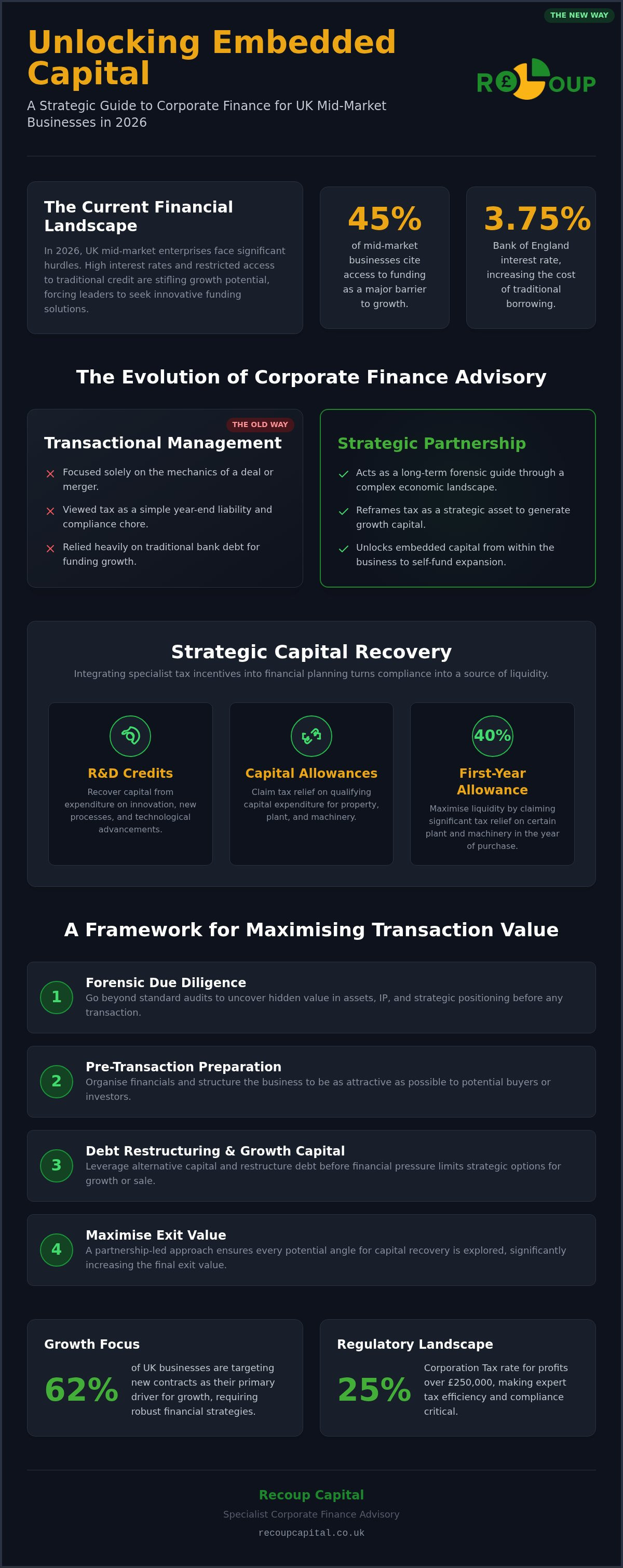
In the current UK business environment, the definition of Corporate Finance has shifted. It's no longer just about the mechanics of a deal or managing a basic merger. The role of corporate finance advisory UK has transformed into a proactive, long-term strategic partnership. In 2026, specialists do more than manage a transaction; they act as forensic guides through a complex economic landscape. With the Bank of England's main interest rate at 3.75%, traditional borrowing has become a significant hurdle for many. Research shows that 45% of mid-market businesses now view funding as a major barrier to expansion. This climate has forced a change in how SMEs access capital, moving away from bank debt and toward the strategic reinvestment of embedded assets and tax-driven liquidity.
The modern advisor integrates tax compliance directly into the broader financial strategy. It's a shift from seeing tax as a year-end obligation to viewing it as a source of growth capital. By aligning corporate restructuring with specialist incentives, businesses can generate the cash flow needed to fund innovation without increasing their debt profile. This holistic approach ensures that every financial decision strengthens the balance sheet whilst maintaining total compliance with evolving HMRC standards.
The Role of an Advisor in Mid-Market Growth
Mid-market businesses often outgrow the capabilities of a general accountant when preparing for complex acquisitions or disposals. A specialist advisor identifies strategic positioning opportunities that standard audits frequently overlook. They look beyond the profit and loss statement to find hidden value in intellectual property or underutilised assets. This level of insight is crucial when 62% of UK businesses are targeting new contracts as their main growth driver. Successful growth requires a partner who understands how to package a business for maximum value, ensuring every potential capital recovery angle is explored before entering the market. Using corporate finance specialists allows directors to focus on operations whilst their advisor builds the financial case for expansion.
Navigating Regulatory Complexity in 2026
The regulatory environment in 2026 demands a higher level of technical specialism than ever before. HMRC has increased its transparency requirements, making technical accuracy a non-negotiable part of financial reporting. With corporation tax rates held at 25% for profits over £250,000, the margin for error is slim. Modern advisors protect organisations from "careless" inaccuracies that could lead to penalties or delayed transactions. They ensure that incentives like the 40% First-Year Allowance are utilised correctly and documented forensically. This protective guidance transforms regulatory hurdles into predictable steps within a larger growth plan, providing the certainty directors need to make bold investment decisions without the fear of future compliance audits.
Strategic Capital Recovery: Integrating Tax Incentives into Financial Planning
Many directors view tax as an unavoidable liability, but in 2026, savvy leaders treat it as a strategic asset. Embedded capital represents the significant liquidity trapped within your historical and ongoing expenditure. By identifying these hidden reserves, you can create a self-funding mechanism for growth that doesn't rely on expensive external debt. This is precisely where specialized corporate finance advisory UK adds the most value. It bridges the gap between technical tax expertise and high-level commercial strategy, ensuring that every available relief is repurposed to strengthen your balance sheet.
Integrating these incentives into your broader financial plan allows for more aggressive reinvestment. Whether you're looking to fund a bolt-on acquisition or manage a complex debt restructuring, the cash flow generated from capital recovery provides a low-friction alternative to traditional lending. Understanding the UK's legal and regulatory framework is essential here, as it allows businesses to align their tax position with their long-term corporate objectives. For developers and construction firms, tools like Land Remediation Relief offer up to 150% tax deduction on qualifying costs, turning challenging brownfield projects into viable strategic opportunities.
Unlocking Liquidity Through R&D Tax Credits
The 2026 Merged Scheme has changed the landscape for UK SMEs, requiring a more forensic approach to claim preparation. Innovation isn't restricted to laboratories; it's often found in the complex engineering solutions and bespoke software developments used to drive operational efficiency. Identifying these qualifying activities requires a deep technical understanding of your specific sector. When these credits are successfully recovered, they act as a vital cash injection that can be used to reduce gearing or fuel research into new market sectors. You can understand R&D tax credits for your business to see how this capital can be redirected toward your next major milestone.
Maximising Asset Value with Capital Allowances
Commercial property often holds substantial unclaimed relief in the form of embedded fixtures. Forensic surveying identifies tax-deductible items like climate control systems, cabling, and security infrastructure that are frequently missed by standard accounting practices. With the Annual Investment Allowance set at £1,000,000, the potential for immediate tax relief is significant. Beyond the immediate cash flow benefit, maximising these allowances increases the overall attractiveness of your business during a sale. A property with a clear, fully utilised capital allowance history presents a much cleaner proposition for potential buyers. It's a proactive way to explore capital allowances for property and ensure your assets are performing at their peak financial capacity. If you're planning a disposal, checking your allowance history is a sensible first step to protecting your exit value.
Debt Restructuring and Growth Capital for Mid-Market Enterprises
In 2026, the UK lending landscape has become increasingly sophisticated. With the Bank of England interest rate at 3.75%, the era of easy, cheap bank credit has passed. This shift has left 45% of mid-market firms struggling to access traditional funding. It's a challenging environment. However, professional corporate finance advisory UK helps bridge this gap by looking beyond high-street lenders. According to TheCityUK, the financial services sector remains a critical engine for growth, yet businesses must now be more creative in how they structure their liabilities. Debt restructuring isn't merely a tool for managing distress; it's a strategic move to unlock cash flow for innovation. By renegotiating terms with lenders and trade partners, advisors create the breathing space necessary for long-term stability.
Securing Growth Capital in a Shifting Market
Traditional banks are no longer the only game in town. More than half (56%) of mid-market businesses are now exploring private credit funds to fuel their expansion. Another 50% are considering private equity. To tap into these reserves, your business must be "investment-ready." This involves more than just tidy bookkeeping. It requires forensic valuation services to ensure you're securing the best possible terms. When you understand your true market value, you're in a stronger position to negotiate. Professional corporate finance advisory UK packs your financial history into a compelling narrative that attracts alternative capital.
Strategic Debt Management for Construction and Engineering
The construction and engineering sectors face unique pressures. Project-based debt and fluctuating material costs create volatile cash flow cycles. In fact, 51% of firms cite heightened costs as their biggest barrier to growth in 2026. Managing this requires a specialist approach. Advisors facilitate debt restructuring that aligns your repayment schedules with your project milestones. This ensures that a single delayed payment doesn't stall your entire operation. It's about building resilience into your capital structure. You can discover our corporate finance services to see how tailored restructuring supports sector-specific growth without the constant pressure of traditional bank constraints.
Navigating the Transaction Lifecycle: A Framework for Business Owners
Success in a business sale or acquisition is rarely the result of luck. It's the outcome of meticulous engineering. For many UK business owners, the transaction lifecycle is the most significant financial event of their career. Navigating this successfully requires a shift in perspective. You must move from viewing your business as an operational entity to seeing it as a structured investment. Expert corporate finance advisory UK ensures that every phase, from the initial spark of an exit plan to the final signature, is handled with forensic precision. By preparing early, you protect your legacy and ensure the value you've built over decades is fully realised at the point of sale.
Step 1: Valuation and Forensic Readiness
Preparation begins long before you engage with potential buyers. You need an accurate valuation that accounts for shares, tangible assets, and intellectual property. However, a high valuation is meaningless if the deal collapses during due diligence. This is why "cleaning" the balance sheet is essential. You must identify and resolve hidden liabilities or risks, such as unresolved tax queries or messy share structures, that could derail a deal. Forensic readiness means looking at your business through the eyes of a buyer's auditor. When your records are impeccable, you remove the buyer's leverage to chip away at the price. It's about presenting a business that is not just profitable, but transparent and low-risk.
Step 2: Negotiation and Deal Structuring
Finding the right "home" for your business often matters more than simply chasing the highest bidder. A buyer who understands your culture is more likely to support a smooth transition for your staff and clients. Deal structuring is where the real value is secured. Advisors help you navigate nuances like earn-outs, where part of the price is paid based on future performance, or equity retention, allowing you to benefit from the next phase of growth. These multi-party negotiations are complex. Senior-led advice ensures you don't lose sight of your primary objectives whilst managing the "human element" of the deal. Balancing financial gain with the emotional weight of an exit requires a partner who is focused on your long-term interests.
The lifecycle doesn't end when the funds hit your account. Post-transaction integration is vital for the long-term health of the new entity. Whether you're staying on as a consultant or exiting entirely, a clear framework for the first 100 days ensures the business you built continues to thrive. If you're ready to prepare your business for its next chapter, you can book a forensic review of your corporate finance options to ensure you maximise your eventual exit value.
Recoup Capital: Delivering Value Through Specialist Financial Partnership
Recoup Capital isn't a traditional consultancy. We've built our reputation on a unique blend of chartered tax expertise and high-level corporate finance. This combination allows our team to see opportunities that others miss. Whilst many firms focus solely on the transaction at hand, we look at the entire capital structure of a UK limited company. Our corporate finance advisory UK service is defined by a "Strategic Capital Recovery" philosophy. We don't just process paperwork; we identify trapped capital and repurpose it as a strategic tool for growth. This approach is backed by a success-based fee model. We believe this is the fairest way to support SMEs, as it aligns our interests directly with your results. There's no aggressive sales pressure here. We prefer to demonstrate our value through the capital we recover and the strategic deals we facilitate.
By reframing financial returns as strategic assets, we help directors move away from reactive decision-making. Our role is to act as a protective guide through the complexities of HMRC compliance and the shifting credit markets of 2026. This partnership-led style ensures that your business remains agile and ready to capitalise on market opportunities as they arise.
A Partnership-Oriented Advisory Model
Acting as a long-term partner for UK innovation is at the heart of our mission. We don't view a claim or a transaction as a one-off event. Instead, we provide end-to-end management that saves you significant time and internal resources. From the initial forensic assessment to the final submission or deal closure, our specialists handle the heavy lifting. This allows you to focus on your core operations whilst we ensure your financial strategy remains robust and compliant. It's this commitment to long-term collaboration and transparency that explains why businesses choose Recoup Capital as their trusted financial guide.
Holistic Tax and Finance Strategy
Our team looks far beyond the immediate deal. We examine every facet of your business to identify often-overlooked reliefs like Patent Box or Land Remediation Relief. Having a single advisor manage both your capital recovery and your strategic growth creates a powerful synergy. It ensures that the liquidity generated from tax incentives is immediately and effectively deployed into your corporate objectives. Whether you're planning a merger or investing in new technology, our holistic view provides the clarity needed for success. You can book a no-obligation R&D and finance assessment to discover how this integrated strategy can transform your business's financial future.
Securing Your Financial Future Through Strategic Partnership
The landscape of UK business finance has shifted. Navigating the 3.75% interest rate environment requires a move away from traditional bank debt toward the strategic reinvestment of embedded capital. By integrating forensic tax recovery into your long-term planning, you transform standard compliance into a powerful engine for innovation. Whether you're preparing for a complex business disposal or restructuring debt within the construction and engineering sectors, success depends on technical precision and proactive management.
Expert corporate finance advisory UK acts as your protective guide, ensuring every financial decision strengthens your balance sheet whilst maintaining total regulatory clarity. Our team of Chartered Tax Accountants and Corporate Finance Specialists operates on a success-based fee model, ensuring our results directly drive your growth. We don't rely on aggressive pitches; we prefer to demonstrate value through the liquidity we recover for our partners. You can Book a No-Obligation Strategic Financial Assessment with Recoup Capital to explore the untapped potential within your organisation. It's time to turn your financial returns into strategic assets and build a resilient future.
Frequently Asked Questions
What does a corporate finance advisory firm actually do for a UK business?
They act as strategic architects for high-level financial decisions. This includes managing acquisitions, disposals, and fundraising whilst aligning these actions with tax-efficient capital recovery. Unlike general accountants, they focus on long-term value creation and deal execution. They guide directors through complex regulatory landscapes to ensure every transaction is forensically sound and commercially viable. It's about transforming a company's financial structure into a tool for sustainable growth.
How has the Merged R&D Scheme changed corporate finance planning in 2026?
The 2026 Merged R&D Scheme has streamlined the claiming process but increased the requirement for technical precision. It forces companies to integrate R&D claims directly into their core corporate finance planning rather than treating them as year-end bonuses. This shift means that innovation-led capital is now a predictable line item on the balance sheet. Directors can use these projected returns to support more aggressive expansion strategies or as leverage for alternative funding routes.
Can I use R&D tax credits to fund a business acquisition or debt restructuring?
Yes, R&D tax credits are frequently repurposed as strategic capital for acquisitions or restructuring. Because these credits represent a genuine cash injection from HMRC, they provide a non-dilutive funding source. This liquidity can be used to reduce gearing or pay down high-interest debt, creating the breathing space needed for a smooth transition. It's a proactive way to use internal innovation to fund external growth without relying on expensive bank loans.
How do specialist corporate finance consultants charge for their services?
Specialist consultants often employ a success-based fee model, which aligns their interests with the client's outcomes. This "no win, no fee" approach ensures that the advisor is motivated to maximise the value of the transaction or capital recovery. It removes the barrier of high upfront costs for SMEs and provides transparency regarding the value delivered. This results-driven advisory style ensures that you only pay when your business achieves a tangible financial benefit.
What is the role of forensic accounting in a corporate transaction?
Forensic accounting provides a deep-dive analysis of a company’s financial health to identify hidden risks or assets. In a corporate transaction, this ensures that the valuation is accurate and that the balance sheet is "clean" before due diligence begins. It uncovers trapped liquidity, such as unclaimed capital allowances, which can significantly increase the final sale price. This protective guidance prevents deal-breaking surprises and ensures that both buyers and sellers have total confidence in the numbers.
Is my construction firm eligible for corporate finance advisory and tax relief?
Construction and engineering firms are prime candidates for corporate finance advisory UK and specialist tax relief. Many projects involve solving technical uncertainties that qualify for R&D credits or Land Remediation Relief. Additionally, commercial properties often hold significant unclaimed Capital Allowances. A specialist advisor identifies these sector-specific opportunities, helping firms manage volatile project-based cash flows whilst building a robust capital structure that supports long-term resilience and innovation-led growth.
How long does a typical UK mid-market corporate finance transaction take?
A typical mid-market transaction usually takes between six and twelve months to complete. This timeline depends on the complexity of the deal and the level of pre-transaction preparation. The process involves valuation, finding the right buyer or partner, and navigating the forensic due diligence phase. Starting the preparation early is vital. It allows for the identification of capital recovery opportunities that can strengthen the business's position before the formal negotiation begins.
Why should I choose a specialist advisor over my general accountant for a deal?
Specialist advisors bring technical depth and sector-specific deal experience that general accountants often lack. Whilst your accountant manages day-to-day compliance, a corporate finance advisory UK specialist focuses on value maximisation and transaction strategy. They understand the nuances of deal structuring, earn-outs, and forensic capital recovery. This expertise is crucial for identifying hidden assets and navigating complex multi-party negotiations, ensuring you achieve the best possible commercial outcome for your business.


