

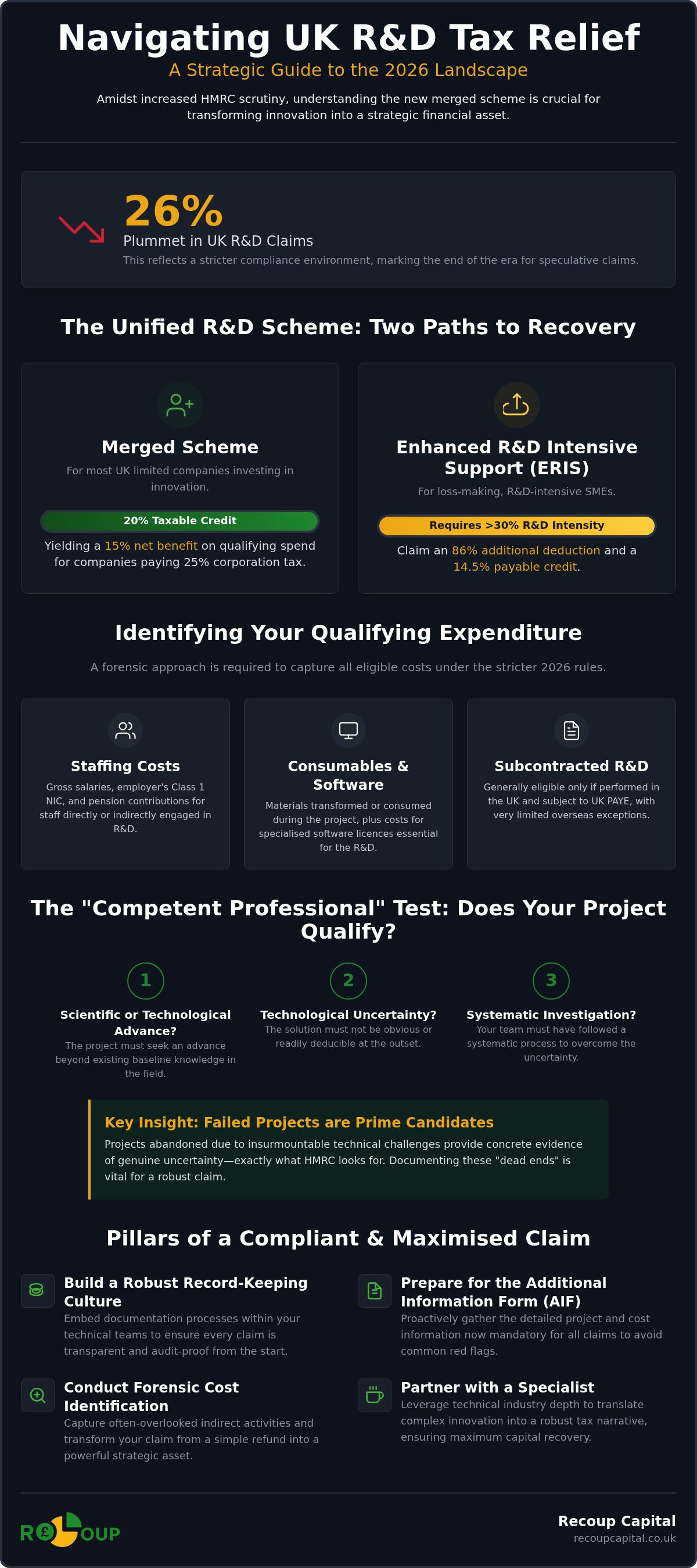
Did you know that the number of UK R&D claims plummeted by 26% in the most recent HMRC figures? Whilst this drop reflects a significantly more rigorous compliance environment, it doesn't mean the opportunity for capital recovery has vanished; it simply means the era of speculative claims is over. You're likely feeling the pressure of increased scrutiny or perhaps you're confused by how the 2024/2025 scheme mergers affect your 2026 tax strategy. It's a common frustration when general accountants lack the technical industry depth to translate your complex innovations into a robust tax narrative.
This guide is designed to restore your confidence. You'll discover how to identify qualifying innovation and navigate the current regulatory landscape with total transparency. By exploring sector-specific R&D tax credit examples UK businesses are successfully utilising, you can bridge the gap between technical uncertainty and successful capital recovery. We'll preview how to distinguish qualifying spend from non-qualifying costs under the 20% merged scheme rules, ensuring your returns are treated as strategic assets for growth rather than just a one-off refund.
Key Takeaways
- Learn how to apply the "Competent Professional" test to your unique projects by exploring real-world R&D tax credit examples UK businesses use to define genuine scientific breakthroughs.
- Understand the critical role of the 2026 Mandatory Additional Information Form (AIF) and how to proactively avoid the common "red flags" that trigger HMRC compliance checks.
- Discover how forensic cost identification can capture often-overlooked indirect activities, transforming your claim into a powerful strategic asset for business reinvestment.
- See why a specialist partnership providing technical industry depth is essential for securing maximum capital recovery whilst navigating the complexities of the 20% merged scheme.
- Master the art of building a robust record-keeping culture within your technical teams to ensure every claim is both transparent and audit-proof.
What is Research and Development Tax Relief in the UK?
Research and Development (R&D) Tax Relief is a pivotal UK tax incentive for R&D designed to reward limited companies that invest in scientific or technological innovation. For the 2026 tax year, this incentive remains a cornerstone of the government's strategy to bolster national productivity. It functions by either reducing a company's Corporation Tax liability or providing a payable cash credit for those currently in a loss-making position. By reframing these returns as strategic assets, businesses can reinvest capital directly back into their growth cycles.
The Merged Scheme and ERIS Explained
Since April 2024, the landscape has shifted toward a unified system. The previous SME and RDEC schemes have been consolidated into a single Merged Scheme. Under this framework, most companies receive a taxable credit of 20% on their qualifying expenditure. For a firm paying the main 25% corporation tax rate, this results in a net benefit of 15% of the qualifying spend. It's a streamlined approach that simplifies how R&D tax credit examples UK businesses follow are calculated across different sectors.
However, loss-making, R&D-intensive SMEs can access more generous support through Enhanced R&D Intensive Support (ERIS). To qualify for ERIS in 2026, your relevant R&D expenditure must meet a 30% intensity threshold relative to your total expenditure. These businesses can deduct an additional 86% of qualifying costs and claim a payable credit of 14.5%. Identifying which path applies to your accounting period is the first step in seeing how these incentives apply to your own balance sheet. You can find more detail on these mechanisms in our guide on how R&D tax credits are explained for modern businesses.
Qualifying Expenditure: What Can You Claim For?
Whilst specific R&D tax credit examples UK companies provide often focus on laboratory work, the reality is that many engineering and software activities qualify under broad categories. Maximising your claim requires a forensic look at where your capital is actually going. Qualifying costs generally fall into three main buckets:
- Staffing Costs: This includes gross salaries, Class 1 NIC, and pension contributions for employees directly or indirectly involved in the R&D process.
- Consumables and Software: You can claim for materials transformed or consumed during the project, alongside specialised software licences required for the technical work.
- Subcontracted R&D: Under the 2026 rules, subcontracted work is generally only eligible if performed in the UK. Payments must be subject to UK PAYE, with very limited exceptions for overseas activities that cannot be replicated domestically.
Understanding these boundaries is vital. The rules are stricter than in previous years, but they provide a clear framework for high-quality, transparent claims. By documenting these costs accurately, you ensure your innovation is properly rewarded whilst maintaining full compliance with HMRC standards.
R&D Tax Credit Examples UK: Does Your Work Count?
Identifying qualifying activity is often the most significant hurdle for UK businesses. HMRC applies the "Competent Professional" test, which essentially positions your internal technical experts as the benchmark. It's not enough for a project to be new to your company. It must represent a scientific or technological advance that isn't readily deducible by an experienced professional in your field. If your team had to overcome technological uncertainty where the solution was not obvious from the outset, you're likely looking at a valid claim. These R&D tax credit examples UK firms frequently overlook are often the most valuable.
Surprisingly, failed projects are frequently the strongest candidates for a successful claim. When a project is abandoned because of technical "dead ends" or insurmountable challenges, it provides concrete evidence that the solution was not easily found. These failures prove that genuine uncertainty existed, which is exactly what HMRC looks for. Documenting these struggles is a vital part of building a robust and transparent narrative for your claim.
Sector Example: Innovation in Construction and Engineering
In the construction sector, R&D often hides within bespoke engineering solutions that push beyond standard building regulations. For instance, developing modular building techniques to achieve thermal efficiency levels far exceeding current UK standards requires significant prototyping and testing. Similarly, creating new methods for land remediation on complex brownfield sites involves solving unique geological and chemical challenges. You can learn more about Land Remediation Relief to see how environmental challenges often overlap with these technical incentives.
Sector Example: Food Technology and Manufacturing
Food technology is another area where "trial and error" on the factory floor often constitutes qualifying R&D activity. Formulating new preservation techniques to extend shelf-life whilst completely avoiding chemical additives involves complex biological testing and process refinement. Redesigning manufacturing lines to incorporate bespoke automation that reduces energy consumption by 30% is another high-value activity. If your production environment feels like a laboratory during these transitions, you should explore why to claim to ensure these strategic assets are properly recognised on your balance sheet.
Maximising Your Claim Whilst Maintaining Compliance
Identifying the full scope of your eligible activity requires a forensic approach to cost identification. Many businesses focus solely on the obvious technical work, but significant value often hides in indirect activities. For example, R&D administration, specific maintenance tasks, and even certain cleaning requirements for laboratory environments can boost the overall claim value. By examining these R&D tax credit examples UK firms often miss, you can ensure no eligible capital is left on the table whilst remaining strictly within HMRC guidelines.
Creating a robust record-keeping culture amongst your technical teams is essential for long-term success. HMRC auditors expect to see contemporary evidence that supports your staff time apportionment. If a senior engineer balances R&D with day-to-day commercial duties, you must accurately track the percentage of their time dedicated to resolving technological uncertainties. This isn't just about satisfying a compliance check; it's about building a solid foundation for claiming R&D tax credits with absolute confidence and transparency.
The Technical Narrative: The Heart of Your Submission
Your technical report is now the most critical component of your submission. HMRC inspectors prioritised spreadsheets in the past, but the 2026 landscape demands a narrative that clearly articulates "uncertainty" using the specific language required by DSIT guidelines. You must explain why a solution wasn't readily available and how your team's approach differed from standard industry practice. A well-structured report doesn't just list activities; it tells the story of the technical hurdles you overcame. This narrative must be submitted via the mandatory Additional Information Form (AIF) before your tax return to ensure it's even considered by the authorities.
Managing Subcontractor and EPW Costs
Navigating the Merged Scheme requires a clear distinction between subcontracted R&D and general contracted services. The 2026 rules are particularly strict regarding overseas expenditure. Following the 1 April 2024 changes, costs for subcontractors and externally provided workers (EPWs) generally only qualify if the work is performed in the UK and subject to UK PAYE. Ensuring your contracts are structured to reflect these requirements is vital for a successful claim. If you use international talent, you must document precisely why that work could not be performed domestically to meet the narrow exceptions allowed under current legislation.
Navigating HMRC Scrutiny and Transparency Standards
The HMRC landscape in 2026 is defined by a rigorous "digital-first, detail-always" approach. Every claim must now be preceded by a mandatory Additional Information Form (AIF). This digital gatekeeper ensures that only well-documented projects reach the desk of an inspector. Accountability is paramount; every limited company must appoint a "Named Officer" who takes personal responsibility for the claim's validity. This shift ensures that the leadership team is directly engaged with the technical narrative rather than outsourcing the entire process to a third party without sufficient oversight.
HMRC identifies several "red flags" that frequently trigger a compliance check. Generic technical descriptions that fail to highlight specific uncertainties are a primary cause for concern. Additionally, high subcontractor ratios, particularly when they involve overseas entities, act as magnets for scrutiny. When reviewing R&D tax credit examples UK inspectors look for evidence that the claimant company truly owns the risk and the technical direction of the project. If you receive a "Letter of Intent" regarding a claim check, responding professionally with contemporary evidence is your best defence. You can find more advice on this in our frequently asked questions section.
The Risk of Inaccurate or Aggressive Claims
The days of "grey area" filing are over. HMRC now distinguishes clearly between careless errors and deliberate inaccuracies, with penalties and interest charges scaled accordingly. Beyond the financial impact, the reputational damage of being flagged for aggressive tax avoidance can be devastating for a growing business. Self-filing without a specialist review has become increasingly risky. Without a protective guide to verify your technical narrative against the latest DSIT standards, you may inadvertently expose your company to prolonged inquiries and financial clawbacks.
Future-Proofing Your Claims for 2026 and Beyond
Staying ahead of legislative shifts is vital for maintaining a successful innovation strategy. HMRC has recently clarified its stance on AI-generated technical narratives, stating that automated claim preparation without human technical oversight is a significant compliance risk. Transparency remains your strongest asset. By fostering a culture of honest record-keeping and clear communication, you ensure your returns are treated as strategic assets rather than liabilities. If you're concerned about the robustness of your current filing, it's worth considering how to maximise your claim whilst ensuring compliance through expert partnership.
Why Partner with an R&D Tax Specialist?
Choosing between a general accountant and a dedicated R&D tax specialist is a decision that dictates the quality and security of your claim. Whilst generalists are vital for day-to-day compliance, they often lack the technical industry depth required to translate complex engineering or scientific challenges into a robust tax narrative. A specialist doesn't just look at the numbers; they look at the technical uncertainty. By employing chartered tax accountants who understand the nuances of the 2026 HMRC landscape, you ensure your submission is treated as a strategic growth asset rather than just a yearly administrative task.
Success-based fee models further distinguish the specialist approach by lowering the barrier to entry for innovative SMEs. Unlike traditional hourly rates, this structure ensures total alignment between your business and your advisor. We only win when you win. This partnership-oriented model allows you to explore potential claims without financial risk, transforming capital recovery into a predictable tool for reinvestment. When you examine the R&D tax credit examples UK businesses use to benchmark their success, the common thread is almost always a specialist guide who understands how to maximise value whilst maintaining total transparency.
Specialist Expertise vs Generalist Knowledge
Technical sector knowledge is the bridge between a rejected claim and a successful recovery. Specialists possess the engineering or food tech background necessary to identify qualifying work that generalists frequently miss. This forensic approach extends beyond the primary claim; it often reveals opportunities for capital allowances embedded within your property or equipment. Understanding why to claim R&D tax credits with a specialist becomes clear when you realise that a general accountant may only see the surface-level costs, whilst a specialist sees the underlying innovation.
The Recoup Capital Approach to Innovation
Our end-to-end process is designed to facilitate significant tax relief whilst minimising the time investment from your senior team. We handle the heavy lifting, from the initial technical assessment through to the final HMRC submission and any subsequent liaison. This proactive guidance is particularly vital in 2026, where the mandatory Additional Information Form (AIF) requires a level of technical detail that goes beyond standard accounting. You can learn more about our R&D tax credit process and how we act as a protective guide through the complexities of the merged scheme. By partnering with us, you gain a long-term collaborator invested in your future growth, ensuring every R&D tax credit examples UK narrative we build for you is both audit-proof and high-value.
Secure Your Future Through Strategic Capital Recovery
The 2026 HMRC landscape demands a shift from simple tax filing to a forensic, technical approach. By examining the R&D tax credit examples UK companies have successfully navigated, it's clear that transparency and robust documentation are now non-negotiable. Whether you're innovating in food tech, engineering, or construction, the key is to move beyond generic descriptions and embrace a technical narrative that satisfies the latest DSIT standards. You've seen how identifying "hidden" costs and maintaining a record-keeping culture can transform your claim from a mere refund into a strategic business tool.
Partnering with a specialist team ensures you don't face this complex regulatory environment alone. At Recoup Capital, our chartered tax accountants and technical experts bring deep sector expertise to every submission. We operate on a success-based fee structure; we only win when you do. This alignment allows you to explore your potential without financial risk whilst we handle the intricate HMRC liaison on your behalf. It's time to maximise your innovation potential with a free R&D assessment from Recoup Capital. Let's work together to protect your business and fuel your next breakthrough.
Frequently Asked Questions
What is the meaning of R&D for tax purposes in the UK?
R&D for tax purposes is defined as a project that seeks to achieve an advance in overall knowledge or capability in a field of science or technology. It's not simply about creating a new product; it requires overcoming a technological uncertainty that a competent professional cannot easily solve. Whilst R&D tax credit examples UK businesses often cite involve high-tech labs, the definition actually covers any industry where technical challenges require systematic investigation to resolve.
Can my company claim R&D tax relief if we are making a trading loss?
You can absolutely claim R&D tax relief if your company is making a trading loss. Under the Merged Scheme, you receive a taxable expenditure credit, but R&D-intensive SMEs may qualify for Enhanced R&D Intensive Support (ERIS). This provides a payable tax credit of 14.5% of the surrenderable loss. This cash injection is a strategic asset, allowing loss-making firms to recoup significant capital and reinvest it directly into further innovation and business growth.
How far back can a company go to claim R&D tax credits in 2026?
In 2026, you can generally claim for the two previous accounting periods. The deadline for submitting a claim is two years after the end of the relevant accounting period. However, you must notify HMRC of your intention to claim within six months of the end of the period if you haven't claimed in the previous three years. Missing this notification window can invalidate your right to recover capital for that specific financial year.
What happens if HMRC decides to inquire into our R&D claim?
If HMRC opens an inquiry, you must provide contemporary evidence and a detailed technical narrative to justify your claim. They'll scrutinise your Additional Information Form and may ask for project logs or staff time records. Responding professionally and transparently is the best way to de-risk the situation. Having a specialist partner with technical depth ensures your response addresses the inspector's specific concerns whilst protecting your company from unfair penalties or clawbacks.
Do I need a laboratory or a PhD on staff to qualify for R&D tax credits?
You don't need a laboratory or a PhD on staff to qualify for these incentives. HMRC uses the Competent Professional test, which looks at the experience and technical knowledge of the people leading your project. Many R&D tax credit examples UK firms rely on involve site managers in construction or factory leads in food manufacturing. If they are solving technical problems that standard industry practice cannot address, the work likely qualifies for relief.
How long does it typically take for HMRC to process an R&D tax credit claim?
HMRC currently aims to process 85% of R&D tax credit claims within a 40-day target. Whilst most businesses receive their benefit or credit within this window, complex claims or those subject to additional compliance checks can take longer. Submitting a high-quality, transparent claim through the Agent Services Account helps prevent delays. Consistent, well-documented filings often move through the system more efficiently, providing quicker access to your recovered capital for reinvestment.
Is the R&D tax credit scheme changing again in 2026?
The R&D landscape remains stable but rigorous in 2026, following the major consolidation into the Merged Scheme. Key updates include the mandatory tax adviser registration effective from 18 May 2026 and stricter tracking for state aid in Northern Ireland. HMRC continues to refine its scrutiny of overseas expenditure, ensuring that relief primarily supports innovation performed on UK soil. Staying compliant requires a proactive approach to these evolving transparency standards and administrative requirements.
Can I claim R&D tax credits if my project was partially funded by a grant?
You can still claim R&D tax relief if your project received a grant, though the interaction between the two has changed under the Merged Scheme. Previously, grants could push an SME claim into the less generous RDEC system. Now, the unified 20% credit rate applies more consistently across different funding sources. It's vital to declare all state aid accurately, as this ensures your claim remains compliant whilst you maximise the total funding available for your innovation.


