

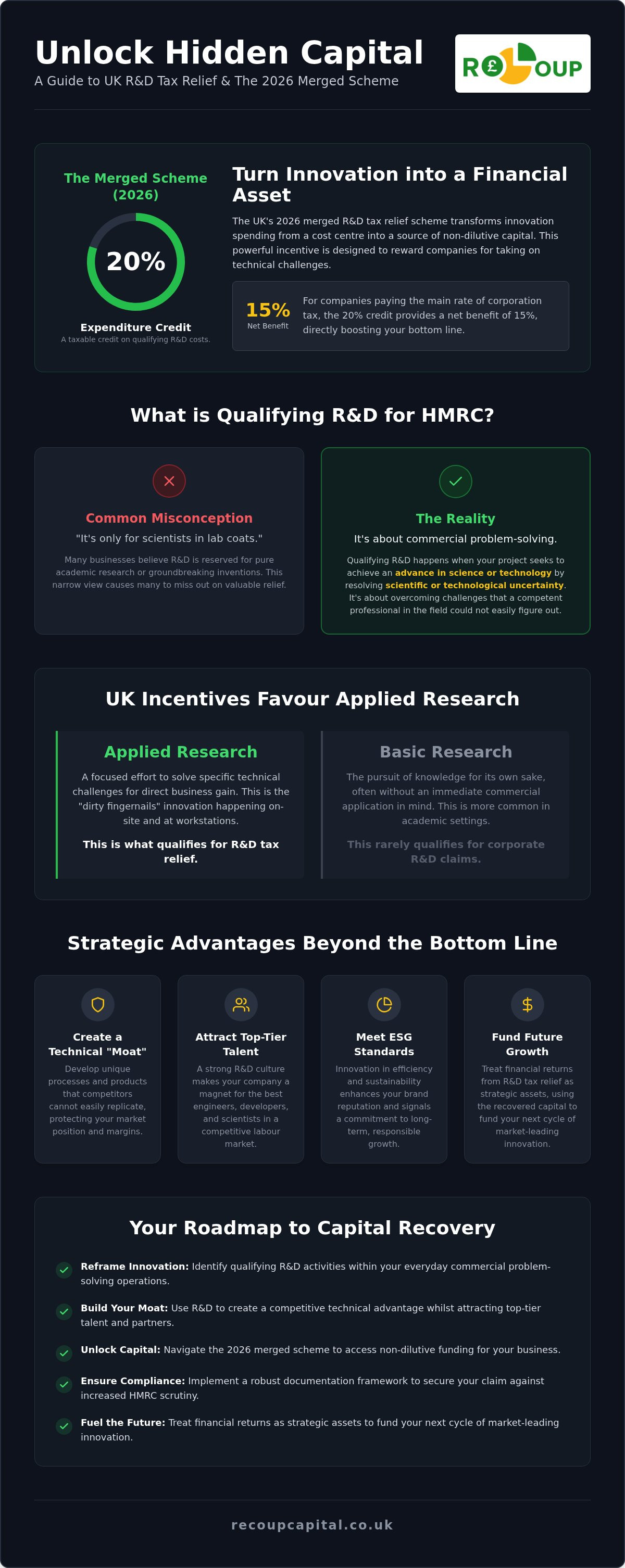
What if your most expensive innovation projects weren't actually costs, but hidden reserves of non-dilutive capital? For many UK firms, the perceived high cost of innovation feels like a barrier to growth, yet the strategic benefits of corporate R&D can transform these expenditures from a cost centre into a powerful engine for capital recovery. In 2026, the landscape has shifted with the merged R&D tax relief scheme, offering a 20% expenditure credit that turns technical challenges into measurable financial assets.
You likely recognise that staying ahead of the competition requires constant evolution, but the complexity of HMRC compliance and the fear of inquiry risks can make the process feel more like a gamble than a strategy. It's difficult to distinguish between standard commercial work and qualifying research without a clear framework. This guide demonstrates how to bridge that gap, showing you how to secure the ROI of your innovation and fund future growth through specific tax incentives. We'll explore the 2026 regulatory framework, the mechanics of the Enhanced R&D Intensive Support (ERIS) scheme, and how to build a robust claim that stands up to the closest scrutiny.
Key Takeaways
- Discover how to reframe innovation as commercial problem-solving, identifying qualifying activities within your standard everyday operations.
- Understand how the strategic benefits of corporate R&D create a competitive technical "moat" whilst attracting top-tier talent and industry partners.
- Navigate the 2026 financial landscape to unlock non-dilutive capital through the new merged scheme and Enhanced R&D Intensive Support (ERIS).
- Secure your business against increased HMRC scrutiny by implementing a robust documentation framework that ensures full regulatory compliance.
- Learn to treat financial returns as strategic assets, using capital recovery to fund your next cycle of market-leading innovation.
Defining Corporate R&D in the Modern UK Economy
Corporate innovation is often misunderstood as a luxury reserved for pharmaceutical giants or aerospace engineers. Broadly defined, Research and development (R&D) encompasses activities that companies undertake to innovate and introduce new products and services. In the UK, however, the definition is far more specific and commercially grounded. For a limited company, R&D occurs when a project seeks to achieve an advance in science or technology through the resolution of scientific or technological uncertainty. It isn't just about "new" ideas; it's about the technical "how" behind the solution.
The 2026 market demands a shift in perspective. We've moved away from purely academic exploration toward a model of commercial problem-solving. One of the primary benefits of corporate R&D is its role as the engine of productivity. With the Department for Science, Innovation and Technology (DSIT) allocating £13.9 billion for R&D in the 2025/2026 financial year, the government has made it clear that innovation is the cornerstone of national economic strategy. For your business, this means that resolving a difficult technical challenge in a factory or a software suite isn't just "fixing a problem" anymore. It's a strategic activity that creates a valuable, claimable asset.
HMRC guidelines for qualifying R&D are rigorous but accessible when viewed through the right lens. To qualify, you don't need to be wearing a lab coat. You simply need to be pushing the boundaries of what is currently possible within your field, ensuring that the solution wasn't readily deducible by a competent professional. This distinction is vital for accurate capital recovery.
The Distinction Between Basic and Applied Research
Understanding the difference between basic and applied research is essential for a successful claim. Basic research is the pursuit of knowledge for its own sake, often without an immediate commercial application in mind. Whilst this is valuable for universities, it rarely fits the corporate mould. Applied research, conversely, is a focused effort to solve specific technical challenges for business gain. It's the "dirty fingernails" innovation that happens on construction sites, in engineering bays, and at tech workstations.
UK tax incentives, particularly the merged R&D tax relief scheme, heavily favour this applied approach. The system is designed to reward companies that take financial risks to improve their processes or products. By focusing on applied research, businesses can access a taxable expenditure credit of 20%, which provides a net benefit of 15% for those paying the main rate of corporation tax.
Why Innovation is No Longer Optional for Limited Companies
In the current economic climate, standing still is the same as moving backwards. Rapid technological change and shifting consumer demands mean that traditional business models are under constant threat. R&D serves as a protective moat, shielding your company from competitor encroachment by creating unique technical capabilities that others can't easily replicate. It's your best defence against market disruption.
Beyond survival, innovation is now a key component of meeting ESG (Environmental, Social, and Governance) standards. Whether you're developing more efficient building materials or reducing the energy consumption of a data centre, the benefits of corporate R&D extend to your brand reputation. Being an R&D-active firm signals to investors, talent, and partners that your business is a forward-thinking leader committed to long-term growth.
Strategic Advantages: Beyond the Bottom Line
R&D is often the invisible architecture that supports a business's long-term survival. One of the most profound benefits of corporate R&D is the creation of a technical "moat". This barrier to entry is formed when a company develops unique processes or products that competitors cannot easily duplicate without significant investment. By aligning your business with the UK Research and Development Roadmap, you aren't just following a government trend; you're building a defensible market position that protects your margins. It ensures your innovations are grounded in national strategic priorities, making your firm more resilient.
Beyond technical defensibility, being an R&D-active firm carries a significant reputation benefit. In a competitive labour market, top-tier talent is drawn to organisations that prioritise innovation. Engineers, developers, and scientists want to work on projects that push boundaries. The benefits of corporate R&D extend far beyond immediate tax relief, influencing how your brand is perceived by potential investors and industry peers. Investors and buyers look for proprietary technology and proven innovation cycles when assessing a company's worth. Our team at the Recoup Capital Corporate Finance advisory often sees how a robust R&D portfolio can significantly enhance the attractiveness of a business during an acquisition or disposal, turning technical success into a liquid asset.
Developing a Sustainable Competitive Edge
Possessing a "Competitive Edge" means your firm has proprietary process developments that allow it to consistently outperform rivals on quality, speed, or cost efficiency. R&D lets you refine these internal processes, making operations leaner and more effective. There's also a psychological advantage to being a market leader. When you're the one setting the technical standard, your competitors are forced to be reactive followers. This proactive stance ensures you're always ahead of market shifts.
Intellectual Property and the Patent Box Advantage
Successful R&D projects often result in patentable assets that act as secure revenue streams. By protecting your innovation, you can access the Patent Box regime. This incentive allows companies to apply a lower rate of Corporation Tax, currently 10%, to profits earned from patented inventions. There's a powerful synergy here: R&D tax credits fund development, whilst the Patent Box rewards commercialisation. Specialist corporate finance advice can help clarify your strategic path.
Financial Incentives: Turning Innovation into Capital
Many directors view research as a drain on resources. That's a mistake. One of the primary benefits of corporate R&D is its ability to generate non-dilutive capital. Unlike venture capital or bank loans, this funding doesn't require you to give up equity or take on debt. By following the official R&D tax relief guidance, you can transform technical uncertainty into a tangible financial asset. It's about turning past spending into future liquidity. This process allows you to recoup significant costs, which improves your cash flow during critical growth phases.
The mechanism is straightforward. You identify qualifying costs, and the government provides a tax credit or a reduction in your Corporation Tax liability. Understanding why to claim is the first step in treating your tax return as a strategic growth tool rather than a mere compliance chore.
R&D Tax Credits: The UK Government’s Primary Incentive
For accounting periods beginning on or after 1 April 2024, the UK shifted to a simplified system. Most companies now fall under the Merged Scheme, whilst R&D-intensive small businesses may qualify for Enhanced R&D Intensive Support (ERIS). To qualify for ERIS in 2026, your R&D expenditure must be at least 30% of your total expenditure.
| Feature | Merged Scheme (Standard) | ERIS (R&D Intensive) |
|---|---|---|
| Benefit Rate | 20% taxable credit | 86% enhanced deduction |
| Net Cash Benefit | Up to 15% | Up to 27% |
| Eligibility | All company sizes | Loss-making SMEs (30% intensity) |
Qualifying expenditure includes more than just salaries. You can claim for software licences, consumables used in the process, and certain subcontractor costs. Even the power and water used specifically for your R&D projects can be included in your calculations.
Reinvesting Tax Relief for Compound Growth
A successful claim does more than pad the balance sheet. It fuels the "Innovation Flywheel." When you reinvest your tax relief into the next project, you're effectively lowering the financial risk of future innovation. This creates a cycle where each technical breakthrough funds the next one. Because Recoup Capital operates on a success-based fee structure, your business cash flow is protected throughout the claim process. We align our success with yours, ensuring that the capital recovered remains a strategic asset for your firm's expansion.
Industry-Specific Benefits: Construction, Engineering, and Tech
Many directors still assume R&D is the preserve of scientists in white coats working in sterile laboratories. This misconception leads to thousands of missed opportunities every year. One of the greatest benefits of corporate R&D is that it applies to any sector where technical uncertainty is resolved through trial and error. Whether you're a developer on a complex brownfield site or a manufacturer automating a bespoke assembly line, your technical challenges are likely qualifying activities. You can explore how these rules apply to your specific field in Recoup Capital’s sector-specific R&D explanation.
In the tech sector, the 2026 landscape is dominated by the integration of advanced technologies like AI and quantum computing into legacy systems. Qualifying examples in these non-traditional "labs" include:
- Developing bespoke algorithms to synchronise disparate supply chain databases in real time.
- Creating carbon-sequestering concrete mixes that meet rigorous UK structural load requirements.
- Designing high-precision robotic components for assembly in contaminated or hazardous environments.
Overcoming Technical Uncertainties in Construction
Innovation in the built environment often centres on sustainable materials and modular construction techniques. When you encounter unforeseen ground conditions or complex structural constraints that require a non-standard engineering solution, you're performing R&D. These aren't just project hurdles; they're technical challenges that require systematic resolution. Developers should also look beyond tax credits. Land Remediation Relief provides a vital financial incentive for cleaning up contaminated or derelict sites, offering a significant boost to the viability of ambitious projects.
Engineering Innovation and Process Improvement
Engineering R&D is defined as the resolution of technical conflict in design or manufacture where the solution is not readily apparent to a competent professional. This often involves bespoke manufacturing or the development of more efficient, automated production lines. When you're trying to integrate incompatible systems or reduce the weight of a component without compromising its integrity, you're innovating. This work often leads to broader financial advantages. For instance, the R&D process frequently identifies new plant and machinery that qualify for Capital Allowances, allowing you to write off the cost of equipment against your taxable profits.
If you're unsure if your site-based or factory-floor activities qualify for these incentives, check our FAQ for sector-specific guidance on how to proceed.
Navigating the Compliance Landscape to Secure Your Benefits
Securing the benefits of corporate R&D is no longer just about identifying innovation; it's about proving it through a rigorous, evidence-based framework. In 2026, HMRC's approach has shifted toward intense scrutiny and mandatory transparency. For many UK businesses, the fear of an enquiry often outweighs the excitement of capital recovery. This hesitation is understandable, as the regulatory environment now requires meticulous documentation that many internal teams aren't equipped to produce. To protect your claim, you must treat compliance as a core part of your innovation strategy rather than an afterthought.
Building a robust claim starts with moving away from a "DIY" approach. Whilst your internal accountants are experts in your day-to-day finances, they may lack the technical depth to articulate complex scientific or technological advances. This gap often leads to two outcomes: either money is left on the table because qualifying activities were missed, or the claim is flagged for an enquiry due to vague technical narratives. Seeking professional R&D tax credit assistance ensures that your technical and financial data are perfectly aligned with current HMRC expectations.
Meeting HMRC’s Transparency and Documentation Standards
HMRC now requires an Additional Information Form (AIF) for every submission. This document must clearly articulate the "Advance" you sought and the "Technical Uncertainty" your team faced. It's not enough to say you improved a product; you must explain why the solution wasn't readily deducible by a competent professional in your field. High-quality narratives are the foundation of a successful claim.
Real-time record-keeping has become the gold standard for maximising accuracy. Waiting until the end of the financial year to "reconstruct" R&D projects often leads to forgotten costs and weakened evidence. By capturing technical hurdles and staff hours as they happen, you create a contemporary audit trail that stands up to scrutiny. This proactive habit ensures that every pound of qualifying expenditure is captured and defended.
The Role of Specialist R&D Consultancy
A specialist consultancy acts as a protective guide through these regulatory complexities. Unlike generalist accountants, a technical tax team includes sector specialists who understand the nuances of engineering, construction, and software development. These experts can identify "hidden" R&D in areas directors often overlook, such as failed prototypes or internal process optimisations that never reached the public eye.
Choosing a partnership-oriented consultancy provides more than just a financial return; it offers peace of mind. Our success-based fee model ensures that our interests are perfectly aligned with yours. We don't just process paperwork; we act as a long-term partner invested in your future growth. This collaborative approach transforms a potentially intimidating regulatory procedure into a streamlined opportunity for business innovation. By treating your recovered capital as a strategic asset, you can confidently reinvest in your next cycle of growth, knowing your compliance is handled by specialists who understand your bottom line.
Future-Proofing Your Business Through Strategic Innovation
The 2026 landscape for UK industry demands a shift from reactive problem-solving to proactive innovation. By recognising the broad benefits of corporate R&D, you can transform technical hurdles into a sustainable competitive edge and a vital source of non-dilutive capital. Whether you're navigating the complexities of the merged tax scheme or seeking to protect your margins through the Patent Box, the right documentation and specialist guidance are essential to secure your returns.
At Recoup Capital, our team of chartered tax accountants and sector specialists acts as your protective guide through this regulatory terrain. We bring a proven track record across construction, engineering, and tech, ensuring your claims are both maximised and compliant. Because we operate on a success-based fee model, we only win when you do. We're committed to long-term collaboration, helping you reframe financial returns as strategic tools for growth. Book a no-cost technical assessment with Recoup Capital to discover your R&D potential.
Let's turn your technical challenges into your most powerful strategic assets.
Frequently Asked Questions
What are the main benefits of corporate R&D for a UK limited company?
The primary benefits of corporate R&D include the generation of non-dilutive capital and the creation of a technical moat that protects your market position. By reclaiming expenditure through tax credits, you effectively lower the financial risk of innovation. This recovered capital can then be used to fund future projects, creating a cycle of growth. It's a strategic asset that transforms technical challenges into a liquid resource for your business expansion.
Can my business claim R&D tax credits even if the project failed?
Yes, you can claim regardless of the project's outcome. HMRC rewards the attempt to resolve scientific or technological uncertainty, not the eventual commercial success. If your team spent time and resources trying to achieve a technical advance but ultimately found it impossible or unfeasible, those costs are still qualifying expenditure. This ensures that the financial risk of ambitious, high-stakes innovation is mitigated by the government's support framework.
What industries benefit the most from R&D tax relief in the UK?
Whilst tech and software are traditional leaders, construction and engineering sectors see immense benefits of corporate R&D. In construction, solving site-specific structural constraints or developing sustainable materials often qualifies. Engineering firms benefit when resolving conflicts in bespoke manufacture or process automation. Any industry that pushes the boundaries of current knowledge can find significant value, provided they can document the technical hurdles they have successfully overcome during the development process.
How does R&D reinvestment affect my company’s long-term valuation?
Constant reinvestment in R&D builds a portfolio of proprietary intellectual property and unique technical capabilities. This technical maturity makes your company significantly more attractive to potential buyers or investors during an acquisition. A proven track record of innovation acts as a signal of long-term viability and market leadership. By using tax relief to fund continuous development, you increase your business valuation by turning technical expertise into a defensible corporate asset.
Is corporate R&D tax relief only for large pharmaceutical companies?
No, this relief is available to any UK limited company regardless of size or sector. The lab coat myth often prevents smaller firms in construction or manufacturing from claiming what they are rightfully owed. Provided your project seeks a technical advance by resolving uncertainty, you are eligible. In 2026, the system is designed to be inclusive, with specific support like ERIS helping intensive small businesses thrive alongside larger corporate entities.
What is the difference between R&D tax credits and the Patent Box?
R&D tax credits focus on the costs incurred during the development phase, whilst the Patent Box rewards the profits earned once that innovation is commercialised. Think of them as two sides of the same coin. R&D relief provides immediate capital recovery for your spending on staff and materials. The Patent Box then allows you to pay a lower 10% Corporation Tax rate on profits derived from your patented inventions, creating long-term tax efficiency.
How much can a UK company expect to recoup through R&D tax credits in 2026?
In 2026, most companies using the merged scheme can expect a net benefit of 15% on their qualifying R&D expenditure. For loss-making, R&D-intensive SMEs qualifying for the ERIS scheme, this benefit rises to approximately £27 for every £100 spent. These rates ensure that a significant portion of your innovation investment is returned to the business. The exact amount depends on your specific tax position and the intensity of your research activities.
What happens if HMRC decides to inquire into my R&D claim?
If HMRC opens an inquiry, you will need to provide detailed technical narratives and evidence of your expenditure. This is why professional documentation is vital. A specialist consultancy acts as your protective guide, handling the communication with HMRC and defending the technical merits of your claim. Having a robust audit trail and expert representation ensures that the inquiry process is managed efficiently, protecting your recovered capital and reducing potential stress.


